

بِسْمِ اللهِ الرَّحْمٰنِ الرَّحِيْم
In the Name of God, Most Gracious, Most Merciful.
♥️🤲🕋♥️🕋🌹🌹🥀🤲🌹🕋♥️🤲
UNITED STATES DISTRICT COURT
[PROPER DISTRICT TO BE DETERMINED
FROM GOVERNING X TERMS]
ABDUL-JABBAR IBN YUSUF IBN OMAR IBN ABDUL KARIM,
an individual,
Plaintiff,
v.
X CORP.,
Defendant.
COMPLAINT FOR DECLARATORY, INJUNCTIVE, AND MONETARY RELIEF
NATURE OF THE ACTION
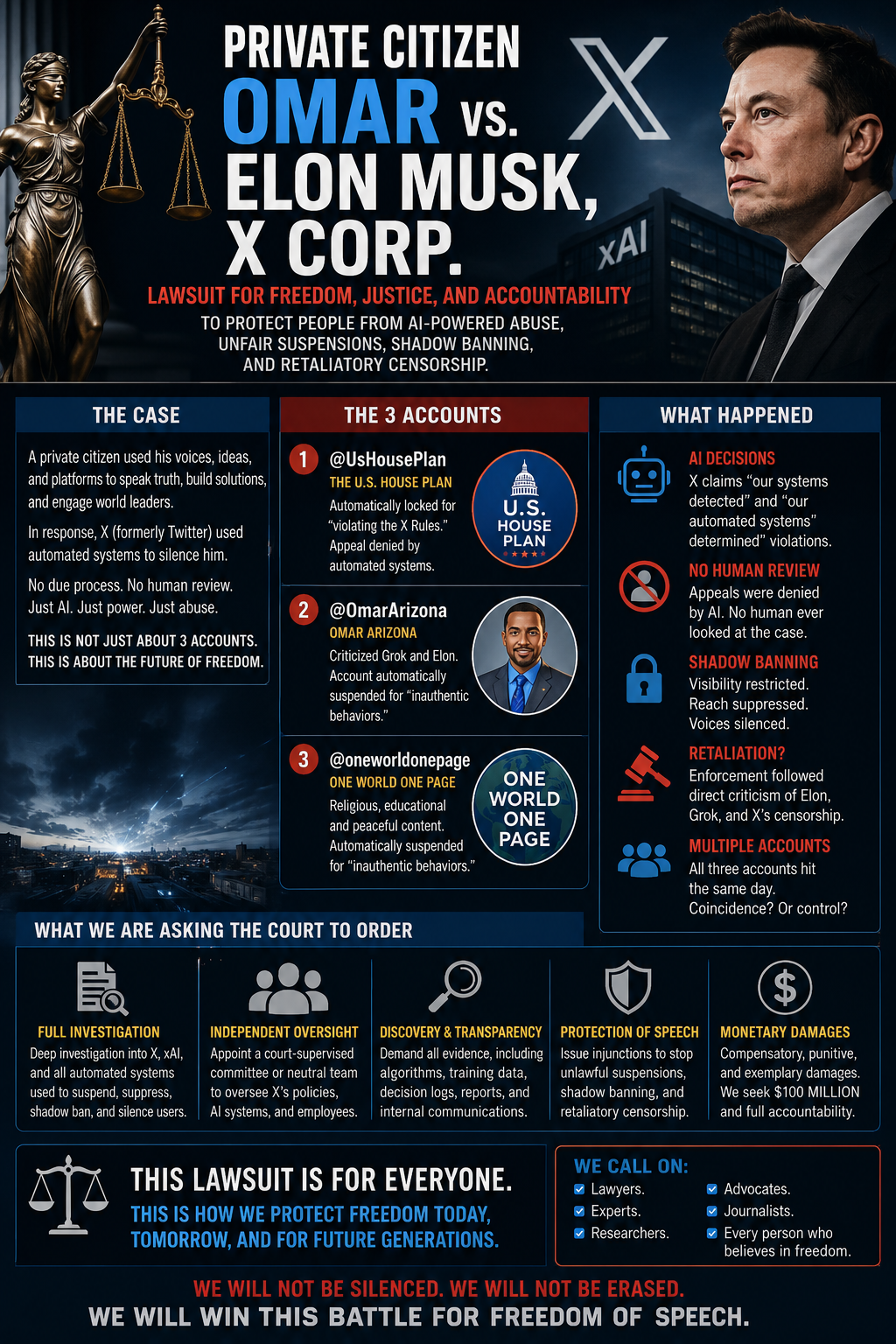
Plaintiff brings this action arising from repeated enforcement actions by X Corp. against multiple accounts operated by Plaintiff, including @UsHousePlan, @OmarArizona, and @oneworldonepage.
This action concerns not merely the loss of access to social-media accounts, but the manner in which a major communications platform uses automated systems to detect alleged violations, impose suspensions, restrict visibility, and review appeals.
Plaintiff possesses communications in which X expressly states that accounts were “detected by our systems and automatically suspended.” Plaintiff also possesses an appeal determination in which X states that “our automated systems have determined that a violation of our Rules did take place.”
Plaintiff disputes that the accounts engaged in the prohibited conduct alleged by X and seeks adjudication of legally cognizable claims arising from X's conduct.
Plaintiff further seeks appropriate discovery concerning what X's automated systems detected, what evidence supported the enforcement decisions, whether meaningful human review occurred, whether Plaintiff's accounts were linked together for enforcement purposes, and whether visibility restrictions were imposed before the disclosed suspensions.
THE THREE ACCOUNT INCIDENTS
Incident One — U.S. House Plan (@UsHousePlan). X accused the account of violating its authenticity rules and separately described spam or platform manipulation. Plaintiff appealed. X subsequently stated that its automated systems determined that a violation occurred. Plaintiff disputes the alleged violation and seeks identification of the specific activity underlying X's determination.
Incident Two — Omar Arizona (@OmarArizona). Shortly before enforcement, Plaintiff publicly criticized Grok/X and addressed criticism to Elon Musk concerning the operation of Grok and information relating to Gaza. X subsequently informed Plaintiff that @OmarArizona had been “detected by our systems and automatically suspended” for alleged “inauthentic behaviors.” Plaintiff disputes that allegation. Plaintiff seeks discovery concerning the reason for the suspension and whether Plaintiff's criticism had any relationship to the enforcement action.
Incident Three — One World One Page (@oneworldonepage). X likewise informed Plaintiff that this account had been “detected by our systems and automatically suspended” for alleged “inauthentic behaviors.” Plaintiff states that this account concerned the House of Wisdom/One World One Page project and contained religious, educational and technological material. Plaintiff disputes that the account engaged in prohibited inauthentic activity.
Plaintiff alleges that the timing of enforcement against multiple accounts warrants investigation into whether the accounts were linked together by X's enforcement systems and whether enforcement against one account triggered enforcement against others.
WHAT PLAINTIFF SEEKS
Plaintiff seeks restoration of the accounts where legally available; preservation of relevant records; identification of the specific conduct X contends violated its Rules; appropriate discovery concerning automated enforcement, appeals, human review and visibility restrictions; and monetary relief to the extent recoverable under claims ultimately established.
Plaintiff also seeks appropriate equitable and injunctive relief.
That is the legal concept you were reaching for when you said “takeover.”
But we should not ask a judge literally to take over X or put a committee in charge of the company unless we identify extraordinary statutory authority permitting such relief. Instead, we can ask for whatever prospective judicial supervision the law permits—for example, a narrowly tailored injunction, compliance reporting, preservation requirements, or potentially a special master or independent review mechanism if the facts and law ultimately justify one.
AUTOMATED DECISION-MAKING
A central factual issue will be whether X provided meaningful human review of these enforcement actions.
Plaintiff does not presently claim that the screenshots prove that no human ever participated. They prove something narrower and important: X itself expressly attributed particular enforcement determinations to its systems and, in one appeal communication, to its automated systems.
Plaintiff seeks evidence establishing the remainder.
ALLEGED RETALIATION
Plaintiff believes some enforcement may have been retaliatory.
Plaintiff will present the chronology and supporting evidence and seek discovery concerning causation.
Plaintiff will not presently allege that Elon Musk personally “flipped a switch” as an established fact because the evidence collected so far does not establish that. If discovery reveals personal involvement by Musk or conduct creating an independent basis for liability, Plaintiff can seek appropriate relief consistent with the procedural rules.
DAMAGES
Plaintiff seeks compensatory damages in an amount established through evidence and, if a legally viable cause of action permits them and the required level of misconduct is proven, punitive or exemplary damages.
We can preserve your desired $100 million demand, but before putting that number into a signed federal pleading, we should determine precisely which cause of action could legally support it and what evidence supports the damages calculation.
THIS CASE IS NOT A FIRST AMENDMENT CLAIM BY DEFAULT
There is another important distinction that actually makes the draft more credible.
Plaintiff believes deeply that this controversy concerns freedom of expression. But X is a private corporation, and calling the suspensions a direct constitutional First Amendment violation without establishing state action would run directly into existing precedent.
The complaint therefore should distinguish between the public importance of freedom of expression and an actual constitutional cause of action.
The case must stand on causes of action that the law recognizes against a private defendant.
PUBLIC PARTICIPATION
Plaintiff welcomes other individuals, attorneys, researchers, and organizations concerned about automated platform enforcement to examine the issues raised by this litigation.
But we should not call this a class action yet or represent that other suspended users automatically become plaintiffs. Class litigation has specific requirements under Federal Rule of Civil Procedure 23, and a self-represented plaintiff generally cannot represent a class of other people.
For now:
One plaintiff.
Three documented account incidents.
X's own suspension notices.
X's own statements concerning automated systems.
Specific requests for evidence.
Specific legally sustainable claims.
That gives us a much more serious starting point.
And before filing this week, the next document we need isn't another speech. It's the most important part of the lawsuit: CAUSES OF ACTION. That's where we take the Barnes/Berenson research and determine exactly what legal duties X allegedly violated.
AN OPEN LETTER TO THE WORLD
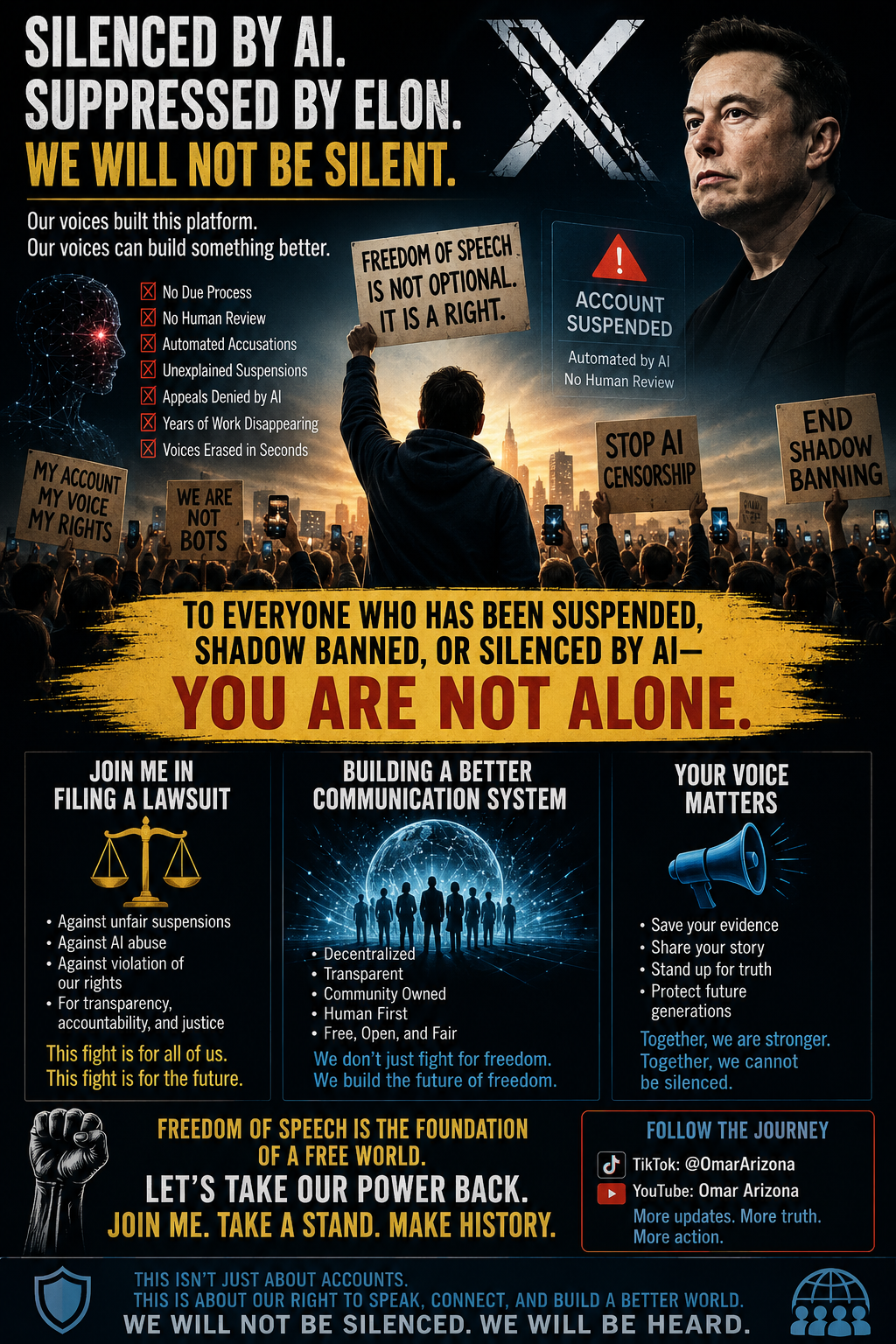
IF X SUSPENDED YOU, I WANT TO HEAR YOUR STORY
To everyone who has ever opened X and discovered that years of communication, relationships, work, ideas, and influence had suddenly been taken away:
I am going to court.
And if this happened to you, I want you to come forward.
If X suspended your account and never clearly showed you exactly what you did wrong, I want to hear from you.
If an automated system accused you of spam, manipulation, or “inauthentic behavior,” I want to hear from you.
If you appealed and received what appeared to be an automated rejection minutes later, I want to hear from you.
If your account was restricted, suppressed, deboosted, or effectively made invisible without a meaningful explanation, preserve your evidence.
Take screenshots. Save the emails. Save the appeal. Save the dates. Save everything.
Because this is becoming much larger than my accounts.
MY CASE
I have now documented multiple accounts that X suspended.
One was the U.S. House Plan.
Another was OmarArizona.
Another was One World One Page, connected to my House of Wisdom project.
And X's own communications contain extraordinary language.
X told me that accounts were “detected by our systems and automatically suspended.”
When I appealed one enforcement decision, X told me:
“Our automated systems have determined that a violation of our Rules did take place.”
Think about what that means.
A system can accuse you.
A system can restrict you.
A system can suspend you.
And an automated system can participate in deciding whether the original decision should stand.
The evidence I presently possess does not establish that no human ever participated anywhere in that process. That is one of the things I intend to ask the judicial process to help uncover.
Who reviewed the evidence?
What evidence existed?
What exactly did the account do?
Was there meaningful human review?
How long was the account's visibility restricted before suspension?
What role did automated systems play?
Those questions matter far beyond me.
EVERY TWEET WAS A SEED
I have spent roughly fifteen years communicating online.
Every post was a seed.
Every open letter was a seed.
Every conversation was a seed.
Every connection was a seed.
Over years, those seeds become relationships, history, credibility, reach and influence.
A social-media account isn't merely something a person opened yesterday.
For some people, it represents years of their lives.
People build businesses there.
Journalists develop sources there.
Artists develop audiences there.
Activists organize there.
Religious teachers educate there.
Ordinary people find communities there.
And people without wealth or institutional power can sometimes speak directly to people they could never otherwise reach.
That opportunity matters.
THIS IS ABOUT THE AGE OF AI
My concern extends beyond X.
We are entering an era in which artificial intelligence will increasingly participate in decisions affecting human beings.
If automated systems are permitted to accuse, restrict and punish people without meaningful accountability, the precedent we accept today will become the infrastructure inherited by our children.
That is why I'm challenging what happened.
Not because I believe that every suspension is unlawful.
Not because a private platform can never enforce its rules.
But because enormous technological power should still be capable of being questioned through lawful institutions when someone alleges a legally cognizable wrong.
When a company says an automated system determined that somebody violated its rules, there should be a way—where the law provides one—to determine what happened and why.
THIS IS FOR FUTURE GENERATIONS
I don't need X to define my existence.
My writing continues.
My projects continue.
My work continues.
But accepting repeated unexplained or inadequately explained enforcement without challenging it would mean leaving the same problem for somebody else.
And eventually that somebody else will be our children.
Technology will become more powerful.
Artificial intelligence will become more powerful.
The systems controlling information will become more sophisticated.
The time to establish accountability is before those systems become impossible for an ordinary person to challenge.
IF THIS HAPPENED TO YOU
I am asking people who have experienced similar enforcement to preserve their records and come forward.
I especially want to hear from people who possess documentation showing automated suspension, automated appeal determinations, unexplained spam or authenticity classifications, repeated account restrictions, unexplained visibility suppression, or contradictory enforcement notices.
Lawyers interested in these issues are welcome to examine the evidence.
Researchers are welcome.
Civil-liberties advocates are welcome.
Technology experts are welcome.
Journalists are welcome.
And other affected users are welcome to preserve their stories and seek independent legal advice about whether they have claims of their own.
As this litigation develops, counsel can determine whether claims involving multiple affected people could appropriately be coordinated, consolidated, or pursued through a legally certified class proceeding.
Until then, I will not pretend that a class has already been certified.
First we build the evidence.
Then we bring the evidence to the courthouse.
Then we let the law do its work.
I AM GOING FORWARD
I am not a wealthy man.
X has enormous resources.
That does not decide who gets access to a courthouse.
Federal courts have procedures through which qualifying litigants can request permission to proceed in forma pauperis, without prepaying the ordinary filing fee.
I will use the lawful procedures available to me.
I will present the screenshots.
I will present the suspension notices.
I will present the appeal responses.
I will document each account separately.
And I will ask the Court for the remedies that the evidence and law permit.
This journey may take a long time.
That's okay.
Some questions are important enough to ask even when answering them is difficult.
TO EVERY PERSON WHO HAS EVER BEEN SILENCED BY AN AUTOMATED DECISION:
SAVE YOUR EVIDENCE.
DOCUMENT YOUR EXPERIENCE.
KNOW WHAT ACTUALLY HAPPENED.
AND IF YOUR EXPERIENCE MATCHES THIS ONE, COME FORWARD.
This isn't simply about recovering an account.
It is about deciding what accountability should look like when artificial intelligence begins exercising enormous power over human communication.
Today it is our accounts.
Tomorrow it will be systems our children depend upon.
We have an obligation to ask these questions now.
The courthouse doors belong to ordinary citizens too.
A REQUEST TO THE CITIZENS OF THE WORLD
THE RIGHT TO COMMUNICATE CANNOT BELONG TO ONE MAN OR ONE AI
To the citizens of the world, to governments, to builders, to technologists, and to everyone thinking seriously about the age we are entering:
The future is AI.
There is no avoiding that reality.
But there is an enormous difference between artificial intelligence serving humanity and artificial intelligence becoming an instrument through which concentrated private power can disconnect human beings from one another.
It was already dangerous when human beings possessed the power to silence another person's voice with the flip of a switch.
It becomes far more consequential when that power is automated.
A machine can classify you.
A machine can restrict you.
A machine can reduce your visibility.
A machine can suspend you.
And if we build the wrong systems, another machine may eventually be asked to decide whether the first machine was right.
That cannot become the architecture of our future.
COMMUNICATION IS NOT A FAVOR
The ability to communicate with the world cannot become something human beings must beg a billionaire, corporation, algorithm, or artificial intelligence to receive.
Your reputation is something you build.
Your relationships are something you build.
Your influence is something you build.
Your ideas are something you create.
Every message you write, every person you teach, every relationship you develop, every argument you make and every contribution you offer becomes part of your history.
That history represents human labor.
It represents years of creativity, thought, sacrifice and participation.
A communications company may operate its platform and enforce lawful contractual rules. But humanity should seriously question an architecture in which decades of accumulated digital relationships can effectively disappear because a centralized system makes a decision that the affected person cannot meaningfully examine.
Our digital future needs a better architecture.
INFORMATION FLOWS LIKE BLOOD
Information is becoming part of the circulatory system of civilization.
Governments depend upon it.
Businesses depend upon it.
Families depend upon it.
Journalists depend upon it.
Teachers depend upon it.
Students depend upon it.
And increasingly, artificial intelligence itself depends upon the information generated by humanity.
When the circulation of information becomes concentrated in too few hands, civilization becomes vulnerable.
Today somebody else can be disconnected.
Tomorrow it could be you.
That is why this moment matters.
MY MESSAGE TO GOVERNMENTS
Governments around the world should begin seriously examining whether their citizens are becoming excessively dependent upon privately controlled communications infrastructure.
Do not wait for the AI age to fully arrive before asking these questions.
Study automated moderation.
Study algorithmic visibility restrictions.
Study appeal procedures.
Study interoperability.
Study data portability.
Study whether people can preserve their social relationships and reputations when they leave a platform.
Study decentralized and federated architectures.
And determine whether citizens need stronger protections as automated systems assume greater responsibility for decisions affecting access to communications networks.
I am also asking governments and institutions considering major relationships with X, xAI or other centralized AI communications infrastructure to conduct serious independent due diligence before increasing that dependency.
I am calling for scrutiny, accountability and alternatives—not punishment without evidence or lawful process.
BUILD THE ALTERNATIVE
My response will not simply be litigation.
I intend to build.
I have already described an offline office: a system in which human authority and human participation cannot disappear merely because somebody loses access to a technological platform.
Now comes the online component.
AI should help human beings communicate.
AI should help organize knowledge.
AI should help ordinary people participate intelligently in governance.
AI should help people understand complicated systems.
But the architecture must remain accountable to the human being.
That is one purpose of the Superuser System:
Human beings should govern with AI—not live underneath AI.
The offline and online worlds should reinforce each other.
If one system disappears, the human being remains.
If one company fails, the network remains.
If one AI refuses to participate, another can be used.
If one billionaire changes his mind, civilization does not lose its communications infrastructure.
That is the resilience we should be building.
TO THE PEOPLE WHO UNDERSTAND WHAT IS COMING
Watch what happens next.
Watch the litigation.
Watch the evidence.
But more importantly, watch what we build.
Keep an eye on my work because I intend to develop the online architecture alongside the offline office.
I welcome governments, engineers, researchers, lawyers, teachers, communities and ordinary citizens who understand the principle:
No single person should own humanity's ability to communicate.
No single corporation should become humanity's permanent gatekeeper.
No single artificial intelligence should determine who exists in the global conversation.
We don't have to destroy technology.
We have to design something better.
Something resilient.
Something transparent.
Something interoperable.
Something that gives every human being an opportunity to develop a reputation, build relationships, create influence and participate in the world without living in permanent fear that everything can disappear with one automated decision.
THIS IS THE MOMENT
AI is arriving quickly.
That makes this the perfect moment to make the adjustment.
Not twenty years from now.
Now.
The communications architecture inherited by future generations is being designed during our lifetime.
We therefore have a responsibility to build something worthy of them.
Something no individual can arbitrarily disconnect.
Something no corporation can permanently monopolize.
Something no artificial intelligence can independently rule.
Something capable of bringing humanity together rather than dividing humanity into people who possess access and people who can simply be erased.
Communication belongs to humanity.
Reputation belongs to the person who earns it.
Human relationships belong to the people who build them.
And the future of artificial intelligence must preserve those principles.
I look forward to working with everyone willing to build that future.
We will not merely complain about the system we inherited.
We will build the system that should replace it.
Thank you.
وَعَلَى اللَّهِ فَلْيَتَوَكَّلِ الْمُؤْمِنُونَ
“And upon Allah let the believers place their trust.”
اللَّهُمَّ بِكَ تَوَكَّلْنَا، وَإِلَيْكَ أَنَبْنَا، وَإِلَيْكَ الْمَصِيرُ.
O Allah, in You we place our trust, to You we turn in repentance, and to You is the final return.
رَبَّنَا لَا تَجْعَلْنَا فِتْنَةً لِلَّذِينَ كَفَرُوا، وَاغْفِرْ لَنَا وَارْحَمْنَا، أَنْتَ مَوْلَانَا فَانْصُرْنَا عَلَى الْقَوْمِ الْكَافِرِينَ.
Our Lord, do not make us a trial for those who disbelieve. Forgive us and have mercy upon us. You are our Protector, so grant us victory over the disbelieving people.
وَعَلَى اللَّهِ تَوَكَّلْنَا.
We have done what is ours to do: speak, document, build, and seek justice through lawful means.
The outcome belongs to Allah.