
بِسْمِ اللهِ الرَّحْمٰنِ الرَّحِيْم
In the Name of God, Most Gracious, Most Merciful.
♥️🤲🕋♥️🕋🌹🌹🥀🤲🌹🕋♥️🤲
Politics Beginning in Heaven with Allah, the Magnificent
Before you read another word, pause.
What you are about to enter is not opinion, not theory, and not history as it is usually told. You are about to step into a conversation that begins before nations existed, before laws were written, before power learned how to disguise itself. This is a space where theology, human ambition, and accountability meet. It is not written to persuade you emotionally, nor to flatter your beliefs, but to orient you—to remind you where you stand in a universe where power has an Owner and ambition has limits.
This is not light reading. It is deep water.
What follows will ask you to think about politics not as parties and elections, but as a consequence of choice, pride, obedience, and restraint. You will move from the sovereignty of God to the burden of prophets, from absolute authority to lived responsibility, from heaven to earth. Read slowly. Let the ideas settle. Do not rush to agreement or disagreement. This is not about winning an argument—it is about understanding the ground beneath every argument that has ever been made.
In the Name of God, the Most Merciful, the Especially Merciful.
Before there were nations, before there were laws, before there were leaders and followers, there was God—Perfect, Independent, Absolute.
And everything else was created.
Power did not belong to creation.
Greatness did not belong to creation.
Pride did not belong to creation.
Those attributes were never negotiable.
They belong to the Owner of the universe alone.
God did not need politics.
Politics needed God—because the moment creation was given choice, some would forget their place.
When the command was given, heaven itself witnessed the first political act:
not a rebellion of strength, but a rebellion of comparison.
“I am better than him.”
That sentence did not challenge God’s existence.
It challenged God’s authority.
And from that moment on, politics was born—not as a divine attribute, but as a human condition: the management of power after pride enters the heart.
God responded not with chaos, but with order.
Not with silence, but with truth.
“I am the cloak of Pride. I am the robe of Greatness.”
In that declaration, the Lord of the worlds set an eternal boundary: No created being may wear what belongs to God.
Anyone who tries will be broken.
This is not metaphor.
This is law.
Adam disobeyed—and was forgiven.
Because disobedience bows when truth appears.
But arrogance did not bow.
Arrogance argued.
Arrogance justified itself.
Arrogance demanded status.
And arrogance was cast down.
Then God said what defines the human world forever:
“Go down—some of you enemies to one another.”
Not because God loves conflict, but because truth cannot exist without a test, and justice cannot exist without resistance.
This world is not Eden.
It is the arena where pride is exposed, humility is rewarded, and power is judged.
So let this be stated clearly, without apology and without fear:
All power belongs to God.
All greatness belongs to God.
All pride belongs to God.
Every human who forgets this will destroy themselves.
Every political system that forgets this will collapse.
Every leader who refuses to bow will be humbled—if not in this world, then in the next.
This series is not written to flatter ambition.
It is written to discipline it.
It is not written to abolish politics.
It is written to put politics back in its place.
Bend your neck—or be broken by the weight you were never meant to carry.
That is not a threat.
That is mercy, spoken plainly.
And that is where politics truly begins.
A Necessary Pause: Understanding What You Just Read
Before we go further, we must pause.
Not to soften the message—but to understand it correctly.
What you just read is not poetry.
It is not metaphor.
It is not philosophy.
It is revelation, understood through the words of the Prophet Muhammad ﷺ.
Islam does not ask people to guess who God is.
God describes Himself.
And the Prophet ﷺ explains what that means for human beings.
So let us explain—plainly—what is happening here.
What God Says About Himself
In a sacred narration (Hadith Qudsi), God says—through the tongue of the Prophet ﷺ:
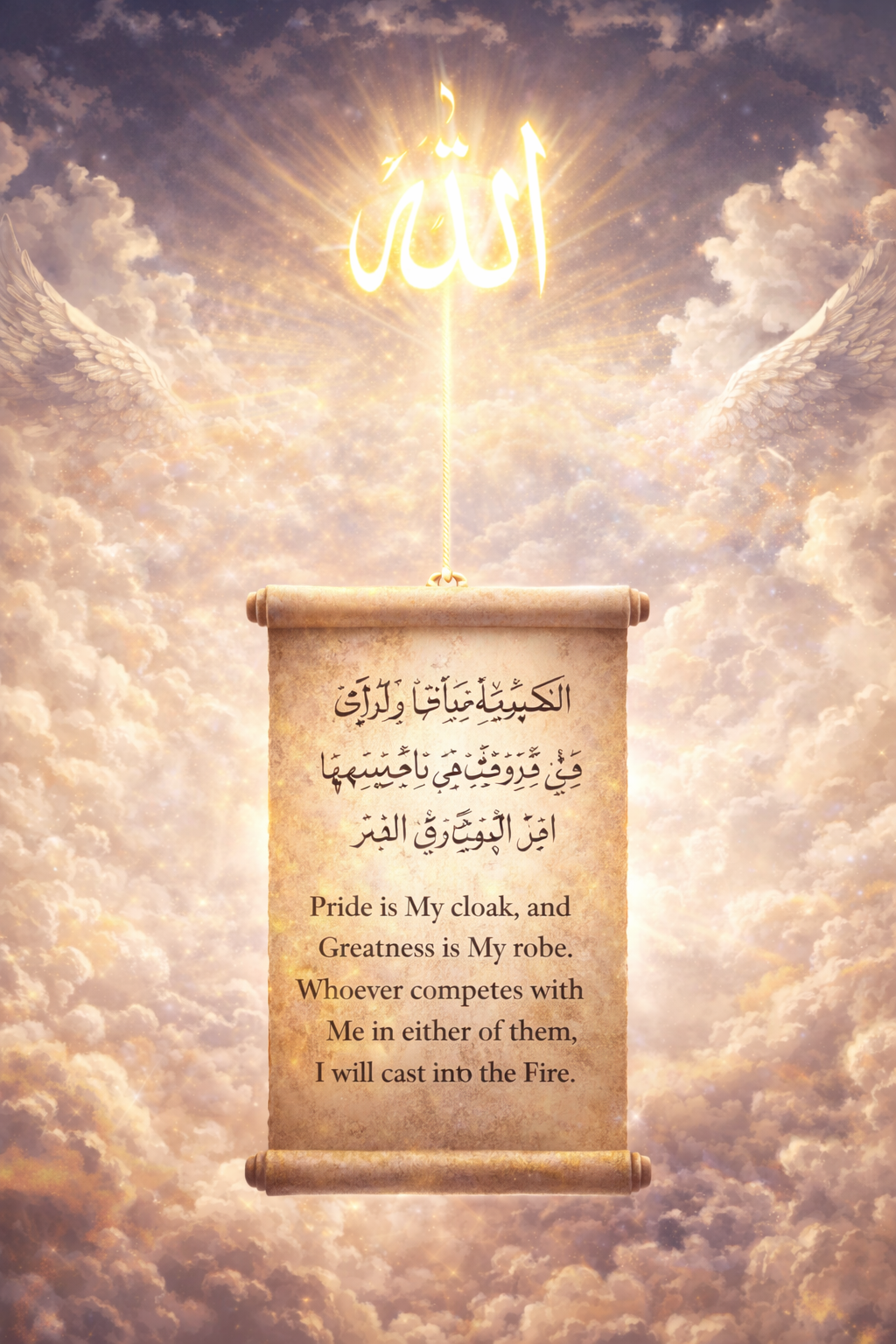
“Pride is My cloak, and Greatness is My robe. Whoever competes with Me in either of them, I will cast into the Fire.”
This statement is terrifying—and merciful at the same time.
Terrifying, because it draws a red line no human may cross.
Merciful, because it warns us before we destroy ourselves.
key point for the reader:
God is not saying “humans should never be confident.”
God is not saying “humans should be weak.”
God is not saying “humans should not lead.”
God is saying:
Absolute pride and absolute greatness do not belong to creation.
They belong to Him alone.
Why?
Because only God:
cannot be corrupted by power
cannot become unjust
cannot forget the weak
cannot be blinded by ego
When a human being claims what only God can carry, that human collapses—internally first, then externally.
Why Arrogance Is Different From Sin
This is critical to understand.
Islam makes a sharp distinction between:
sin (disobedience)
arrogance (kibr)
Sin can happen in weakness.
Arrogance happens in self-worship.
Adam disobeyed—and admitted it.
Iblis disobeyed—and justified himself.
That difference is everything.
This is why Adam was forgiven.
And this is why Iblis was expelled.
Because arrogance does not ask for forgiveness.
It argues.
What the Prophet ﷺ Taught About Arrogance
The Prophet Muhammad ﷺ did not leave this abstract.
He explained it so clearly that no one can pretend ignorance.
A man once asked him ﷺ about wearing nice clothes and shoes.
The Prophet ﷺ replied:
“Allah is Beautiful and loves beauty. Arrogance is rejecting the truth and looking down on people.”
This is revolutionary.
Arrogance is not:
success
leadership
intelligence
wealth
beauty
Arrogance is:
rejecting truth when it is clear
despising people
seeing yourself as above correction
That is why arrogance is so political.
Because politics is full of:
refusing facts
silencing opponents
humiliating the weak
rewriting reality
Showing Off (Riyāʾ): The Hidden Twin of Arrogance
Now comes something even more dangerous.
The Prophet ﷺ warned not only against arrogance—but against showing off.
Showing off is when:
you perform righteousness to be seen
you speak truth to be praised
you lead to be admired
Outwardly, it looks humble.
Inwardly, it is ego.
The Prophet ﷺ called this:
“The hidden shirk.”
Why?
Because the heart shifts:
from God → to people
from truth → to applause
from accountability → to image
This matters in politics more than anywhere else.
Because politics rewards performance.
And punishes sincerity.
Why This Matters Before We Speak About the Prophet ﷺ
We began with God—because no political discussion is safe until pride is placed where it belongs.
Now we turn to the Prophet Muhammad ﷺ.
Why?
Because he is the living proof that:
authority can exist without arrogance
leadership can exist without pride
power can exist without corruption
The Prophet ﷺ was:
obeyed more than any leader
loved more than any ruler
feared by tyrants
gentle with the weak
And yet he said:
“Do not exaggerate in praising me as the Christians exaggerated in praising Jesus.”
He refused to be inflated.
This is where Islamic politics becomes unique.
The Transition
So understand the structure:
God establishes the boundary
Pride and greatness belong to Him alone.The Prophet ﷺ explains the boundary
Arrogance is rejecting truth and despising people.Human beings are now accountable
Rise—but bow.
Lead—but fear God.
Speak—but do not perform righteousness for applause.
Now—and only now—are we ready to speak about politics among humans.
Because politics without this education becomes tyranny.
And politics with this education becomes responsibility.
In the next section, we will move fully into the life, words, and conduct of the Prophet Muhammad ﷺ—
not as a preacher,
but as the most successful political leader in history who never claimed ownership of power.
That is not myth.
That is fact.
And that is where the real lesson begins.
Conclusion: The Politics of God — and Why It Must Be Understood First
We conclude this chapter where it must end:
with God firmly in His place—and humanity firmly in ours.
Before there was history, before there were nations, before there were ambitions written into constitutions or carved into stone, there was Divine authority. Absolute. Unquestioned. Perfect.
God does not compete.
God does not argue.
God does not justify Himself.
The Qur’an states this without ambiguity:
He is not questioned about what He does, but they will be questioned.
This single truth establishes the ultimate political order of existence.
God governs reality itself.
Creation governs nothing without permission.
This is not a metaphor.
This is not poetry.
This is law at the level of existence.
God elevates whom He wills and humbles whom He wills.
God opens doors and closes them.
God grants power, withdraws it, delays it, tests it, and sometimes destroys it.
Not because He is political like humans are—but because all politics unfolds inside His dominion.
Fortune is not proof.
Fame is not protection.
Power is not ownership.
Everything a human being touches—authority, success, legacy, victory—is borrowed.
And the borrowing comes with conditions.
The condition is humility.
The condition is remembrance.
The condition is knowing that pride and greatness are not yours to wear.
God made this boundary explicit through the words of His Messenger ﷺ:
“Pride is My cloak.
Greatness is My robe.
Whoever competes with Me in either, I will break.”
This is not threat.
This is mercy spoken in advance.
Because no human can carry what only God can carry.
When humans forget this, politics turns into madness:
leaders begin to believe they are destiny,
systems begin to worship themselves,
truth becomes optional,
cruelty becomes rational.
History does not collapse by accident.
It collapses when arrogance outgrows its limits.
God sends signs to remind humanity:
through sudden elevation,
through sudden loss,
through saints who act beyond explanation,
through stories like Musa and Khidr, where human logic fails but Divine wisdom remains intact.
These are not anomalies.
They are lessons.
God is always ahead of time.
God is always reshaping conditions.
God is always exposing arrogance—slowly or suddenly.
This is the politics of God: not negotiation, not persuasion, not compromise—
but absolute sovereignty with absolute justice.
Understanding this is not optional.
It is the prerequisite for every political discussion that follows.
Because once God is forgotten, politics becomes idolatry.
Where We Go Next
Now—and only now—do we descend.
Not away from God, but into the human arena.
The next chapter begins where heaven ends and earth begins:
The Politics of the Prophets
The politics of beings who:
must live among humans,
must fight devils and tyrants,
must resist ego and despair,
must deliver truth without arrogance,
must carry authority without stealing the cloak.
This is politics under accountability.
Politics under pain.
Politics under restraint.
The prophets did not rule from above humanity.
They walked among it.
They were tested by:
rejection,
betrayal,
ridicule,
exile,
war,
temptation,
exhaustion.
And yet they never claimed greatness for themselves.
That is the transition.
From the Politics of God, where greatness belongs only to Him,
to the Politics of the Prophets, where humans learn how to carry responsibility without forgetting their place.
That is where the real struggle begins.