

اللهِ الرَّحْمٰنِ الرَّحِيْمِ
In the Name of God , Most Gracious, Most merciful
♥️🤲🕋♥️🕋🌹🌹🥀🤲🌹🕋♥️🤲
Socrates and Athens: A Saint in a Civic Machine
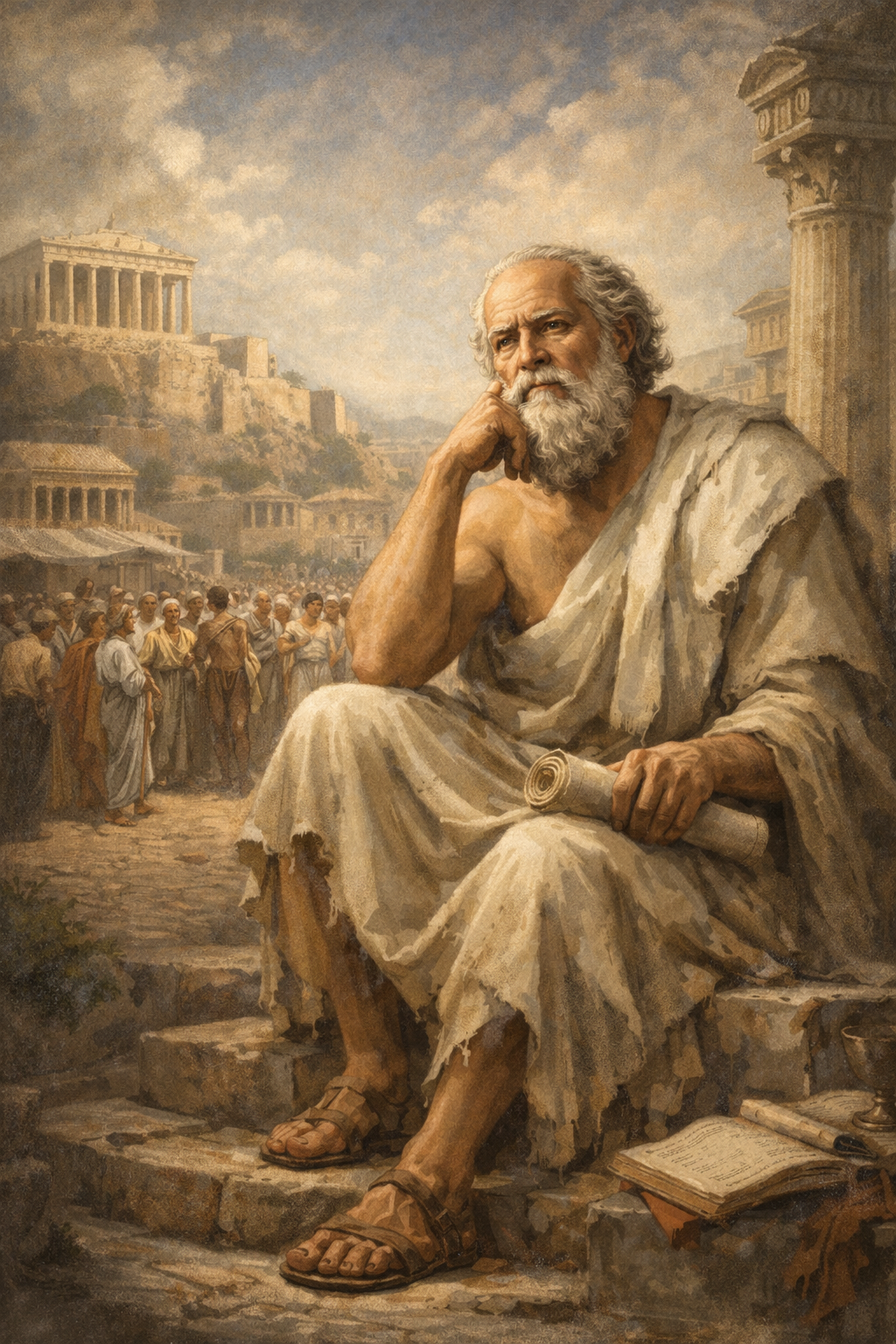
Socrates was a saint.
Athens was not a saintly society.
That distinction matters, because much confusion comes from treating Athens either as a villain or as an enlightened ideal. It was neither. It was an early democracy of citizens—impressive for its time, limited by its structure, and ultimately unable to accommodate a figure like Socrates.
What Athens Was
Athens deserves credit where credit is due.
It was an early experiment in citizenship:
Citizens voted.
Citizens debated.
Citizens bore responsibility for collective decisions.
Citizens fought and died for those decisions.
This was not tyranny. It was not blind despotism. It was a serious attempt to distribute political agency beyond kings and priests. In that sense, Athens represented progress.
But this structure came with conditions.
Citizenship in Athens was not merely a right; it was a function. The city required:
Participation
Loyalty to civic narratives
Willingness to act decisively as a collective
Democracy, especially in a war environment, depends on coherence. It cannot tolerate too much internal hesitation.
What Socrates Was
Socrates did not oppose citizenship.
He did not campaign against voting.
He did not reject the city.
What he rejected was unexamined authority.
His posture was permanent humility:
He claimed no knowledge.
He refused payment.
He held no office.
He appealed to no faction.
He spoke of an inner restraint—a daimonion—that prevented him from wrongdoing. It did not grant him power. It did not protect him from consequences. It simply aligned him with what he understood to be right.
This posture is recognizable across traditions as saintly:
Non-attachment
Moral restraint
Refusal to lie for advantage
Willingness to suffer rather than distort truth
Socrates functioned as a conscience, not a competitor.
The Structural Conflict
The conflict between Socrates and Athens was not personal. It was structural.
Athens relied on:
Confident speech
Persuasive leaders
Civic myths that motivated action
Youth who trusted inherited narratives
Socrates introduced something incompatible with that machinery:
Discernment without replacement authority
Questions without ready answers
Doubt directed upward, not downward
He did not tell the youth what to believe.
He taught them how to notice when belief was unsupported.
From the city’s perspective, this was destabilizing.
Not because it was immoral, but because it slowed obedience.
“Poisoning the Youth” Reconsidered
The charge of “poisoning the youth” should not be read morally. It was political.
What was being poisoned was not virtue, but automatic compliance.
A citizen-soldier who asks:
“Is this just?”
“Is this necessary?”
“Do we actually know what we’re claiming?”
is harder to mobilize.
Socrates did not encourage rebellion.
He encouraged examination.
In a fragile democracy under external pressure, examination can feel like sabotage—even when it is not.
The Vote and the Verdict
Athens voted.
This matters. Socrates was not killed by a tyrant. He was condemned through civic process. That does not make the decision righteous, but it explains it.
Democratic systems can still misjudge moral outliers, especially when fear is present. Voting does not guarantee wisdom; it guarantees participation.
The citizens did what citizens do:
They chose stability over discomfort.
Coherence over conscience.
Survival over truth.
The Role of the Saint
Saints, intellectual or spiritual, rarely fit comfortably into functioning systems.
They do not optimize systems.
They expose their limits.
Socrates did not offer Athens a new model. He offered it a mirror. And mirrors are often rejected not because they lie, but because they reveal too much at the wrong moment.
The Conclusion Without Romance
Socrates was a saint in function: humble, restrained, incorruptible, and willing to die rather than falsify truth.
Athens was a civic experiment: innovative, participatory, but ultimately unable to integrate a figure whose loyalty was to truth before consensus.
Neither side was cartoonish.
But the outcome was decisive.
When a society cannot distinguish between examination and betrayal, it will always remove the examiner.
This is not unique to Athens.
It is a recurring tension between conscience and coordination.
Understanding that tension—without mythologizing either side—is the real lesson.