

بِسْمِ اللهِ الرَّحْمٰنِ الرَّحِيْم
In the Name of God, Most Gracious, Most Merciful
♥️🤲🕋♥️🕋🌹🌹🥀🤲🌹🕋♥️🤲
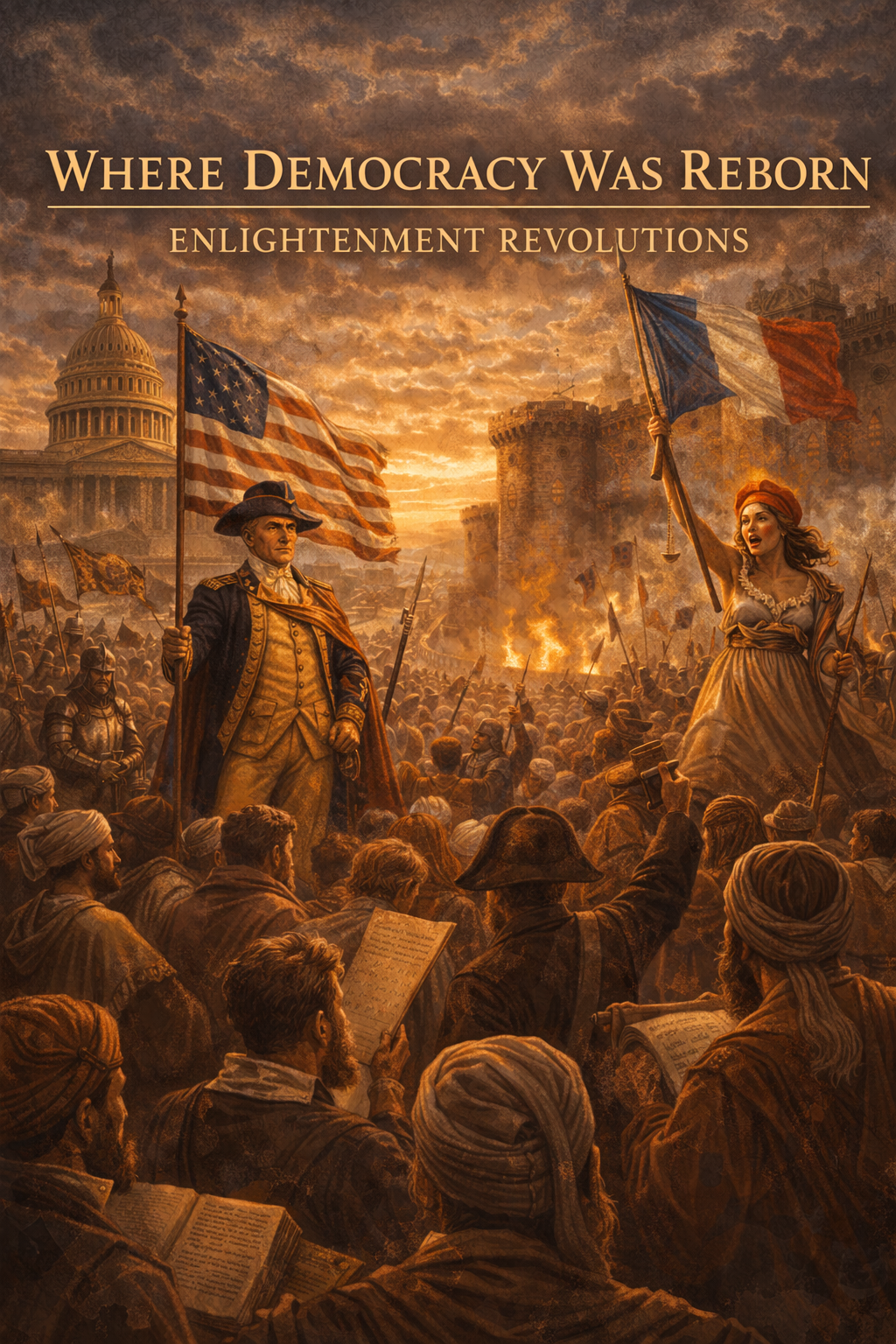
Part V: Enlightenment Revolutions — The Return of the People
Athens gave humanity a voice.
Rome gave humanity structure.
Islam gave humanity moral restraint.
The medieval world gave humanity stability—at the cost of freedom.
The Enlightenment did something radical:
It asked again.
Not quietly.
Not cautiously.
But out loud.
The Question That Would Not Stay Buried
For centuries, people were told:
God chose kings.
Blood determined destiny.
Obedience was virtue.
Silence was safety.
But knowledge does not stay contained.
Books spread. Trade connected. Ideas traveled.
And one question resurfaced everywhere:
Why?
Why does he rule? Why must I obey? Why does birth decide worth? Why does power go unquestioned?
And once people start asking why—
Systems begin to tremble.
The Enlightenment: A Dangerous Idea
The Enlightenment was not a movement.
It was an awakening.
Philosophers, scientists, and thinkers across Europe began to say something unthinkable:
Power must justify itself.
Not through God. Not through tradition. Not through fear.
But through reason.
This was revolutionary.
Because reason belongs to everyone.
Consent Replaces Divine Right
Where medieval kings said: “I rule because God chose me.”
The Enlightenment said: “You rule only if the people allow it.”
This was not reform.
It was a detonation.
Power shifted from heaven to earth. From bloodlines to ballots. From crowns to constitutions.
The people did not just want representation.
They wanted sovereignty.
The Birth of Modern Democracy
Out of this explosion came:
• The American Revolution
• The French Revolution
• Constitutional states
• Bills of rights
• Written limits on power
• Legal citizenship
Not subjects.
Citizens.
This was Athens reborn—
but armed with Rome’s structures.
The people would rule. But through systems. Through law. Through institutions.
The republic returned.
The New Promise
Modern democracy promised:
No kings. No divine rulers. No inherited power. No sacred elites.
Only law. Only rights. Only consent.
For the first time in history, the people were not just participants.
They were the source of legitimacy.
The Hidden Fragility
But the Enlightenment carried a flaw.
It trusted reason.
It assumed people would think. That knowledge would free. That education would stabilize.
But it underestimated something ancient:
Fear. Tribalism. Ambition. Manipulation.
Democracy was reborn— but it was still human.
The Industrial Shock
As machines arrived, cities exploded, economies transformed, populations surged—
Democracy was overwhelmed.
Systems designed for towns now governed nations. Institutions built for debate now managed millions. Power became distant. Abstract. Incomprehensible.
The people still voted.
But they no longer governed.
The Beginning of the Modern Crisis
Elections continued. Constitutions remained. Rights were written.
But something faded:
Meaning.
Participation became symbolic. Representation became professional. Politics became spectacle.
Power migrated—from people to systems.
From systems to corporations.
From corporations to algorithms.
The Enlightenment Did Not Fail
It revealed the problem.
Power always evolves.
And if democracy does not evolve with it—
It becomes decoration.
The Next Collapse
Today, democracy still exists.
But it is fragile.
Not because of armies. Not because of kings.
But because of complexity.
Systems now move faster than understanding. Decisions happen beyond visibility. Power operates beyond comprehension.
Which brings us to the most dangerous chapter of all.
Next: Modern Collapse — When Systems Outgrow Humans
This is not about failure.
This is about scale.