

بِسْمِ اللهِ الرَّحْمٰنِ الرَّحِيْم
In the Name of God, Most Gracious, Most Merciful
♥️🤲🕋♥️🕋🌹🌹🥀🤲🌹🕋♥️🤲
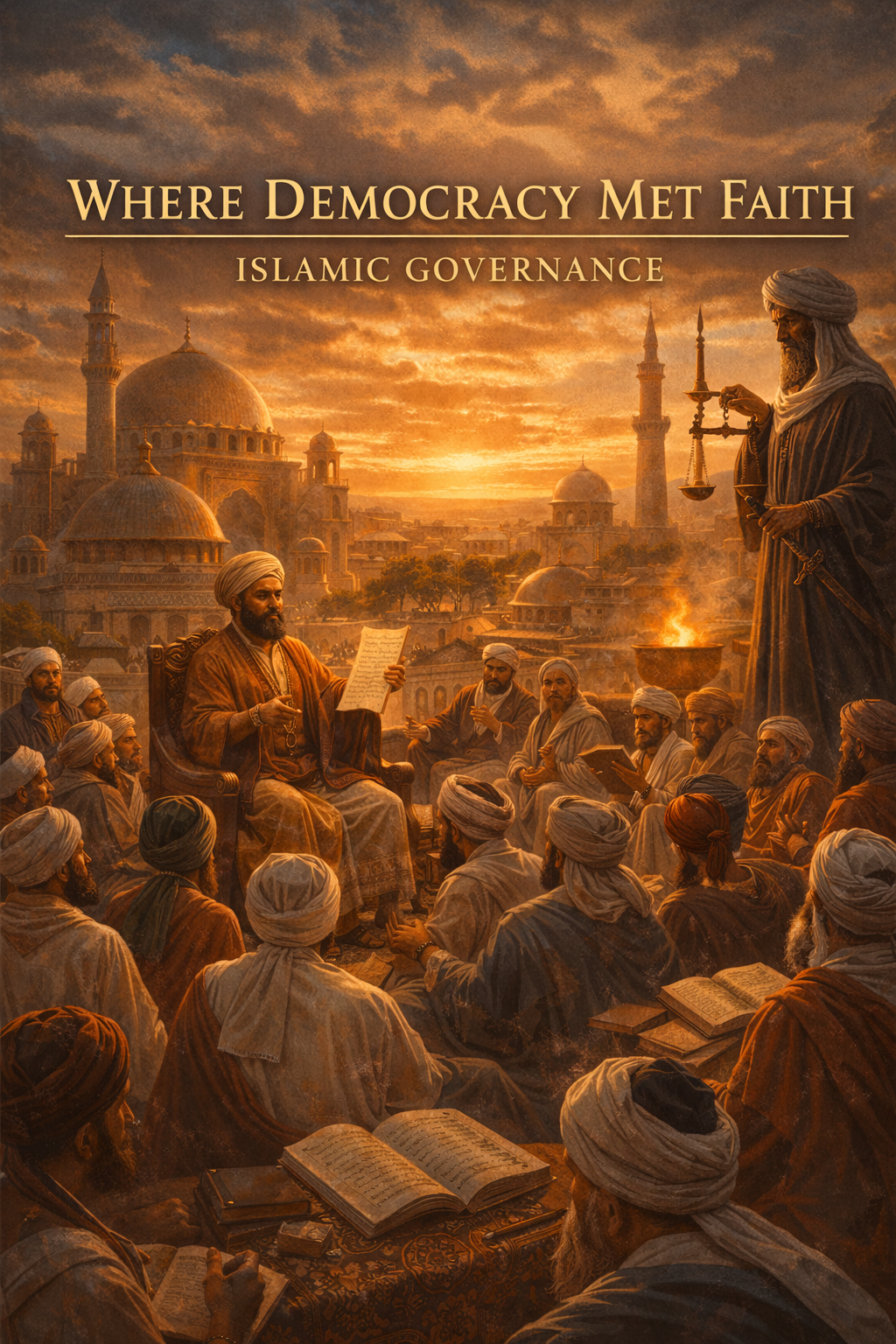
Part III: Islamic Governance — Power Under God, Not Men
Athens asked: Who should rule?
Rome asked: How should power be restrained?
Islam asked something deeper:
What should power answer to?
Not the crowd.
Not the elite.
Not tradition.
Not empire.
But God.
This was not a political adjustment.
It was a civilizational redefinition of authority.
A New Question Enters History
By the time Islamic civilization emerged, the world already knew tyranny.
It knew kings. It knew emperors. It knew priesthoods. It knew bloodlines.
Rome had shown that institutions could restrain power—but not purify it. Athens had shown that people could rule—but not always wisely.
Islam entered history with a radical claim:
No human being owns another human being.
No ruler is sacred.
No authority is above moral law.
Power itself was placed on trial.
Sovereignty Belongs to God
In Islamic governance, sovereignty does not belong to the ruler.
It belongs to Allah.
This single principle shattered every ancient political model.
Kings ruled because of lineage. Emperors ruled because of conquest. Pharaohs ruled because of divinity.
Islam said:
You rule only if you obey the law.
And the law is not yours to change.
This was unprecedented.
A ruler could not rewrite morality. A caliph could not suspend justice. A general could not excuse tyranny.
Power was not absolute.
It was conditional.
Shura: Consultation, Not Spectacle
Islam did not copy Athenian democracy. It did not copy Roman republicanism.
It introduced Shura—consultation.
But not as theater. Not as noise. Not as popularity contests.
Shura was a duty.
Leaders were obligated to consult. To listen. To seek counsel. To justify decisions.
Power was no longer solitary.
It was accountable.
The Law Above the Ruler
In Rome, law was a human creation.
In Islam, law was divine.
This meant something revolutionary:
The ruler could not bend the law. The law could break the ruler.
Judges (Qadis) were independent. Rulers could be summoned. Complaints could be filed. Decisions could be overturned.
This was not symbolic.
It was functional.
Power was no longer sacred.
Justice was.
Knowledge as Governance
Where other civilizations built monuments, Islam built libraries.
Where others preserved bloodlines, Islam preserved knowledge.
Because Islam understood something critical:
A just society requires educated people.
Ignorance creates tyranny. Knowledge restrains it.
So governance was tied to: • Scholarship
• Law
• Ethics
• Debate
• Preservation of truth
The House of Wisdom was not a luxury.
It was infrastructure.
Rights Before the West Named Them
Islamic civilization codified:
• Property rights
• Contract law
• Due process
• Presumption of innocence
• Welfare systems
• Orphan protections
• Women's legal standing
• Religious minorities’ protections
Not as favors.
But as obligations.
Because justice was not optional.
It was worship.
Where It Faltered
Islamic governance was not immune to corruption.
Dynasties formed. Power concentrated. Empires rose. And politics began to override principles.
But something remained unique:
The moral standard never changed.
Even when rulers failed it, the ideal remained above them.
And that matters.
Because it preserved the critique.
What Islam Added to Civilization
Athens gave humanity voice.
Rome gave humanity structure.
Islam gave humanity moral constraint.
It said:
Power is not just a function of systems. It is a test.
Leadership is not privilege. It is responsibility.
And governance is not control.
It is accountability before God.
The Next Collapse
After Islamic civilization, Europe would re-centralize power.
Kings would rise again. Churches would crown rulers. Absolute monarchy would return.
The people would be silent.
And democracy would go underground.
For centuries.
Until it exploded.
Next: Medieval Power — Thrones, Churches, and Absolute Rule
This will be the darkest chapter.
Not because nothing worked.
But because everything worked—for the few.
And nothing worked for the many.