
بِسْمِ اللهِ الرَّحْمٰنِ الرَّحِيمِ
Opening — When Humanity Fell to Zero
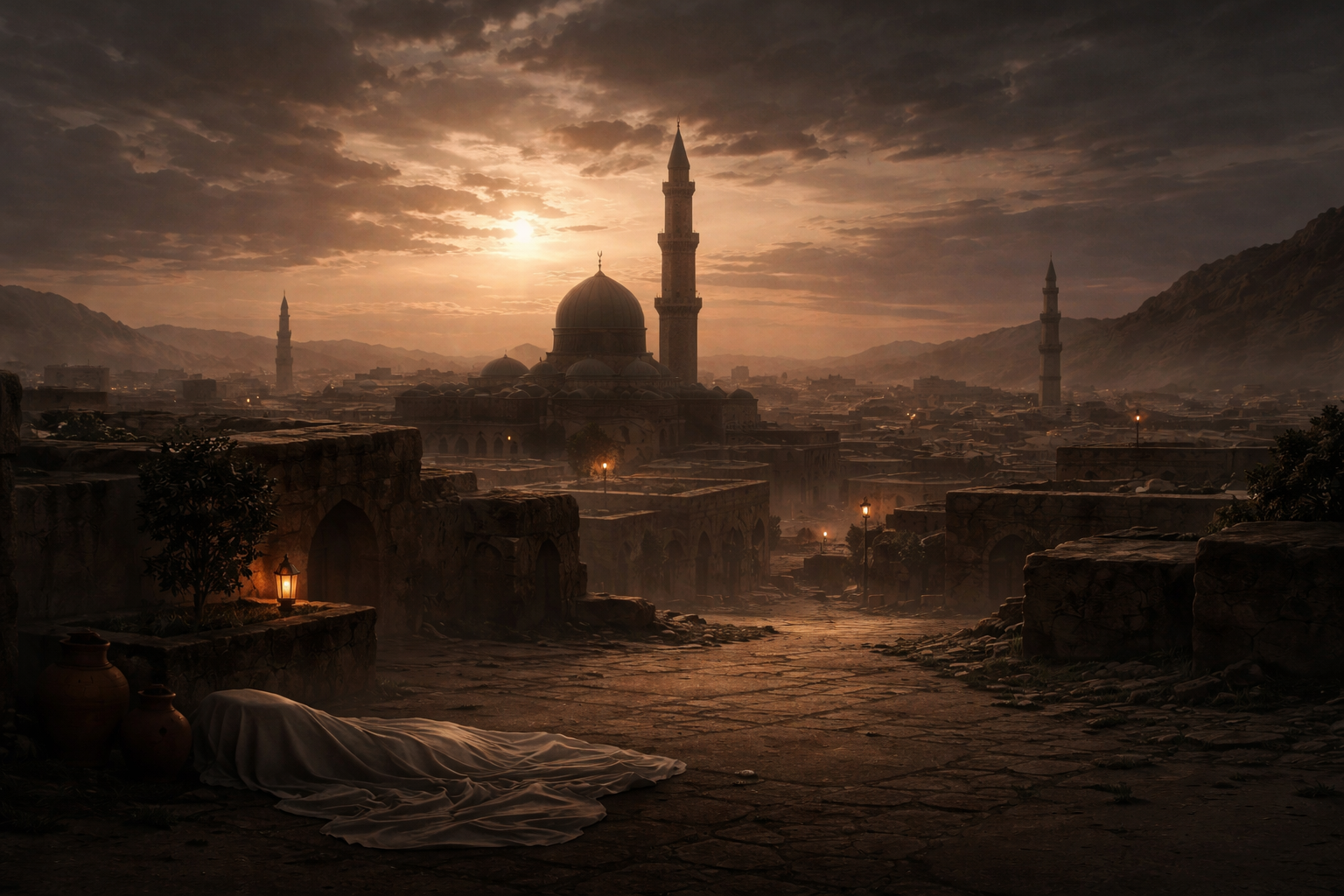
It is said—and this was taught by the scholars of light—that when the Prophet Muhammad ﷺ entered Madinah, a real light was added to the city. Not metaphor alone. Not poetry alone. A light that ordered hearts, softened disputes, restrained power, and made truth immediately accessible. Problems did not linger. Confusion did not metastasize. Injustice did not hide long. If a matter was unclear, it could be brought to him. If a wrong was committed, revelation could descend. If power overstepped, heaven corrected it.
Madinah was not just governed.
It was guided.
A woman could stop the Messenger ﷺ in the marketplace, raise her complaint, and be heard fully. A verse could descend in response. A dispute could be settled not by compromise, but by truth. The Prophet ﷺ carried a direct connection to heaven—through revelation, through Hadith Qudsi, through divine correction that never slept. With him present, humanity was never alone. There was always an answer. There was always a restraint. There was always a higher authority watching power carefully.
And then, suddenly, that light was gone.
When the Prophet ﷺ passed away, Madinah darkened—not because faith vanished, but because revelation stopped. One of the women of the community, when asked why her grief was so heavy, said words that echo through history: “I am not crying because the Messenger of Allah has died. I am crying because revelation has stopped.” She understood something profound before politics had time to organize itself: guidance itself had withdrawn.
In that moment, humanity fell to zero.
There was no leader.
There was no verse coming.
There was no angel descending.
There was no divine interruption waiting in the wings.
The greatest human to ever live had just left the world, and there would never be anyone better. From this point forward, everything would be less clear, more fragile, more contested. Every decision would be made without a safety net. Every argument would have consequences. Every political move would be human—fully human—exposed to ego, fear, urgency, love, ambition, and grief.
This is the moment we are about to enter.
The moment when light that once resolved everything withdrew.
The moment when humans had to govern with memory instead of revelation.
The moment when leadership returned—not as certainty, but as burden.
With the Prophet ﷺ alive, any problem could be settled.
With the Prophet ﷺ gone, every problem became a test.
This chapter begins there—at zero.
At the edge of darkness.
At the instant politics returned, not because people wanted it, but because life demanded it.
And from that moment on, humanity would have to learn how to walk without the light walking ahead of them.
بِسْمِ اللهِ الرَّحْمٰنِ الرَّحِيمِ
Chapter 0 — The Day Politics Returned
The moment the Prophet Muhammad ﷺ passed away, the world did not pause.
Revelation had just concluded. The greatest human to ever walk the earth lay unburied. Angels who once descended in battle were gone. Miracles had ended. And yet—politics did not wait. It surged forward with frightening speed, stripped of restraint, laid bare in grief, fear, ambition, urgency, and confusion.
This was the greatest test the Muslim community would ever face.
Not a test of faith in God—
but a test of what happens to humans when divine intervention withdraws.
Some companions collapsed under the weight of loss, unable to accept that the Messenger ﷺ could die at all. Others gathered themselves and rushed toward leadership discussions, terrified that delay would fracture the community beyond repair. Others withdrew entirely, refusing to engage in power while the best of creation still awaited burial. And others—quietly, decisively—began to rebel, refusing obligations, hoarding wealth, declaring independence, or inventing new claims to authority.
Everything poured out.
Love did not stop politics.
Loyalty did not stop politics.
Miracles did not stop politics.
Fighting alongside angels did not stop politics.
Even proximity to the Prophet ﷺ did not stop politics.
This was not hypocrisy revealed later—it was human reality exposed immediately.
The greatest leader humanity will ever know had departed. There would never be anyone better. From this point forward, everything would be a descent from perfection. And yet, the world still had to be governed. Life still demanded order. Justice still demanded defense. Unity still demanded leadership.
So politics returned—not as revelation, but as burden.
Some spoke too soon.
Some remained silent out of reverence.
Some feared chaos more than error.
Some feared error more than chaos.
And in that moment, Allah showed humanity something terrifying and merciful at the same time: death is the ultimate political stress test. It strips intention bare. It exposes whether obedience was conviction or convenience. It reveals who loved God, who loved order, who loved power, and who loved neither but simply feared collapse.
This is where prophetic politics ends—not in failure, but in transfer.
From this day forward, no angel would descend to correct a decision. No verse would arrive to settle disputes. No miracle would silence ego. Humanity would have to govern with memory, conscience, fear of Allah, and accountability alone.
And that is why this chapter must exist.
Before we judge caliphs, before we praise or condemn, before we measure success or failure, we must stand still at this moment—the day politics returned, the day the Ummah learned how weak it was without revelation, and how necessary restraint would be from this point forward.
What follows is not prophecy.
What follows is implementation.
And it begins with those who stood up while the ground was shaking, while grief was raw, while unity was fragile, and while the shadow of collapse loomed over everything.
This is the beginning of Politics After Prophecy.