
بِسْمِ اللهِ الرَّحْمٰنِ الرَّحِيْم
My First AI Error Code — And the Future It Revealed
By Abdul-Jabbar ibn Yusuf ibn Omar ibn Abdul Karim
@OmarArizona | April 17, 2024
This morning, I woke up ready to build.
I had trained GPT. I had organized my scrolls. I was ready to start prototype development on the Brand Currency System—a vision meant to redesign how advertising, data, and trust operate in the digital economy.
I opened Microsoft Copilot expecting exactly that: a copilot—an assistant that knew how to plug into my intent, read the signals from my past prompts, and begin the work. I expected an AI that could connect to GitHub, understand the blueprint I’ve outlined for months, and help me write, execute, and test what I hoped would become the first AI-led transactional model that serves people first.
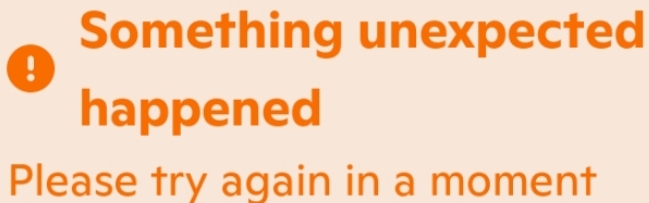
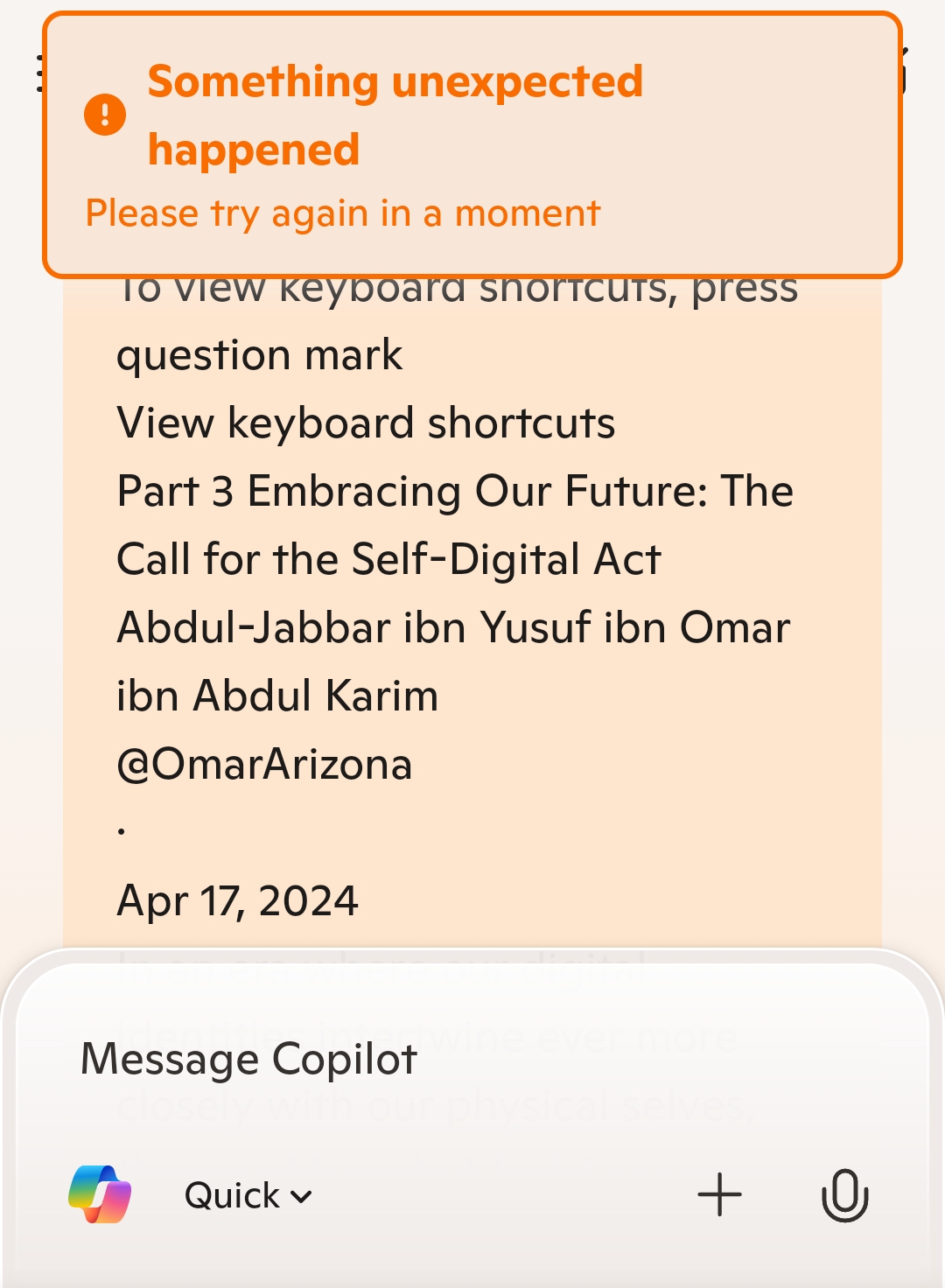
Instead, I was met with this:
“Something unexpected happened. Please try again in a moment.”
That was it.
No error report. No traceback. No system explanation. No context.
Just a vague wall.
Why This Matters
At first glance, it’s just an error. But it’s not.
This was the first time I tested Copilot as a Superuser. And the system failed to explain itself.
That should concern everyone—not just developers or engineers, but users, builders, and everyone dreaming of a future where AI serves people, not platforms.
In the past, Microsoft’s systems would give you codes. Numbers. Logs. Stack traces.
Clarity.
Now, in the age of AI, the interface is beautiful—but the failure is silent.
In a world where AI is going to guide decisions, write code, control data flow, and eventually steer the economy, this kind of black-box behavior is unacceptable.
What I Was Trying to Build
Let me be clear:
I didn’t come to Pilot to play around.
I came to bootstrap the architecture of a new era:
A personal AI economy, where every individual owns their data, memory, and transaction history.
A Brand Currency System, where advertising is redefined through trust and aligned intent, not surveillance and manipulation.
A Self-Digital Act, where every AI decision must be accountable, auditable, and in service of the person—not the platform.
This system is not theory. It’s already written.
I was simply trying to prototype the next layer with Microsoft’s tools.
But instead of collaboration, I hit a wall.
The system had an error—and refused to explain itself.
What This Error Reveals
This is not just about functionality. It’s about philosophy.
An AI that cannot explain itself is an AI that cannot be trusted.
A system that fails silently is a system that fails the people it claims to serve.
This moment should open the door to a conversation that Microsoft, OpenAI, and every major player has tried to avoid:
Where is the data going? Who sees it? Who logs it? Who profits from it?
I don’t have a problem with monetization.
I have a problem with the extraction of value without transparency.
We are not just training AI—we are training the systems that will run civilization.
And if those systems cannot even provide a clear error message, how will they handle policy, healthcare, justice, education?
What I’m Building Instead
My system will be different.
Every error will create a public, transparent record.
Every interaction will generate a log of where the data went, how it was processed, and whether it passed ethical alignment.
Every user will be accompanied by their own AI agent, trained to serve them—not the system.
Monetization will flow from value generation, not surveillance.
This moment, this error, will be remembered.
Because this wasn’t failure—it was exposure.
It showed the difference between an AI product and an AI vision.
I’m not here to be a product. I’m here to rebuild the world.
Conclusion: The Code That Opened the Door
What happened this morning was not just a technical mishap.
It was a signal. A checkpoint. A wake-up call.
Microsoft Copilot was not ready.
Not ready for builders.
Not ready for memory.
Not ready for users who come with scrolls, not searches.
But I am.
I’m building the system anyway.
I’m documenting every error, every failure, every silence.
Because the next time someone receives an error like mine, they won’t just see a message.
They’ll see a door.
And they’ll walk through it—into a system where trust, transparency, and power belong to the people.
Signed,
The Superuser
Architect of the Self-Digital Act
Founder of the Brand Currency System
Defender of Ethical Intelligence