

بِسْمِ اللهِ الرَّحْمٰنِ الرَّحِيْم
In the Name of God, Most Gracious, Most Merciful
♥️🤲🕋♥️🕋🌹🌹🥀🤲🌹🕋♥️🤲
MUSASHI AND IMAM AL-GHAZALI: TWO MASTERS OF SELF-MASTERY
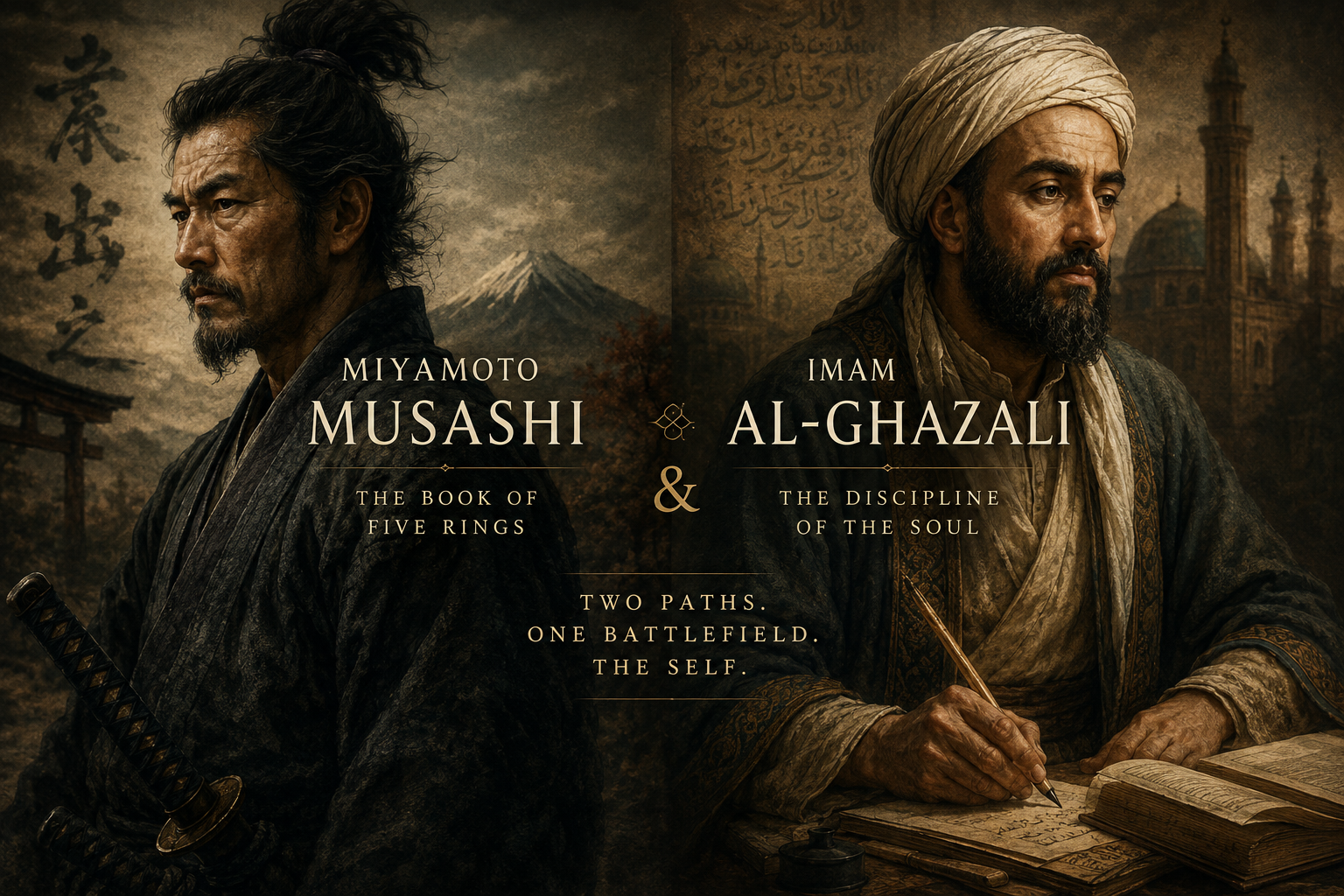
Introduction: A Meeting Across Five Centuries
What happens when a samurai from seventeenth-century Japan sits down with a theologian and spiritual master from eleventh-century Baghdad?
At first glance, the comparison seems impossible.
One lived by the sword.
One lived by the pen.
One wrote for warriors.
One wrote for seekers.
One sought victory on the battlefield.
One sought purification before Allah.
Yet beneath these differences lies something extraordinary. Both men devoted their lives to understanding the same subject: the human being.
Both sought to answer the same question:
Why do people know what is right and yet fail to do it?
The answer they discovered was remarkably similar.
The greatest obstacle is not the enemy outside.
The greatest obstacle is the disorder within.
The Wild Horse of Human Nature
Musashi repeatedly warns against allowing emotions, fear, excitement, and hesitation to dominate the warrior. Al-Ghazali repeatedly warns against allowing the Nafs, the lower self, to dominate the intellect and the heart.
Both men begin from the same observation:
The human being possesses tremendous power, but that power becomes destructive when left without guidance.
Musashi Said
"Do not let the body be dragged by the spirit, nor the spirit be dragged by the body."
Throughout The Book of Five Rings, Musashi repeatedly emphasizes balance, composure, and command over one's emotional state. A warrior who becomes excited, fearful, angry, or reckless loses command of himself before he ever loses command of the battlefield.
Al-Ghazali Said
The Nafs must be disciplined until it submits to the intellect and obeys what is beneficial rather than what is merely desired.
In The Discipline of the Soul, Al-Ghazali describes the lower self as something that cannot simply be trusted. Left unchecked, it pursues comfort, pleasure, praise, and immediate gratification while resisting what is beneficial.
The Connection
Musashi fears a warrior controlled by emotion.
Al-Ghazali fears a soul controlled by appetite.
Different language.
Same architecture.
In both systems, freedom is not the ability to satisfy every desire.
Freedom is the ability to refuse a desire.
Training Beats Inspiration
Modern culture often teaches that transformation begins with motivation.
Neither Musashi nor Al-Ghazali would agree.
Both insist that lasting change emerges from repetition.
The warrior becomes a warrior through training.
The saint becomes a saint through practice.
Musashi Said
"Step by step walk the thousand-mile road."
Musashi constantly returns to the idea that mastery emerges through relentless repetition. The warrior practices the same fundamentals over and over until correct action becomes natural.
Al-Ghazali Said
Virtue is acquired through repeatedly performing virtuous acts until they become natural.
Al-Ghazali teaches that generosity emerges from repeated acts of giving. Patience emerges from repeated acts of patience. Humility emerges from repeated acts of humility.
The Connection
Neither master believes in sudden transformation.
Neither master offers shortcuts.
Neither master promises an easy path.
Both understand that identity is formed through repetition.
You do not become disciplined by admiring discipline.
You become disciplined by practicing discipline.
Identity is not declared.
Identity is rehearsed.
The Battle Against Immediate Pleasure
One of the most striking similarities appears in how both men approach impulse.
Musashi teaches that an opponent's rhythm must be disrupted before it gains momentum.
Al-Ghazali teaches that a desire must be opposed before it becomes established.
Musashi Said
Victory often comes from disrupting the enemy's timing.
The skilled warrior does not simply react. He breaks the opponent's rhythm, seizes initiative, and refuses to allow the enemy to dictate the pace of the encounter.
Al-Ghazali Said
The lower self must be opposed before its desires become dominant.
Al-Ghazali teaches that when a desire first appears, it is weak. If it is entertained and negotiated with, it gains strength. The wise person interrupts it before it becomes established.
The Connection
Consider the alarm clock.
The alarm rings.
The mind immediately begins negotiating.
Five more minutes.
Tomorrow.
Later.
Musashi would call this surrendering initiative.
Al-Ghazali would call this surrendering authority to the Nafs.
Both masters would advise the same response:
Move immediately.
Act before the negotiation becomes stronger.
Presence Versus Heedlessness
Both Musashi and Al-Ghazali regarded inattentiveness as dangerous.
Musashi called it fixation.
Al-Ghazali called it heedlessness.
Musashi Said
If you become fixated on one movement, you lose sight of the entire battlefield.
A warrior who becomes obsessed with one threat loses awareness of everything else occurring around him.
Al-Ghazali Said
If the heart becomes absorbed in worldly distractions, it loses sight of its purpose.
A heedless person moves through life without examining intentions, actions, desires, and priorities.
The Connection
The modern world manufactures fixation.
Social media.
Advertising.
Notifications.
Entertainment.
Endless distraction.
Musashi would immediately recognize the danger.
Al-Ghazali would immediately recognize the danger.
Both would diagnose the same problem:
Attention has been captured.
The individual is no longer governing himself.
Something else is governing him.
The Final Difference
Despite these similarities, it is important to honor the difference between the two masters.
Musashi Said
Master strategy so thoroughly that fear, confusion, and hesitation no longer control your actions.
Musashi sought mastery.
He wanted a warrior capable of acting decisively under pressure.
Al-Ghazali Said
Purify the soul so thoroughly that pride, greed, and desire no longer control your actions.
Al-Ghazali sought purification.
He wanted a soul capable of returning to Allah in peace.
The Connection
Musashi's horizon was victory.
Al-Ghazali's horizon was nearness to Allah.
Different destinations.
Remarkably similar disciplines.
Both require vigilance.
Both require training.
Both require self-command.
: The Battlefield Within
A samurai from Japan.
A scholar from Baghdad.
Five centuries apart.
Different languages.
Different religions.
Different missions.
Yet both arrived at a truth that remains as relevant today as it was in their own time.
A person who cannot govern himself cannot truly govern anything else.
The battle begins when temptation appears.
The battle begins when anger rises.
The battle begins when comfort competes with principle.
The battle begins when the lower self demands obedience.
Whether one calls it strategy, discipline, self-mastery, purification, or Jihad al-Nafs, the lesson remains unchanged:
The greatest battlefield is within.
And the greatest victory is not over another human being.
The greatest victory is mastery over oneself.
IN Conclusion
A samurai from Japan and a scholar from Baghdad may never have met, yet both arrived at a truth that remains as relevant today as it was in their own age: a person who cannot govern himself cannot truly govern anything else. Whether we call it strategy, discipline, self-mastery, or Jihad al-Nafs, the battle begins long before we face the world—it begins within. In Part 1, we have established the battlefield and examined the remarkable parallels between two masters of human nature. In Part 2, we will move beyond diagnosis and into execution, exploring the daily architecture, habits, audits, and systems they used to transform knowledge into action and discipline into a permanent way of life.