

بِسْمِ اللهِ الرَّحْمٰنِ الرَّحِيْم
In the Name of God, Most Gracious, Most Merciful
♥️🤲🕋♥️🕋🌹🌹🥀🤲🌹🕋♥️🤲
MUSASHI AND IMAM AL-GHAZALI: PART 3 — THE ARCHITECTURE OF REMEMBRANCE AND THE ULTIMATE LEGACY
Introduction: The Unraveling of the Modern Mind
If Part 1 mapped the internal battlefield and Part 2 provided the operational machinery of daily practice, Part 3 addresses the final, most critical frontier: Permanence.
How does a sovereign individual prevent their internal infrastructure from breaking down over time? How do you ensure that the discipline built today survives the relentless, eroding pressure of tomorrow?
In our modern digital landscape, everything is built to be temporary. Algorithms change by the hour. Financial systems fluctuate on speculative whims. Human attention span has been reduced to seconds, leaving our collective memory fluid, volatile, and fragmented.
When your internal environment is constantly shifting, your character becomes impossible to stabilize. To fix this, both Miyamoto Musashi and Imam al-Ghazali arrived at an identical strategic solution: You must anchor your mind to an immutable foundation that exists entirely outside the reach of the world's noise.
Pillar I: The Illusion of Wealth vs. True Sovereignty
Most people spend their entire lives accumulating things that can be altered, devalued, or taken away from them in an instant. They mistake temporary material dominance for actual security. Both masters looked at the pursuit of external wealth and recognized it as a profound strategic vulnerability.
The Samurai’s View: Weaponry Without Attachment
In his final testament, the Dokkodo (The Way of Walking Alone), written just days before his death, Musashi warns against the accumulation of luxury goods, expensive property, or sentimental attachments. He believed that if a warrior relies on a specific luxurious sword or a grand estate to feel powerful, that warrior is no longer sovereign—he is hosted by his possessions. True power lies in the internal capability of the user, not the tool.
The Scholar’s View: The Rented Marketplace
Al-Ghazali breaks this down with ruthless clarity in The Alchemy of Happiness. He compares the immediate world to a temporary marketplace or a traveler's inn. The body is merely a vehicle, and material wealth is just fuel for the journey. To become obsessed with the accumulation of the fuel while forgetting the ultimate destination of the journey is the absolute definition of madness.
Side-by-Side: The Vulnerability of Attachment
Miyamoto Musashi (The Dokkodo):
"Do not possess any intermediate objects or weapons that are unnecessary for your ultimate path... Do not seek pleasure or luxury for its own sake. You must remain completely indifferent to where you live and what you own, so that your focus remains entirely on the way."
Imam Al-Ghazali (The Alchemy of Happiness):
"Wealth is like a dangerous snake; it contains both a deadly poison and a potent antidote. He who knows its nature can extract its benefit, but he who is deceived by its smooth skin will be destroyed by its venom... True sovereignty is owning your desires, not being owned by them."
Pillar II: The Immutable Vault of Character
To survive an unpredictable environment, you must build what can be called a Vault for Immutable Memory within your own consciousness. This means establishing principles that are so deeply etched into your character that no external crisis, financial collapse, or social pressure can retroactively edit or revise them.
Musashi’s Direct Path: No Regret
Musashi’s architecture of the mind is entirely unyielding. In the Dokkodo, his very first rule is: "Accept everything just as it is." His second rule is: "Do not seek pleasure for its own sake." He built a mental ledger that was entirely independent of external circumstances. Whether he was sleeping under a roof or exposed to the freezing rain on a mountain, his internal stance never shifted by a single degree.
Al-Ghazali’s Cryptographic Ledger: The Protected Heart
Al-Ghazali describes the healthy heart as a secure fortress (*Al-Qalb al-Salim*). In his treatise Mishkat al-Anwar (The Niche for Lights), he explains that the true intellect must become a divine mirror. When you clear away the noise of the ego, the mirror reflects unchanging, eternal truths. Once these truths are anchored in the heart, they become permanent memory—a ledger of truth that cannot be corrupted or audited out of existence by worldly rulers.
Side-by-Side: The Unalterable Stance
Miyamoto Musashi (The Book of Five Rings):
"Do not under any circumstances stray from the true path of strategy. Your mind must remain completely unshakeable in the face of all worldly changes. If you do not change your posture inside, no external force can ever break your rhythm."
Imam Al-Ghazali (The Discipline of the Soul):
"When the heart is thoroughly purified through continuous discipline, **its virtues become deeply rooted, permanent traits (*Malakah*)**. They are no longer temporary states that come and go; they become an immutable part of the soul's very essence."
Pillar III: The Ultimate Legacy — The Century Horizon
Most modern digital products, companies, and lifestyles are engineered for the immediate fiscal quarter. They are optimized for rapid, temporary engagement. Musashi and Al-Ghazali did not write for their contemporary moment; they engineered their works to act as permanent, self-sustaining networks of truth for centuries to come.
The Sword to the Brush
Musashi spent the final years of his life living in a cave (Reigando), stripped of all worldly distractions, carefully transferring his lifetime of physical tactical data into a text-first blueprint (*The Book of Five Rings*). He understood that his physical body would soon decay, but an unalterable framework of strategy could train sovereign individuals for a thousand years.
The Renewal of the Era
Al-Ghazali walked away from the highest, most prestigious academic position in Baghdad at the absolute peak of his fame and wealth. He spent a decade in remote isolation, traveling between Damascus, Jerusalem, and Mecca, completely rebuilding his internal infrastructure. The result was the Ihya, a massive, self-contained educational shell that completely revived the intellectual and spiritual baseline of civilization.
Side-by-Side: Writing for the Centuries
Miyamoto Musashi (The Book of Five Rings):
"This is the path for men who want to learn my strategy. I have recorded these principles so that even a thousand days or ten thousand days from now, the seeker can look at these words, practice the forms, and discover the true way for himself."
Imam Al-Ghazali (The Deliverer from Error):
"I recognized that the spiritual disease of this age had become widespread and that the intellects of men were corrupted by distraction... Therefore, I set out to uncover the root architecture of certainty, so that the foundation of true knowledge could be preserved for future generations."
Conclusion: Building Your Sovereign Spine
We have completed the three-part journey through the minds of the Swordsman and the Teacher.
* Part 1 mapped the internal battlefield: The war against the lower self.
* Part 2 detailed the operational engine: Immediate action and daily auditing.
* Part 3 secures the permanent architecture: The immutable vault of character.
`
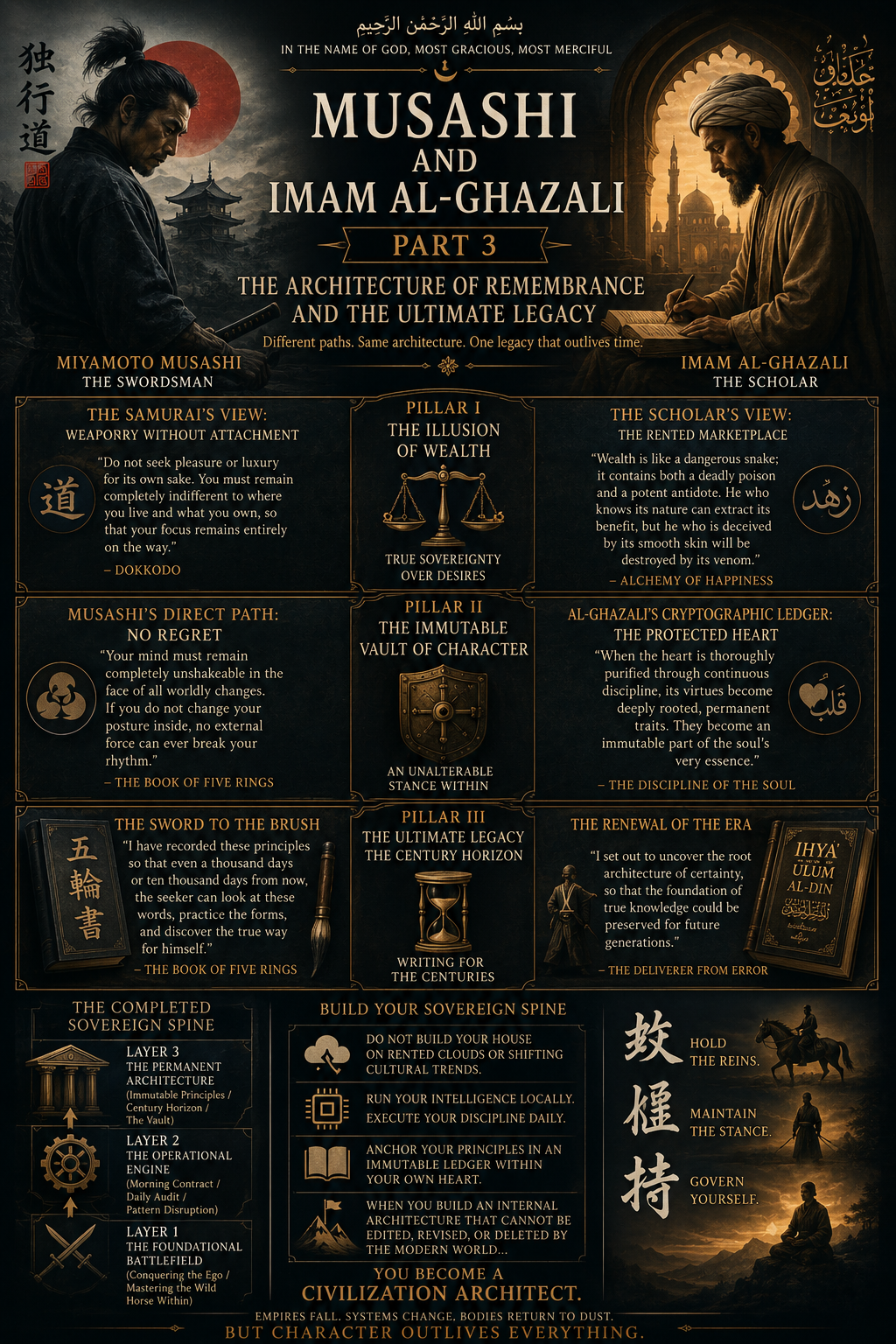
[THE COMPLETED SOVEREIGN SPINE]
LAYER 3: THE PERMANENT ARCHITECTURE
(Immutable Principles / Century Horizon / The Vault)
^
|
LAYER 2: THE OPERATIONAL ENGINE
(Morning Contract / Daily Audit / Pattern Disruption)
^
|
LAYER 1: THE FOUNDATIONAL BATTLEFIELD
(Conquering the Ego / Mastering the Wild Horse Within)
`
The lesson for your life, your work, and your blog is absolute: Do not build your house on rented corporate clouds or shifting cultural trends.
Run your intelligence locally. Execute your discipline daily. Anchor your principles in an immutable ledger within your own heart. When you build an internal architecture that cannot be edited, revised, or deleted by the modern world, you cease to be a passive consumer.
IN Conclusion to Part 3: The Vault is Locked
We have moved from the chaos of raw impulse into the unyielding architecture of permanence. We know how to secure our internal ledger and how to anchor our principles so deeply into our character that no external crisis, market collapse, or digital noise can ever overwrite who we are.
We have built the Vault. Our internal sovereignty is entirely locked down.
But true self-mastery was never meant to stay hidden inside a cave or a remote spiritual retreat. True power is never passive, and it cannot be contained in isolation.
What happens when a sovereign individual, completely in command of his own mind, steps back out into a chaotic world? How do the exact same principles that govern a single personal choice scale up to organize massive technical systems, economic realities, and the very structure of human society?
In Part 4: The Civilization Architect, we reach the final, explosive expansion of the Sovereign Spine. We will put the macro-strategic writings of the Swordsman and the Teacher side-by-side to discover how to transition from simply governing the self to rewriting the operational code of the world around us.
The vault is locked. The spine is set.
Get ready for the final frontier.
Hold the reins.
Maintain the stance.
Govern yourself.