بِسْمِ اللهِ الرَّحْمٰنِ الرَّحِيْم
In the Name of God, Most Gracious, Most Merciful.
♥️🤲🕋♥️🕋🌹🌹🥀🤲🌹🕋♥️
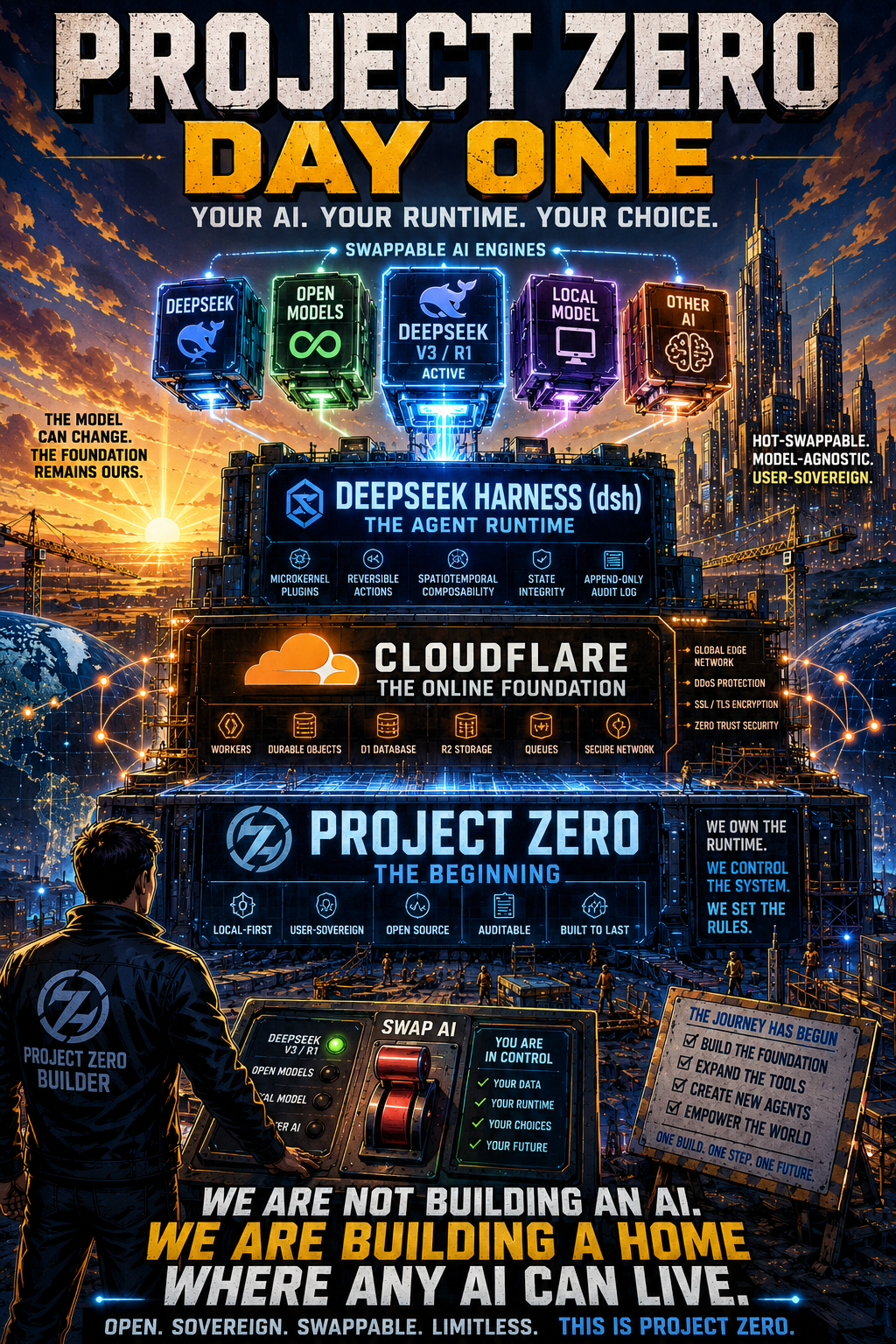
THE MISSING FOUNDATION: WHY DEEPSEEK HARNESS VALIDATES THE "STAGE ZERO" ARCHITECTURE
For the past three years, the artificial intelligence industry has been locked in an arms race centered around a single metric: model intelligence. Every week brought a new benchmark, a larger parameter count, or a higher score on specialized reasoning tests. Silicon Valley operated under an unspoken assumption:
If you make the model smart enough, everything else will magically fall into place.
That assumption was wrong.
When you move from conversational chatbots to autonomous software agents that execute multi-step tasks in the real world—editing files, executing shell commands, maintaining state, and invoking external APIs—the bottleneck is rarely raw model reasoning.
The bottleneck is the runtime environment.
On August 13, 2026, DeepSeek shifted the industry's focus by releasing DeepSeek Harness (dsh). It wasn't a new frontier model or an incremental benchmark bump. It was an open-source, model-agnostic agent runtime built on top of a formal plugin microkernel named Cordis, governed by an 88-page mathematical framework titled Spatiotemporal Composability.
Within days, the project gained over 150,000 GitHub stars, making it one of the fastest-adopted developer releases in history.
For most observers, this was a surprising breakthrough from an innovative AI lab. But for those who have argued that system architecture, sovereign data ownership, and decoupled runtimes must precede intelligence, DeepSeek Harness wasn't a sudden revelation—it was a high-profile industry validation.
It was the sudden, mass-market realization of Stage Zero.
WHAT IS "STAGE ZERO"?
Before you deploy an autonomous agent, before you fine-tune a model, and before you wire up complex agentic loops, you must answer a fundamental architectural question:
What is the uncompromised, local baseline upon which this entire system rests?
That uncompromised baseline is Stage Zero.
Stage Zero is the foundational software architecture that exists before intelligence enters the room. It is the sovereign ground layer. It dictates that:
The System Is Local-First: Sovereign memory, local execution contexts, and complete control over system permissions belong to the user, not a remote cloud vendor.
The Intelligence Layer Is Ephemeral: AI models are non-deterministic, fast-changing, and inherently temporary. Therefore, no core software system should ever be tightly coupled to a specific model or proprietary API. Models are external engines; they are not the foundation.
State Integrity Is Absolute: An autonomous system operating over extended periods cannot accumulate silent side effects, orphaned processes, or corrupted context windows. The runtime must enforce absolute state hygiene.
The Runtime Governs the Agent: The agent does not govern the system; the system governs the agent. The runtime layer establishes the boundaries, sandboxes, and execution rules within which any model must operate.
For years, the mainstream AI ecosystem built backwards.
They started at "Stage Three"—building elaborate prompt chains and agentic wrappers directly on top of closed, proprietary APIs like OpenAI's Assistants API or Anthropic's early closed environments. When those remote models changed, degraded, or updated their terms of service, the underlying agent systems broke. When long-running agent tasks accumulated memory leaks or unexpected side effects, the entire workflow crashed.
DeepSeek Harness succeeded because it started at Stage Zero.
THE ENGINEERING BREAKDOWN: HOW DEEPSEEK HARNESS IMPLEMENTS STAGE ZERO PRINCIPLES
To understand why DeepSeek Harness resonated so deeply with developers, you have to look past the AI branding and look directly at the underlying software engineering.
DeepSeek did not build dsh as a monolithic application. In fact, they didn’t even write its core composition engine from scratch. They adopted Cordis, an open-source, microkernel plugin framework that had already spent four years being battle-tested inside the Koishi project ecosystem.
Underneath dsh, everything is a plugin.
The model adapter, the terminal execution tool, the filesystem reader, the append-only session log, the UI, and even the agent loop itself are modular components registered onto a shared runtime context.
This modularity directly mirrors the four core imperatives of Stage Zero:
1. Decoupling the Runtime from the Reasoning Engine
In traditional agent setups, such as Claude Code or proprietary enterprise harnesses, the execution environment is fused to a specific provider's API.
DeepSeek Harness treats the language model as an interchangeable, hot-swappable module. Through simple configuration changes, a developer can run dsh using DeepSeek V3/R1, route heavy reasoning tasks to Claude Sonnet, or execute lightweight sub-routines using a local, open-weight model running on their own workstation.
By separating the runtime harness (which stays fixed and local) from the reasoning engine (which is fluid and interchangeable), dsh enforces the primary rule of Stage Zero:
Never build a permanent house on top of someone else's volatile infrastructure.
2. Solving State Pollution via Spatiotemporal Composability
The primary failure mode of long-running, multi-step AI agents is state pollution. An agent installs a tool, edits a configuration file, spawns a background process, or updates a memory layer. Five steps later, the task fails or needs to pivot. In a conventional system, stripping out that tool or resetting the session leaves behind orphaned state—leftover memory references, dangling API connections, or modified files—that eventually degrade system stability.
DeepSeek formalized the solution to this in their research paper on Spatiotemporal Composability:
Temporal Reversibility (Time): Every action registered in the harness carries an explicit, inline tear-down instruction at the exact moment of creation. When a plugin or sub-agent is disabled or uninstalled, the runtime walks backward through the exact execution stack in last-in, first-out (LIFO) order, completely unwinding its side effects without requiring a system reboot.
Spatial Coeffects (Space): Dependencies between modules (e.g., a logging skill depending on a database adapter) are declared dynamically rather than hardcoded. If an underlying database dependency is swapped from an in-memory session store to a permanent local disk store mid-run, dependent plugins are automatically notified and re-bound on the fly.
This is Stage Zero in mathematical form: guaranteeing that the system baseline can always return to a clean, deterministic state regardless of what an non-deterministic AI model attempts to do.
3. Local Sovereignty and Auditability
DeepSeek Harness is released under the open MIT license and runs locally via a lightweight TypeScript engine. It maintains an append-only, model-visible session event log that acts as an immutable source of truth.
Nothing happens silently inside the black box of a cloud server.
Every tool call, system prompt adjustment, file modification, and context compaction event is logged locally, under the complete administrative authority of the local hardware owner.
THE FOUR EXECUTION MODES: STRUCTURING THE RUNTIME SURFACE
The alignment between Stage Zero and DeepSeek Harness is also visible in how dsh exposes its operational modes to the user. Rather than forcing a "one-size-fits-all" chat interface, the harness provides four discrete runtime environments assembled from different configurations of the same underlying plugin tree:
+-----------------------------------------------------------------------+
|                         DEEPSEEK HARNESS (dsh)                        |
|                     Built on Cordis Microkernel                       |
+-----------------------------------------------------------------------+
|                                                                       |
|  [ Standard Mode ]   --> Full agentic suite (Shell, Files, Web)       |
|  [ Code Mode ]       --> Programmatic execution via TypeScript SDK    |
|  [ Minimal Mode ]    --> Bare-metal evaluation (Bash + Editor)        |
|  [ Creator Mode ]    --> Meta-environment for live plugin creation    |
|                                                                       |
+-----------------------------------------------------------------------+
|                         SHARED BASELINE LAYER                         |
|  - Immutable Event Log    - Local Sandbox Rules                       |
|  - Reversible Actions     - Hot-Swappable Model Adapters              |
+-----------------------------------------------------------------------+
Standard Mode: The full-featured workspace environment. It equips the agent with file manipulation tools, bash execution, skills, planning routines, and sub-agent orchestration.
Code Mode: Instead of making piecemeal, slow tool calls back and forth over HTTP, the agent writes small, atomic TypeScript programs that chain multiple operations together in a single execution pass. This drastically reduces API latency and token consumption.
Minimal Mode: A stripped-down, two-tool baseline (a persistent bash shell and a text editor). DeepSeek uses this precise mode to benchmark models on raw engineering capability without the noise of complex harness abstractions.
Creator Mode: The meta-mode. It provides interactive tools to inspect the live running Cordis runtime, test dynamic plugin loading in memory, and build custom agent workflows on the fly.
WHY THIS MATTERS FOR THE FUTURE OF AI DEVELOPMENT
The explosive industry reaction to DeepSeek Harness marks a permanent shift in developer sentiment.
Silicon Valley spent billions trying to convince developers that the future of computing was renting access to a centralized, closed "super-brain" in the cloud. But as models proliferate, become cheaper, and equalize in capability, the locus of value has dramatically shifted.
Watch "The Insane Engineering Behind DeepSeek Harness" on YouTube
The value is no longer in leasing the model; the value is in owning the harness.
When you own the harness:
You are immune to vendor lock-in. If a provider raises prices, changes API policies, or experiences downtime, you update a single configuration line in your local Stage Zero layer and point your agents to a different endpoint.
You maintain absolute privacy over your workspace, source code, and internal system logs.
You can build complex, long-running agent workflows that don't decay over time, because your runtime enforces strict state hygiene and reversible side-effects.
DeepSeek Harness is not the end of the journey—it is a developer preview (v0.1), and its rapid evolution will bring breaking changes, community adaptations, and competing implementations.
However, its release marks an irreversible milestone.
It proved that the open-source community will not settle for being mere consumers of remote AI APIs.
By establishing a robust, modular, local-first runtime layer, DeepSeek Harness has turned "Stage Zero" from a theoretical imperative into a practical reality for developers worldwide.
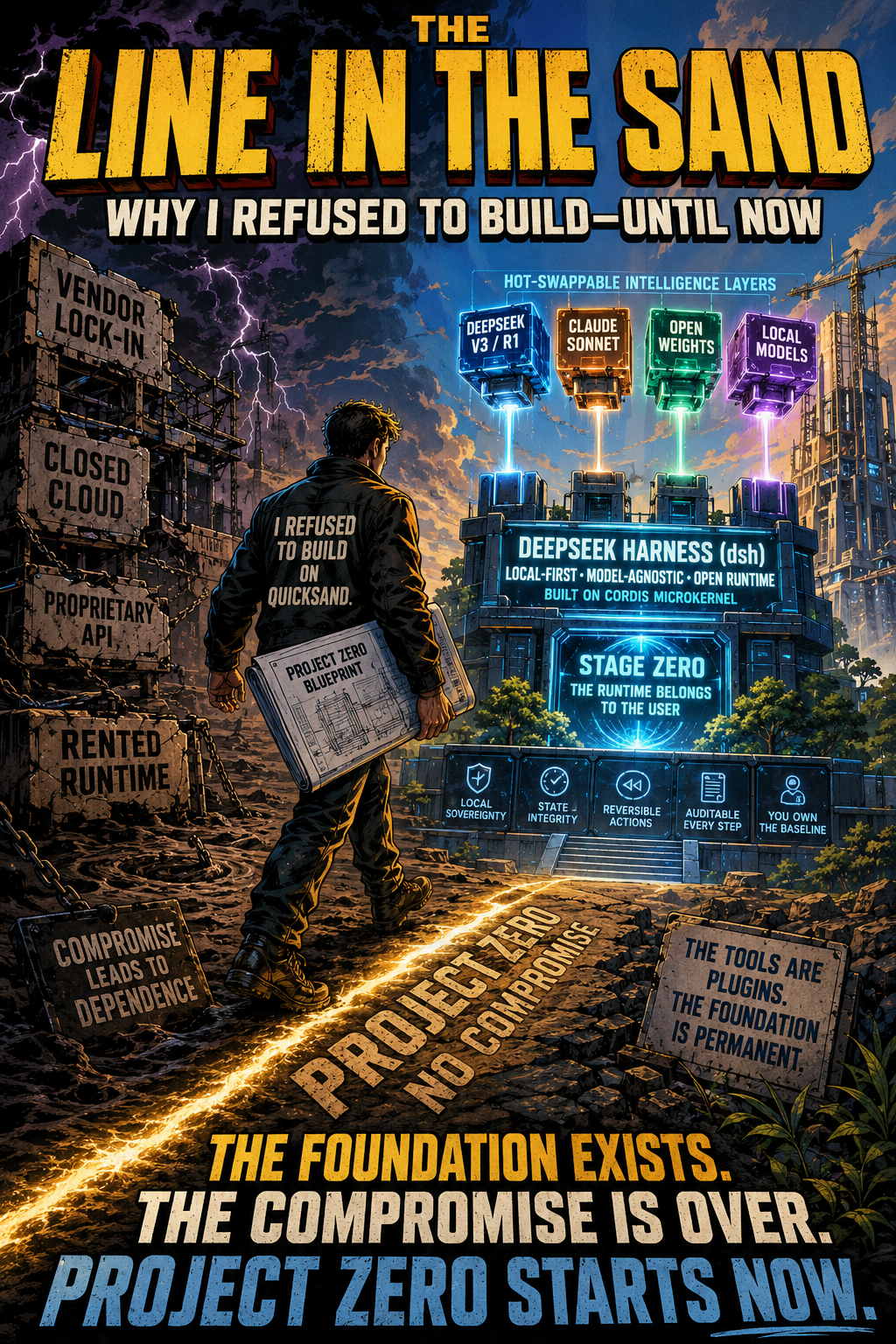
THE LINE IN THE SAND: WHY I REFUSED TO BUILD—UNTIL NOW
For a long time, the only available path forward required accepting an unacceptable compromise.
Building an intelligent system on proprietary platforms meant surrendering the baseline. It meant accepting vendor lock-in, leasing an agent runtime inside someone else’s cloud, and allowing proprietary ecosystems to dictate how system memory, local file execution, and tool interactions were structured.
Every closed platform was a trap—a walled garden where the runtime engine was permanently fused to a commercial API, designed to ensure that you could never own the foundation of your own work.
So, I waited. I refused to build on quicksand.
The commitment was absolute: Do not compromise on Project Zero.
Project Zero was never just an application or a temporary experiment; it was the requirement for an uncompromised, local-first runtime foundation.
It demanded complete sovereignty over local execution, absolute state integrity, and a decoupled architecture where intelligence layers could come and go without taking the host environment down with them.
Until an open, model-agnostic execution harness existed that respected those boundaries, starting was not an option.
With the release of DeepSeek Harness (dsh), that line in the sand has finally paid off.
By open-sourcing a local-first, microkernel-based agent runtime governed by explicit lifecycle rules and reversible side-effects, the paradigm has fundamentally shifted.
The barrier of proprietary lock-in has broken.
The execution layer belongs to the user, the tools and models are hot-swappable plugins, and the local machine remains the supreme administrative authority.
The foundation is no longer theoretical.
The runtime exists, the baseline is sovereign, and the compromise is over.
Now, the real work begins.
The journey of building on Project Zero—powered by DeepSeek—starts today. Next building begins