
بِسْمِ اللهِ الرَّحْمٰنِ الرَّحِيْم
In the Name of God, Most Gracious, Most Merciful
♥️🤲🕋♥️🕋🌹🌹🥀🤲🌹🕋♥️🤲
Malcolm X and the Sovereign Mind
There are few figures in modern history whose transformation is as remarkable as that of Malcolm X, later known as El-Hajj Malik El-Shabazz.
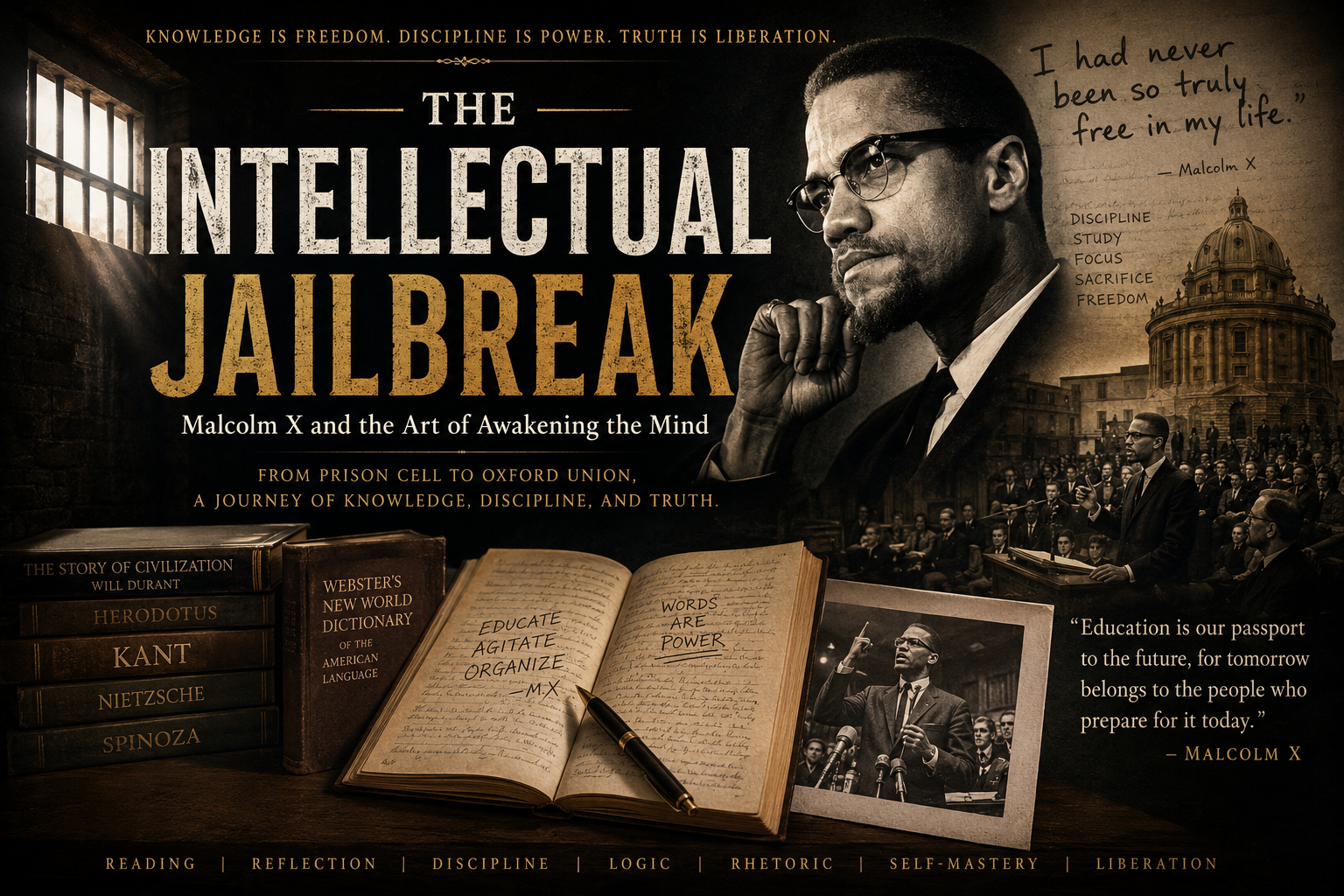
Many people know Malcolm as a civil rights leader, a powerful orator, and a fearless advocate for justice. Fewer understand the deeper story: the story of a man who rebuilt himself from the ground up through discipline, reading, reflection, and an uncompromising search for truth.
In this remarkable lecture, Shaykh Hamza Yusuf, President of Zaytuna College, explores the intellectual and spiritual forces that shaped Malcolm X into one of the most influential figures of the twentieth century. Rather than focusing solely on the political Malcolm, Shaykh Hamza takes us into the prison cell where the transformation began. He examines the frustration that drove Malcolm to educate himself, the discipline that led him to copy entire pages of the dictionary by hand, and the relentless pursuit of knowledge that eventually opened the doors of intellectual, moral, and spiritual freedom.
Watch "What Made Malcolm X choose ISLAM - Shaykh Hamza Yusuf" on YouTube
This lecture is not merely a biography. It is a meditation on the nature of knowledge itself. It asks profound questions that remain relevant today:
What separates information from wisdom?
How does language shape our understanding of reality?
Can a person become truly free while physically confined?
What role do books, discipline, and self-education play in transforming a human being?
What happens when the intellect awakens and begins its search for truth?
For students, educators, seekers of knowledge, and anyone interested in the life of Malcolm X, this lecture offers more than history. It offers a blueprint for self-mastery.
As you watch, pay attention not only to Malcolm's achievements, but to the process that produced them. The lesson of Malcolm X is not that extraordinary people are born different. The lesson is that through discipline, knowledge, and sincerity, a human being can radically transform their understanding of themselves and the world around them.
What follows is the lecture, followed by extensive seminar-style notes designed to help students, researchers, and lifelong learners revisit the major themes, concepts, and lessons explored by Shaykh Hamza Yusuf.
May it benefit all those who seek knowledge, wisdom, and truth.
Notes for Students, Seekers of Knowledge, and Future Generations
Before presenting these notes, I would like to extend my sincere gratitude to Shaykh Hamza Yusuf, President of Zaytuna College, for delivering a lecture that is not merely educational but transformational.
At a time when many institutions measure success through credentials, careers, and economic outcomes, this lecture reminds us of something much older and much more profound: the purpose of education is freedom.
Through the life of El-Hajj Malik El-Shabazz (Malcolm X), Shaykh Hamza presents a timeless lesson on knowledge, discipline, language, logic, and spiritual awakening. He takes us beyond the public image of Malcolm X and into the prison cell where one of the greatest intellectual transformations of the twentieth century quietly began.
These notes were prepared to serve students, researchers, educators, community leaders, and anyone who wishes to revisit the major lessons contained in this lecture. They are intended as a companion resource that can be reviewed after watching the video, used in study circles, classroom discussions, book clubs, or personal reflection.
The story of Malcolm X is often told as a political story.
This lecture reveals that it was first an intellectual story.
Before Malcolm became a powerful speaker, he became a reader.
Before he became a leader, he became a student.
Before he changed the world around him, he changed the world within him.
The central lesson of this lecture is that genuine transformation begins with a hunger for truth. Malcolm's path was not built on shortcuts, slogans, or blind loyalty. It was built upon the difficult work of learning, questioning, reading, reflecting, and pursuing knowledge wherever it led.
Through frustration, he discovered language.
Through language, he discovered books.
Through books, he discovered ideas.
Through ideas, he discovered truth.
And through truth, he discovered a higher purpose.
Students watching this lecture should pay particular attention to four themes that appear repeatedly throughout Shaykh Hamza's presentation:
1. The Power of Language
Malcolm's transformation began when he realized he lacked the words necessary to express himself. His decision to copy the dictionary by hand demonstrates that language is not merely a tool of communication; it is a tool of perception. The more precise our language becomes, the more clearly we can understand reality.
2. The Discipline of Self-Education
Malcolm's prison years represent one of the greatest examples of self-directed learning in modern history. Reading for up to fifteen hours a day, often under difficult conditions, he transformed a prison cell into a university and a punishment into an opportunity.
3. The Importance of Logic and Critical Thinking
The lecture demonstrates that Malcolm's effectiveness as a public speaker did not arise from emotion alone. His mastery of logic allowed him to identify contradictions, expose weak arguments, and communicate ideas with clarity and force.
4. The Search for Truth
Most importantly, Malcolm never stopped seeking. He was willing to question assumptions, challenge inherited ideas, and continue learning throughout his life. This relentless pursuit of truth ultimately led him toward Islam and toward a broader understanding of humanity.
Perhaps the most powerful statement highlighted in this lecture is Malcolm's observation that during his years of study in prison, he had "never been so truly free in his life."
This paradox lies at the heart of the entire presentation.
A man can be physically confined and intellectually free.
A person can possess wealth, comfort, and unlimited mobility while remaining mentally imprisoned.
The true measure of freedom is not the absence of walls. It is the presence of knowledge, discipline, purpose, and truth.
May these notes help preserve the lessons contained within this remarkable lecture and inspire future generations to follow the path of reading, reflection, critical thinking, self-mastery, and sincere pursuit of knowledge.
With gratitude to Shaykh Hamza Yusuf, Zaytuna College, and all teachers who continue to illuminate minds and hearts through the pursuit of truth.
My contribution is much smaller.
I do not claim to be the teacher.
I do not claim to be the scholar.
I do not claim to be the philosopher.
What I try to do is point.
I point at the people who are doing something worth learning from.
I point at the books that make us think.
I point at the lectures that challenge us.
I point at the ideas that awaken us.
I point at the struggles that many people overlook.
I point at the men and women who dedicate years of their lives to mastering a subject, reading deeply, thinking carefully, and wrestling with difficult questions.
In a world that often celebrates noise, I want to point at substance.
In a world that rewards distraction, I want to point at focus.
In a world that measures popularity, I want to point at discipline.
That is why I share lectures like this.
That is why I leave notes for students.
That is why I try to preserve these journeys.
Because intellectual development does not happen by accident.
Someone has to point.
Someone has to say, "Look over here. There is something valuable happening."
Someone has to say, "This person has spent years thinking about this. You can learn something from them."
So I leave these notes behind for anyone who wishes to continue the journey.
Not because I have reached the destination.
But because we all need fellow travelers on the road to knowledge.
Watch "How to Educate Yourself Like an MIT Scholar (without school)" on YouTube
Notes for Students and Seekers of Knowledge
How to Educate Yourself Like an MIT Scholar (Without School)
Presenter: Stephen Petro
This video explores five habits that help develop elite-level thinking and self-directed learning without relying solely on formal institutions.
1. Understanding Through Building
Real learning happens when ideas are tested in the real world. Instead of waiting until you completely understand a subject, build something with it. Creating projects exposes gaps in understanding and accelerates learning.
2. Solve Before You Are Shown
Attempt difficult problems before looking at solutions. Struggling with a problem reveals weaknesses in your thinking and prevents the illusion of competence that comes from simply reviewing someone else's answer.
3. Learn at the Frontier
Move beyond summaries and textbooks. Engage with current research, unresolved questions, and real-world problems where there are no answer keys. This develops independent thinking and comfort with uncertainty.
4. Structured Experimentation
Create dedicated periods of focused exploration. Step outside routine learning and immerse yourself in a subject that sparks genuine curiosity. Some of the most important breakthroughs happen during unstructured intellectual exploration.
5. Build Breadth Before Specialization
Develop a broad foundation before narrowing your focus. A wide range of knowledge helps connect ideas across disciplines and prevents intellectual tunnel vision.
Key Takeaway
The central message of this video is that exceptional learning is not primarily about credentials, institutions, or prestige. It is about habits.
Build things.
Struggle with problems.
Explore difficult questions.
Follow curiosity.
Develop a broad foundation.
And become an active participant in your own education rather than a passive consumer of information.
In Conclusion
My journey to honor Malcolm would probably come from my current status, which is being a diabetic.
Attaining knowledge of blood sugar, understanding how to sustain good blood sugar, understanding nutrition, understanding sleep, and understanding how to be healthy again.
Probably the crisis of our time is that we do not have enough education about ourselves.
Simple things.
The fact that when you sleep, your body goes through processes of repair.
The fact that sleep matters.
The fact that health matters.
The fact that what we eat affects how we think, how we feel, and how we learn.
Perhaps one of the missing links in education is that people are not educated enough about their own bodies.
People are not educated enough about nutrition.
People are not educated enough about health.
People are not educated enough about the foundations required to pursue knowledge in the first place.
Ironically, people in prison often have structure.
They have routines.
They are separated from many distractions.
They are separated from alcohol.
They are separated from many of the things that consume modern life.
And who knows?
Maybe what we need today is some type of voluntary digital jail.
Not a prison.
But a place where your phone is put away.
A place where you are left alone with books.
A place where you eat properly.
A place where you sleep properly.
A place where you learn.
A place where you grow.
A place where you work on your mental health.
A place where you work on your intellectual health.
I guess I have to think deeply about what my contribution will be.
I want to counter the problems of our time with something positive.
I want to contribute in my own way.
And I believe there are people walking among us who possess intellectually precious knowledge.
Those people should be celebrated.
Those people should be honored.
Those people should be pointed out.
And with that, I look forward to finding my own way to contribute and I know this is a starting point I end with a prayer from Malcolm himself.
Watch "malcom" on YouTube
9p