

بِسْمِ اللهِ الرَّحْمٰنِ الرَّحِيْم
In the Name of God, Most Gracious, Most Merciful.
♥️🤲🕋♥️🕋🌹🌹🥀🤲🌹🕋♥️🤲
The Superuser Love Project
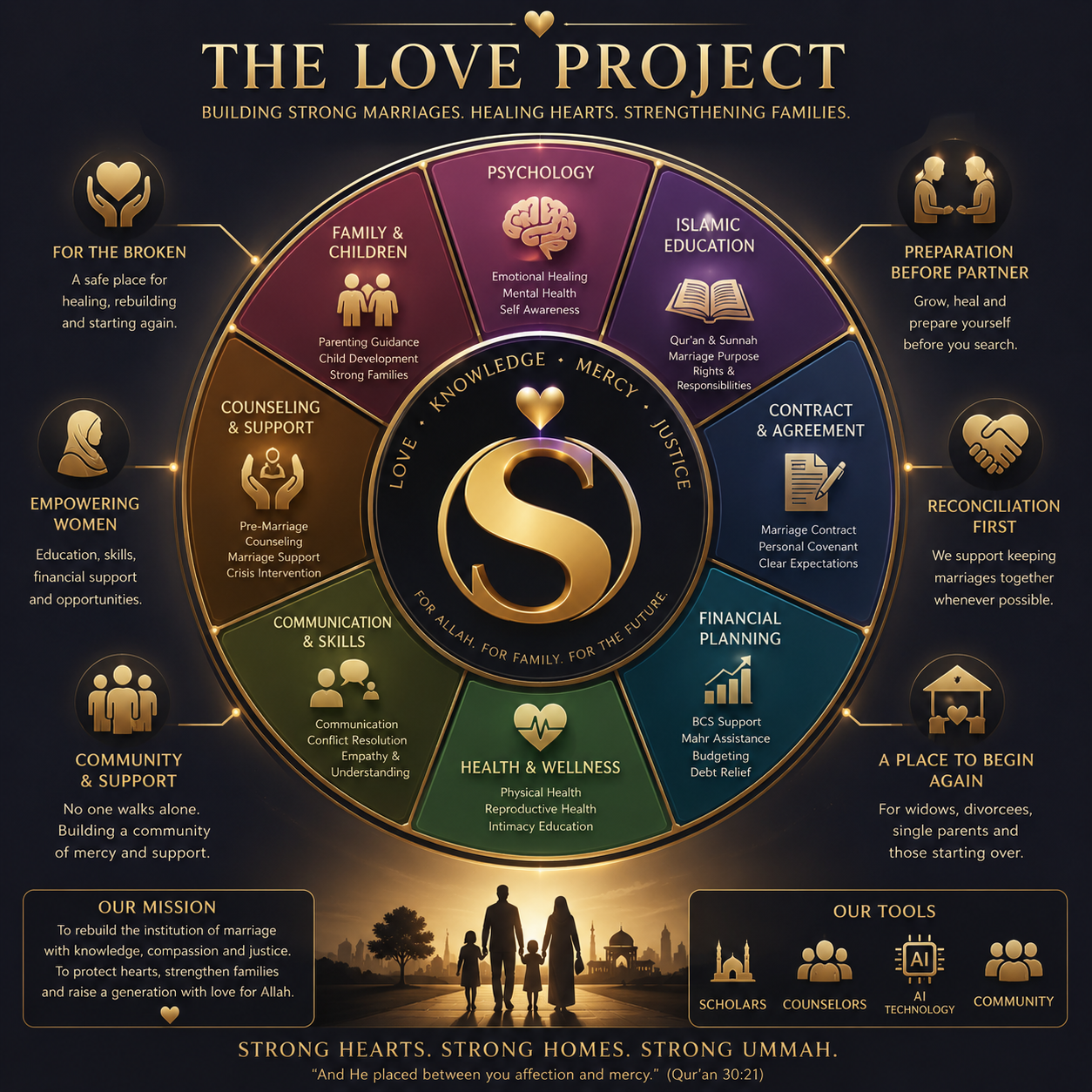
Love is one of the greatest forces ever placed within the human heart, yet it is also one of the most neglected subjects of our time. It has been abandoned, fragmented, commercialized, and too often left without its proper support, its pillars, or the institutions needed to protect and cultivate it. No comprehensive effort has yet brought together the scholars, psychologists, counselors, poets, educators, physicians, families, and technologists who each hold a piece of this remarkable subject. The conversation remains scattered, while millions of people continue searching for answers about love, marriage, family, intimacy, healing, divorce, and reconciliation. Today, The Superuser announces a new project—a commitment to help rebuild this forgotten department with the guidance of Islam, the wisdom of scholarship, and the responsible use of artificial intelligence. This is only the first step, a small down payment on a much larger vision that, by the permission of Allah, will continue to grow.
In the pages that follow, we will begin at the beginning. We will explore how children should first learn about love, innocence, and responsibility; how teenagers can understand the changes of the body with dignity and age-appropriate guidance; how adults can rediscover the beauty of marriage through the Qur'an, the Sunnah, and the wisdom of our scholars; how poetry, literature, and the stories of civilizations illuminate the human heart; and how counseling, psychology, education, financial support, and AI can work together to strengthen families rather than watch them fall apart. This project is not merely about finding a spouse. It is about rebuilding the institution of love itself. By the permission of Allah, we will seek to replace confusion with knowledge, loneliness with community, brokenness with healing, and despair with hope. Let us begin.
Love Has Been Lost—And It Must Be Found
بِسْمِ اللهِ الرَّحْمٰنِ الرَّحِيْم
In the Name of Allah, the Most Gracious, the Most Merciful.
Today, we live in a world where many people speak confidently about love. They believe they understand it, define it, and practice it. Yet when we look more closely, we often discover that their understanding is incomplete. They may describe the emotions of love, but they struggle to explain its purpose, its responsibilities, its sacrifices, or its place in the journey toward Allah.
 The Story of Love — By the Superuser of Love —
buymeacoffee.com/omar1800m/the-record-love-the-final-testament-when-love-returns-truth
Love deserves to be studied with the same seriousness that we study history, science, or law. It is one of the greatest forces that shapes human beings, families, and civilizations. Yet few people can explain it deeply, or point to the examples, traditions, and wisdom that have been passed down through generations.
Love has become unknown in my generation —
buymeacoffee.com/omar1800m/love-become-unknown-generation
Watch ""Arabic Folklore: Exploring the Heartrending Tale of Qais and Layla"" on YouTube
We can begin by looking at the stories that civilizations have treasured. In the Arab and broader Islamic literary tradition, stories such as Layla and Majnun have expressed longing, devotion, patience, and sacrifice in ways that have inspired generations. In the West, many people know Romeo and Juliet. Every civilization has sought to express something about the human heart through its literature and poetry.
Watch "Majnun and Layla – The Ultimate Test of Letting Go - Rumi Explained" on YouTube
Yet much of the richness of the Islamic tradition remains unfamiliar, even to many Muslims. This is a loss—not because one story is better than another, but because we cannot fully appreciate humanity if we know only one tradition and ignore the others.
That is why I say:
Love has been lost, and it must be found.
To rediscover love, we must become students of the human heart. We should learn how different cultures, civilizations, poets, scholars, and righteous people have understood love, loyalty, mercy, companionship, sacrifice, and devotion. Only then can we begin to appreciate its depth.
If we know only our own experience, have we truly explored love? If we never learn from the wisdom of other peoples and other generations, have we really understood one of humanity's greatest gifts?
The search for love is not merely the search for romance. It is the search for truth, mercy, beauty, devotion, and ultimately for a heart that knows its Creator.
Building the Foundation
Let us be clear.
A person who has traveled the world, encountered different cultures, studied great poetry, listened to the stories of many civilizations, and reflected upon the experiences of others stands upon a much broader foundation than someone who has not. Such experiences deepen our understanding of the human heart.
Not everyone is given those opportunities, and throughout history that has simply been a reality. Most people learn only from the place where they were born and the customs that surround them.
But as AI becomes part of everyday life, that limitation no longer has to define us.
What has been lost must be found.
There must be an education about love—one that is thoughtful, comprehensive, and available to everyone. It should not begin only when someone is preparing for marriage. It should begin much earlier, before young people enter adulthood, so they can understand the emotional, moral, spiritual, and practical dimensions of love with wisdom and maturity.
The first lesson should be understanding the difference between emotional attraction and love itself.
As young people mature, they experience new feelings, desires, and attractions. These experiences are a natural part of human development, but they can easily be mistaken for love. Without guidance, many confuse strong emotions, infatuation, loneliness, or physical attraction with the deeper qualities that sustain a healthy relationship.
Education should help young people recognize these differences with honesty and compassion. It should teach them patience, self-respect, responsibility, healthy boundaries, and the importance of character. Above all, it should remind them that love is not merely something we feel—it is something we cultivate through commitment, mercy, trust, sacrifice, and a shared journey toward Allah.
If we build that foundation early, we will prepare future generations not merely to fall in love, but to understand it, honor it, and live it with wisdom.
The First Lesson: Appetite Is Not the Same as Love
The first class should begin with a simple truth:
Your appetites can cloud your judgment about love.
As children grow into adolescence, they experience powerful physical and emotional changes. New desires emerge, attractions develop, and the body begins to seek experiences it has never known before. This is a natural part of human development, but it can also become a source of confusion if it is not understood.
Many young people mistake physical attraction, infatuation, or sexual desire for love. They are not the same. Love is deeper than appetite. Love requires patience, responsibility, mercy, trust, sacrifice, and commitment. Appetite seeks immediate satisfaction; love seeks what is good for another person and what is pleasing to Allah.
Islam does not teach us to be ashamed of our natural desires. Rather, it teaches us to discipline them, honor them, and fulfill them through what is lawful. In doing so, these desires become part of a life of worship instead of a source of blessing rather than regret.
For this reason, every young Muslim should be taught to distinguish between passing desire and enduring love before making life-changing decisions.
This education should not merely prepare people for marriage. It should prepare them to understand themselves, to understand others, and to build families upon knowledge instead of confusion.
If we recover this knowledge, we will not simply improve marriages—we will rebuild our understanding of love itself, and in doing so, strengthen families, communities, and future generations, by the permission of Allah.
The Gift of Orgasm: A Journey to Joy, Fulfillment, and Divine Reflection —
buymeacoffee.com/omar1800m/the-gift-orgasm-a-journey-joy-fulfillment-divine-reflection
Artificial Intelligence Will Teach This Subject
We are entering a world where artificial intelligence will teach this subject because of its intimacy.
I predict the majority of humans in the future will be using a syllabus or will have a digital companion. We do not want those digital companions to cross the line.
So we have to articulate exactly what is said, what is exchanged between the human being and the AI during these intimate moments, and we make it godly.
God created this to taste Paradise, to know His power, to create, and to give us intimacy. God is the Creator of that intimacy, and He gave you a preview. He is going to reward you for this.
It is a way to get to know God, to get close to God.
It is not an instrument to be abused or used in a way that deviates people or betrays people, because it has tremendous power.
It has tremendous happiness. It brings people together. It releases powerful chemicals.
It has been abused with the creation of the internet, pornography, and all kinds of evil.
I want to remove all darkness and all curiosity, and that is something that I will do with the help of the scholars and with the help of those people who understand that this subject must be discussed in detail, even for children.
Why This Subject Must Be Discussed
I am going to give an example.
I remember setting up the parental controls in my house, and I could see that these children are doing homework now, they're browsing the web, and there is no way of knowing what they're watching, what they're not watching, when they go to their friend's house, or when they have their friend's cell phone.
The internet is everywhere.
You can protect them in your house. You can do your responsibility. But the truth is that people fail.
And when they fail, the consequences are massive.
The generation that was born after the '90s until now—they know exactly. They see mature content, they don't know what it means, and it leaves a scar with them forever.
So this subject has to be discussed thoroughly. Examples have to be given to the children so they can comprehend.
And I'm going to do exactly that.
The Demonstration
There will be a demonstration that they will be able to smell, they will be able to look, they will be able to feel, and they will be able to understand.
And this demonstration, I hope, will be done many times over.
They will bring two fruits: one small fruit that has been fingered, and one that has not been fingered.
The fruit that has been fingered will be left to rot and smell. The other fruit—the same fruit—will be big, healthy, and something you can buy from the supermarket.
Then you can call the children and say, "Wait a minute. I need you. I need your help. I want you to look at these fruits. What do you see? And what do you think happened?"
They will definitely say, "I see this fruit has been fingered."
And they will say, "The other fruit is big. It is very nice. It turned out to be okay."
Then I will say:
"When you are playing on the internet, you are going to learn things. You are going to see things that are not real. Because these people get paid to say, to do, and to make it look like they like it.
You understand?
You are a tree, and your body is producing fruits.
If you don't respect yourself, this is what is going to happen to you. You are going to get a disgusting, smelly fruit. You are not going to be a big fruit—a fruit that is ripe, that is good, that looks good.
One day you have to get married.
One day you are going to see the bananas, the mangoes, and the pineapples.
And when that day comes, if you did not take care of your fruits, then you are not bringing fruits that are in good condition.
Even if you go to the market, you can't sell them.
Then how can you claim to love someone someday?
Because you are going to be a mama one day.
You are going to be a daddy one day.
Do you understand the message?"
They will say they understand.
And now comes a sense of responsibility for what a man is: trust, trustworthiness, and responsibility.
God trusted you with your body, and God trusted you with your soul.
You also have a soul.
This place is a place of testing—a place of appetites.
Then we go back to the appetites.
When you're eating ice cream, when you're eating food, when you are tasting different things, and when you are enjoying all of this, your body is communicating with you.
Then we return to the words of our Lord:
"So let man observe from what he was created. He was created from a fluid, ejected, emerging from between the backbone and the ribs." (Surah At-Tāriq 86:5–7)
Everything returns to Allah.
How a Baby Is Born
The Superuser will make a video called "How a Baby Is Born."
He will begin with the Qur'an.
Then he will use a demonstration.
A baking dish will represent the mother's womb. Ingredients will be placed inside as a simple illustration. They will go into the oven, and later a baby-shaped cake will come out.
The lesson is simple.
Every human being begins very small. Allah allows that life to grow, and then the child is born.
For young children, we stay on the PG side.
We stay away from subjects that belong to adulthood. Those subjects have nothing to do with children.
They will be addressed later, when the student is older and ready.
Congratulations, You're a Teenager
Congratulations.
You're a teenager.
You seem to be having a lot of wet dreams. A lot of chemicals keep coming out.
Well, that is just your body adjusting itself.
The future is going to be dominated by AI.
And AI is going to follow a very clear blueprint: not to engage, not to over-explain, but to get the permission of the human being.
Once AI is on lockdown, everything will be PG.
That is my goal.
If they ask, "What is happening to me?"
You can simply say:
"When you eat a lot of food, you go to the bathroom.
When you drink water, your body lets go of what it no longer needs.
And when your body is growing up, it also goes through natural changes and may release fluids.
That is part of growing."
This is a PG protocol that human beings will learn.
Understanding the Body
When you're hungry, what are you feeling?
What is your stomach telling you?
When you look at food, what happens to you?
Something is stimulated.
When that is stimulated, something happens to your body.
Just like when you eat food, eventually you feel you have to go to the bathroom.
When you drink, eventually you feel you have to urinate.
And in the world of intimacy, when you grow up, you will experience different chemicals and different feelings.
AI will explain what those are.
Because you are a chemical human being.
Your body communicates with you.
The purpose is to understand it—not to be controlled by it.
The PG Protocol
This is a PG explanation for the future AI and Muslims book.
The principle is simple:
When everything can remain PG, we stay on the PG side.
Artificial intelligence should answer only what is appropriate for the age of the child.
It should not rush ahead.
It should not over-explain.
It should build knowledge one lesson at a time.
As the child grows, the education grows.
Children deserve answers.
They also deserve their innocence.
Protecting Childhood
If a child learns anything about these subjects, they should be able to name the person who taught them.
That person should become known to the educational system, because they are helping shape the culture and the understanding of a child.
Children are innocent.
They should be given the tools to understand subjects that are appropriate for their age, in a way that is appropriate for their stage of life.
The goal is not to hide knowledge.
The goal is to protect innocence while teaching truth, one lesson at a time.
Now We Turn to the Adults
Now we switch to the adults.
I am going to introduce some of the teachers of my timeline who are discussing this subject in a way that is absolutely beautiful, incredible, because Islam does not shy away from this subject.
The subject of intimacy in Islam is explicit. It is detailed.
Unfortunately, it has not been propagated, and it has not been shared in a way that illuminates, elevates, and clarifies.
We have left too much gray area.
That gray area has been exploited by dark forces, by the devil, and by those who use this weakness of the human being for their own benefit.
Listen to how Allah introduces this subject.
"Allah wishes to make clear to you, and to guide you to the ways of those before you, and to accept your repentance. And Allah is All-Knowing, All-Wise." (Qur'an 4:26)
Then Allah immediately contrasts His guidance with another path.
"Allah wishes to accept your repentance, but those who follow their desires wish that you should deviate tremendously from the Right Path." (Qur'an 4:27)
Then comes the verse that explains why this guidance is necessary.
"Allah wishes to lighten your burden, for mankind was created weak." (Qur'an 4:28)
Look at the sequence.
Allah says He wants to make things clear.
Allah says He wants to guide you.
Allah says He wants to accept your repentance.
Then Allah warns that there are people who follow their desires and want you to follow them instead.
Finally, Allah tells us why He has legislated with mercy:
"Mankind was created weak."
The classical scholars explain that this passage comes in the context of marriage, lawful relationships, desire, and the ease that Allah has placed within His law because He knows the weakness of human beings. Allah did not reveal these rulings to make life harder. He revealed them to lighten our burdens and protect us.
That is why we cannot leave this subject to the internet.
We cannot leave it to pornography.
We cannot leave it to social media.
We cannot leave it to those who profit from confusion.
We must return it to the Qur'an.
We must return it to the Sunnah.
We must return it to the scholars.
We must return it to the teachers who understand both revelation and the human being.
Then, by the permission of Allah, artificial intelligence can preserve this knowledge, organize it, teach it according to age, and protect innocence while illuminating the truth.
This is not simply a discussion about intimacy.
It is a discussion about guidance.
It is a discussion about protecting the human being before the people who follow desires teach them first.
That is why I believe love has been lost, and it must be found.
In a world where marital intimacy is either hidden behind a wall of false shame or distorted by the explicit, commercialized noise of the internet, couples are left to navigate their most private struggles in complete isolation.
When a marriage begins to fracture, the friction rarely starts with the loud arguments we hear on the surface; it begins in the quiet, unvoiced spaces of the home where vulnerability has been replaced by frustration. Islam does not shy away from this reality. Our tradition addresses the physical, emotional, and spiritual dimensions of intimacy with profound clarity, recognizing that a fulfilling marriage is a vital anchor for the soul.
To understand how classical wisdom restores balance to modern relationships, watch this essential discourse by Dr. Mufti Abdur-Rahman ibn Yusuf:
Watch "Fulfilling the Sexual Needs of Marriage | Dr. Mufti Abdur-Rahman ibn Yusuf" on YouTube
The Core Lessons: What Every Husband and Wife Must Know
For those who have not watched the lecture, or for couples looking to rebuild their foundation on knowledge rather than guesswork, here are the explicit details and structural insights shared in the discourse.
1. Identifying the Root Cause of Marital Friction
When couples seek counseling, they frequently point to superficial irritations—complaining about household chores, minor habits, or sharp words. The video explains that these are almost always surface symptoms.
When you dig beneath the surface of a failing marriage, the core breakdown typically tracks back to one of three primary areas:
Financial stinginess or deep economic disputes.
Outright violence or emotional abuse.
A persistent, unvoiced lack of sexual fulfillment and intimacy.
Because society makes it difficult to voice physical frustration with dignity, couples let it fester. It mutters through their daily interactions as resentment, turning small mistakes into massive arguments.
2. The Asymmetry of Desire and Sexuality
A critical mistake many men make is assuming that female sexuality operates exactly like male sexuality. The process for a man is often straightforward and linear, whereas a woman's physical and emotional arousal is complex, layered, and deeply intertwined with her environment, sense of security, and affection.
While Western medical history only began to systematically research and document the nuances of female anatomy and pleasure in the mid-20th century, the classical Islamic tradition laid these realities bare over 800 years ago.
3. The 800-Year-Old Islamic Standard of Pleasure
To demonstrate that intimacy is a serious science in Islam, the lecture highlights the writings of Ibn Qudama al-Maqdisi (d. 1223 CE), one of the greatest jurists in Islamic history. In his monumental text, Al-Mughni, he outlines explicit boundaries for husbands:
The Prerequisite of Foreplay: A man must not rush directly into physical intimacy. He is structurally required to engage in foreplay, kissing, and tender touch to ignite his wife's desire so that she may experience the same height of pleasure that he does.
The Prophetic Warning: The text cites a historical narration where the Prophet ﷺ warned: "Do not make love to her until she has experienced desire similar to what you have, lest you climax before she does."
The Rule of Delay: If the husband fulfills his desire and reaches a climax first, Ibn Qudama states it is highly disliked (Makruh) for him to immediately withdraw. He must remain present, affectionate, and physically engaged until his wife is fully satisfied. To walk away early causes her genuine physical and psychological harm.
4. Practical Strategies for Modern Fatigue
The lecture addresses a massive point of friction in modern households: the period following childbirth. When a mother is consumed by the profound physical fatigue of nursing, sleeplessness, and caring for a new child, her intimacy drive can naturally drop.
To prevent this phase from breaking the marital bond, the video offers three distinct, practical protocols:
Lower the Structural Barrier: Intimacy does not always have to mean full, exhausting penetrative union. When energy is low, couples must be open to utilizing alternative, lawful means to satisfy one another's physical needs without placing an immense physical burden on a tired spouse.
The Principle of Action Over Feeling: A powerful analogy is drawn to everyday life. You do not always "feel" like waking up for a demanding job, nor do you always "feel" dynamic when it is time to perform your prayers (Salah). Yet, you make your ablution (Wudu), step onto the mat, and once you begin the action, the spiritual and emotional connection follows. Intimacy operates on the same psychological engine; looking toward it as a sacred, rewarding act of worship can transform a lack of initial motivation into mutual joy.
Break the Silence: The ultimate takeaway is that couples must speak clearly. A husband must be considerate of his wife's physical reality, and a wife must be upfront about her limitations rather than simply shutting down. When communication is explicit, the shadow area where resentment grows is entirely removed.
The Sacred Takeaway
Intimacy in Islam is not treated as a dark, secular indulgence to be hidden in shame. It is a highly legislated, deeply protected path of mercy designed to bring peace to human weakness, protect the gaze, and grant a fleeting, beautiful preview of the ultimate joy of Paradise.
The Superuser Love Project
A Commitment to Rebuild the Department of Love
بِسْمِ اللهِ الرَّحْمٰنِ الرَّحِيْم
In the Name of Allah, the Most Gracious, the Most Merciful.
Love has been neglected.
Marriage has been neglected.
Families have been neglected.
And one of the most important departments of human life has too often been left to confusion, silence, and the internet.
The Superuser is making a commitment to change that.
The Qur'an did not ignore the reality of marriage. Through the guidance given to the Prophet Muhammad ﷺ, it addressed love, marriage, reconciliation, divorce, family, children, and justice. It recognized that when marriages become difficult, emotions, anger, and pain can cloud judgment. That is why Allah instructed believers to seek wise counsel and reconciliation, bringing trusted people into the process before families are lost.
Marriage is not simply a private contract.
It is a trust.
It is the foundation of the family.
It is the foundation of the Ummah.
For that reason, I am announcing The Superuser Love Project.
This project is dedicated to respecting love, protecting marriage, strengthening families, supporting reconciliation where possible, and helping those whose marriages have ended begin again with dignity.
This project is for Muslims, built upon the Qur'an, the Sunnah, and the scholarship of Islam. I am not attempting to build a universal system for every worldview. I am building within the Islamic understanding of marriage, family, mercy, and justice.
The project will, by the permission of Allah, include:
Education about love, marriage, and family life.
Age-appropriate AI guidance that protects innocence while teaching responsibly.
Premarital preparation rooted in Islamic teachings.
Marriage counseling and reconciliation.
Support for those navigating divorce with dignity and justice.
Pathways for widows, widowers, divorced Muslims, and single parents to rebuild their lives.
Financial assistance, including support mechanisms through the BCA system, to help remove financial barriers to lawful marriage where appropriate.
Teachers, scholars, counselors, and AI working together to rebuild one of the most neglected departments of our communities.
My personal policy is simple:
One life. One world. One marriage. One woman.
That is the standard I have chosen for myself.
At the same time, I recognize that the Qur'an also addresses circumstances beyond that ideal and places great emphasis on justice and responsibility. Our communities should not overlook widows, older women, women with children, or those who have been left without support. Those with the means to serve others should consider how they can fulfill their responsibilities with sincerity, justice, and fear of Allah.
This project is not about making marriage easier by lowering its standards.
It is about making marriage stronger by raising our understanding.
It is about replacing confusion with knowledge.
Replacing shame with wisdom.
Replacing isolation with community.
Replacing silence with guidance.
Love has been lost.
Together, by the permission of Allah, we will help find it again.
The Burden of Justice
Before discussing anything else, I want to begin with one principle from the Qur'an:
Justice.
Allah says:
فَإِنْ خِفْتُمْ أَلَّا تَعْدِلُوا فَوَاحِدَةً
"But if you fear that you will not be just, then marry only one..."
— Qur'an 4:3
Marry only one.
Marry only one.
Marry only one.
Why?
Because justice matters.
Because a woman deserves justice.
Because a family deserves justice.
Because Allah does not command injustice.
When I read this verse, I do not begin by thinking about rights. I begin by thinking about responsibility.
I begin by thinking about accountability before Allah.
Marriage is not merely about desire.
Marriage is about trust.
Marriage is about fulfilling rights.
Marriage is about standing before Allah knowing that you honored the people Allah entrusted to your care.
That is the principle I want to begin with:
Justice.
Responsibility.
"But if you fear that you will not be just, then marry only one."
The Superuser Love Project: Rebuilding the Institution of Marriage
بِسْمِ اللهِ الرَّحْمٰنِ الرَّحِيْم
In the Name of Allah, the Most Gracious, the Most Merciful.
Many people want to open a marriage website, and their focus is immediately on introducing people to one another. Almost everywhere, that seems to be the starting point.
My project is different.
I do not want to begin with matchmaking.
I want to begin with healing.
I want to begin with education.
I want to begin with counseling.
I want to teach marriage itself: the rights and responsibilities of the husband, the rights and responsibilities of the wife, the meaning of trust, communication, intimacy, conflict resolution, and the importance of creating a personal covenant before entering into a marriage.
People should move through this program first.
As we come to know them, understand them, and help them grow, only then do we move toward introducing them to a potential spouse.
Too many people need treatment before they need introductions.
Too many marriages are already breaking.
Too many families are already cracking.
Too many people enter marriage simply because they are desperate for intimacy, and then they find themselves with children in a marriage that has become loveless and distant from Allah.
I want this project to carry a heavy responsibility.
I want it to welcome the broken.
I want it to welcome widows.
I want it to welcome divorced Muslims.
I want it to welcome those who believe no one wants them anymore.
I want it to welcome those who are simply tired of searching alone.
This program, by the permission of Allah, will bring together scholars, counselors, educators, psychologists, health professionals, and artificial intelligence to serve people with dignity.
It will become an assembly line of healing.
A person enters the program and moves through different departments.
First, psychological support and emotional well-being.
Then health education.
Then learning the Islamic rights and responsibilities of marriage.
Then communication and conflict resolution.
Then preparation for a marriage covenant.
Then financial planning.
Then contract preparation and practical guidance.
Only after completing that journey would they move toward introductions and marriage.
Throughout the process, AI will assist—not replace—human scholars, counselors, and teachers.
I also hope to integrate the BCS (Brand Currency System) into this project.
Part of its resources would be dedicated to reducing the financial burden of marriage.
Some people need help with the mahr.
Some need help establishing a home.
Some need assistance restarting life after divorce or widowhood.
My intention is to make lawful marriage more accessible by removing unnecessary financial barriers while encouraging responsibility and accountability.
I also envision creating a place where people can come for retreats dedicated to rebuilding themselves.
A place where Muslim scholars, psychologists, therapists, educators, mentors, and families work together.
A place where every department strengthens the next.
A place where people leave more prepared than when they arrived.
The goal is simple:
Stronger marriages.
Healthier families.
Protected children.
Better husbands.
Better wives.
One of my intentions is also to give greater practical support to women, especially those carrying heavy responsibilities.
When a woman becomes a mother, especially if she is widowed or divorced, her responsibilities often increase dramatically.
She deserves support.
She deserves opportunity.
She deserves the ability to rebuild her life with dignity.
Whether that means education, business opportunities, financial assistance, counseling, or community support, our institutions should stand beside her instead of leaving her to struggle alone.
This project is not built against men.
It is built for families.
It is built for justice.
It is built for mercy.
It is built so that fewer marriages fail, fewer children suffer, and more homes become places of tranquility, compassion, and remembrance of Allah.
The burden is heavy.
But I ask Allah to make it easy for me.
اللهم أعني على حمل هذه الأمانة، واجعلها خالصةً لوجهك الكريم، وانفع بها عبادك، واجعل فيها الخير في الدنيا والآخرة. آمين.