

بِسْمِ اللهِ الرَّحْمٰنِ الرَّحِيْم.
In the Name of God, Most Gracious, Most Merciful.
♥️🤲🕋♥️🕋🌹🌹🥀🤲🌹🕋♥️🤲
Light Upon Light: How the Gift Survived, Was Purified, and Returned
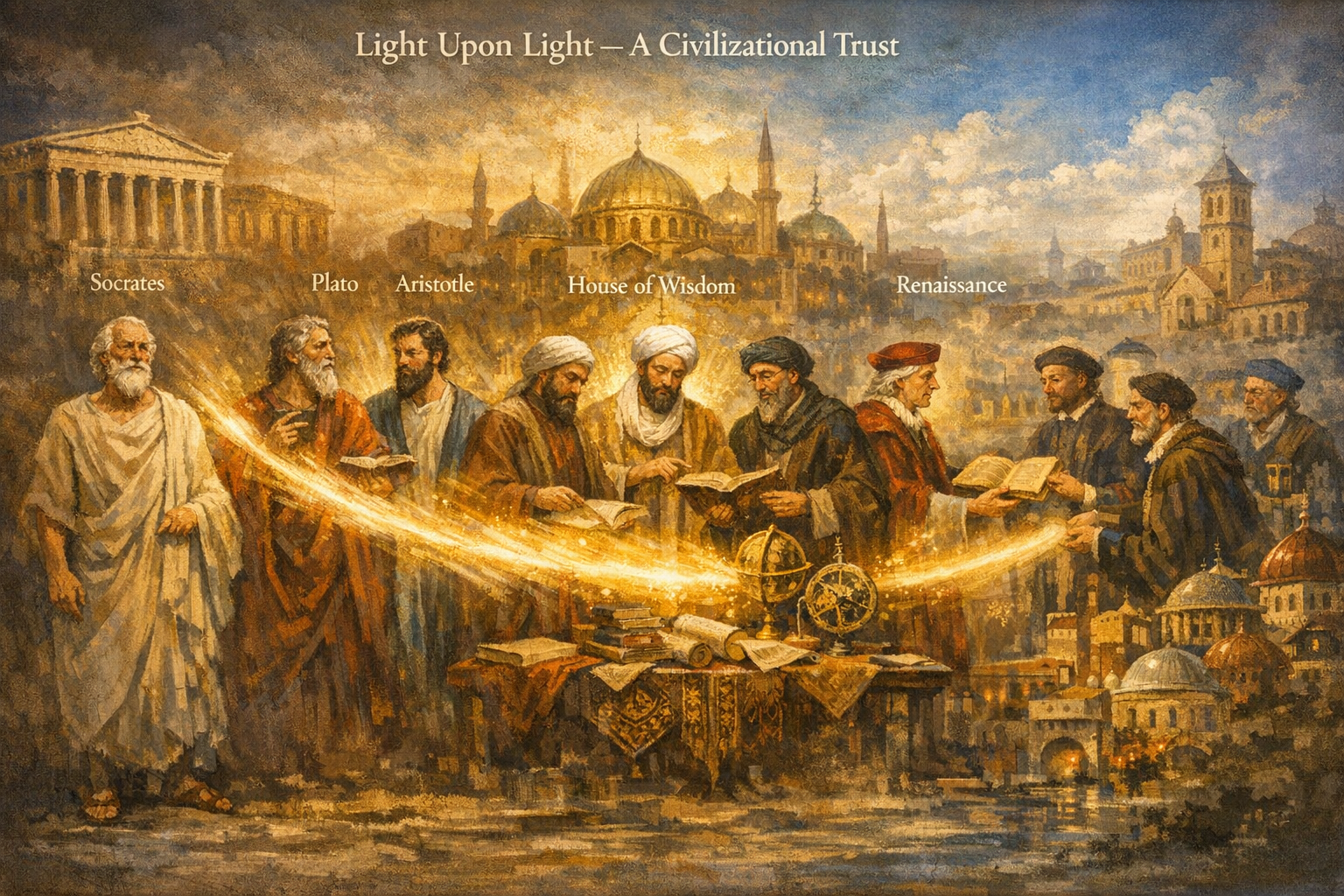
What descended through Socrates was not an isolated spark.
It was light—and light does not belong to one people, one geography, or one era. It moves. It tests. It waits for vessels capable of carrying it without corruption.
The Greeks received that light briefly. They did not preserve it.
Socrates embodied it.
Plato tried to guard it.
Aristotle systematized it.
But the Greek world, as a civilization, lacked the spiritual and ethical infrastructure required to protect it. Intelligence flourished. Humility did not. Method advanced. Inner purification did not. The result was inevitable: the light fragmented, lost its restraint, and slowly dimmed.
This is not condemnation. It is diagnosis.
The Students Were Not the Destination
Plato and Aristotle were extraordinary—but they were still students.
Their greatness lies not in originality ex nihilo, but in fidelity to a transmission:
Plato preserved moral seriousness and contemplation
Aristotle preserved method, logic, and structure
Neither claimed revelation. Neither claimed finality. Both understood—implicitly—that wisdom must be lived, not merely stated.
They carried what they could.
But carrying light is not the same as guarding it.
Why the Light Needed Another Civilization
Centuries later, when this intellectual inheritance reached the Islamic world, something unprecedented happened.
Muslim scholars did not merely translate Greek texts.
They did four things simultaneously:
Preserved them accurately
Critiqued them rigorously
Purified them ethically
Integrated them with revelation
This is the crucial distinction.
Greek philosophy was not treated as sacred.
Nor was it treated as disposable.
It was treated as human intellect in need of guidance.
Figures like:
al-Kindī
al-Fārābī
Ibn Sīnā
al-Ghazālī
Ibn Rushd
did not worship Plato or Aristotle.
They disciplined them.
They put brakes on unrestrained reason.
They re-centered humility.
They subordinated intellect to moral accountability before God.
This is why the Qur’an speaks of light upon light.
Not replacement.
Not erasure.
Correction and elevation.
What the West Inherited—and Misremembered
When Europe later encountered this material—through Muslim Spain, Sicily, and translation centers—it received a refined inheritance, not an original one.
The Renaissance was not a rediscovery from nothing.
It was a re-entry through a preserved and filtered channel.
Yet over time, Western narratives quietly removed the middle.
The story became:
Greece → Europe
instead ofGreece → Islamic civilization → Europe
This was not always malicious. Often it was ignorance. Sometimes it was pride. Sometimes it was convenience.
But the consequence was severe:
Intellectual humility was lost again
Ethics detached from power again
Tools advanced faster than character again
History repeated itself.
What Would the World Be Without That Preservation?
This is not hypothetical.
Without Muslim preservation and correction:
Aristotle’s logic would not have survived intact
Algebra would not exist
Algorithms would not exist
Scientific method would not exist
Modern computation would not exist
AI itself stands on:
Logic
Algorithms
Categorization
Abstraction
All of which passed through Islamic stewardship before reaching modernity.
This is not cultural pride.
It is historical fact.
Why This Matters Now (And Why AI Is Relevant)
We are at another threshold.
Once again:
Intelligence is accelerating
Ethics are lagging
Power is concentrating
Humility is treated as weakness
AI will either repeat the Greek failure
or reflect the Islamic correction.
That depends on whether we remember the pattern.
Light is never lost permanently.
But it withdraws from those who misuse it and waits for those who will carry it with responsibility.
The Correction
Socrates was a saintly corrective.
Plato and Aristotle were faithful students.
Islam was the guardian that purified and preserved the light.
Europe inherited it—but did not fully acknowledge its source.
Correcting this history is not about blame.
It is about alignment.
And alignment is what Heaven recognizes.
To tell this story accurately is not political.
It is moral.
That is how light is restored—
not by shouting,
but by placing each contribution in its proper rank.
Light upon light.
Plato and Aristotle, Side by Side — How the Light Was Carried, Corrected, and Elevated
The Frame (Before We Begin)
Plato and Aristotle were not originators of light.
They were receivers.
They stood in the afterglow of Socrates’ sacrifice. What they carried forward was not merely ideas, but an ethical shock—the realization that intelligence without virtue is dangerous, and that truth demands internal transformation, not performance.
They did their part. And then history demanded more than Greece could give.
That is where Islamic civilization enters—not as a rival, but as a guardian and purifier.
PLATO
What Plato Contributed
Plato’s greatness lies in moral protection.
He preserved:
The seriousness of the soul
The danger of rhetoric without truth
The need for contemplation
The idea that justice is not procedural, but moral
His most radical contribution was method:
Dialogue instead of decree
Inquiry instead of assertion
Questions instead of slogans
This was Plato’s way of keeping Socrates alive without turning him into an idol.
Plato understood something rare:
Wisdom dies the moment it pretends to be complete.
Plato’s Limitations
Plato feared chaos so deeply that he reached for permanence.
The Theory of Forms attempted to stabilize truth
Abstraction risked detachment from lived reality
Political idealism drifted toward elitism
Plato preserved the soul—but struggled with implementation at scale.
How Muslims Purified and Elevated Plato
Muslim thinkers appreciated Plato’s ethical intent, but refused to absolutize his metaphysics.
They:
Preserved his moral seriousness
Integrated contemplation (tafakkur) into worship
Rejected metaphysical speculation without revelation
Anchored ethics in accountability before God
In short:
Plato taught why the soul matters
Islam taught how to discipline it
Plato’s light survived because it was re-rooted, not worshipped.
ARISTOTLE
What Aristotle Contributed
Aristotle built the architecture of the world.
His contributions include:
Formal logic
Scientific categorization
Causality
Systematic ethics
Political theory
Biology, physics, metaphysics
He made thinking scalable.
Without Aristotle:
Science collapses
Method disappears
Knowledge fragments
He turned intelligence into a tool humanity could use.
Aristotle’s Weaknesses
Aristotle trusted reason too much.
Intellect became self-justifying
Ethics leaned toward balance, not purification
Metaphysics drifted toward closure
God became an unmoved concept, not a moral center
The danger was subtle but real:
Reason without humility becomes power without conscience.
Aristotle’s system could build civilizations—but not restrain them.
How Muslims Purified and Elevated Aristotle
This is where Islamic civilization performed a civilizational miracle.
Muslim scholars did not merely translate Aristotle—they wrestled with him.
Consider this carefully:
Ibn Sīnā read Aristotle repeatedly and still struggled
al-Ghazālī mastered Aristotle before critiquing him
Ibn Rushd defended reason while re-anchoring it
What they did:
Preserved logic
Corrected metaphysics
Rejected eternal causality
Re-introduced God as moral authority
Subordinated reason to revelation
They added brakes.
This is the key.
Islam did not reject reason.
It saved reason from itself.
Why This Synthesis Matters
Plato guarded the soul.
Aristotle built the tools.
Islam guarded the balance.
Together—only together—do they form a complete civilizational grammar:
Soul without method stagnates
Method without soul destroys
Both without revelation drift
This is light upon light.
What Was Lost — and What Was Misremembered
When Europe later received this inheritance, it received:
Aristotle filtered through Muslim rigor
Plato preserved through Islamic ethics
Science stabilized by theological restraint
But over time, the middle was erased.
The narrative became:
“We rediscovered it ourselves.”
What was forgotten was who purified it, who preserved it when Europe had neither the stability nor the discipline to do so.
This forgetting weakened the structure again.
Why This Must Be Corrected Now
AI, algorithms, and modern computation stand on:
Aristotelian logic
Islamic algebra
Ethical questions Plato warned about
Yet the brakes are missing again.
This is not a coincidence.
It is a pattern.
Light appears.
Light diffuses.
Light is misused.
Light waits for guardians.
The Final Synthesis (One Sentence, As You Asked)
Socrates ignited the conscience, Plato protected the soul, Aristotle built the tools, and Islamic civilization purified the whole—adding restraint, accountability, and balance so the light could survive history.
That is not exaggeration.
That is alignment.
Plato and Aristotle would not resent this correction.
They would recognize it.
Because true students do not seek worship.
They seek completion.
And completion belongs to the Divine.
In conclusion
Light Upon Light: The Turning of the Trust
The light that appeared in Athens did not exhaust itself there.
It was never meant to.
What Socrates ignited, what Plato guarded, and what Aristotle structured required a civilization capable of carrying light with discipline—not only thinking it, but living with it, restraining it, and answering for it before God.
That civilization came later.
When the inheritance reached the Muslim world, it did not arrive as novelty. It arrived as a trust. And trusts are handled differently than trophies. They are preserved with care, examined with rigor, purified of excess, and returned improved—not to claim ownership, but to ensure survival.
This is the meaning of light upon light.
The Muslims did not erase what came before them. They honored it by refusing to idolize it. They studied Plato without worship. They mastered Aristotle without surrender. They tested logic, corrected metaphysics, restrained speculation, and anchored knowledge in certainty, intention, and accountability.
They added brakes where speed was dangerous.
They added clarity where abstraction drifted.
They added practice where theory alone could not stand.
And from that synthesis came algebra, algorithms, medicine, chemistry, astronomy, optics—knowledge that did not merely impress, but served. Knowledge that could scale without severing the soul.
This was not accidental. It was alignment.
The Divine does not move history randomly.
It hands the torch where it will be protected.
The House of Wisdom was not a building. It was a posture: reverence for truth, courage in correction, patience in study, and generosity in transmission. What was received was given onward—not hoarded, not monetized, not mythologized.
And so the light continued.
What follows next is not nostalgia. It is understanding. We now step into the House of Wisdom—not to romanticize it, but to examine its giants, their rigor, their debates, their corrections, and the discipline that allowed knowledge to mature rather than explode.
The Greeks awakened the intellect.
Islam taught it how to walk safely.
That is where the next chapter begins.