

بِسْمِ اللهِ الرَّحْمٰنِ الرَّحِيْم
In the Name of God, Most Gracious, Most Merciful
♥️🤲🕋♥️🕋🌹🌹🥀🤲🌹🕋♥️🤲
Lesson Two — Methodological Divergence
Watch "Lesson Two — Methodological Divergence" on YouTube
How One Toolkit Produces Four Valid Schools
Opening: Same Tools, Different Weight
In Lesson One, we established something critical: all four Sunni schools of law share the same foundation. They drink from the same sources, speak the same legal language, and operate within the same boundaries of the Sharia.
Now comes the moment where many students get confused.
If the sources are the same,
if the Qur’an is the same,
if the Prophet ﷺ is the same,
why do the rulings differ?
Lesson Two answers that question.
The short answer is this:
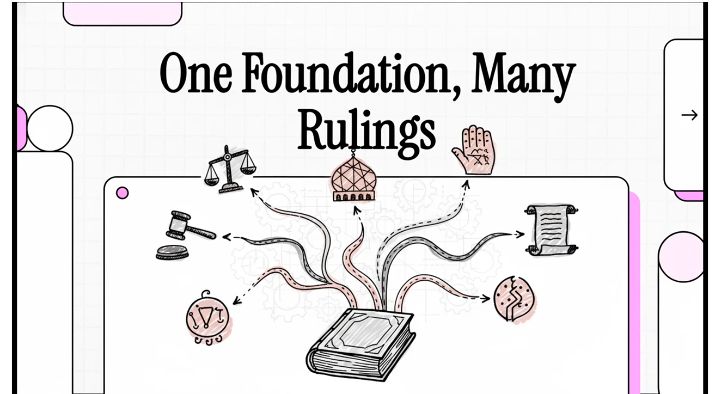
Difference does not come from new tools—it comes from how the same tools are weighted, sequenced, and trusted under pressure.
This lesson is designed to remove fear from disagreement and replace it with literacy.
1. The Core Principle of Divergence
Before naming any school, we must understand the rule that governs them all:
Every Mujtahid must decide which form of evidence speaks first when sources appear to compete.
This is not a theological disagreement.
It is a methodological decision.
Each school answers questions like:
What do we do when a hadith conflicts with established practice?
How much linguistic ambiguity can carry legal weight?
When does analogy override literal reading?
How cautious should we be in issuing new rulings?
The answers to these questions define a school.
2. The Four Methodological Sensitivities (Without Names Yet)
Before attaching labels like Hanafi or Maliki, students must first see the four methodological instincts that naturally emerge in any legal system:
A. Preservation-Oriented Methodology
Prioritizes inherited communal practice
Trusts continuity over innovation
Fears legal fragmentation
This instinct asks:
“How was this lived consistently by the earliest community?”
B. Logic-Oriented Methodology
Prioritizes analogy and reasoning
Designed for new, complex societies
Comfortable with hypothetical cases
This instinct asks:
“What is the governing principle behind this rule?”
C. Text-Synthesis Methodology
Balances hadith, language, and reasoning
Builds structured legal theory
Seeks universal consistency
This instinct asks:
“How do we harmonize all evidence without privileging one unfairly?”
D. Verification-Oriented Methodology
Extremely cautious with evidence
Prefers fewer rulings over speculative ones
Prioritizes direct textual proof
This instinct asks:
“Do we have enough certainty to speak at all?”
Important: These are not ideologies. They are risk-management strategies.
3. Why These Differences Were Necessary
The Prophet ﷺ did not leave behind a centralized legal court.
Instead, he left behind people—spread across regions, cultures, and conditions.
After his passing:
Medina preserved lived practice
Iraq faced unprecedented legal complexity
Egypt and Hijaz became synthesis zones
Baghdad became a center of hadith verification
Different environments demanded different calibrations of the same law.
If all scholars had used the same weighting everywhere, the law would have failed real human life.
4. Difference Is Not Relativism
This lesson must be clear on one crucial point:
Methodological divergence is not “everyone is right.”
Each school:
Has strict internal rules
Rejects arbitrary reasoning
Disallows personal desire
Submits fully to Revelation
What differs is not truth, but how certainty is achieved.
Think of it as four routes to the same city:
Some are faster
Some are safer
Some avoid risk
Some prioritize continuity
All are valid if they follow the map.
5. What This Protects Students From
Understanding methodological divergence protects students from:
❌ Sectarian arrogance
❌ Declaring others “wrong” without knowledge
❌ Mixing rulings without understanding logic
❌ Rejecting scholarship due to confusion
❌ Treating disagreement as chaos
Instead, it builds:
✔ Intellectual humility
✔ Respect for scholars
✔ Confidence without rigidity
✔ Unity without uniformity
6. The Golden Rule of Lesson Two
Never ask: “Which school is right?”
Always ask: “What methodology is being applied—and why?”
Once students understand how a ruling was reached, disagreement stops feeling threatening.
Lesson Two Checklist (Student-Facing)
By the end of this lesson, students should be able to:
☐ Explain why disagreement exists without accusing error
☐ Identify methodological weighting as the source of divergence
☐ Describe four legal instincts without naming schools
☐ Understand disagreement as mercy, not weakness
☐ Feel comfortable proceeding deeper without confusion
Closing: Preparing for Lesson Three
Lesson Two teaches why difference exists.
Lesson Three will go further.
In Lesson Three, we will:
Name the four schools explicitly
Map each school to its dominant methodology
Show how the same case produces four valid rulings
Teach students how not to mix methods improperly
You are now ready.
You have the shared tools.
You understand why weight matters.
Next, you will see the schools in full clarity.
May Allah increase us in understanding, protect us from arrogance, and make knowledge a source of mercy for the Ummah.
رَبِّ زِدْنِ عِلْمًا