

بِسْمِ اللهِ الرَّحْمٰنِ الرَّحِيْم
In the Name of God, Most Gracious, Most Merciful
♥️🤲🕋♥️🕋🌹🌹🥀🤲🌹🕋♥️🤲
Lesson Four — Disagreement,
Authority, and the Ethics of Following
Why Ikhtilaf Exists, Who Speaks, Who Follows, and How Knowledge Is Carried Without Breaking the System
Watch "Lesson Four — Disagreement, Authority, and the Ethics of Following" on YouTube
Opening: Why This Lesson Matters
By the time a student reaches this lesson, something dangerous and beautiful has already happened.
They now understand:
The shared foundations of Islamic legal reasoning
Why scholars legitimately differ
How the four schools are structured
And now comes the moment where many people fall.
This lesson exists to prevent that fall.
Because once you understand how scholars reason, the ego quietly whispers:
“If I understand the tools… why can’t I decide for myself?”
Lesson Four answers that question without humiliating the student and without surrendering the tradition.
Part I — Ikhtilaf Is Not Chaos
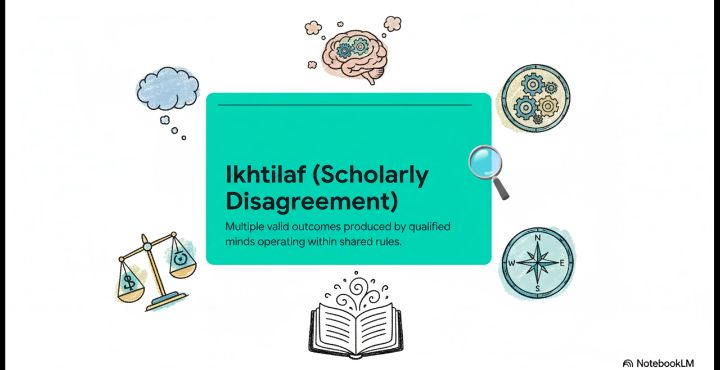
1. What Ikhtilaf Actually Is
Ikhtilaf (scholarly disagreement) is:
The presence of multiple valid outcomes
Produced by qualified minds
Operating within shared rules
Ikhtilaf is not:
Everyone choosing what they like
Personal intuition replacing method
Emotional preference masquerading as mercy
Key principle:
Disagreement is a feature of the Sharia, not a flaw.
The Prophet ﷺ himself validated multiple interpretations when they were reached through sound reasoning.
2. Why the System Allows Disagreement
Islamic law had to govern:
Multiple continents
Multiple languages
Multiple cultures
Multiple temperaments
A single rigid interpretation would have shattered under that weight.
Ikhtilaf allows:
Flexibility without collapse
Mercy without relativism
Diversity without fragmentation
Part II — Authority Is Not Opinion
This is where clarity becomes critical.
1. Not All Knowledge Grants Authority
There is a difference between:
Understanding a ruling
Explaining a ruling
Deriving a ruling
A person may:
Read Usul
Understand logic
Even detect weak arguments
And still not be authorized to issue law.
Why?
Because authority in Islam is not about intelligence alone.
2. What Makes a Mujtahid
A Mujtahid is not:
Someone confident
Someone articulate
Someone with followers
A Mujtahid must possess:
Exhaustive Arabic mastery
Total familiarity with Qur’an and Sunnah
Awareness of consensus and disagreement
Ability to weigh competing evidences
Deep moral restraint and fear of error
This is why Shaykh Ninowy emphasized:
Absolute Mujtahids are exceedingly rare today.
Part III — Taqlid: The Most Misunderstood Concept
1. Taqlid Is Not Blindness
Taqlid does not mean:
Turning off your brain
Following culture blindly
Obeying scholars without accountability
Taqlid means:
“I trust a verified methodology more than my incomplete grasp.”
It is an ethical decision, not an intellectual failure.
2. Why Taqlid Protects the Layperson
Without Taqlid:
Confidence outpaces knowledge
Personal bias replaces discipline
Every person becomes their own religion
Taqlid preserves:
Stability
Continuity
Humility
And it keeps students from mistaking exposure for mastery.
Part IV — Certainty, Probability, and Intellectual Honesty
One of the greatest protections in Islamic law is its honesty about certainty.
1. Qatʿi vs. Dhanni
Qatʿi (Definitive):
No disagreement allowedDhanni (Probabilistic):
Multiple interpretations possible
Problems arise when:
Dhanni rulings are treated as divine absolutes
Or Qatʿi principles are treated as optional opinions
Lesson Four trains students to recognize the difference.
Part V — The Ethical Student
This lesson ultimately produces a specific type of student:
Not:
A debater
A refuter
A social media mufti
But:
A disciplined learner
A respectful navigator of difference
Someone who knows when to speak and when to remain silent
Silence, in the wrong hands, is ignorance.
Silence, in the right hands, is wisdom.
Part VI — AI, Knowledge, and Responsibility
AI changes access — not authority.
AI can:
Retrieve sources
Compare opinions
Highlight inconsistencies
AI cannot:
Bear moral accountability
Possess taqwa
Replace lived transmission
This lesson prepares students for a world where:
Information is abundant
Authority must be earned
Responsibility cannot be outsourced
Lesson Four Summary
Ikhtilaf is mercy when governed by method
Authority requires more than understanding
Taqlid is ethical restraint, not ignorance
Certainty and probability must never be confused
Knowledge without adab is destructive
Closing: Preparing for Lesson Five
Lesson Four teaches you how to stand inside the tradition.
Lesson Five will ask a harder question:
In a world of AI, global access, and collapsing authority — who is allowed to reason, who must follow, and how does the modern Muslim walk safely without freezing or rebelling?
We will move next into:
Lesson Five — Ijtihad, Taqlid, and the Modern Student
And we conclude this lesson with the prayer:
رَبِّ زِدْنِي عِلْمًا
My Lord, increase me in knowledge.
When you are ready, we move forward.