
بِسْمِ اللهِ الرَّحْمٰنِ الرَّحِيْم
In the Name of God, Most Gracious, Most Merciful
♥️🤲🕋♥️🕋🌹🌹🥀🤲🌹🕋♥️🤲
Lesson Five — Ijtihad, Taqlid, and the Modern Student
Watch "Lesson Five — Ijtihad, Taqlid, and the Modern Student" on YouTube
Who Is Allowed to Reason, Who Must Follow, and How the System Survives the Age of AI
Opening: The Most Dangerous Moment in Learning
There is a moment in every serious student’s journey where knowledge becomes a test.
Not a test of memory —
but a test of character.
That moment arrives when the student understands enough to question authority, but not enough to replace it.
Lesson Five exists exactly for that moment.
Part I — The Three Roles in the Sharia System
Islamic legal reasoning was never designed for everyone to play the same role.
The system survives because roles are clearly defined.
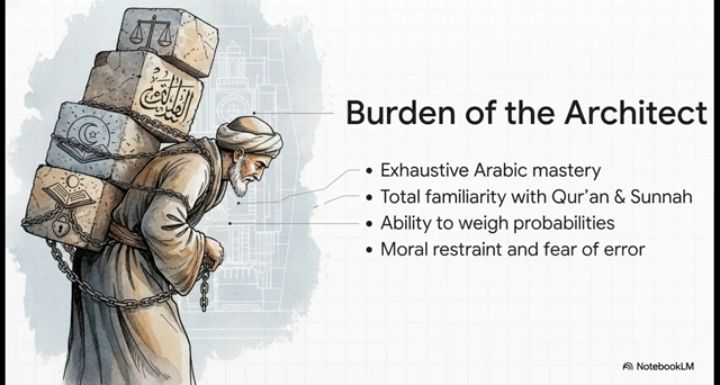
1. The Mujtahid (The Architect)
The Mujtahid:
Builds law
Derives rulings
Resolves conflicts between evidences
This role requires:
Exhaustive Arabic mastery
Total familiarity with Qur’an, Sunnah, consensus, and disagreement
Ability to weigh probabilities
Moral restraint and fear of error
This is not a title.
This is a burden.
2. The Muqallid (The Follower)
The Muqallid:
Follows a verified methodology
Does not invent law
Does not cherry-pick opinions
This is not a lower rank spiritually.
It is the default state of the Ummah.
Most of the greatest Muslims in history were not Mujtahids —
they were righteous followers.
3. The Student (The Apprentice)
The student is in between.
They are allowed to:
Ask questions
Understand reasoning
Learn why differences exist
They are not allowed to:
Issue rulings
Undermine consensus
Turn learning into self-authorization
Lesson Five teaches students how to remain students without becoming passive or arrogant.
Part II — Ijtihad Is Not a Feeling
One of the most damaging modern errors is confusing:
Intelligence with authorization
Insight with authority
Confidence with competence
Ijtihad requires:
Exhaustive preparation
Independence from desire
Accountability to peers
Acceptance of error
If someone:
Chooses opinions because they feel “stronger”
Selects rulings that align with convenience
Rejects tradition in the name of sincerity
That is not Ijtihad.
That is ego dressed as courage.
Part III — Taqlid Is an Ethical Discipline
Taqlid is not about ignorance.
It is about trusting a structure larger than yourself.
Just as:
A patient trusts a trained surgeon
A pilot trusts aeronautical engineering
The believer trusts:
A school that has been tested for centuries
Taqlid protects:
The student from premature certainty
The Ummah from fragmentation
The religion from personalization
Part IV — The AI Question (Without Fear or Fantasy)
AI changes the landscape, not the law.
AI can:
Compare madhhabs
Expose weak reasoning
Highlight inconsistencies
Assist scholarship
AI cannot:
Bear sin
Possess taqwa
Replace lived transmission
Become morally accountable
The Real Danger
The danger is not AI replacing scholars.
The danger is untrained humans using AI to bypass humility.
Lesson Five establishes this rule:
AI may assist reasoning — it may never authorize it.
Part V — The New Category: The Literate Layperson
We are entering a new era.
Not of Mujtahids everywhere —
but of literate followers.
The literate layperson:
Understands why scholars differ
Knows the hierarchy of evidence
Recognizes certainty vs. probability
Can audit logic without issuing rulings
This strengthens the Ummah —
if humility survives.
Part VI — What This Course Is Actually Producing
This course is not producing:
Internet muftis
Opinion warriors
Sectarian debaters
It is producing:
Grounded students
Respectful navigators
Muslims who know where knowledge begins and ends
That is the real victory.
Lesson Five Summary
Ijtihad is rare, heavy, and dangerous if abused
Taqlid is ethical restraint, not intellectual surrender
Students must remain students longer than they want
AI assists clarity but cannot replace accountability
The future belongs to disciplined, literate followers
Closing: Where This Journey Leads
You now understand:
What all schools share
Why they differ
How disagreement works
Who speaks and who follows
Where AI fits — and where it must stop
From here, the path is clear.
Next phases may include:
Deep dives into each madhhab
Applied case studies
AI-assisted comparative analysis
Ethics of modern fatwa-making
But the foundation is complete.
We end Lesson Five with the prayer:
رَبِّ زِدْنِي عِلْمًا
My Lord, increase me in knowledge.
When you are ready, we move from foundation to application.