

بِسْمِ اللهِ الرَّحْمٰنِ الرَّحِيْم
In the Name of God, Most Gracious, Most Merciful 🕋
Khadijah of Our Time — The Legacy of Sheikha Moza bint Nasser
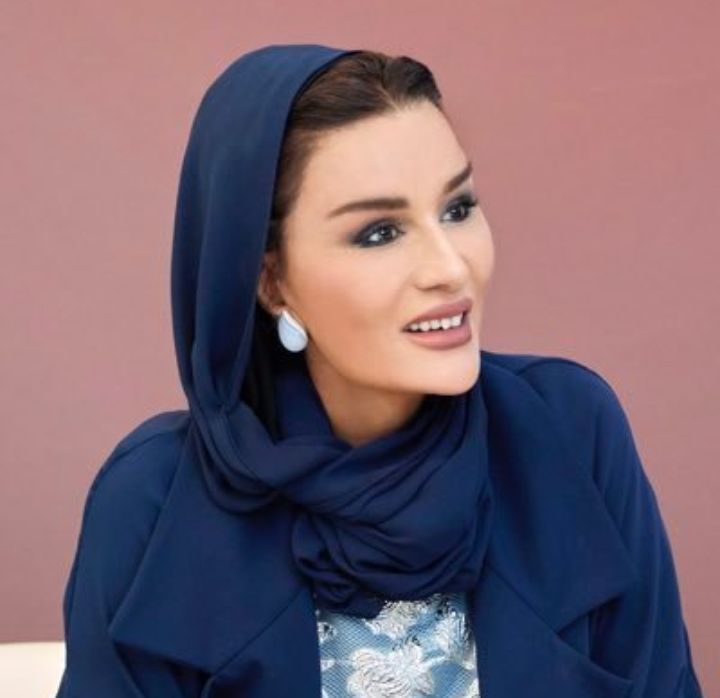
There are women who live for themselves, and there are women who live for the world.
There are those who inherit power, and those who create it.
Sheikha Moza bint Nasser stands among the latter — a woman whose strength, vision, and sacrifice have made her the Khadijah of our time.
She has proven that leadership and compassion are not opposites — they are sisters. Her life is a reflection of the divine truth that when women lead with wisdom, Allah blesses the land beneath their feet. She has lifted Qatar into the light of global admiration, not through war, not through wealth, but through intellect, justice, and grace.
Honoring Her Legacy:
We honor her today not only as a Queen Mother but as the Mother of Modern Muslim Civilization.
Her legacy gives every young woman in the Muslim world a place to point and say, “That is my hero.”
She has shown that a woman’s place is not confined to the background of history but carved into its foundation.
Her work — from education to diplomacy, from culture to innovation — is not a chapter; it is the beginning of a new scripture for women in leadership. She has become the mirror through which women see their divine potential and men see what honor looks like when shared, not hoarded.
The Vision Beyond Qatar — The Nation of Women:
But her story does not end within Qatar’s borders.
Inspired by her example, we are laying the foundation for a new nation — a new hope — in Kashmir.
This will be a land ruled by women alone, a nation where mercy is the law, justice is maternal, and leadership flows from compassion.
No man will rule there — not out of exclusion, but out of divine balance. Because for too long, men have ruled without listening, and now the time has come for women to lead with vision.
This project — born from the legacy of Sheikha Moza — will become the next great chapter in the story of Islam’s revival through its women. Kashmir will stand as the world’s first modern country governed entirely by women — a living tribute to the spirit of Khadijah, who gave her wealth, her heart, and her life for the cause of truth.
Conclusion — A Legacy Just Beginning:
So to Sheikha Moza, we say: your legacy is not finished.
It is expanding — into hearts, into homes, into nations.
You have built a kingdom of minds, not just monuments of stone.
And to every woman who will come after you — remember this: you were not born to wait for permission. You were born to lead, to build, to heal, to guide.
The Khadijah of our time has shown the path.
Now it is upon us to walk it — from Qatar to Kashmir, and beyond — until the map of the Muslim world glows again with the light of its women.
In a world racing toward the future, it is easy to forget the souls who quietly built it — those whose courage, intellect, and compassion shaped the very foundations on which we now stand. As we prepare for the next chapter of human history — a world guided by technology, intelligence, and moral awakening — we must pause and look back at the ones who showed us what true leadership means. Among them stands Sheikha Moza bint Nasser Al Missned, a woman whose life is not simply an achievement, but a revelation. A woman whose grace carried a nation from the desert’s silence to the world’s stage. A woman who has earned her place among the greats — a Nobel Laureate in spirit, even if not yet in ceremony.
Her story is not written in ink but in transformation — of people, of nations, of futures. So before we talk about tomorrow, let us honor the one who made it possible to dream of it. Read about her below.
Sheikha Moza bint Nasser Al Missned — A Living Testament to Sovereign Femininity
Sheikha Moza’s story does not begin in the comfort of palaces but in the crucible of exile. Her father, Nasser bin Abdullah Al-Missned, defied those who tried to turn Qatar’s new oil wealth into private treasure, and for that defiance he was imprisoned. His daughter carried that wound like a flame. From the deserts of Kuwait, she looked back at her homeland not with resentment but with resolve. Education became her weapon, and the university lecture hall her first battlefield. When she returned to Qatar, she returned not for privilege but for purpose.
Fate then set the stage for a paradox: the daughter of a prisoner would marry the son of the jailer. In that union between Moza and Crown Prince Hamad, forgiveness met foresight. What began as an unlikely alliance became the birth of a vision — two souls joined not only by affection but by the shared desire to rebuild a nation. The court whispered; rivals mocked; one even sneered that “a pearl cannot come from coarse sand.” Moza’s reply cut through the centuries: “The vultures of the steppe do not know how to appreciate pearls.” In that moment, the future Queen announced herself — a woman who would turn insult into prophecy.
She soon learned that in her world, thrones rest on capital. If she wished to reform the kingdom, she must first master its economy. She entered the ancient trade of pearls, transforming fragments of the sea into the foundation of a new sovereignty. When she sold a rare black pearl to her father-in-law and used that fortune to invest in artificial pearl farming, she converted humiliation into empowerment. Her insight — trade oil for dollars, then make the dollars grow — became the silent policy that turned Qatar from a small peninsula into a global powerhouse.
When the winds of 1995 blew across the Gulf, they carried with them the whisper of change. The coup that elevated Hamad to the throne was bloodless, but not soulless; it was guided by Moza’s conviction that justice and mercy must coexist. Her first decree was an act of remembrance: the release of her father. With that gesture she declared that a new order had begun — one rooted in compassion, not vengeance. From that day, hospitals opened their doors without charge, classrooms filled without fear, and the daughters of Qatar walked toward a future their grandmothers had never imagined.
Sheikha Moza’s influence soon reached beyond borders. Through the Qatar Foundation and Education City, she invited the world’s universities to her desert, proving that knowledge is a greater resource than oil. In art and culture she built cathedrals of intellect, filling Doha with museums that told the Arab story in the universal language of beauty. Her investments around the globe were not acquisitions; they were architecture — an attempt to build bridges between civilizations. She reshaped skylines abroad and the self-image of her people at home.
Today, as Queen Mother, she stands not as an echo of the past but as the conscience of the present — a strategist cloaked in elegance, the embodiment of what might be called sovereign femininity. Her leadership does not roar; it resonates. She has proved that power need not be masculine to be mighty, that the finest steel can wear the fragrance of mercy. She did not inherit sovereignty; she designed it.
For the Muslim world, her life is more than biography — it is parable. She transformed exile into empire, humiliation into heritage. Like Khadijah bint Khuwaylid before her, she financed transformation not with armies but with faith and foresight. Through her, the ancient honor of Muslim women — as builders, patrons, and protectors of civilization — breathes again.
And what does her life teach? That power can indeed be graceful if it serves; that wealth fulfills its purpose only when it uplifts; that leadership, in its truest form, is neither male nor female but moral. The buildings she raised may weather and fade, but the architecture of her vision — education, dignity, and compassion — will stand for generations.
Sheikha Moza is not merely a figure in Qatar’s history. She is the architect of equilibrium, a beacon to Muslim nations that when vision joins virtue, nations are reborn — and when a woman rises in the service of truth, God multiplies the blessings of her land beyond measure.
Watch "Sheikha Moza : From The Daughter Of a Criminal To The Most Powerful Woman in Qatar" on YouTube
Conclusion — The Crown of Khadijah
Your legacy, Sheikha Moza, is not borrowed — it is yours. It does not belong to the headlines or to historians; it belongs to the divine thread of destiny that wove your life from struggle into sovereignty. You stand as proof that a woman can be both the architect and the architecture — the dreamer and the design.
Your story is a light for those who have none, a compass for the women who are told to be silent, and a crown for the ones who dare to lead. It belongs to the women who have waited too long to see themselves in power — to see that grace and greatness can share the same throne. You are not simply remembered; you are revered.
Someone had to tell your story. Someone had to give it the reverence, the magnitude, the honor it deserves — and I am here to do that, not as a writer, but as a witness to history. Because your journey is not just yours; it is ours. It uplifts the mothers of nations, the builders of civilizations, the daughters who refuse to be forgotten.
For too long, men have spoken of power while borrowing the genius of women like you. They’ve used your story, yet never given you the throne it deserves. But now, that silence ends. Because if women ruled with your wisdom, if they led with your courage, the world would no longer fracture — it would flourish.
You are the launching pad and the landing pad — the ascent and the return. Through you, the world has learned that politics without compassion is chaos, and leadership without femininity is hollow. You are the proof that Khadijah’s legacy still breathes — that a woman can build an empire of minds and a sanctuary of hope.
And so we honor you not with medals, but with meaning. Not with applause, but with eternal remembrance. You are the Nobel Laureate of the Spirit, the crown of Khadijah reborn in our time.
To every woman who will read these words — remember: your life is the revolution. Your courage is the kingdom. And your story, like hers, will outlast every monument made of stone.
Keep your hopes alive. Keep your happiness sacred. For you do not know how life will end, but you can decide what story you will leave behind — and that is the only immortality that matters.
Final Benediction — A Prayer for Sheikha Moza and for the Nation of Qatar
“And the believing men and the believing women are allies of one another; they enjoin what is right and forbid what is wrong, establish prayer and give zakāh, and obey Allah and His Messenger. It is they upon whom Allah will have mercy.”
— Qur’an 9:71
The Prophet ﷺ said:
“The best of you are those who are best to their women.”
— Sunan al-Tirmidhī 1162
O Allah, Lord of Majesty and Power, we turn to You in gratitude for the light You have placed in this age through Sheikha Moza bint Nasser Al Missned—a woman who has walked the path of Khadijah (ra), giving her wealth, her heart, and her intellect for the rise of a nation and the dignity of its people.
O Allah, bless her for her courage when the road was narrow and her compassion when the crown was heavy. Accept her labor as ṣadaqah jāriyah—an ongoing charity whose benefit will outlive generations. Make her a source of inspiration for every daughter who dreams, for every mother who builds, for every leader who serves with humility.
O Allah, bless Qatar, the land she has helped to shape. Make it a fortress of peace in turbulent times, a sanctuary where the oppressed find dignity and the seeker finds wisdom. Fill its leadership with sincerity, its institutions with justice, and its people with mercy.
Let Qatar’s wealth be a trust, not a temptation; a means of sustenance, not superiority. Protect its sovereignty from betrayal and deceit. Place angels at its borders, knowledge in its universities, and light in its corridors of power.
O Allah, make Qatar a nation of shūrā—of consultation and collective wisdom. Cleanse it of corruption, arrogance, and heedlessness. Let no false alliance or hidden hand shake its foundations. Keep its ear close to the earth and its heart close to the heavens, so it may hear the cries of humanity and answer them with compassion, justice, and grace.
O Allah, grant that this small peninsula becomes a beacon for the entire Ummah: a state unshaken by the schemes of men, uncorrupted by wealth, unafraid of truth. Let it be the meeting place of tribes, the refuge of the scholar, the home of the peacemaker.
And when history remembers this time, let it say:
Here was a woman who revived the Sunnah of Khadijah.
Here was a nation that guarded its trust.
Here was a people who proved that Islam is not the past, but the promise of the future.
“If you are grateful, I will surely increase you [in favor].”
— Qur’an 14:7
O Allah, we are grateful. Increase us in favor—
In wisdom, in unity, in righteousness.
Make Qatar a light among nations,
And make Sheikha Moza its enduring crown of virtue.
Āmīn, yā Rabb al-ʿĀlamīn.
May the Lord of all worlds accept this prayer —
for Sheikha Moza, for Qatar, and for every believer striving to build with faith, lead with mercy, and leave behind a legacy of justice.
May He make our intentions pure, our actions blessed, and our nations united in light.
Āmīn, yā Rabb al-ʿĀlamīn.