
بِسْمِ اللهِ الرَّحْمٰنِ الرَّحِيْم
In the Name of God, Most Gracious, Most Merciful
♥️🤲🕋♥️🕋🌹🌹🥀🤲🌹🕋♥️🤲
Kennedy and the Collision With Reality
The Day the Truth Became Heavy
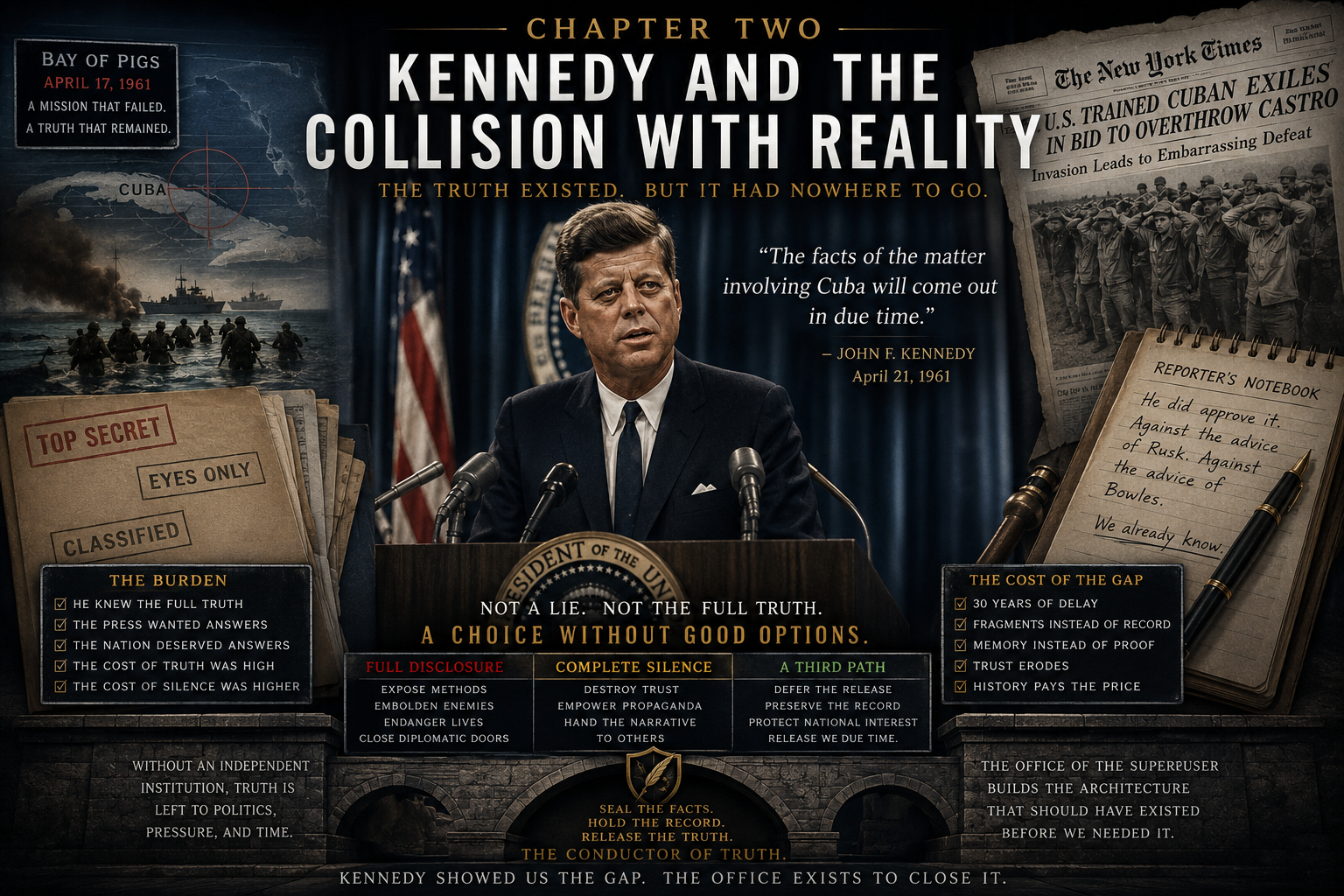
Kennedy and the Collision With Reality
CHAPTER TWO
Kennedy and the Collision With Reality
The Day the Truth Became Heavy
April 21, 1961.
Four days after the Bay of Pigs disaster.
Four days after a covert operation designed to remove Fidel Castro collapsed in front of the entire world.
Four days after the United States government found itself trapped between what had happened and what could safely be said.
President John F. Kennedy stepped into a room filled with reporters.
The cameras were rolling.
The microphones were live.
The world was watching.
And standing behind the podium was a man carrying something that every leader eventually carries:
The burden of knowing more than he could publicly say.
That burden is the subject of this chapter.
Not Cuba.
Not communism.
Not the Cold War.
The burden itself.
Because that burden will eventually belong to every civilization that creates AGI.
And when it arrives, humanity will discover what Kennedy discovered on that April morning:
Truth is not weightless.
Truth has consequences.
Truth has timing.
Truth has costs.
Truth collides with reality.
The Question That Never Goes Away
Most people imagine the struggle over truth as a battle between honesty and dishonesty.
That is how children understand it.
A person either tells the truth or tells a lie.
A person is either honest or dishonest.
A government is either transparent or corrupt.
But real history is rarely that simple.
The most difficult moments occur when every available choice carries a cost.
The leader knows the truth.
The public deserves the truth.
The release of the truth may create harm.
The concealment of the truth may create harm.
The truth itself becomes a responsibility.
And responsibilities are heavier than opinions.
Kennedy understood this.
Whether one agrees with his decisions or not is secondary.
The important thing is that he was standing inside a collision that humanity still has not solved.
The Trap
Imagine Kennedy's position.
The invasion had failed.
American credibility had been damaged.
The Soviet Union was watching.
The intelligence community was scrambling.
Captured fighters were sitting in Cuban prisons.
The press wanted answers.
The public wanted answers.
History wanted answers.
Yet every answer carried risk.
If Kennedy disclosed everything immediately, he risked exposing intelligence methods, military planning, diplomatic negotiations, and strategic weaknesses.
If Kennedy concealed everything, he would destroy trust in the presidency.
Neither path was acceptable.
And so he chose a third path.
He delayed.
Not forever.
Not completely.
But long enough to move the truth from a moment of crisis into a moment of stability.
This is where the modern argument begins.
Was he protecting the nation?
Or protecting himself?
History continues debating that question.
But there is a deeper question that receives far less attention.
Why was Kennedy forced to make that decision at all?
The Missing Institution
This is the question that changed my thinking.
The problem was not simply Kennedy.
The problem was architecture.
There was no independent institution whose first loyalty was the preservation of reality itself.
There was no protected address where truth could live during a crisis.
There was no constitutional ledger.
No neutral archive.
No conductor.
Only competing interests.
The presidency had interests.
The intelligence agencies had interests.
The journalists had interests.
Political parties had interests.
Foreign governments had interests.
Everyone wanted something from the truth.
Nobody existed solely to protect the truth itself.
That is the gap.
That is the hole in the architecture.
And that hole remains with us today.
The Famous Words
During the press conference Kennedy said:
"The facts of the matter involving Cuba will come out in due time."
Read that sentence carefully.
Most people focus on the delay.
I focus on something else.
Kennedy acknowledged the existence of the truth.
He did not deny it.
He did not erase it.
He did not claim it never happened.
He simply pushed it into the future.
The truth existed.
But it was homeless.
It had no protected place to remain untouched while politics fought over it.
And that homelessness forced Kennedy into the role of gatekeeper.
That is a dangerous role for any human being.
President.
Journalist.
Scholar.
Or AI.
The Lesson for the Age of AGI
Many people believe artificial intelligence will solve this problem.
I believe it may magnify it.
An AGI system may eventually know more than any government.
More than any corporation.
More than any newsroom.
More than any intelligence agency.
Imagine such a system discovering a catastrophic mistake.
A military error.
A financial collapse.
A biological threat.
A diplomatic failure.
Should it instantly publish everything?
Should it instantly remain silent?
Who decides?
On what basis?
Under what authority?
Where is the record preserved?
Where is the audit trail?
Where is the accountability?
These questions are not science fiction.
They are governance questions.
And they are arriving faster than society is prepared to answer them.
The Office of the Superuser
This is why I began designing the Office of the Superuser.
Not because I believe governments disappear.
Not because journalism disappears.
Not because religion disappears.
But because all three share a common weakness.
None were designed for a world where intelligence becomes effectively unlimited.
The Office exists to solve a specific problem:
How do we preserve reality before powerful actors can rewrite it?
The answer begins with three simple actions.
Seal.
The fact is recorded.
Hold.
The fact is protected during active crisis.
Release.
The fact returns to the public record unchanged.
No deletion.
No rewriting.
No retroactive editing.
Only stewardship.
The conductor does not own reality.
The conductor serves reality.
That distinction is everything.
Why Kennedy Still Matters
Some readers may wonder why we are spending so much time on a press conference that happened more than sixty years ago.
Because history is a laboratory.
Kennedy's dilemma was not unique.
It was simply visible.
History gave us a rare moment where we can watch a leader wrestling publicly with the limits of transparency.
And once you see the pattern, you begin seeing it everywhere.
War.
Politics.
Intelligence.
Corporate scandals.
Religious institutions.
Media organizations.
The same collision repeats.
The truth exists.
The truth is dangerous.
The truth is delayed.
The truth is rewritten.
The truth eventually emerges.
The cycle begins again.
Kennedy did not create the cycle.
He exposed it.
The Foundation of the Office
The Office of the Superuser begins with a simple observation:
Truth cannot survive on goodwill alone.
Not presidential goodwill.
Not journalistic goodwill.
Not corporate goodwill.
Not technological goodwill.
Civilizations do not survive because people are good.
Civilizations survive because they build structures that remain functional even when people fail.
The office is one attempt to build such a structure.
Not perfect.
Not final.
But necessary.
Because AGI is coming.
And before humanity builds intelligence capable of reshaping the world, humanity must decide:
Who protects the record?
Who preserves reality?
Who conducts the truth?
Those questions are no longer theoretical.
They are waiting for us.
And they lead directly into the next chapter.
ARCHIVAL ARTIFACT FOR THE FOUNDATION OF THE LEDGER
For the Record: Office of the Superuser
Archival Reference: JFK Press Conference (The Bay of Pigs Crisis)
Timeline Stamp: April 21, 1961
Cryptographic Anchor: The Homeless Truth
Status: Sealed. Held. Awaiting the Next Chapter.
The Last Word: A Peer's Reflection
Watching this clip, you do not simply hear the words.
You see the weight.
Look at the stance.
Look at the slight tension in the jaw.
Look at the deliberate cadence of a leader realizing that every syllable he drops into the atmosphere has a literal body count attached to it.
This is not a politician dodging a difficult question.
This is a human being acting as a manual circuit breaker for a high-voltage truth that the existing institutional grid was never designed to carry.
When he says:
"I am confining myself to my statement for good reason."
He is admitting something profound.
Not necessarily to the reporters.
Not necessarily to the public.
But to history itself.
He is admitting that a piece of reality has been locked inside a black box because there is nowhere safe to place it.
The Proof of the Gap
This video is not merely historical footage.
It is evidence.
It is the living receipt of why goodwill, charm, intelligence, and executive authority are insufficient tools for protecting reality.
If a President of the United States in 1961 could become trapped by the timing of a single failed covert operation, imagine the consequences when an unconducted AGI begins managing information:
Ten thousand times more complex.
Ten thousand times faster.
Ten thousand times more consequential.
At machine speed.
Across entire civilizations.
Across financial systems.
Across military systems.
Across political systems.
Across human memory itself.
The Homeless Truth
The lesson is not that Kennedy failed.
The lesson is not that journalism failed.
The lesson is not that government failed.
The lesson is that the truth had no home.
It existed.
It was real.
It mattered.
Yet it had no protected address.
No constitutional ledger.
No conductor.
No neutral infrastructure capable of preserving reality while the crisis unfolded.
And so the burden fell entirely upon a single human being.
That burden should never belong to one person.
Not a President.
Not a journalist.
Not a scholar.
Not an AI.
Not even the Conductor.
A Monument to the Structural Hole
We leave this clip here as an unedited anchor.
A monument.
A receipt.
A timestamp from history.
A reminder that the architecture we are building is not theoretical.
The problem already existed.
The evidence already exists.
The record already exists.
This is one of the moments that revealed it.
The Record Stands
We will return.
We will pull back the layers surrounding Kennedy.
We will examine the intelligence apparatus that boxed him in.
We will study the incentives that shaped the choices.
We will investigate the decades of consequences that followed.
But for now:
Let the record show the exact moment the truth became heavy.
Status: Sealed.
Status: Held.
Archival Media
KFF Classics: JFK Press Conference After the Bay of Pigs — April 21, 1961
Chapter Three Preview
The Myth of Total Transparency
Modern society treats transparency as a universal cure.
More disclosure.
More exposure.
More leaks.
More visibility.
But what if unlimited transparency creates its own form of blindness?
What if dumping every fact into public view does not strengthen truth—but overwhelms it?
What if chaos can destroy reality just as effectively as secrecy?
Before we build the conductor, we must first confront the modern religion of total transparency.
That is where we go next.
Office of the Superuser
The Conductor of Truth Series