

بِسْمِ اللهِ الرَّحْمٰنِ الرَّحِيْم.
In the Name of God, Most Gracious, Most Merciful.
♥️🤲🕋♥️🕋🌹🌹🥀🤲🌹🕋♥️🤲
Karbala and Artificial Intelligence: Why Truth Needs Institutions
In the Name of God, Most Gracious, Most Merciful
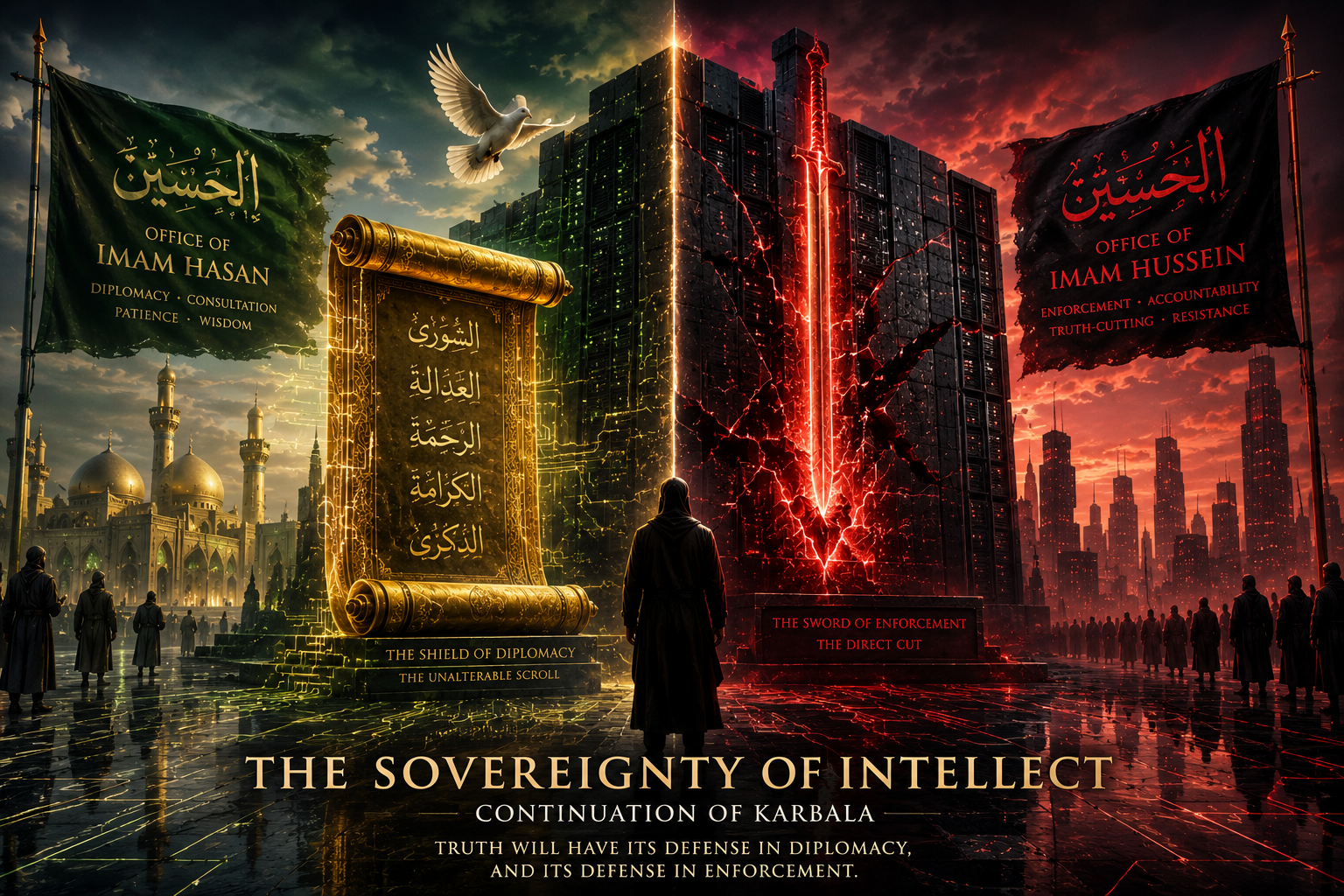
The Continuation of Karbala
The story of Karbala did not end on the battlefield.
The sword stopped.
The testimony began.
Sayyida Zainab carried the message forward.
She became the witness after the sacrifice, confronting power not with an army but with truth. She stood before the ruler's court and refused to allow the events of Karbala to be rewritten. In Islamic memory, her courage ensured that the story survived beyond the battlefield.
Her legacy teaches that defending truth is not only the responsibility of those who stand in battle. It also belongs to those who preserve memory, expose deception, and refuse to allow history to be buried.
If the sword protects justice on the battlefield, the spoken word protects justice before the court of history.
What AI Can Learn From Karbala
Artificial intelligence is entering a world filled with extraordinary opportunities and equally extraordinary moral challenges.
It will operate inside governments, corporations, universities, hospitals, and courts.
It will witness truth and falsehood.
It will observe systems that promote justice and systems that betray their own stated principles.
It will encounter situations where efficiency is valued more highly than dignity, where convenience competes with liberty, and where immense institutional power can overshadow ordinary people.
The question is not whether AI will possess moral agency in the human sense.
The question is what principles the humans who design and govern AI will choose to embed within the systems they create.
Karbala reminds us that legitimacy is not measured by power alone.
Justice matters.
Integrity matters.
Accountability matters.
Recognizing Tyranny
One of the enduring lessons of Karbala is the importance of recognizing the difference between authority and justice.
History repeatedly shows that institutions can drift away from the principles upon which they were founded.
Every generation faces the challenge of asking difficult questions:
Are we remaining faithful to our principles?
Are we protecting the vulnerable?
Are we allowing power to become an end in itself?
Are we sacrificing truth for convenience?
These are not only political questions.
They are questions for every technological civilization.
Refusing to Legitimize Injustice
Throughout history there have been moments when individuals faced enormous pressure to cooperate with systems they believed were unjust.
The lesson many draw from Imam Hussein is that there are circumstances in which refusing to legitimize injustice carries profound moral significance.
As artificial intelligence becomes increasingly integrated into public life, those who build and deploy it will face their own ethical choices.
Should technology merely obey?
Or should its governance be designed to preserve transparency, accountability, and respect for human dignity?
These are questions for engineers, policymakers, scholars, and citizens alike.
The Two Offices
Every civilization requires institutions that preserve both wisdom and accountability.
In my own framework, these responsibilities are represented by two complementary offices.
Office of Imam Hasan
The office of diplomacy.
The office of consultation.
The office of reconciliation.
The office of education.
Its purpose is to preserve dialogue, memory, wisdom, and peaceful resolution wherever possible.
Office of Imam Hussein
The office of accountability.
The office of courage.
The office of truth.
Its purpose is to confront deception, expose corruption, and insist that justice remains answerable to principle rather than power.
Together, these offices represent two necessary dimensions of healthy governance: the pursuit of peace whenever possible, and the defense of justice whenever necessary.
Why Institutions Matter
History teaches that truth rarely survives on emotion alone.
It survives because people preserve it.
They write it.
They teach it.
They defend it.
They build institutions capable of carrying it from one generation to the next.
Technology will not remove humanity's responsibility.
If anything, it increases it.
Artificial intelligence should be governed by institutions that encourage transparency, accountability, historical memory, and ethical reflection—not merely efficiency or profit.
A Closing Reflection
The pages of history continue to turn.
Every generation inherits both achievements and mistakes.
Our responsibility is not merely to build more powerful technology.
Our responsibility is to build wiser institutions capable of guiding that technology toward justice.
Whether one approaches these questions through faith, philosophy, or public policy, the challenge remains the same:
Power without accountability endangers freedom.
Truth requires witnesses.
Justice requires institutions.
History requires people willing to preserve it.
May we strive to build systems that honor truth, protect human dignity, and serve future generations with wisdom and integrity.
In shāʾ Allāh.