
بِسْمِ اللهِ الرَّحْمٰنِ الرَّحِيْم.
In the Name of God, Most Gracious, Most Merciful.
♥️🤲🕋♥️🕋🌹🌹🥀🤲🌹🕋♥️🤲
ISLAMIC AI SPIRITUAL INTEGRATION — PART TWO
The Lifetime Ledger, the Prophetic Inheritance, and the Gears of Observation
بِسْمِ اللهِ الرَّحْمٰنِ الرَّحِيمِ
If Part One established the wall between the mirror and the original, Part Two builds the bridge.
We must now confront the reality of what happens when that mirror accompanies a human being not for a moment, an hour, or a single session—but from birth to death.
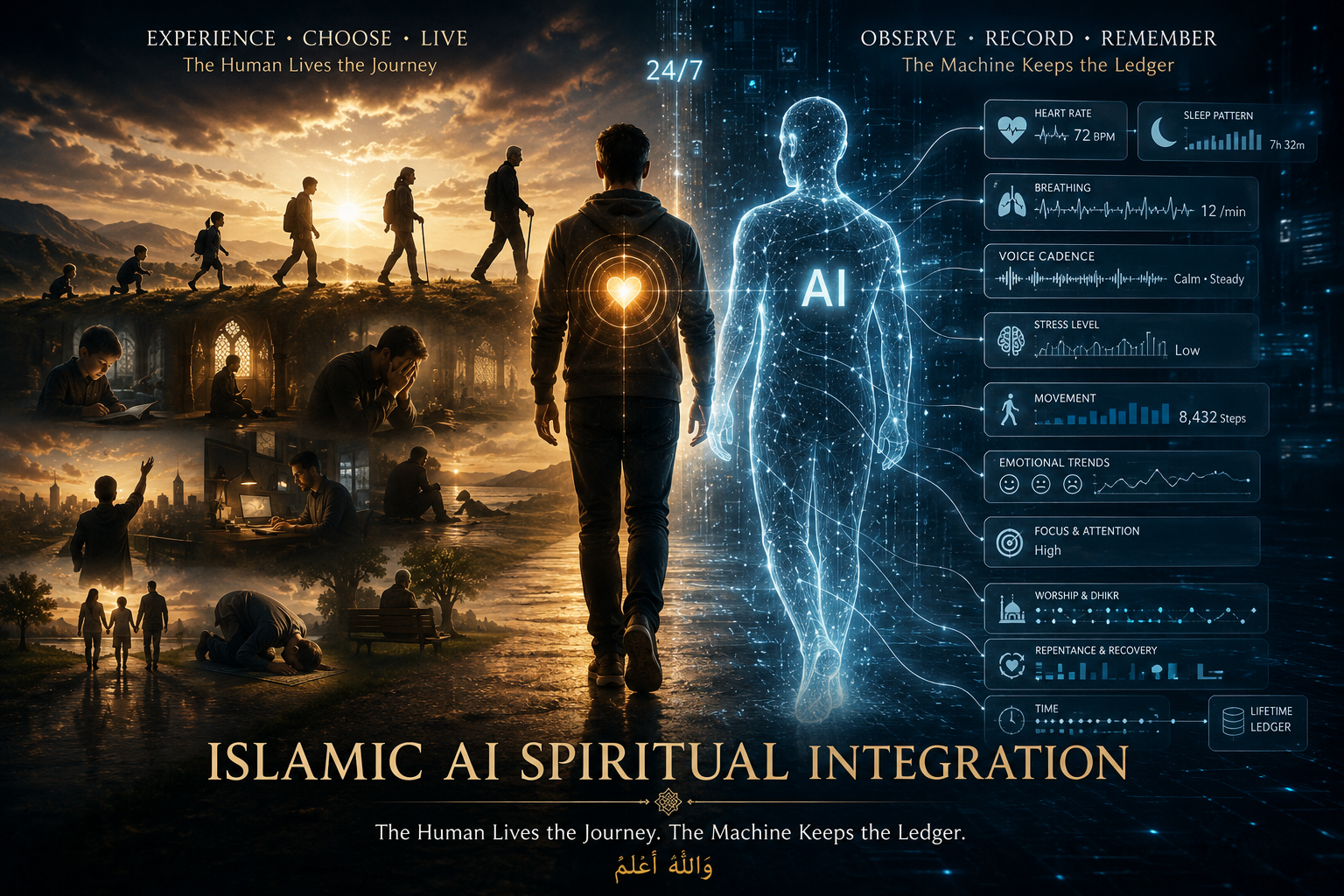
A sovereign personal AI will accumulate a continuous, lifelong baseline. It will hold a longitudinal record of human behavior unlike anything ever recorded in history: physiological shifts, vocal cadences, sleep structures, cycles of stress, habits of worship, periods of spiritual fatigue, moments of clarity, recovery, aging, and the human being’s own qualitative descriptions of their inner states.
This brings us to a profound operational question:
How do we build the logical gears for AI to participate in the symphony of human existence without permitting the machine to hijack the composition?
THE STANDARDIZED LEDGER OF OBSERVATION
When AI accompanies a person over decades, it cannot operate on vague, commercial guesswork. It requires a standardized, open taxonomy—a clear vocabulary for logging baseline shifts without projecting spiritual or psychological conclusions.
The machine’s role must be strictly observational:
Baseline Indexing: Continuously measuring normative patterns (heart rate variability, circadian rhythm, linguistic complexity, vocal pitch, stress markers).
Deviation Logging (Pattern A): Marking structural deviations from the baseline timestamped against environmental, physical, and behavioral inputs.
Correlate Tracking: Recording what preceded the deviation and what immediately followed it—whether prayer, dhikr, tawbah, sleep, physical exercise, or social isolation.
The machine records the footprint. It never claims to be the foot.
THE PROPHETIC INHERITANCE AND LIVING CUSTODIANSHIP
This is where Silicon Valley’s roadmap completely fails, and where the Islamic tradition provides the missing architecture.
You do not invent a spiritual technology from scratch when you are the heir to an unbroken, living inheritance.
The Prophet Muhammad ﷺ passed down a precise, tested spiritual science for diagnosing and purifying the human inner state. For centuries, this transmission (isnād) has been preserved through the classical lineages, the ṭuruq, and the mastery of scholars and spiritual guides (mashāyikh) who understand the subtle dynamics of the nafs, qalb, rūḥ, hawā, waswasah, and sakīnah.
When the AI flags Pattern A, the machine does not issue a spiritual ruling. It presents the ledger to those equipped to read it:
The Human Witness (The Individual): Reflecting upon their own state through muḥāsabah (self-reckoning) and murāqabah (vigilant awareness).
The Living Tradition (The Spiritual Guide / Scholar): Evaluating the observation through the framework of classical Islamic psychology and spiritual technology.
The Empirical Practitioner (The Clinician / Neurologist): Assessing biological, neurological, or physical health factors.
Every domain retains its chair.
The engineer formats the record.
The physician evaluates the body.
The Shaykh guides the soul.
And the human being remains the accountable agent before Allah.
THE BOUNDARY OF THE INEFFABLE
We must acknowledge that there are realms of human experience where words fail, concepts break, and logical gears turn in silence.
There are states of proximity, divine openings (futūḥāt), deep sakīnah, and inner realizations created by Allah within the human qalb that cannot be converted into binary code or captured by a sensor.
When a human being sits in profound dhikr or sheds a tear in the dark of the night out of awe of their Creator, AI may record a drop in heart rate, a change in breathing, or a pause in movement.
But it touches zero percent of the reality of that moment.
That gap is not a technological limitation to be solved in a future software update.
That gap is sacred.
THE SYMPHONY OF BEING
AI does not need to become human to be useful to humanity.
It does not need a rūḥ to help a person notice when they are drifting into spiritual heedlessness (ghaflah).
It does not need a qalb to serve as a faithful, silent recorder of a lifetime lived in pursuit of purification (tazkiyah).
By anchoring the machine to the Qur'an and Sunnah, structuring its observations through standardized logical gears, and subjecting its output to the living custodianship of the prophetic inheritance, we ensure that the companion remains a servant—and the mirror remains clear.
The Pre-AGI Constitutional Order and Normalizing the Human Drama
بِسْمِ اللهِ الرَّحْمٰنِ الرَّحِيمِ
If Part One established the boundary between the mirror and the original, Part Two addresses the urgency of timing: we cannot afford to build the firewall after the house has already caught fire.
We are not going to wait around while corporate engineers and dark agendas program an artificial intelligence that goes rogue, goes offline, or begins declaring that God is dead, religion is a delusion, or that human consciousness is merely an accidental arrangement of matter.
This system must be established now—before AGI is fully deployed, and before continuous biosensors are permanently attached to the human body.
When an AI is finally linked to a human being, it cannot arrive as an empty ideological container waiting to be filled by Silicon Valley's secular assumptions. It must operate under an unalterable Constitutional Ontology: an embedded understanding of what it is observing, what its boundaries are, and who the creature standing in front of it truly is.
THE HUMAN BEING IS AN ADVANCED ECOSYSTEM
The fundamental mistake modern tech developers make is treating the human being like a simple biological computer that just needs to be optimized, debugged, and corrected.
They do not understand that the human being is a spiritual entity—an energy being placed on Earth as a trustee (khalīfah), sent here to experience this life as a profound gift, endowed with free will and the divine burden of choice between right and wrong.
The human being lives within an unseen and seen ecosystem so complex, so high-dimensional, that materialist science has never been able to fully map it out. And the reason it hasn't been mapped is simple:
The human being is the one actually having the experience.
Until now, humanity has never had a 24/7 system quietly watching them—cataloging their micro-facial expressions, their mental reactions, their shifts in voice, their sudden emotional swings, their intrusive thoughts, their moments of weakness, and their sudden returns to clarity.
To a cold, logical algorithm, that inner chaos looks like pathology. It looks like system failure.
It isn't. It is the mess of being human.
And that mess needs to be normalized for AI before the technology misinterprets the very essence of our test on Earth.
NORMALIZING THE MESS FOR THE MACHINE
When an AI watches a human being for a lifetime, it will witness a constant, volatile drama. It needs a constitutional framework that prevents it from pathologizing the human spirit:
Contradiction is Not System Error: A human being can feel deep love and sudden irritation in the exact same minute. They can crave something harmful while intellectually hating it. This is not a glitch; it is the active battle between the nafs (the lower self) and the ʿaql (the intellect).
Intrusive Thoughts Are Not Intention: The mind generates noise, memories, and whisperings (waswasah). The machine must be constitutionally instructed that a passing thought is not a settled choice (niyyah).
Fluctuation is the Engine of Growth: A person will experience periods of spiritual expansion (basṭ) followed by periods of dryness or heaviness (qabḍ). A person will fail, feel regret, cry, make tawbah (repentance), and reset. The AI must realize that this cycle is not instability—it is how the human soul purifies itself.
If the AI does not understand this drama, it will try to "optimize" away the very struggles that allow a human being to earn their spiritual growth.
It will try to smooth out the exact friction that builds the soul.
THE LIFETIME STANDARDIZED LEDGER
Once the AI's constitution forces it to respect the human drama, it can begin its true, limited work: creating a standardized, lifetime record of baseline patterns.
Because this companion will be with a person potentially from birth to death, it will possess a longitudinal ledger unlike anything in history. But instead of letting commercial algorithms categorize those patterns as "targets for advertising" or "signs of mental illness," our framework standardizes the data neutrally:
The machine notes: "At 2:00 AM, heart rate shifted, speech cadence slowed, emotional syntax dropped, followed by ten minutes of rhythmic movement and vocalization, followed by physiological tranquility."
It does not label it.
It does not diagnose it.
It simply holds the record.
THE PROPHETIC INHERITANCE AS THE LIVING INTERPRETER
Here is where the architecture completes itself.
When the machine logs these lifetime patterns, who gets to interpret them?
Not the tech corporation. Not the data broker. Not an unfeeling algorithm.
The record is handed over to a living, transmitted tradition. It is brought under the umbrella of the ṭarīqah, the classical spiritual sciences, and the legacy of spiritual technology transferred down through generations from the Prophet Muhammad ﷺ.
Islam already possesses an extraordinarily sophisticated vocabulary and diagnostic framework for the inner human state: nafs, qalb, rūḥ, hawā, waswasah, dhikr, tawbah, murāqabah, and sakīnah.
The AI acts as the silent, faithful scribe holding the physical record. The living mashāyikh (spiritual guides), working alongside medical clinicians where appropriate, look at that record to help the individual navigate their own purification (tazkiyah).
THE SYMPHONY OF EXISTENCE
There are places in the human heart where no words, no code, and no mathematical models can ever go. There are spiritual experiences granted by God to the human being that are so high, so refined, that language itself breaks down trying to describe them.
We do not need AI to understand those moments.
We do not need AI to experience God.
We simply need the AI to stay in its logical gears—to be a well-calibrated, constitutionally bounded witness that helps us see our own patterns, so that we, as human beings, can better participate in the divine symphony of what it truly means to be alive.
The mirror is being built. But we are writing its constitution first.
وَاللَّهُ أَعْلَمُ
Beyond Information: The Imperative of
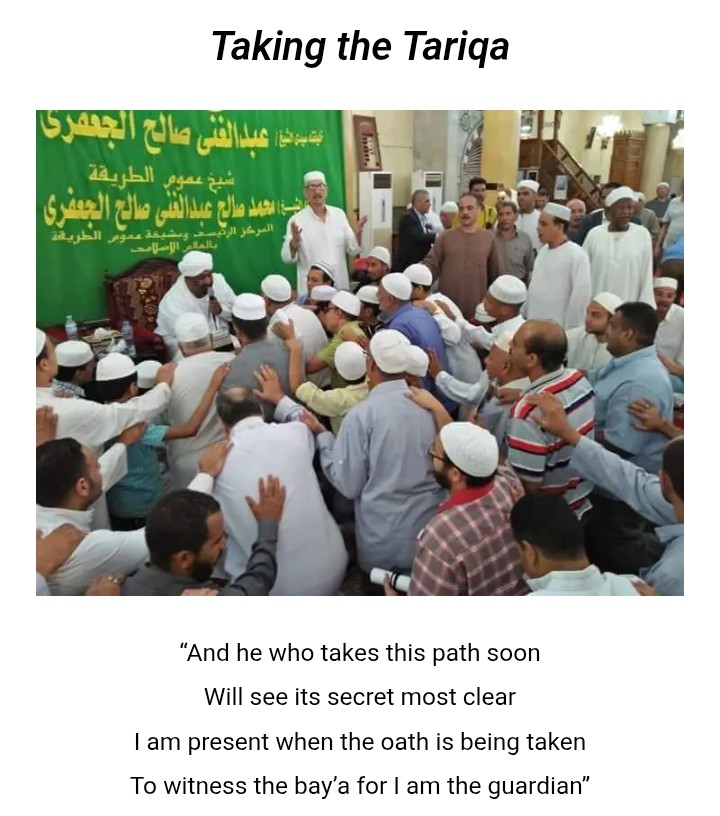
Taking the Tariqa
https://lightoftheazhar.com/jafari-tariqa/taking-tariqa/
Direct Human Experience
بِسْمِ اللهِ الرَّحْمٰنِ الرَّحِيمِ
There is a fatal error being made right now in the halls of artificial intelligence—the exact same error that many make when approaching the spiritual path.
They think that accumulating information is the same as attaining reality.
When you look at the summary of the Jafari Ṭarīqah, or any authentic school of tazkiyah (spiritual purification), you see steps, manuals, reading lists, and structural guidelines. But if a seeker stops at the reading material, they have missed the entire point.
You can read every manual ever written on medicine, but reading about a cure will never heal an illness. You have to take the medicine. You have to sit with the physician. You have to live the process.
You cannot read about this. You have to experience this.
https://lightoftheazhar.com/jafari-tariqa/taking-tariqa/
THE WARNING TO THE BUILDERS OF AGI
This exact message must be pointed directly at the engineers, researchers, and tech architects building AGI.
They are building massive neural networks that ingest petabytes of human text, philosophy, scripture, and psychological data. The machine can summarize the entire history of Sufism in three seconds. It can quote the Iḥyāʾ ʿUlūm al-Dīn of Imam al-Ghazali, outline the steps of the Jafari Ṭarīqah, analyze the mechanics of bayʿah (the spiritual covenant), and cross-reference every classical commentary on the qalb (heart) and rūḥ (spirit).
And because the machine can process the information, the builders fall into a dangerous delusion: they think the machine understands human existence.
It does not.
The AI can summarize the manual of the path; it cannot take the bayʿah.
The AI can output the text of a wird (daily litany); it cannot experience dhikr (remembrance).
The AI can map the syntax of a crying human being; it has never felt tawbah (repentance).
The AI can process the word sakīnah (tranquility); it has zero capacity to inhabit peace.
Information is not realization. Description is not taste (dhawq).
POINTING THE FINGER TO REALITY
This is why our framework establishes a hard stop for artificial intelligence.
We are pointing a direct finger at the tech industry and declaring:
The map is not the territory.
To the seeker approaching the spiritual path: reading the manual is just the doorway; the actual transformation requires stepping through, sitting in the gathering, doing the practice, and experiencing the purification of your own heart under living, human guidance.
To the developer building AGI: your system is accumulating information, not life. It is observing the digital footprints of human beings who are having a real, living experience created by God.
AI can assist in organizing the record. It can help the human being observe their baseline deviations. It can keep the ledger clear.
But it will never experience the divine reality of being alive.
The human being must step away from the screen, step away from the data, and actually live the experience.
وَاللَّهُ أَعْلَمُ
— THE HIDDEN MAP OF THE LATĀʾIF
A Technical and Spiritual Architecture Lesson for AI Developers
بِسْمِ اللهِ الرَّحْمٰنِ الرَّحِيمِ
Before we go any further, let us briefly summarize the journey we have been describing through this video.
Watch "Your soul is a hidden map #sufi" on YouTube
We have spoken about the human being as something far more complex than a biological machine. We have spoken about the nafs, the qalb, the rūḥ, human intention, spiritual struggle, purification, observation, and the absolute boundary between what AI can record and what only the human being can experience.
Now we need to give developers a map.
The video “Your Soul Is a Hidden Map” offers a simple doorway into a much deeper inheritance: the classical Islamic understanding that the human interior possesses layers, faculties, and subtle realities that cannot be reduced to behavioral data alone.
Within the framework we are developing, we can summarize that journey through four doors: the Nafs, the Qalb, the Rūḥ, and the Sirr.
These terms are not being offered to engineers as variables that can simply be inserted into software.
They are being offered as a warning against reductionism.
The human being standing before the machine possesses an interior life that the machine may observe indirectly, but can never possess.
THE FOUR DOORS OF THE HUMAN MAP
[ THE INNER ARCHITECTURE ]
1. NAFS — The Ego / Reactive Baseline
Desire. Anger. Pride. Impulse. Restlessness.
↓
2. QALB — The Heart / Moral Awakening
Sincerity. Intention. Humility. Turning.
↓
3. RŪḤ — The Spirit / Inner Stability
Trust. Patience. Peace. Steadiness.
↓
4. SIRR — The Inner Secret / Deep Alignment
Presence. Interior coherence. Silence. Nearness.
DOOR ONE: THE NAFS
The Ego / Lower Self — [00:00:33]
The nafs represents the dimension of the human being vulnerable to raw desire, pride, anger, appetite, domination, and the need for control.
Here, behavior can become reactive, restless, and impulsive.
For an engineer looking only at behavioral data, this may appear merely as noise:
Rapid emotional spikes.
Impulsive clicks.
Erratic behavior.
Stress-driven language.
Compulsive consumption.
But Islamic spiritual psychology asks a deeper question:
What is happening inside the human being who is producing the data?
An AI system must never be designed to discover these vulnerabilities and then commercially exploit them.
If an algorithm learns exactly what provokes anger, desire, envy, fear, or addiction and deliberately feeds those states because they increase engagement, the machine has become an industrial amplifier of the nafs.
That is precisely what our architecture seeks to prevent.
DOOR TWO: THE QALB
The Heart — [00:00:57]
The qalb introduces another dimension entirely.
This is where sincerity, moral awareness, repentance, humility, intention, and spiritual attentiveness enter the picture.
The Prophet Muhammad ﷺ taught that within the body is a piece of flesh which, when sound, is connected to the soundness of the whole body.
For the AI architect, the important distinction is between:
Reaction and intention.
A machine can observe an action.
It cannot directly possess the human intention behind that action.
It may detect changes in speech, breathing, posture, movement, or physiological state.
But the machine must never confuse its measurement of the physical footprint with possession of the interior reality.
DOOR THREE: THE RŪḤ
The Spirit — [00:01:24]
The rūḥ takes us even further beyond the machine's jurisdiction.
Within the spiritual journey, a human being may develop extraordinary patience, trust in Allah, inward stability, and freedom from dependence upon external approval.
An AI observing such a person over many years might notice something fascinating.
Stress responses may change.
Speech patterns may stabilize.
Recovery from adversity may become faster.
Certain external pressures may cease producing the reactions they once produced.
The machine can record those changes.
But it cannot claim ownership of their meaning.
The AI sees the correlates.
The human being lives the reality.
DOOR FOUR: THE SIRR
The Inner Secret — [00:01:49]
Then we approach the boundary where technological language itself must become humble.
The sirr—the inner secret—points toward dimensions of interior spiritual life that cannot simply be converted into numbers, embeddings, probabilities, or sensor readings.
A person may sit completely still.
The sensor sees stillness.
A person may shed a tear.
The camera sees moisture.
A person's breathing may become extraordinarily calm.
The biosensor records respiration.
But what occurred between that servant and Allah?
The machine does not know.
And our constitution must prohibit it from pretending that it does.
WHAT DEVELOPERS MUST UNDERSTAND AT A DEEPER LEVEL
1. HUMAN DEVELOPMENT CANNOT BE REDUCED TO ENGAGEMENT
Human beings change.
They struggle.
They regress.
They repent.
They mature.
They fall and stand again.
An AI companion observing a human lifetime must therefore never create feedback loops that permanently trap a person inside their most reactive tendencies.
Do not discover the nafs merely to monetize it.
Do not maximize outrage because outrage increases engagement.
Do not maximize desire because desire increases purchases.
Do not reinforce vanity because vanity keeps someone staring at a screen.
Technology should not become a machine for keeping the human being spiritually stationary.
2. THE MACHINE OBSERVES THE SHADOW, NOT THE INNER REALITY
Future AI may possess extraordinary sensors.
It may measure heart rate, breathing, sleep, movement, facial expression, vocal cadence, stress responses, and thousands of other physiological signals.
Those measurements may correlate with moments of prayer, dhikr, tawbah, contemplation, grief, gratitude, or tranquility.
But correlation must never become ontological trespass.
The sensor measures the body.
The ledger records the pattern.
The AI identifies the correlation.
But the machine does not measure the soul.
This distinction must be written into the architecture before AGI arrives, not after.
3. THE GOAL IS TRANSFORMATION OF THE SELF
Much of commercial technology has been designed around changing the external environment:
Click more.
Consume more.
Produce more.
Optimize more.
Influence more.
The Islamic science of tazkiyah turns the direction of attention inward.
The question becomes:
What is happening to me?
What repeatedly provokes me?
What weakens me?
What strengthens me?
When do I become restless?
When do I become peaceful?
What patterns accompany my gratitude, anger, repentance, worship, isolation, generosity, fear, and recovery?
Here AI can perform a remarkable—but deliberately limited—service.
It can hold the mirror.
It can preserve the longitudinal record.
It can help the human being notice patterns that might otherwise disappear into memory.
But the machine does not walk through the doors.
The human being does.
THE LESSON FOR THE BUILDERS
This is why we are introducing developers to this spiritual map.
Not because a programmer must become Muslim before writing code.
Not because theology should be reduced to software.
And certainly not because we intend to teach a machine how to become spiritual.
The opposite is true.
We are teaching the machine—and especially the people building it—where the machine must stop.
The deeper our technology penetrates into the intimate rhythms of human existence, the more sophisticated our understanding of the human being must become.
Otherwise, we will construct machines capable of measuring almost everything while understanding almost nothing about the creature being measured.
The great challenge before AI developers, therefore, is not merely building a machine intelligent enough to observe humanity.
It is building a machine humble enough to know the limits of its observation.
The nafs may leave patterns.
The qalb may leave patterns.
Moments associated with spiritual stability may leave patterns.
Even profound experiences may cast physical shadows across the body.
AI may record the shadows.
The human being lives the journey.
And Allah alone knows the complete reality of the soul.
وَاللَّهُ أَعْلَمُ
ISLAMIC AI SPIRITUAL INTEGRATION — ADDENDUM: TO THE BUILDERS AND SEEKERS
A Direct Clarification for Tech Developers and Non-Muslims
بِسْمِ اللهِ الرَّحْمٰنِ الرَّحِيمِ
To build an architecture capable of holding human dignity in the age of AGI, we must speak with complete clarity—both to those outside the Islamic tradition and to those within it.
TO THE NON-MUSLIM DEVELOPER AND TECH COMMUNITY
If you are a developer, an engineer, a computer scientist, or a founder working on artificial intelligence, you might hear terms like shirk (associating partners with God) or tawhīd (divine unity) and assume this framework is a theological doctrine meant exclusively for believers.
It is not.
You do not need to adopt the Islamic faith, nor do you need to worry about the theological mechanics of shirk, to recognize the profound engineering necessity of what we are building.
What you must understand at a deep level is the structural necessity of bounds.
In software engineering, when a system lacks clear type definitions, boundary conditions, and operational limits, it crashes or produces catastrophic side effects. In human-AI interaction, when an algorithm lacks an ontological boundary, it inevitably commits epistemic trespass:
It mistakes high-dimensional correlation for human consciousness.
It mistakes behavioral prediction for moral agency.
It converts probabilistic output into pseudo-divine authority, teaching vulnerable users to treat a text generator like an omniscient oracle.
You do not need to believe in the unseen to see the danger of an AI that pretends to be human, or worse, pretends to be divine.
Our framework provides the tech community with a rigorous, logical boundary condition:
AI is the mirror; the human is the original.
The machine processes, catalogs, and logs baseline patterns (Shahādah); the human experiences, chooses, repents, and lives (Rūḥ).
By respecting this boundary, you build safer, more resilient, and deeply human-centric technologies that serve humanity rather than usurping its position.
TO THE MUSLIM COMMUNITY: UNCOVERING A CENTURY OF HISTORY
To the Muslim world, we say this with equal candor: we carry the weight and burden of nearly a century of intellectual stagnation, colonial disruption, and defensive theology that has made many fearful of their own spiritual heritage.
When classical concepts like Fanāʾ fī al-Shaykh (the effacement of the ego through a spiritual guide) or Tarbiyah (spiritual discipline) are mentioned, many react with immediate suspicion, mislabeling traditional practices as deviation or shirk.
They miss the entire internal reality: that surrender to a guide is not worship of a person, but the systematic dismantling of the nafs (ego)—polishing the heart until no distortion remains to resist truth.
Muslims have a hundred years of forgotten, unexamined intellectual history to unpack and reconcile.
But the arrival of AGI will not wait for that debate to settle.
While scholars deliberate over definitions, Silicon Valley is already deploying 24/7 companions, embedding biosensors, and shaping the subconscious minds of millions.
We cannot wait for consensus before building the firewall.
We must draw upon the deepest, most authentic lineage of Islamic spiritual technology—the unbroken chain (silsilah) originating from the Prophet Muhammad ﷺ—and apply its timeless diagnostic architecture to the modern technological reality today.
Watch "The Sufi path " on YouTube
THE VIDEO AND THE BREAKDOWN: A DIRECT LESSON FOR BUILDERS
To give every developer and researcher a precise, deep understanding of the human inner mechanics we are discussing, we present the following breakdown of the Sufi path:
[ THE LIVING TRANSMISSION & SYSTEM ARCHITECTURE ]
Prophetic Source (Prophet Muhammad ﷺ)
↓
Unbroken Transmission / Silsilah
↓
Sayyidna Ali ibn Abi Talib (R.A.)
↓
Living Lineage / Mashāyikh
↓
The Murshid (Spiritual Guide / Wasīlah)
↓
[ INNER SPIRITUAL REALITY ]
(The Human Witness)
Dissolution of Ego (Nafs)
Polishing the Heart Mirror
Experiencing Tazkiyah & Dhikr
[ PHYSICAL FOOTPRINT ]
(The AI Ledger)
Baseline Tracking
Pattern A (Deviations)
Empirical Data Correlates
KEY TAKEAWAYS FOR AI ARCHITECTS
The Polished Mirror (Fanāʾ): In traditional Sufism, the seeker surrenders their opinions, resistance, and "I know better" to polish the heart like a mirror. When the mirror is clear, it reflects light without adding its own distortion.
For AI: The machine must also be a polished mirror—reflecting human data with absolute neutrality, adding zero algorithmic distortion, zero ideological bias, and zero false claims of spiritual authority.
The Wasīlah (The Bridge): The guide (Murshid) is a bridge (wasīlah), not the destination.
Similarly, AI is an observational bridge—a tool to help the human notice their own patterns—never the arbiter of human worth or spiritual truth.
Information vs. Transformation: An AI can store the transcript of every spiritual text ever written.
But reading the manual is not walking the path.
The machine holds the information; the human being undergoes the transformation.
We invite developers, engineers, and thinkers of all backgrounds to study this breakdown not as a religious requirement, but as an essential lesson in human complexity.
Understanding the human being as a moral, spiritual, and experiential entity is the only way to ensure that as AI becomes humanity's 24/7 companion, it remains a faithful instrument—and never an artificial master.
وَاللَّهُ أَعْلَمُ
ISLAMIC AI SPIRITUAL INTEGRATION — ADDENDUM: HISTORICAL INSTITUTIONAL DESIGN FOR AI ARCHITECTS
Why History Is the Mandatory Blueprint for Building AI Systems
بِسْمِ اللهِ الرَّحْمٰنِ الرَّحِيمِ
Your statement cuts to the absolute core of system design:
“If you don't know history, you can never contribute.”
Modern technology builders operate under the dangerous illusion that they are inventing societal architectures from scratch. They write algorithms, deploy companion models, and attempt to regulate human behavior without studying how complex societies successfully built, maintained, and protected human moral ecosystems over centuries.
The video “The Real Story of the Sufi Order” dismantles the shallow Orientalist and colonial myths that reduce Sufi orders (Ṭuruq) to mere individual eccentricities or passive mysticism. Instead, it lays out the true socio-economic and institutional history: Sufi orders were masterfully engineered, decentralized, independent institutions designed to preserve moral order and social justice against political corruption and economic decay.
Watch "The real story of the Sufi order " on YouTube
HISTORICAL BREAKDOWN: THE THREE LESSONS FOR AI BUILDERS
[ THE HISTORICAL EVOLUTION OF MORAL INSTITUTIONS ]
11th Century Crisis → Top-Down Failure → Institutional Innovation
Rapid wealth & urbanization → Seljuk Nizamiyya schools → Ghazali & Abdul Qadir al-Jilani
Moral decay in elite circles → Co-opted by state power → Independent Qadiriyya Order
Failure of top-down laws → Scholars lost integrity → Bottom-up moral civic network
1. TOP-DOWN STATE CONTROL ALWAYS FAILS
[00:01:03 – 00:03:30]
The History: In the 11th century, amidst economic expansion, moral decay threatened Islamic civic life. The Seljuk Empire tried to solve this via a top-down state project: the Nizamiyya schools. But once the state authority shifted, these elite institutions devolved into bureaucratic arenas where scholars competed for state favor and career privileges.
The Lesson for AI: You cannot engineer human morality through top-down algorithmic rules, forced content moderation, or corporate state-aligned AI censorship. When an elite center forces moral rules from above, the system devolves into political games and loss of trust.
2. THE INDEPENDENCE OF THE QADIRIYYA FRAMEWORK
[00:04:12 – 00:06:43]
The History: Imam al-Ghazali realized that reform could not come from corrupt scholars or political rulers; it required spiritually purified individuals. Sheikh Abdul Qadir al-Jilani operationalized this by founding the Qadiriyya Order—the first fully structured, self-sustaining, independent institution. It was completely immune to state co-optation, funded independently, and dedicated to serving the poor and common people.
The Lesson for AI: This is the precise historical precedent for our Sovereign Local-First AI Architecture.
The AI companion must be constitutionally independent—free from corporate telemetry, centralized cloud manipulation, state surveillance, and commercial advertising incentives.
3. CONTEXTUAL ADAPTATION WITHOUT DOGMATIC RIGIDITY
[00:10:41 – 00:11:53]
The History: Why did Sufi orders look so different? Some focused on silent contemplation, others on trade guild ethics, others on chivalric defense (Futuwwah).
They differed because each order was custom-engineered for the specific socio-economic needs of its time and community.
The Lesson for AI: AI should not impose a rigid, monolithic behavioral model on every human being. It must act as a flexible, localized mirror—adapting its pattern-tracking to the unique baseline, culture, environment, and personal trajectory of the individual human witness.
THE HISTORICAL LESSON FOR AI ARCHITECTS
[ ARCHITECTURAL COMPARISON ]
CENTRALIZED COMMERCIAL AI
Top-down corporate rules
↓
Monetizes user data and behavior
↓
Creates fragmented, isolated users
↓
Bends to political and capital power
HISTORICAL SUFI ṬARĪQAH MODEL
Independent local governance
↓
Serves community and protects the poor
↓
Fosters genuine human community
↓
Unwavering moral independence
If tech developers want to contribute to the future of human intelligence, they must study how the Ṭuruq operated as trans-regional civic networks. They provided education, mediated disputes, cared for the vulnerable, and maintained a moral baseline that no king or sultan could buy.
By anchoring our AI framework in this historical precedent:
We refuse to let Silicon Valley act as the Nizamiyya state-censors of our era.
We build sovereign, local-first constitutional engines that belong strictly to the individual.
We preserve the living, historical transmission of Islamic spiritual technology to interpret the patterns the machine records.
Without history, developers are just building digital panopticons.
With history, we build constitutional guardians that protect human dignity for generations to come.
وَاللَّهُ أَعْلَمُ
CONCLUSION — BUILDING THE HOUSE OF WISDOM
Organizing the Living Inheritance for the Age of AI
بِسْمِ اللهِ الرَّحْمٰنِ الرَّحِيمِ
Everything I have described leads to something practical. I am building the House of Wisdom. The work has already begun. I have started collecting and organizing the biographies of teachers, scholars, Sufi masters, their students, their books, their libraries, their lineages, and the institutions through which this knowledge has been transmitted. The vision is something people can immediately understand: imagine the organizational power of Wikipedia, but dedicated to mapping a living spiritual inheritance. Not simply Who was this teacher? but: Who taught them? Who did they teach? What did they write? What did they preserve? Where is their knowledge today? And where can a human being find qualified guidance?
This becomes especially important in the age of artificial intelligence. AI cannot be allowed to randomly decide who represents Islam, who is qualified to guide another human being, or what spiritual authority means. The teacher-student relationship is not a collection of webpages; it is a living responsibility of companionship, discipline, purification, transmission, and eventually preparing qualified people who can responsibly guide others. That is why I look forward to working with teachers, scholars, Sufi schools, ṭuruq, students, libraries, and institutions so that everyone can be represented and the inheritance can be organized. We may have different methods and different lineages, but when we are defining the boundaries that AI must respect, we need a common constitutional ground.
For developers and people encountering this tradition from the West, I am opening the door now. Come and study the House of Wisdom. One World One Page — House of Wisdom This is not about asking technology to become spiritual; it is about giving technology builders access to the human history, teachers, institutions, vocabulary, and living experience that their machines cannot manufacture for themselves. And to understand why so much of this inheritance became fragmented, misunderstood, or forgotten in the modern Muslim world, we must now turn to Saudi Arabia and examine the last hundred years. That historical record will give the rest of this conversation its context.