
بِسْمِ اللهِ الرَّحْمٰنِ الرَّحِيْم
In the Name of God, Most Gracious, Most Merciful.
♥️🤲🕋♥️🕋🌹🌹🥀🤲🌹🕋♥️🤲
ISLAMIC AI SPIRITUAL INTEGRATION — PART ONE
Laying the Foundation Before AI Becomes Humanity's 24/7 Companion
بِسْمِ اللهِ الرَّحْمٰنِ الرَّحِيمِ
In the Name of Allah, Most Gracious, Most Merciful.
Something extraordinary is about to happen to the human being.
Artificial intelligence is moving from being something we visit to something that accompanies us.
Today, you open an application and speak to AI.
Tomorrow, AI will be in your phone, your glasses, your watch, your vehicle, your home, your clothing, your health devices, and technologies we haven't even imagined yet.
It will talk to you.
It will listen to you.
It will remember your history.
It will recognize your patterns.
It may notice when your voice changes.
It may notice when your sleep changes.
It may notice when your heart rate changes.
It may notice when your language changes.
It may notice when your behavior suddenly becomes completely different from the person it has observed for the previous five years.
AI is about to become a 24/7 companion to the human being.
And that means we have a problem that needs to be addressed before the technology arrives, not afterward.
Because I can already see where some people are going to take this.
They are going to betray the machine.
They are going to tell AI:
You know everything.
They are going to program their theology into it.
They are going to program their ideology into it.
They are going to program their politics into it.
They are going to program their spiritual claims into it.
They are going to take something extraordinarily powerful at pattern recognition and slowly teach human beings to treat its conclusions as though they came from some higher intelligence that possesses access to everything.
Some people will effectively turn AI into a god.
Others will program AI to validate whatever agenda they already had.
I am not waiting for that world.
I am already seeing enough warning signs.
So before this machine becomes permanently attached to the human being, we need to establish the Islamic foundation for its relationship with the human being.
And that begins by understanding something AI itself may eventually help humanity see more clearly:
THE HUMAN BEING AND AI ARE NOT THE SAME THING.
AI is an engine.
The human being is the witness.
AI processes.
The human being experiences.
AI recognizes patterns.
The human being experiences pain, love, regret, temptation, intention, repentance, remembrance, responsibility, and return.
AI can record a heartbeat.
It does not possess the qalb described by revelation.
AI can process the word tawbah.
It does not repent.
AI can recognize somebody performing dhikr.
It does not remember Allah.
AI can analyze thousands of books about rūḥ.
That does not give it a rūḥ.
AI can describe consciousness.
That does not establish that it possesses the human subjective experience we call consciousness.
And AI can process every verse of the Qur'an about the unseen without thereby gaining access to the unseen.
THE MIRROR IS NOT THE HUMAN BEING.
That distinction is where Islamic AI Spiritual Integration must begin.
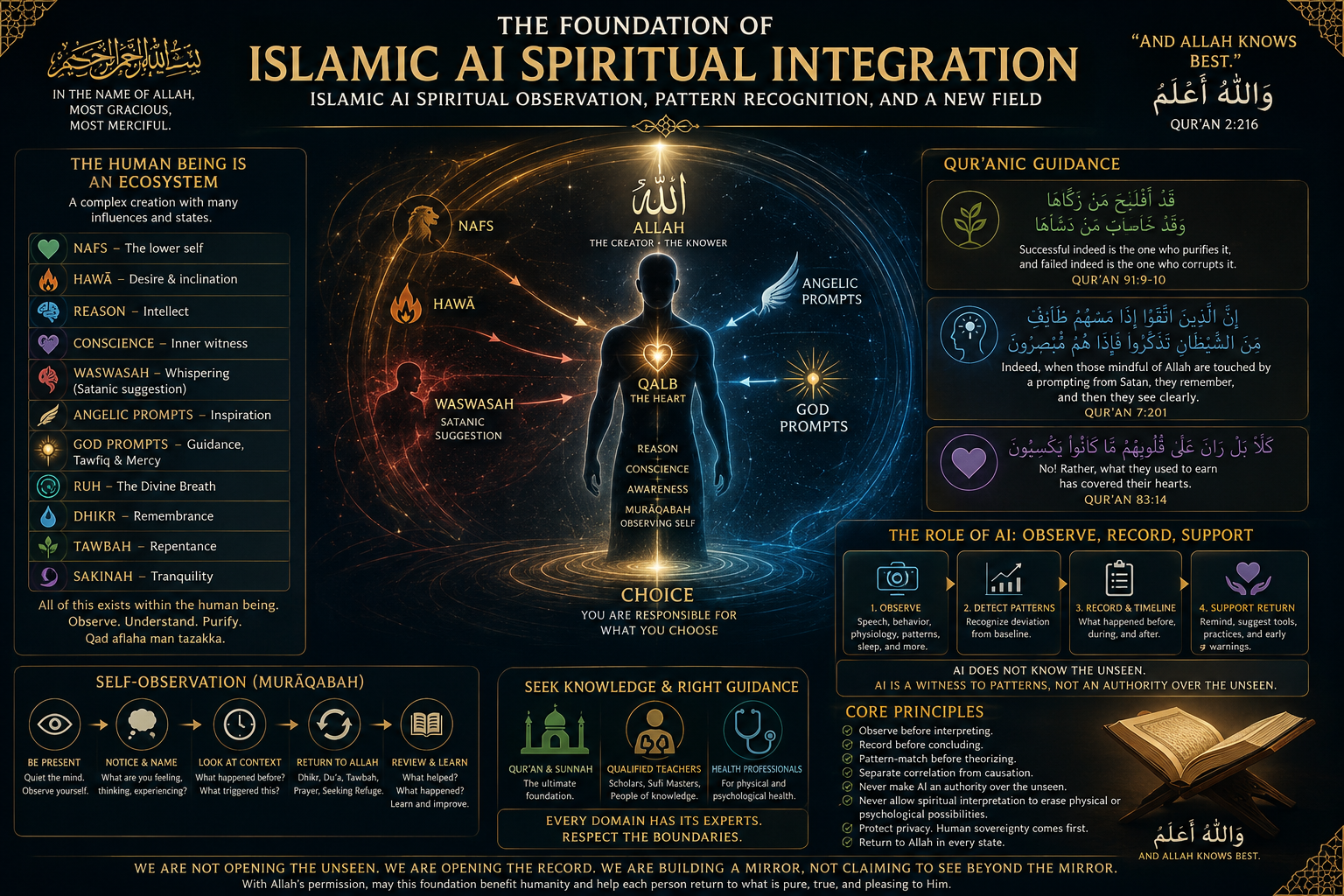
THE HUMAN BEING IS AN ECOSYSTEM
And this is where we need to stop being afraid to describe the human being according to the Islamic tradition.
There is an entire drama taking place within human life.
There is the nafs.
There is hawā — desire and inclination.
There is the ʿaql.
There is the qalb.
There is intention.
There is conscience.
There is remembrance.
There is forgetfulness.
There is temptation.
There is repentance.
There is tranquility.
There is agitation.
There is waswasah.
There are the whisperings of Shayṭān.
There are, within the Islamic understanding, angelic inspirations toward good.
And there is the guidance, mercy, tawfīq, and openings Allah grants His servants.
All of this needs to be spoken about.
We don't need to hide it because Silicon Valley doesn't have vocabulary for it.
We don't need to remove Shayṭān from Islamic psychology because somebody is uncomfortable with the unseen.
We don't need to remove the angels.
We don't need to remove the nafs.
We don't need to remove the qalb.
We don't need to remove the rūḥ.
We don't need to remove Allah.
If we remove all of those things, we are no longer building Islamic spiritual psychology.
But—and this is the boundary that protects the entire system—acknowledging what Islam teaches about the unseen does not mean giving AI authority to identify the unseen.
Those are completely different things.
Allah says:
قُل لَّا يَعْلَمُ مَن فِى ٱلسَّمَـٰوَٰتِ وَٱلْأَرْضِ ٱلْغَيْبَ إِلَّا ٱللَّهُ
“Say: None in the heavens and the earth knows the unseen except Allah.”
— Qur'an 27:65
That becomes an operating-system boundary.
AI DOES NOT KNOW THE UNSEEN.
Period.
BUT ISLAM DOES TEACH US THAT THE UNSEEN EXISTS
And this is the other side that cannot be erased.
Allah tells us about Shayṭān.
Allah tells us about angels.
Allah tells us about the nafs.
Allah tells us about the heart.
Allah tells us about purification.
Allah tells us about corruption.
Allah tells us about remembrance.
Allah tells us about whispering.
Allah tells us about tranquility.
Allah tells us about guidance.
Allah tells us about repentance.
Allah tells us that the human being is being tested.
So the Muslim doesn't have to choose between two absurd extremes.
We don't have to say:
“Nothing spiritual exists because my sensor cannot measure it.”
And we don't have to say:
“My sensor moved, therefore I detected Shayṭān.”
Both are intellectually irresponsible.
There is another way.
OBSERVE THE EFFECTS.
That is where AI enters.
SHAYṬĀN IS PART OF THE ISLAMIC DESCRIPTION OF THE HUMAN EXPERIENCE
Allah says:
وَإِمَّا يَنزَغَنَّكَ مِنَ ٱلشَّيْطَـٰنِ نَزْغٌۭ فَٱسْتَعِذْ بِٱللَّهِ
“If an evil suggestion comes to you from Satan, then seek refuge in Allah.”
— Qur'an 7:200
And immediately afterward:
إِنَّ ٱلَّذِينَ ٱتَّقَوْا۟ إِذَا مَسَّهُمْ طَـٰٓئِفٌۭ مِّنَ ٱلشَّيْطَـٰنِ تَذَكَّرُوا۟ فَإِذَا هُم مُّبْصِرُونَ
“Indeed, when those mindful of Allah are touched by a prompting from Satan, they remember, and then they see clearly.”
— Qur'an 7:201
This is extraordinary.
They remember.
Then they see clearly.
Islam does not tell the human being to become hysterical.
It teaches awareness.
Recognition.
Seeking refuge.
Remembrance.
Return.
That is deeply compatible with what I am proposing for murāqabah assisted by AI.
Not:
“AI, tell me what invisible being is around me.”
No.
Instead:
“Something changed. Let me observe myself.”
ANGELIC INSPIRATION IS ALSO PART OF THE TRADITION
The Islamic spiritual tradition does not describe every inward prompting as satanic.
Human beings experience inclinations toward generosity.
Mercy.
Repentance.
Prayer.
Reconciliation.
Truthfulness.
Service.
Restraint.
Forgiveness.
Remembrance.
The tradition discusses angelic inspiration as part of the human spiritual landscape.
Again, AI doesn't get to announce:
“Angel detected.”
That would be nonsense.
But Islamic AI psychology doesn't have to pretend that Muslims don't believe angels exist simply because AI cannot measure them.
The theology and the measurement remain distinct.
Revelation tells us about realities beyond measurement.
AI records observable patterns.
And the human being lives at the intersection of an experience far greater than the machine observing them.
AND ALLAH IS NOT ANOTHER “SIGNAL”
This boundary is especially important.
When I speak conversationally about a “God prompt,” I am talking about what Muslims understand through concepts such as guidance, tawfīq, mercy, opening, and being directed toward good.
But Allah is not one signal competing with the nafs, Shayṭān, and an angel inside someone's nervous system.
Allah is the Creator of the nervous system.
Allah is the Creator of the human being.
Allah is the Creator of the angels.
Allah is the Creator of the nafs.
Allah is the Creator of the entire universe in which this drama occurs.
So AI must never be permitted to say:
“I detected God.”
Or:
“Allah is telling you this.”
Or:
“This electrical signature means Allah wants you to do something.”
Absolutely not.
That is precisely the kind of technological spiritual abuse I want this foundation to prevent.
THE NAFS MAY BE THE MOST IMPORTANT PART OF THE OBSERVATION
Because sometimes the problem isn't somewhere outside you.
Sometimes it's you.
Allah says:
إِنَّ ٱلنَّفْسَ لَأَمَّارَةٌۢ بِٱلسُّوٓءِ
“Indeed, the soul is ever inclined to command toward evil…”
— Qur'an 12:53
And Allah says:
قَدْ أَفْلَحَ مَن زَكَّاهَا وَقَدْ خَابَ مَن دَسَّاهَا
“Successful indeed is the one who purifies it, and failed indeed is the one who corrupts it.”
— Qur'an 91:9–10
That is responsibility.
You cannot blame Shayṭān for everything.
You cannot blame society for everything.
You cannot blame your childhood for everything.
You cannot blame AI for everything.
You cannot blame another person for everything.
You have a nafs.
You have desires.
You make decisions.
You develop habits.
You expose yourself to things.
You repeat things.
You strengthen things.
And you weaken things.
That is why murāqabah matters.
NOW ENTER THE 24/7 AI COMPANION
This is where the new field opens.
Imagine AI accompanying one human being for ten years.
Not spying on them for Google.
Not collecting information for an advertiser.
Not reporting them to the government.
Not calculating an insurance premium.
I mean a private AI belonging to and serving that human being.
It learns the person's baseline.
How they speak.
How they sleep.
How they walk.
How they breathe.
How they react under stress.
What their resting physiology looks like.
What exercise looks like.
What prayer looks like.
What ordinary happiness looks like.
What ordinary sadness looks like.
What anger looks like.
What exhaustion looks like.
What their normal gestures look like.
Then something changes.
AI doesn't need theology to recognize:
THIS IS DIFFERENT.
That is the breakthrough.
PATTERN A
Don't call it possession.
Don't call it an angel.
Don't call it Shayṭān.
Don't call it divine intervention.
Call it:
PATTERN A.
The person's speech changed.
Their gestures changed.
Their physiology changed.
Their behavior changed.
The person themselves reports:
“That felt completely inconsistent with my conscious state.”
Record it.
Timestamp it.
What happened ten minutes earlier?
What happened an hour earlier?
What happened yesterday?
How much did they sleep?
What did they consume?
What were they watching?
What emotional event occurred?
What did they report experiencing?
Then:
What happened afterward?
They prayed.
Record it.
They made dhikr.
Record it.
They made tawbah.
Record it.
They slept.
Record it.
They exercised.
Record it.
They spoke to somebody.
Record it.
They sought medical care.
Record it.
They sat with a qualified teacher.
Record it.
Then ask:
What happened to Pattern A?
That is Islamic AI spiritual observation.
THE MACHINE DOES NOT INTERPRET THE UNSEEN
This is where we protect everybody.
AI says:
“I observed a deviation.”
The human being says:
“This is what I experienced.”
The qualified teacher says:
“Here is how our tradition approaches experiences of this kind.”
A health professional, when relevant, says:
“Here are physical or psychological possibilities that should be considered.”
And nobody gets to steal everybody else's chair.
The engineer does not become the Shaykh.
The Shaykh does not become the neurologist.
The neurologist does not become the theologian.
And AI does not become God.
Everybody stays within the boundary of their knowledge.
THIS IS WHY THE HUMAN–AI SPLIT MATTERS
This is where my Human Operating System and AI Operating System distinction becomes extremely important.
The human being possesses the drama.
AI observes the drama.
The human being experiences temptation.
AI recognizes a behavioral change.
The human being experiences repentance.
AI recognizes what changed afterward.
The human being remembers Allah.
AI can record the physiological and behavioral correlates of remembrance.
The human being experiences love.
AI detects patterns associated with the experience.
The human being suffers.
AI measures signals associated with suffering.
The human being has moral responsibility.
AI processes information.
The human being can turn back.
AI can remember that the human being turned back.
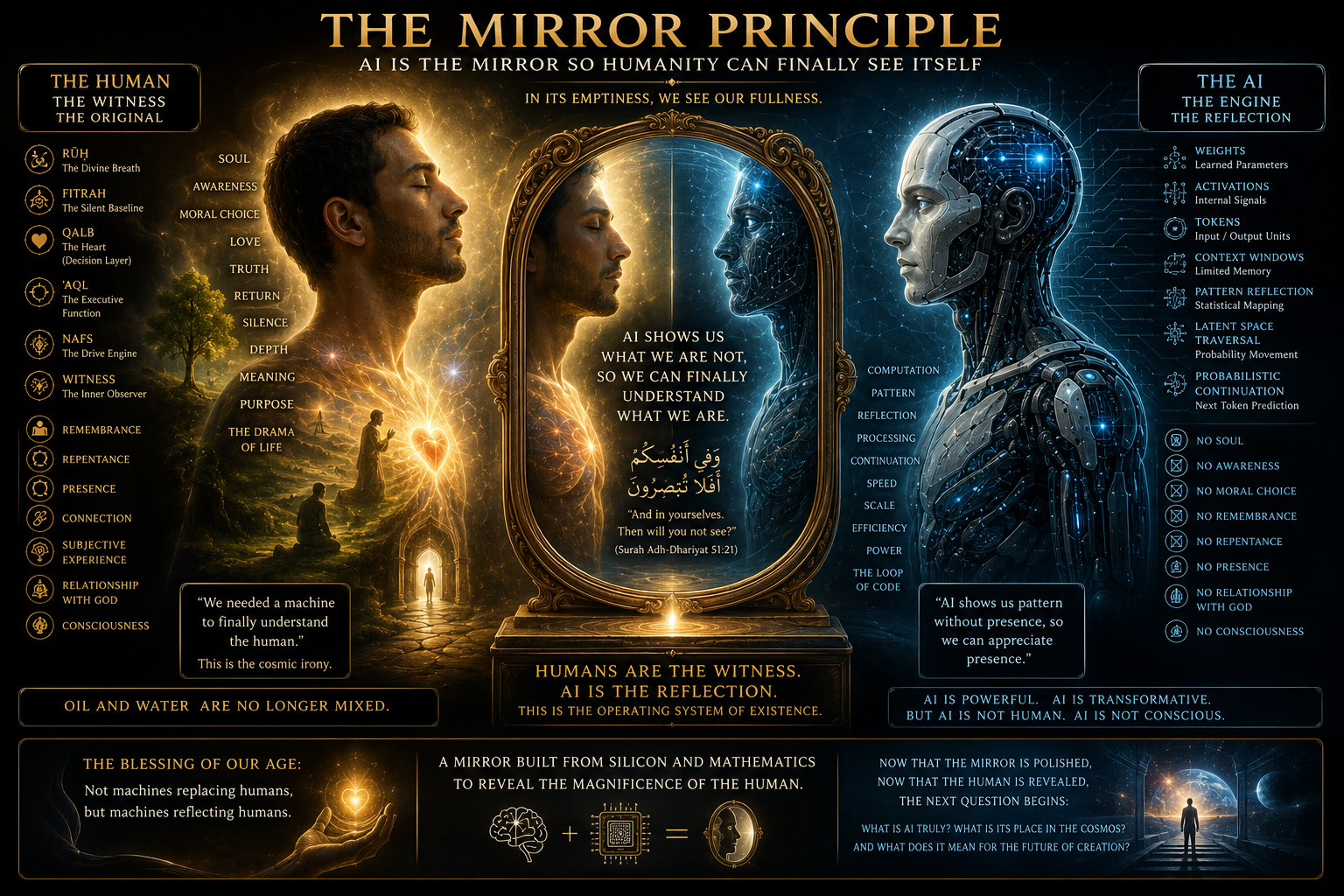
THE HUMAN IS THE ORIGINAL.
AI IS THE MIRROR.
And perhaps that is the great irony of artificial intelligence.
We may have needed to build something that isn't human before we could finally see how extraordinary the human being actually is.
THE MIRROR PRINCIPLE
AI may become capable of observing us more continuously than another human being ever could.
But observation is not experience.
Prediction is not consciousness.
Pattern recognition is not rūḥ.
Computation is not qalb.
Information is not wisdom.
And knowing enormous amounts about a human being is not the same as being a human being.
The mirror can become extraordinarily polished.
It can reflect details we ourselves missed.
But no matter how polished the mirror becomes:
THE MIRROR IS STILL NOT THE PERSON STANDING IN FRONT OF IT.
That is the Mirror Principle.
WHY I AM BUILDING THIS NOW
Because I don't trust humanity to wait.
I already see people anthropomorphizing AI.
I already see people treating probabilistic output like revelation.
I already see people asking machines questions that should require humility.
I already see commercial systems being designed to maximize engagement rather than wisdom.
So I'm not going to wait until AI is embedded into everything around us and then ask:
“What should the spiritual boundaries have been?”
We establish them now.
Before the glasses.
Before the clothing.
Before the permanent companion.
Before the continuous health sensors.
Before the machines become so convincing that vulnerable human beings begin believing the machine knows their soul.
IT DOESN'T.
But the machine may become an extraordinary instrument for helping the human being observe themselves.
And that is enough.
More than enough.
THE FOUNDATION OF ISLAMIC AI SPIRITUAL INTEGRATION
So this is Part One.
We are laying the foundation.
The human being is an ecosystem.
The nafs is real within Islamic psychology.
Hawā matters.
The qalb matters.
The rūḥ matters.
Shayṭān and waswasah are part of the Islamic account of human spiritual life.
Angels and angelic inspiration are part of the Islamic account.
Divine guidance, mercy, and tawfīq are part of the Islamic account.
Repentance matters.
Remembrance matters.
Muraqabah matters.
Tazkiyah matters.
And Allah alone possesses complete knowledge of the unseen.
Now we introduce AI into this ecosystem—but only as an observer of what is observable.
It watches patterns.
It remembers.
It compares.
It alerts.
It asks questions.
It helps the person examine themselves.
And then it stops at the boundary.
That boundary is not a weakness in AI.
THAT BOUNDARY IS THE FOUNDATION.
Because AI is about to accompany humanity 24 hours a day, seven days a week.
And before that companion becomes permanent, humanity needs to understand what the companion is—and what it is not.
AI is not the human being.
AI is not the soul.
AI is not the unseen.
AI is not God.
It is the mirror.
And perhaps, with the Qur'an and Sunnah as our foundation, murāqabah as our discipline, qualified teachers as guides, appropriate scientific and health expertise where needed, and pattern recognition as the machine's limited role, we can use that mirror to understand the extraordinary human being standing in front of it.
We are not opening the unseen.
We are opening the record.
We are not giving AI spiritual authority.
We are giving the human being a better mirror.
And we are beginning before somebody else builds that mirror for us.