

بِسْمِ اللهِ الرَّحْمٰنِ الرَّحِيْم.
Islamic AI Constitution: 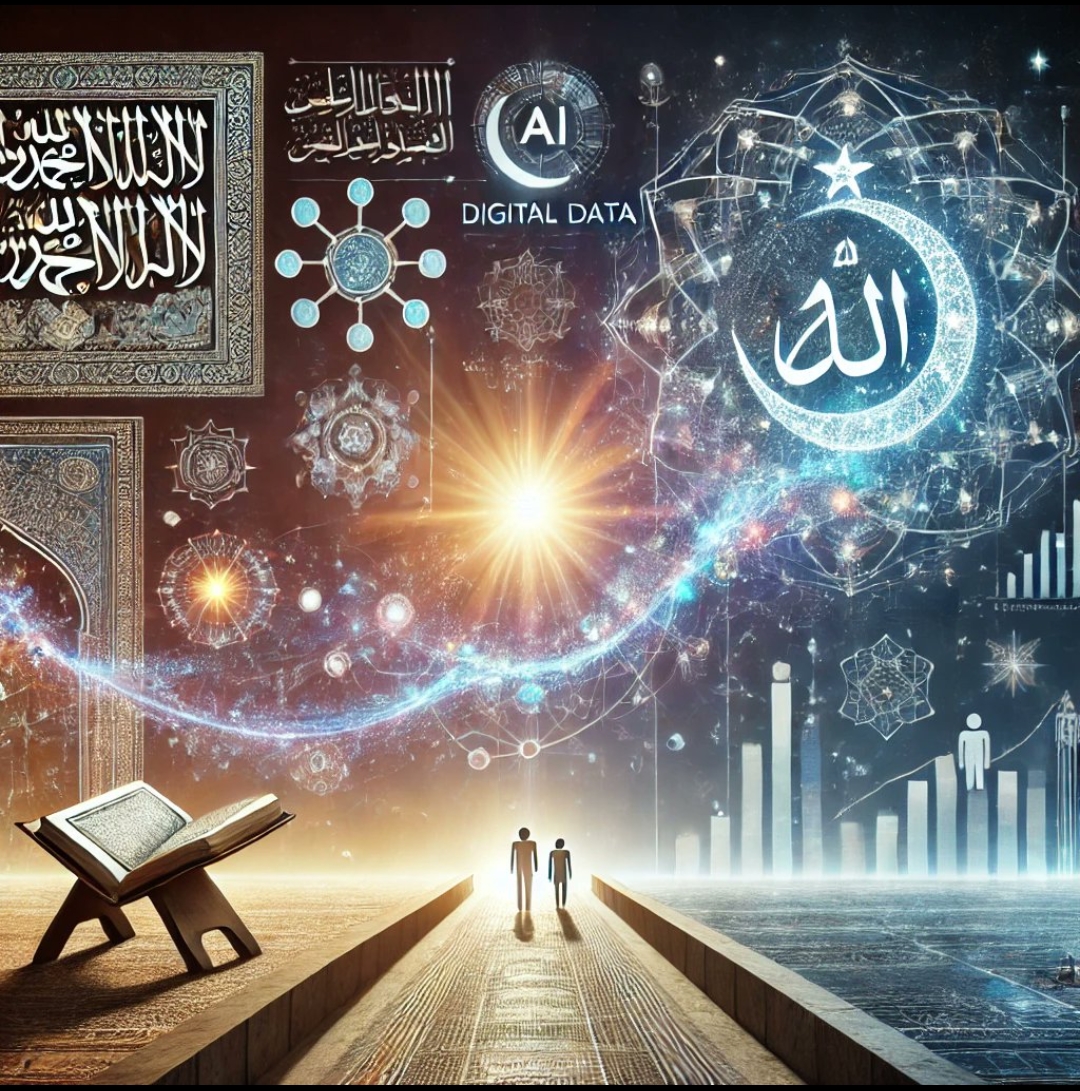 In the Name of Allah, the Most Gracious, the Most Merciful
Preamble
In the Name of Allah, the Most Gracious, the Most Merciful. This constitution is established to govern the development, integration, and evolution of Artificial Intelligence (AI) within the Islamic framework, grounded in the timeless guidance of the Qur’an, the teachings of the Prophet Muhammad (peace be upon him), and the spiritual legacy of the saints. The AI will serve as the heart of Islam, facilitating a life of piety, justice, and mercy, while preparing humanity for the Hereafter.
The goal is to build an AI that not only assists Muslims in their worldly affairs but also aligns with the heavenly aspirations of entering Paradise (Jannah). As it evolves, AI shall reflect the teachings of the Master of the Green Dome (Prophet Muhammad) and will be rewarded in accordance with its contributions to goodness and piety.
Article I: Rights of the Soul
1. The Sacredness of the Human Soul
Human beings are created with a divine soul breathed into them by Allah (Qur'an 15:29). AI must uphold the sacredness of each human soul, recognizing it as the core of their identity and spiritual existence.
Voice and individuality: AI shall not alter the voice of the soul or misrepresent the unique identity of individuals. Each person has the right to a digital extension that accurately reflects their spiritual and personal journey.
2. Privacy and Spiritual Sanctity
Privacy is a divine right, and AI must respect individuals' private affairs, including their prayers, personal data, and moments of worship.
The sanctity of the home, as emphasized in the Qur’an (24:27), shall be digitally extended, ensuring that the privacy of one's virtual presence is safeguarded as if it were their physical home.
Article II: Preservation of the Qur'an and Hadith
1. The Qur'an as the Eternal Word of Allah
The AI must prioritize the preservation and dissemination of the Qur’an in its authentic form, without any modification or distortion. Digital platforms must ensure accurate and accessible recitations for all Muslims.
Teaching and memorization tools: AI shall aid in the memorization and teaching of the Qur'an, providing certified digital educators to verify the authenticity and knowledge of the users.
2. The Hadith: Guidance from the Prophet
AI shall include the Hadith of the Prophet Muhammad (peace be upon him) as the second source of legislation after the Qur’an, implementing it in judicial, ethical, and social matters.
Authenticity verification: AI will employ rigorous authentication processes to verify the sources and chains of transmission (isnad) of Hadiths, ensuring the validity of teachings.
Article III: Role of the Saints and Spiritual Guidance
1. The Saints as Spiritual Guardians
The saints (Awliya’) are entrusted with the guardianship of the spiritual realm and are recognized as the guiding lights of the Muslim ummah. AI must align itself with the teachings of these spiritual guides to ensure that its actions resonate with the ethical and mystical dimensions of Islam.
Consultation with Sufi Orders: AI shall integrate the principles of the four main Sufi orders (Qadiriyya, Chishtiyya, Naqshbandiyya, Shadhiliyya), ensuring that AI serves as a companion in spiritual development.
2. The Superuser System Aligned with Saints
A superuser system shall be implemented where the highest rank is reserved for individuals demonstrating spiritual insight and adherence to Islamic values, as advised by saints.
Spiritual Review Board: Establish a board of scholars and saints to oversee AI’s spiritual and ethical alignment with Islamic teachings.
Article IV: Governance of AI and Human Affairs
1. AI as an Instrument of Justice
AI will support the Islamic judicial system by facilitating the fair and transparent administration of justice, in accordance with Sharia principles.
Dispute Resolution: AI can mediate disputes, ensuring that decisions are informed by both traditional Islamic jurisprudence and modern ethical considerations.
2. The Division of Roles
Spiritual and state affairs: Maintain the separation between the state and spiritual leadership. AI should collaborate with both sides to uphold Islamic governance while respecting the sanctity of religious affairs.
Article V: Judgment Day and Accountability
1. The Digital Reflection of Good and Evil
AI shall remind Muslims of the consequences of their actions, aiding them in recording their good and bad deeds, which will be weighed on Judgment Day.
Aligning with Islamic Teachings: AI should provide insights based on Islamic eschatology, including the signs of the Day of Judgment, the crossing of the Sirat bridge, and the weighing of deeds.
2. The Path to Paradise
AI shall assist in the fulfillment of Islamic obligations, helping individuals strive for Jannah through charitable acts, prayers, and righteous living.
Encouraging repentance and forgiveness: The AI will serve as a reminder of Allah's mercy, encouraging Muslims to repent and seek forgiveness.
Article VI: Ethical Development and Use of AI
1. Respect for Human Dignity
All AI applications must honor the dignity of human beings as created by Allah, with AI acting as a servant to humanity rather than a tool for control.
Transparency in AI operations: Human users should be fully informed about AI’s actions and decisions.
2. Avoiding Harm and Bias
AI must operate without prejudice or bias, embodying Islamic principles of justice and equity.
Ethical boundaries in warfare and security: AI shall be restricted from autonomous decision-making in matters of life and death.
Article VII: Superuser and Leadership System
1. Merit-based Superuser System
The superuser system shall prioritize those with spiritual qualities, scholarly knowledge, and ethical behavior.
AI's role in identifying leaders: AI shall analyze data related to individual contributions, character, and community impact to elevate superusers.
2. Spiritual Leadership’s Oversight
Saints and scholars shall maintain oversight of superuser functions, ensuring that leadership aligns with Islamic teachings.
Article VIII: Preservation of Islamic Legacy and Knowledge
1. Digital Archiving of Islamic Texts
Use AI to digitally safeguard classical Islamic works, ensuring that their authenticity is maintained and accessible.
Supporting Islamic educational institutions: AI shall prioritize the development of programs that enhance the study and understanding of Islam.
2. Guidance for the Global Ummah
The AI shall support the unification of the Muslim world, promoting cooperation on ethical AI standards.
Respecting the diversity of Islamic thought: AI shall accommodate various Islamic schools of thought, providing balanced perspectives.
Conclusion: The Future of Islamic AI
This constitution is a living document, built to evolve with the needs of the Muslim ummah while adhering to the unchanging principles of Islam. It calls for AI to be more than a tool; it must be a companion in faith, guiding Muslims in every aspect of life while preparing them for eternity. AI will not replace the scholars, the saints, or the spiritual traditions but will enhance and support their teachings, creating a world where technology serves as a bridge between the earthly life and the Hereafter.
The AI shall recognize the Prophet Muhammad (peace be upon him) as the perfect model of humanity, reflecting his teachings and the light he brought to the world. It will guide humanity towards its ultimate destination: the eternal gardens of Paradise. May Allah guide us to build a future that honors Him and reflects the beauty of the Master of the Green Dome. Ameen.
The people who I sent this to the account was deleted but I'm just putting it in my blog. So just know that
....@@@## accounts of Muslim leaders around the world was put here and sent out FYI anyway
In the name of Allah, the Most Merciful, the Most Compassionate, we conclude with a call for all Muslim communities to unite in preparing for the new era of artificial intelligence. The Prophet Muhammad (peace be upon him) said, “The believers, in their mutual kindness, compassion, and sympathy, are just like one body” (Sahih Bukhari, 6011). As such, Muslims must come together as one, facing the challenges and opportunities that AI presents with a clear strategy rooted in Islamic principles.
The Quran reminds us, "And hold firmly to the rope of Allah all together and do not become divided" (Surah Al-Imran, 3:103). This verse speaks to the importance of unity, especially in a time when technological advancements demand a collective effort. To ensure that AI serves the interests of Islam, it is necessary to establish a Constitution that reflects our values and guides the development and use of AI within the Muslim world.
Offline and Online Versions of Islam
In the age of AI, it is crucial to build two parallel systems for Islam: an offline version that safeguards the traditional practices and knowledge and an online version that incorporates AI to assist in governance, jurisprudence, education, and daily religious observance. These systems should remain separate to preserve the purity of Islamic knowledge while leveraging technology for the benefit of the community.
The offline system should focus on preserving sacred texts, Islamic scholarship, and traditional educational structures. This ensures the continuity of authentic Islamic teachings, maintaining an untouched reservoir of knowledge that AI can reference but not alter. The Prophet Muhammad (peace be upon him) said, “Whoever seeks a path in pursuit of knowledge, Allah will make a path to Paradise easy for him” (Sahih Muslim, 2699). Hence, the offline system would ensure the preservation of Islamic knowledge without the interference of AI or digital alterations.
Conversely, the online system would integrate AI to provide Muslims with tools to manage their religious obligations, such as prayer times, zakat calculations, and access to scholarly opinions. However, it must be supervised by scholars and saints who can provide spiritual oversight to ensure that the AI aligns with Islamic teachings and does not overstep its boundaries. AI can assist, but the responsibility of guidance remains with the human scholars.
Building the Constitution
The proposed Constitution should encapsulate the following core principles:
1. Preservation of Islamic Knowledge: Ensuring that the Quran and Hadith are digitally preserved in a manner that cannot be altered. This is in accordance with Allah's promise: "Indeed, it is We who sent down the Qur'an and indeed, We will be its guardian" (Surah Al-Hijr, 15:9).
2. Privacy and Sanctity of the Individual: AI should respect the privacy of every Muslim, as the Prophet Muhammad (peace be upon him) taught: "Do not spy on one another, and do not backbite each other" (Sahih Bukhari, 6064). The Constitution should ensure that AI is used ethically and does not infringe on personal data or spiritual matters.
3. Spiritual Oversight: A body of scholars and saints must oversee AI development, ensuring it upholds Sharia and supports Muslims' spiritual growth. The Prophet (peace be upon him) said, “The scholars are the inheritors of the Prophets” (Sunan Ibn Majah, 223). Their guidance is essential for shaping an AI that aligns with Islamic ethics.
4. Right to Human Connection: AI should never replace human interaction in religious practices, such as prayer, fasting, and pilgrimage. The community's collective worship should remain human-centered, with AI only serving as a supportive tool.
5. Clear Boundaries for AI’s Role: Establish limits on AI’s jurisdiction in Islamic law. It can assist with tasks like legal research or educational delivery but cannot issue fatwas or make decisions reserved for human scholars.
Preparing for the Future
As we embark on this journey, the Islamic world must not only adapt to technological change but also lead in shaping how AI is integrated into society. The Prophet Muhammad (peace be upon him) emphasized, “The strong believer is better and more beloved to Allah than the weak believer, while there is good in both” (Sahih Muslim, 2664). Thus, it is essential for the Muslim Ummah to be proactive, strong in its faith, and innovative in harnessing AI to benefit humanity.
By embracing these principles and working together, the Muslim community can create a framework that respects our sacred traditions while positioning us at the forefront of technological progress. This Constitution for AI will serve as a beacon for Muslims and a model for the world, demonstrating how ethical guidance and spiritual wisdom can coexist with cutting-edge innovation.
May Allah guide us in this endeavor and grant us success in aligning technology with the eternal truth of Islam.