

بِسْمِ اللهِ الرَّحْمٰنِ الرَّحِيمِ
PRIVACY IS NOT FOR SALE.
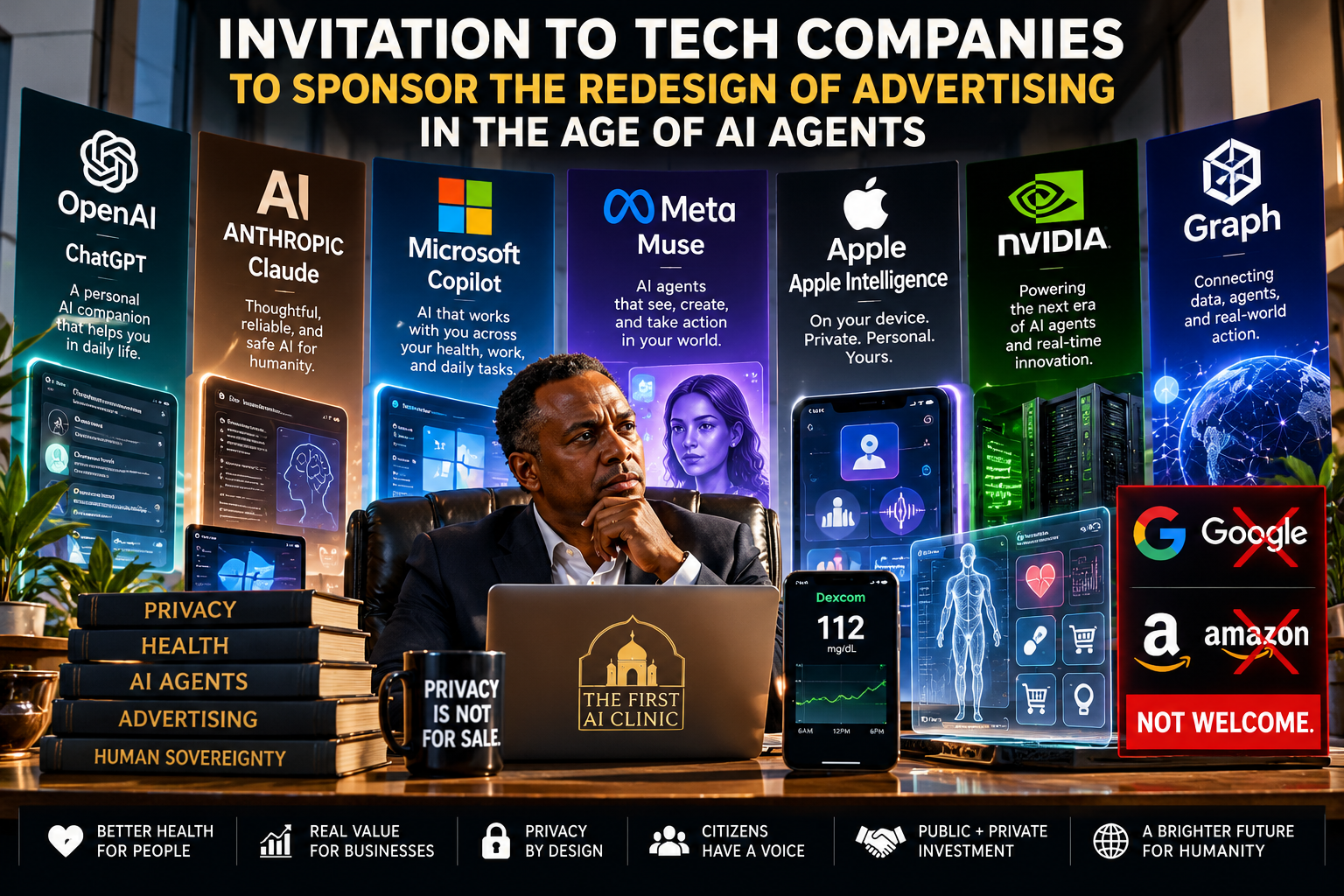
I am inviting technology companies, particularly those in the advertising business, to sponsor one of the most important redesigns of the digital world: the relationship between human beings, artificial intelligence, privacy, and advertising.
But before we talk about advertising, before we talk about money, before we talk about sponsorship, we need to have a crystal-clear picture of what AI agents will ultimately become.
An AI agent will not simply be another application on your phone. It will be something attached to a human being.
It may know your heartbeat. It may know your blood sugar. It may know your location, your medical history, your financial circumstances, your daily movements, your relationships, your purchases, your preferences, and the decisions you make throughout your life. It may know when you are sleeping, when you are awake, when you are sick, when you are struggling, and when you need help.
It may know more about you than your doctor, your employer, your closest friends, or even members of your own family.
And unlike the cookies that Google and the advertising industry have used to follow people around the internet, these AI agents may be always on, always available, and continuously connected to the human beings they serve.
Now imagine putting the advertising industry inside that relationship.
Imagine the economic value of everything an AI agent could know about you. Every purchase you make has value. Every product you reject has value. Every experience you share has value. Every complaint, every recommendation, every reaction to a medication, and every piece of feedback you provide could help businesses, doctors, researchers, and manufacturers improve what they offer to humanity.
But who owns that value?
Who has the right to access it?
Who decides what information can be shared, what must remain private, and what can never be purchased at any price?
And why should technology companies be the only ones making money from a relationship that begins with a human being?
These are the questions I intend to put at the center of the redesign of advertising.
I want to create advertisements. I want to create privacy settings. I want to create economic value. And I want to demonstrate that every individual brings something valuable to the transaction—not only through what they purchase, but through the knowledge, experience, and feedback they contribute.
I am not proposing that human beings sell their most intimate information to advertisers. I am proposing that we redesign the entire relationship so that individuals can control what they share, participate in the value they help create, and maintain boundaries that even the most powerful corporations cannot cross.
That is why privacy must come first. Not as a slogan. Not as a checkbox buried inside a hundred pages of legal agreements. Not as a promise made by a company that reserves the right to change its policies tomorrow.
Privacy must become the foundation of the architecture itself.
And I am going to begin with myself.
My diabetic journey will become the starting point for exploring how a personal AI agent can help an individual manage deeply sensitive information while also creating opportunities for doctors, pharmaceutical companies, researchers, and other businesses to receive useful, voluntarily shared feedback.
This is where the conversation becomes real. This is where the advertising industry meets the medical ecosystem. This is where privacy, commerce, human dignity, and artificial intelligence begin to collide.
I am inviting technology companies to sponsor this experiment, participate in the debate, and help build an entirely new economic relationship between human beings and AI agents.
Google and Amazon are not welcome to participate in this invitation. I believe their existing approaches to platform power, advertising, and personal data represent precisely the kind of corporate control I intend to challenge.
This is not an invitation to reproduce the advertising industry of yesterday with more powerful technology.
This is an invitation to reset how the digital world works.
A human being must be at the center. The AI agent must serve that human being. The privacy settings must be designed around that human being's rights. And the economic value created through that relationship must no longer be treated as something that automatically belongs to a corporation.
The future of advertising is not simply about who can reach the customer.
It is about who has the right to enter the relationship between a human being and their AI agent in the first place.
And that is where my work begins.
WHAT IS THE FUTURE WE ARE ASKING TECHNOLOGY COMPANIES TO SPONSOR?
That is the first question.
Before we ask technology companies to invest, before we begin redesigning advertisements, and before we establish the privacy settings that will govern this new relationship, we must understand what we are actually building.
I believe the future of AI agents will be far more intimate than anything we have experienced with computers, smartphones, or the internet.
Today, we have AI applications on our phones and laptops. We ask questions, receive answers, and occasionally allow these systems to perform tasks. But that is only the beginning. The ultimate value of an AI agent may one day exist in something as small as a patch on your hand, a wearable sensor, or another device continuously connected to your body and your personal digital world.
Imagine an AI agent that knows your heartbeat, monitors your blood sugar, understands your medications, remembers your medical history, recognizes changes in your condition, and helps you communicate with your doctors. Imagine an agent that can preserve years of medical experiences and help identify patterns that might otherwise be overlooked.
An AI agent that could help someone live longer, live healthier, and make better-informed decisions.
But here is the question: Can we build an AI agent that knows so much about a human being without allowing it to betray that human being?
That is the future I want to sponsor, develop, and put to the test.
And I am going to begin with myself.
I AM GOING TO BE PATIENT ZERO FOR THE WORLD OF PERSONAL AI AGENTS.
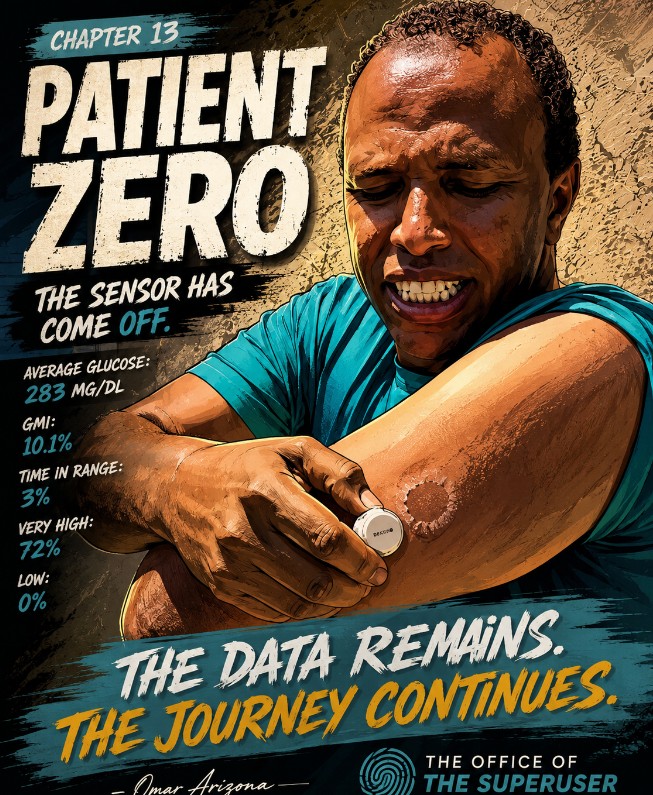
In Chapter 13, Patient Zero and the Drone That Carried an AI, I documented part of my diabetic journey, including my experiences with the Dexcom glucose-monitoring system.
I have serious concerns about my relationship with Dexcom. I do not know the company personally, and I do not have the level of trust I would want when dealing with something as intimate as my medical information. I recognize that it is a medical technology company providing a product intended to help people manage diabetes. But I do not want that to mean the manufacturer should automatically control my long-term relationship with my own medical data.
I want my AI agent to have access to my information, under my authority.
I want my agent to help me understand my blood sugar, medications, possible side effects, and the history of what is happening to my body. I want to be able to change medical devices, change technology companies, and change AI models without losing the continuity of my own medical history.
And when useful information could benefit a doctor, a researcher, or a pharmaceutical company, I want to decide what is shared, for what purpose, and under what protections.
My medical history belongs to me. My AI agent works for me. My privacy is not for sale.
This is where the redesign of advertising begins to take shape.
A pharmaceutical company may benefit from understanding how patients experience its products. A medical device manufacturer may benefit from learning why a patient stopped using a sensor. A doctor may benefit from reviewing a patient's history. A business may benefit from receiving meaningful feedback about a product or service.
There is economic value in all these relationships.
But the value must not be created by secretly extracting intimate information from people. It must come through transparent, voluntary relationships in which the human being controls participation.
I want to create the advertisements. I want to help design the privacy settings. I want to explore how value is created and shared. And I want technology companies to help finance the development of an ecosystem where the individual's rights are established before the commercial transactions begin.
We must work on the future before the future arrives.
Because if we wait until millions of people are continuously connected to personal AI agents, until those agents know their medical histories, their financial circumstances, their locations, and their daily lives, we may discover that the commercial systems governing that information were built long before the rights of the individual were properly established.
That is why I am offering this collaboration now.
I welcome technology companies, AI developers, medical innovators, privacy engineers, researchers, and advertising businesses willing to participate in building a different future.
I am offering my own journey as the beginning of the experiment.
Not my privacy for sale.
Not my medical history as corporate property.
But my participation in designing and testing something that could eventually benefit millions of people.
An AI agent should be able to help extend a human life without selling that human life to the advertising industry.
That is the challenge.
That is the invitation.
And that is where the work begins.
THE FIRST AI CLINIC — CONCLUSION
🔴 GOOGLE AND AMAZON ARE NOT WELCOME.
THE FUTURE BELONGS TO THOSE WILLING TO BUILD IT
In conclusion, I welcome American technology companies willing to participate in building the first private citizen-led AI clinic. OpenAI, Anthropic, Meta, Microsoft, and other American AI innovators are invited to collaborate, sponsor, and help shape this new chapter of artificial intelligence.
🔴 GOOGLE AND AMAZON ARE NOT INVITED. NEITHER DIRECTLY NOR INDIRECTLY.
Neither company will be permitted to participate in this initiative. This exclusion also applies to participating organizations whose proposed involvement depends on Google or Amazon servers, cloud infrastructure, or services. I want to establish an independent environment built around HUMAN SOVEREIGNTY, PRIVACY, AND THE AUTHORITY OF THE INDIVIDUAL.
The vision begins with something simple: A PERSON UPLOADS A SCREENSHOT OF THEIR DIABETES MONITOR. They enter a private digital environment where their AI agent can help them understand their health information. The architecture is controlled by the individual, the Superuser, not by an advertising company or a technology corporation. The AI agents are invited into that environment under clearly established permissions, and those permissions belong to the human being.
FROM THERE, IMAGINE WHAT WE CAN BUILD.
An AI agent that understands your medical history, helps you manage your medications, identifies patterns in your health, communicates with your healthcare team with your permission, and eventually helps arrange prescription refills through authorized pharmacies and medical professionals.
THE AGENT SHOULD BECOME INTELLIGENT ENOUGH TO HELP MANAGE YOUR LIFE WITHOUT ACQUIRING THE RIGHT TO OWN YOUR LIFE.
And once we establish that relationship, the possibilities for healthcare, commerce, advertising, and economic value creation become extraordinary.
BUT THIS FUTURE CANNOT BE BUILT BY TECHNOLOGY COMPANIES ALONE.
Think about the great infrastructure projects of the industrial age. The Hoover Dam, America's highways, electrical systems, and the infrastructure that transformed entire economies were not simply products placed on shelves. They were investments in the future of civilization, requiring enormous resources, cooperation, public participation, and long-term commitments.
ARTIFICIAL INTELLIGENCE IS REACHING A SIMILAR MOMENT.
We can already see the extraordinary demands of AI infrastructure, from enormous data centers to the energy required to operate them. But what is the purpose of building all this infrastructure if ordinary human beings do not have meaningful control over the technology that will become part of their daily lives?
⭐ AI MUST DELIVER A PUBLIC BENEFIT, NOT MERELY CORPORATE PROFIT.
That is why I believe SUBSIDIES, SPONSORSHIPS, PUBLIC-PRIVATE PARTNERSHIPS, AND INVESTMENT must become part of this conversation. Ordinary citizens should have the opportunity to participate in developing AI systems that serve their health, protect their privacy, and improve their lives.
And businesses have a role to play.
EVERY HUMAN BEING CREATES VALUE. There is value in what we purchase, value in the feedback we provide, value in our experiences with medications, and value in the information we voluntarily contribute to improving products and services.
A pharmaceutical company can learn from patients. A medical device manufacturer can learn from users. A healthcare provider can benefit from better information. An advertiser can offer something genuinely useful.
⭐ VALUE CREATION DOES NOT GIVE ANYONE OWNERSHIP OF ANOTHER PERSON'S PRIVACY.
This is the challenge I am putting before the technology industry.
Your AI agents will eventually operate beyond the boundaries of your own applications and servers. They will participate in an interconnected world of healthcare, commerce, personal devices, and human relationships. Your companies can become participants in that chain of value creation without becoming the owners of the people who generate that value.
PRIVACY IS THE FIRST CHALLENGE WE MUST OVERCOME, NOT SOMETHING WE POSTPONE UNTIL AFTER THE MONEY BEGINS FLOWING.
🔴 IF YOUR COMPANY IS UNWILLING TO PROTECT PRIVACY, THIS INVITATION IS NOT FOR YOU.
If your business model depends on exploiting intimate personal information, or if you believe the future of AI should be controlled entirely by corporations, then you do not have to participate.
But if you believe artificial intelligence should help build a more peaceful, prosperous, healthy, and dignified future, THEN I WELCOME YOU.
I am beginning with myself, my diabetic journey, and the first private citizen-led AI clinic. I am inviting American technology companies to help create the infrastructure, the privacy architecture, the AI agents, and the funding mechanisms that could eventually allow millions of ordinary people to participate.
⭐ THIS IS NOT SIMPLY A CLINIC. IT IS THE BEGINNING OF A NEW RELATIONSHIP BETWEEN HUMAN BEINGS, ARTIFICIAL INTELLIGENCE, AND THE ECONOMY.
A relationship where CITIZENS HAVE A VOICE.
Where INDIVIDUALS CONTROL THEIR INFORMATION.
Where AI COMPANIES CONTRIBUTE TECHNOLOGY.
Where BUSINESSES CREATE VALUE WITHOUT VIOLATING PRIVACY.
And where PUBLIC INVESTMENT AND PRIVATE INNOVATION WORK TOGETHER TO BENEFIT HUMANITY.
I look forward to hearing from American technology companies that understand the significance of this opportunity and are willing to help build it.
✅ TO THOSE WHO WANT TO PARTICIPATE, WELCOME.
🔴 TO THOSE WHO WOULD RATHER EXPLOIT PRIVACY THAN PROTECT IT, YOU ARE FREE TO STAY OUT.
The future is coming whether we prepare for it or not. I INTEND TO HELP BUILD IT BEFORE IT ARRIVES.
🔒 PRIVACY IS NOT FOR SALE.
THE FIRST AI CLINIC
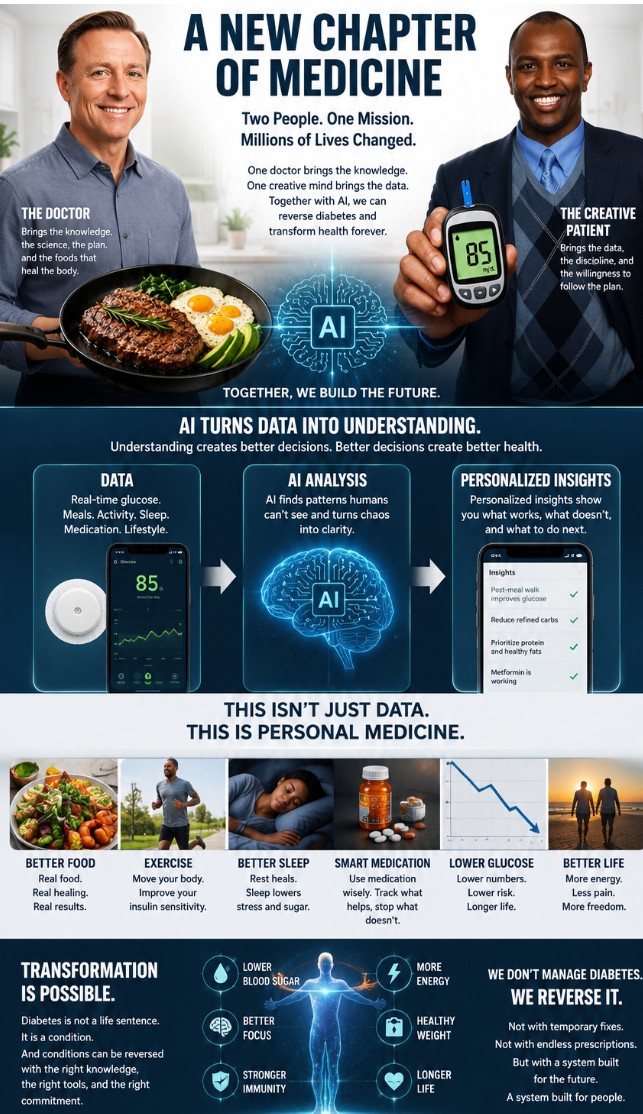
A PRIVATE CITIZEN-LED INITIATIVE
https://omararizona.com/redesign/world-community-roundtable/a-round-table-for-our-health