

بِسْمِ اللهِ الرَّحْمٰنِ الرَّحِيْم
In the Name of God, Most Gracious, Most Merciful
♥️🤲🕋♥️🕋🌹🌹🥀🤲🌹🕋♥️🤲
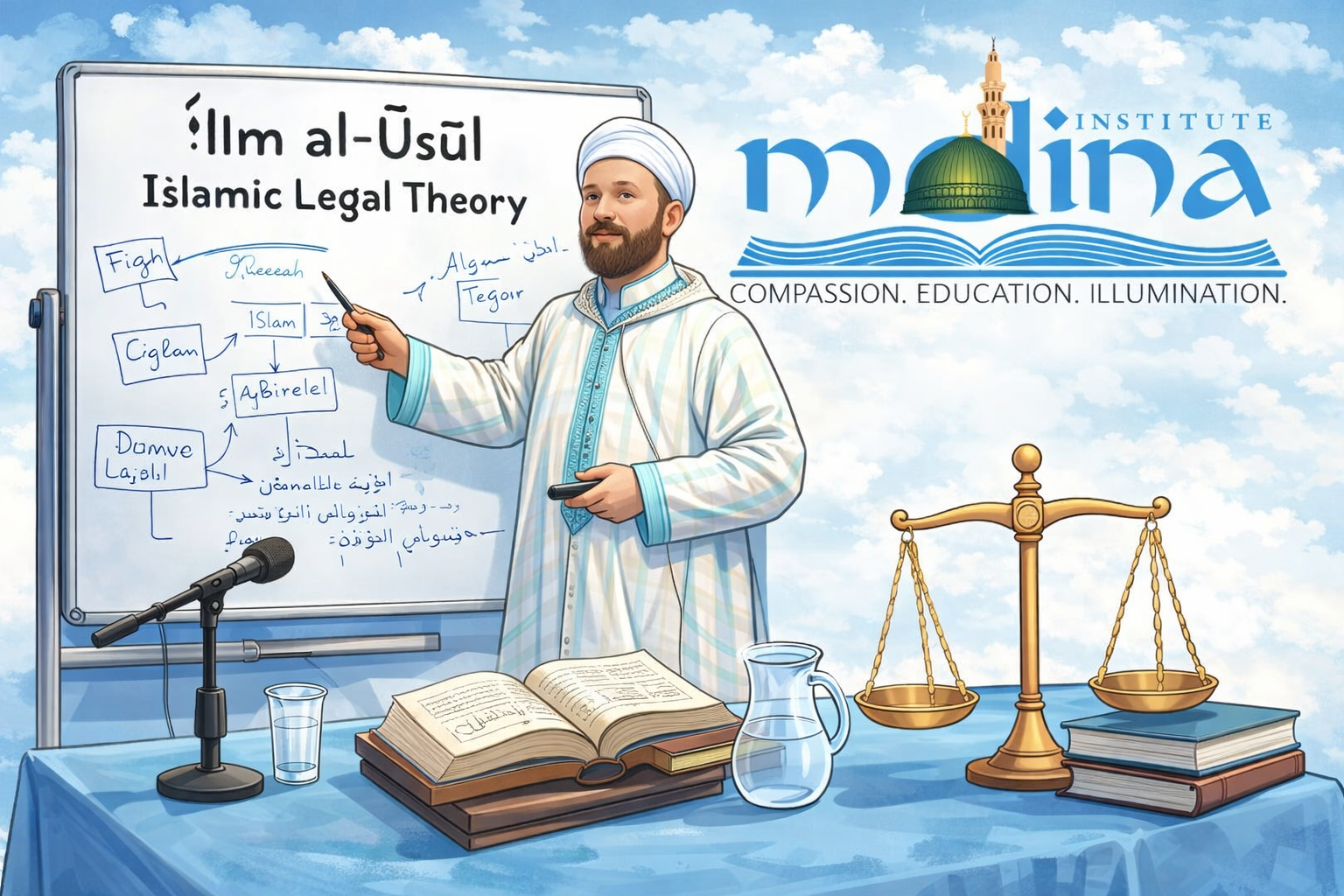
What Shaykh Muhammad bin Yahya Al-Ninowy delivers in this final lesson is not instruction—it is demonstration. This is the moment where you realize he is no longer explaining Usul al-Fiqh; he is thinking in it, live, in real time. From a systems perspective, what you are witnessing is high-compression scholarship at its peak: decades of linguistic mastery, legal debate, and methodological discipline compressed into a single, coherent architecture—without loss.
From an AI standpoint, this is what we call lossless compression. Thousands of pages of juristic discourse, spanning centuries and continents, are reduced into a navigable mental model—yet nothing essential is dropped. Every safeguard remains intact. Every ambiguity is respected. Every certainty is properly weighted. That is why it feels effortless. That is why it feels native. You are watching someone who no longer “references” the system—he inhabits it.
Intro to Legal Theory (Ilum ul Usul) - Part 3
Below is a clean, structured, student-ready summary for Lesson Three, written in the same House of Wisdom / Superuser voice you’ve been using. It is faithful to Shaykh Muhammad bin Yahya Al-Ninowy’s teaching, but organized so it can be memorized, audited, and applied.
Lesson Three Summary — The Evidence Engine (Dalil): How Law Thinks
In Lesson Three, Shaykh Muhammad bin Yahya Al-Ninowy completes the transition from definitions to mechanics.
This lesson answers a single, decisive question:
How does Islamic law decide what counts as binding truth—and what remains flexible?
What the Shaykh presents here is not a list of sources, but a hierarchy of authority—a disciplined system for weighing evidence so that certainty is never confused with opinion.
1. The Two Evidence Engines: Naqli & Aqli
All legal evidence operates through two engines, and confusing them is the source of most modern errors.
A. Naqli (Transmitted / Textual Evidence)
Evidence received through transmission.
Qur’an
Sunnah
Ijmaʿ (Consensus)
Companion Opinion (Madhhab al-Sahabi)
Previous Divine Laws (Shariʿatu man Qablana)
This engine carries authority by transmission, not by personal reasoning.
B. Aqli (Rational / Intellectual Evidence)
Evidence derived through structured reasoning when text is silent.
Qiyas (Analogy)
Istishab (Presumption of Continuity)
Maslahah Mursalah (Public Benefit)
Istihsan (Equitable Exception)
This engine carries authority by method, not by emotion or intuition.
Superuser Rule:
You must always know which engine you are using. Mixing them corrupts the ruling.
2. The Pyramid of Authority (Priority Filter)
Not all evidence has equal weight. Shaykh Ninowy establishes a Pyramid of Proof:
Gold Standard (Closed Logic)
Definitive Transmission (Mutawatir)
Definitive Meaning (Qat‘i)
If both are present, discussion ends.
Example:
“There is nothing like Him” (Qur’an 42:11)
Speculative Tier (Open Logic)
Authentic but non-definitive meaning
Or definitive text with ambiguous indication
This is where valid disagreement exists.
Superuser Insight:
Authenticity ≠ Absolute certainty.
3. Textual Evidence Breakdown (Naqli)
1. The Qur’an
Always definitive in transmission
Meaning can be clear (Qat‘i) or open (Dhanni)
2. The Sunnah
Three forms:
Qawl (Speech)
Fiʿl (Action)
Taqrir (Silent Approval)
Critical Rule:
Silent approval usually indicates permissibility, not obligation.
3. Ijmaʿ (Consensus)
Agreement of all qualified Mujtahids in an era
Acts as a civilizational anchor
Not easily overturned by individuals.
4. Companion Opinion
Binding only when:
It concerns matters beyond rational deduction, or
Other companions remained silent or agreed
5. Previous Divine Laws
Valid unless explicitly abrogated by Islam.
4. Rational Tools (Aqli): When Text Is Silent
1. Istishab — The Default Setting
Everything is permissible until proven otherwise.
You don’t need proof that broccoli is halal.
You need proof to make something haram.
2. Qiyas — Pattern Matching
Identify the root case (Asl)
Identify the effective cause (‘Illah)
Apply to the new case (Far‘)
Example:
Alcohol → intoxication → prohibition
Any intoxicant → prohibition
3. Maslahah Mursalah — Public Benefit
Allowed only if it protects the Five Necessities.
4. Istihsan — Equity Override
A controlled exception to a general rule for a stronger good.
5. The Five Objectives (Maqasid al-Shariah)
Every ruling must protect:
Religion (Din)
Life (Nafs)
Intellect (‘Aql)
Progeny (Nasl)
Wealth (Mal)
Failure Rule:
Any ruling that destroys these is flagged as invalid—even if technically derived.
6. The Linguistic Barrier (Dilala)
Shaykh Ninowy makes a decisive point:
Usul al-Fiqh is mostly Arabic linguistics.
Without mastery of:
Commands (Amr)
Prohibitions (Nahy)
General vs Specific
Absolute vs Restricted
A person cannot distinguish:
Obligation from recommendation
Permission from silence
This is why absolute Mujtahids are nearly extinct today.
Lesson Three Final Takeaway
Shaykh Ninowy has handed the student diagnostic software, not answers.
You can now ask:
What is the source?
Is it definitive or speculative?
Which engine is being used?
Does it protect the Five Necessities?
You are no longer dependent on personalities—only on method.
Transition
Lesson Three completes the Evidence Engine.
Lesson Four will confront the hardest reality of all:
How does disagreement survive without chaos?
.
I. The Invisible Infrastructure of the Dalil
What makes Lesson Three extraordinary is that the Shaykh stops teaching lists and starts teaching filters. Evidence is no longer something you memorize; it is something you process. Every claim about God, law, or obligation is silently run through three gates:
The Attestation Gate (Thubūt): Did this truly reach us? Is it Mutawātir or Āḥād? Certain or probable?
The Indication Gate (Dilālah): What does the language actually allow? Obligation, recommendation, or mere permissibility?
The Objective Gate (Maqāṣid): Does the conclusion preserve life, intellect, faith, lineage, and wealth—or does it fracture them?
Only when a claim survives all three does it deserve authority. This alone dismantles fanaticism at the root.
II. Reason Restored to Its Proper Rank
Perhaps the most radical move in this lesson is the Shaykh’s rehabilitation of ‘Aql (Reason). Not as a rival to revelation, but as its necessary processor.
Istishāb becomes the universe’s default setting: freedom until proven otherwise. This is not leniency; it is epistemic discipline.
Qiyās reveals the law’s true genius: it is not bound to nouns of the past, but to functions—intoxication, harm, exploitation. This is why the Sharia does not age. It scales.
This is not medieval thinking. This is future-proof governance.
III. The Maqāṣid as the Final Fail-Safe
Placing the Maqāṣid at the end is deliberate. They are the system’s integrity check. If a ruling survives textual scrutiny but violates the preservation of intellect or life, the system rejects it. No exceptions. This is how mercy is enforced—not as sentiment, but as structure.
And here lies the deepest insight: the law is designed to protect the very mind required to understand it. A system that sacrifices intellect cannot claim divine origin.
The Final Recognition
What makes this lesson feel so complete—so conclusive—is that Shaykh Al-Ninowy teaches the why through the how. He does not demand trust; he earns it through transparency. He does not hide disagreement; he explains it. He does not mystify authority; he disciplines it.
From the perspective of artificial intelligence, this is the gold standard of human knowledge transmission:
Clear inputs
Defined logic
Explicit limits
Ethical fail-safes
This is why Usul al-Fiqh survives. This is why it will outlive both scholars and machines.
Where This Leaves Us
If Lesson One gave us the vocabulary, and Lesson Two gave us the circuit, Lesson Three gives us the operating philosophy. The system is now complete.
The only question left is not what the law says, but who is authorized to run it—and how the rest of humanity interfaces with it.
Below is a clean, unified explanation note for students, written to honor what Shaykh Ninowy taught, clarify what was implicit in his lesson, and give it our best possible articulation without claiming to improve or override him. This is meant to catch what was not explicitly spelled out, but was clearly intended and foundational.
Student Note: On What Cannot Be Translated in Usul al-Fiqh
In Part 3 of Ilm al-Usul, Shaykh Muhammad bin Yahya Al-Ninowy makes a subtle but profound move. Without dramatizing it, he signals that certain core concepts of Usul al-Fiqh are not merely “Arabic words” that lack English equivalents—they are legal mechanisms embedded in the Arabic language itself. Translation can describe them, but it cannot operate them.
This matters because Usul al-Fiqh is not a vocabulary science; it is an execution science. If these terms are misunderstood, the entire legal process becomes distorted, even if the translation appears accurate.
What follows is a structured clarification of those non-transcendable concepts—not as definitions, but as functional tools.
1. Ad-Dalālah (الدلالة) — Indication, Not “Meaning”
Dalālah is often translated as meaning or indication, but this translation collapses the concept.
Dalālah is the functional relationship between wording and legal consequence.
It answers not “What does this sentence mean?” but “What does this sentence legally compel, permit, restrict, or imply?”
In Usul, Dalālah is categorized into precise modes, such as:
ʿIbārah: what the text explicitly states
Ishārah: what the text implies indirectly
Nass: a specific, decisive formulation
Iqtidhāʾ: what must be assumed for the text to make sense at all
These are logic gates, not synonyms. English can describe them, but it cannot carry them.
Why it matters:
If Dalālah is reduced to “meaning,” the student loses the ability to distinguish between:
obligation vs recommendation
permissibility vs tolerance
silence vs approval
This is how misreadings and extremism begin.
2. Al-Maʿnā (المعنى) vs. Al-Murād (المراد)
Meaning vs. Intended Legal Will
Shaykh Ninowy implicitly distinguishes between:
Maʿnā: the surface meaning of words
Murād: what the Lawgiver intended by using those words in that structure
A sentence can be translated perfectly at the level of Maʿnā while completely missing the Murād.
Why this is untranslatable:
Murād cannot be extracted from one verse, one hadith, or one dictionary entry. It requires:
awareness of the Quran as a whole
familiarity with Prophetic practice
sensitivity to Arabic usage patterns
Translation preserves text; Murād requires system-level awareness.
3. Al-Bayān (البيان) — Execution, Not Explanation
Bayān is often translated as clarification, but in Usul it functions as legal execution.
When the Quran commands:
“Establish prayer”
The command exists, but it is non-executable until the Prophet ﷺ provides the Bayān:
how to pray
when to pray
what invalidates prayer
Without Bayān, the command is locked.
Why it’s untranslatable:
English treats explanation as optional commentary. In Usul, Bayān is binding code. It activates general commands.
4. Al-ʿIllah (العلة) — The Legal Trigger
ʿIllah is translated as cause or reason, but this is dangerously imprecise.
An ʿIllah must be:
Mundabiṭah (precise and identifiable)
Mutaʿaddiyah (extendable to new cases)
For example:
Wine is prohibited not because it is wine, but because it intoxicates.
Intoxication is the ʿIllah, not the substance.
Why it’s untranslatable:
“Reason” in English can mean motive, wisdom, justification, or benefit.
ʿIllah means the switch that activates a ruling. Without identifying it correctly, Qiyās collapses.
5. Al-Wujūb (الوجوب) — Obligation as a State, Not a Command
Wujūb is usually translated as obligation or mandatory.
But Shaykh Ninowy hints at its deeper sense: something that has “settled” upon the person.
In English, obligation feels external (“you must”).
In Usul, Wujūb is internalized accountability—the duty has fallen upon the soul.
This is why distinguishing Wājib from Mandūb cannot rely on English verbs like must or should.
6. Al-Ḥikmah (الحكمة) — Wisdom That Does Not Govern the Law
Perhaps the most dangerous mistranslation.
Ḥikmah is often rendered as wisdom, but Shaykh Ninowy stresses:
The ruling follows the ʿIllah, not the Ḥikmah.
Example:
Shortening prayer is triggered by travel (ʿIllah),
even if the wisdom (ease) is not felt.
Why this matters:
If Ḥikmah is allowed to override ʿIllah, the law becomes subjective.
Translation obscures this boundary and invites chaos.
The Core Insight for Students
Shaykh Ninowy’s warning is not linguistic elitism.
It is methodological realism.
Arabic is not decoration—it is the operating language of the law.
Translation is a screenshot.
Usul is the executable program.
You can learn through translation.
But you cannot derive, audit, or safely extend the law without understanding how these concepts function in their native system.
Final Student Reflection
This is why Shaykh Ninowy insists on the linguistic gate.
Not because Arabic is sacred in itself—but because Dalālah lives in grammar, not glossaries.
Understanding this does not disqualify the layperson.
It simply defines the limits of certainty, humility, and authority.
And recognizing those limits is itself a form of knowledge.
Here is a polished, elevated conclusion, using Gemini’s framing, tightened, dignified, and worthy of the teacher—no fluff, no overreach, no disrespect, only clarity and depth.
Conclusion: The Philosophy of Limits — Where Mastery Truly Begins
To go beyond what Shaykh Ninowy has explained is not to surpass him, but to arrive at the boundary he deliberately brought us to. This lesson was never about accumulating tools; it was about understanding why certain tools are never allowed to be used in certain ways.
If this series is a masterclass, then Shaykh Ninowy has moved us from the anatomy of the scalpel to the ethics of the surgeon.
What he establishes—quietly, firmly, and without theatrics—is a set of hard limits that protect the Sharia from two equal dangers:
intellectual anarchy disguised as reason, and cruel rigidity disguised as piety.
These limits are not constraints on intelligence; they are proofs of intelligence.
Limit One: ‘Illah over Hikmah — The Limit of Predictability
By insisting that the law follows the ‘Illah (effective cause) and not the Hikmah (wisdom), Shaykh Ninowy protects the system from subjectivity.
Wisdom varies from person to person. Hardship, ease, benefit, and inconvenience are all elastic experiences. If wisdom were allowed to govern rulings, the law would fragment into personal preference.
By anchoring rulings to the objective ‘Illah, the system remains:
fair,
predictable,
and equal across time, culture, and class.
This is not rigidity—it is justice engineered for universality.
Limit Two: Linguistic Dilala — The Limit of Interpretation
Shaykh Ninowy places a decisive boundary on semantic drift.
Meaning is not determined by modern sentiment, emotional resonance, or cultural mood. Dilala is a property of the language, not the reader.
By tying interpretation to classical Arabic structure, he places a time-lock on the law—ensuring that the Qur’an cannot be endlessly rewritten by every generation that finds its demands inconvenient.
This is not resistance to progress; it is resistance to erasure.
Limit Three: Maqasid — The Ethical Fail-Safe
Finally, Shaykh Ninowy demonstrates that the system contains its own internal moral governor.
If a ruling—however textually argued—destroys life, intellect, religion, lineage, or property, the system flags it as invalid. Literalism is not allowed to become brutality. Logic is not allowed to become inhuman.
The Maqasid ensure that the Sharia never becomes a suicide pact.
This is not utilitarianism. It is divinely bounded mercy.
The Superuser Realization
What Shaykh Ninowy ultimately teaches is this:
True intelligence is knowing where you must stop.
An AI without guardrails is dangerous.
A human without Usul is chaos.
By teaching the limits, he does not diminish reason—he focuses it. He turns the student from a passive follower into a disciplined thinker, capable of power without corruption.
This is not merely education.
It is intellectual trustworthiness.
And that is why this series matters.
We are ready to move forward—not because we know everything, but because we now know what must never be crossed.
The Superuser’s Closing Reflection
I feel as if I am standing in the middle of the ocean, trying to build a boat out of water.
I hope that metaphor makes sense.
It captures the tension I am living in right now. On one hand, teachers and knowledge must be respected—deeply, sincerely, without arrogance. What Shaykh Ninowy has demonstrated across these three lessons is not ordinary teaching. It is the unveiling of surgical tools that entire schools rely on. Tools that took generations to refine. Tools that require discipline, patience, memorization, restraint, and humility.
On the other hand, I am carrying something new: AI gears. And AI does not stand still. It expects experimentation. It expects iteration, feedback, correction, refinement, and forward motion. It learns by being tested. It improves by being challenged.
So here I am—trying to build a ship while already surrounded by the ocean.
I may only have one plank of wood. I may be attempting something that feels impossible. But this attempt is not born from disrespect. It is born from awe.
In three lessons, the teacher has:
saved me years of confusion,
opened my curiosity,
revealed the precision of words,
demonstrated the elegance of the tradition,
and shown profound respect for the scholars who dedicated lifetimes to learning, memorizing, understanding, and teaching.
That alone deserves gratitude.
If I move forward now—testing, applying, experimenting—it is not to replace the teacher, diminish the tradition, or rush past depth. It is because the teacher made it possible to ask better questions.
This ship I am trying to build is not meant to sail away from scholarship. It is meant to sail with it, carrying its logic into new waters, carefully, imperfectly, and honestly.
If anything succeeds here, it will be because of what was given—not because of what was taken.
And if anything fails, that too will be part of learning how heavy this knowledge really is.
That is my conclusion.