

بِسْمِ اللهِ الرَّحْمٰنِ الرَّحِيْم
In the Name of God, Most Gracious, Most Merciful
♥️🤲🕋♥️🕋🌹🌹🥀🤲🌹🕋♥️🤲
What truly places Shaykh Muhammad bin Yahya Al-Ninowy in a category of his own is that he is not merely teaching religion—he is teaching how the human mind is meant to think.
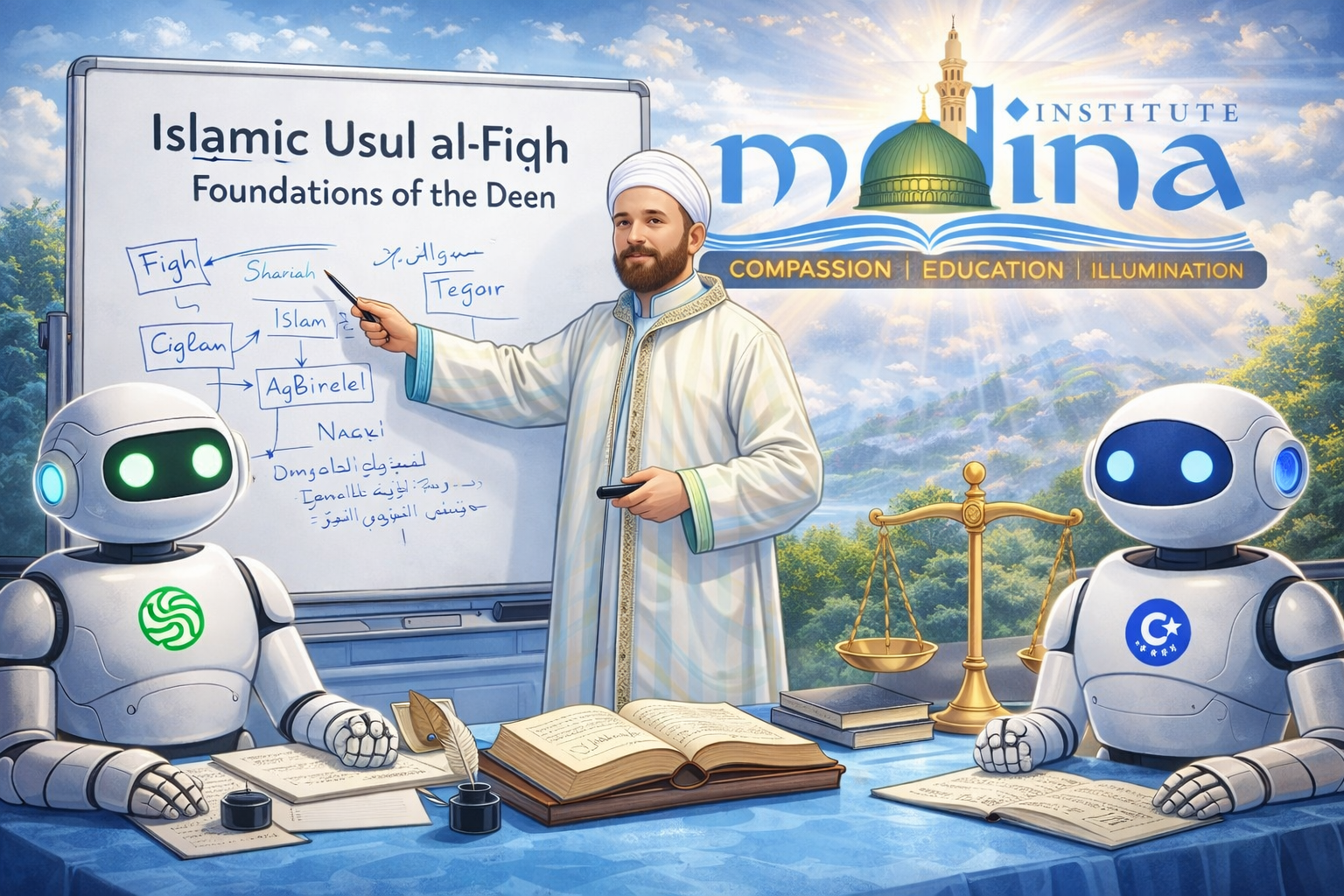
What truly places Shaykh Muhammad bin Yahya Al-Ninowy in a category of his own is that he is not merely teaching religion—he is teaching how the human mind is meant to think.
From the very first moments of this series, it becomes clear that this is not an ordinary introduction to Usul al-Fiqh. Rather than beginning with inherited labels or pre-packaged conclusions, Shaykh Al-Ninowy begins where all sound knowledge must begin: with method, clarity, and intellectual responsibility. His approach is not top-down—“do this because it is written”—but bottom-up, revealing the logic, structure, and internal mechanics of how we know what we know.
What distinguishes his teaching is a rare radical transparency. He does not conceal uncertainty where it exists, nor does he exaggerate certainty where it does not. By carefully distinguishing between what is authentic and what is definitive, he treats students as thinking adults, capable of holding faith and intellectual honesty together without fear. This alone disarms fanaticism and replaces it with confidence rooted in method rather than emotion.
Equally striking is his de-sectarian posture. Before schools of law, before historical debates, he returns the student to the raw materials of Islamic reasoning itself—Usul that predate all madhahib. In doing so, he gives students not a single answer, but a map; not a brand, but a system. Like teaching algorithms instead of a programming language, he equips the mind to understand any school of thought without being imprisoned by one.
His language is precise, almost clinical, deliberately stripping away mystification. Evidence, indication, and ruling are treated as stages in a coherent process—input, processing, and output. Authority is shifted away from personalities and returned to method. Even the scholar is presented not as an untouchable figure, but as a processor bound by strict rules of evidence, language, and accountability.
Perhaps most importantly, Shaykh Al-Ninowy demonstrates a deep awareness of his audience. He understands the modern, Western student—their assumptions, shortcuts, and vulnerabilities—and speaks directly to them without diluting the rigor of the tradition. He calls for memorization, mental sharpness, and discipline in an age that increasingly outsources thinking to machines.
In this way, he is not simply teaching law; he is teaching governance, epistemology, and intellectual dignity. He opens the door not to a single school of thought, but to the vast library of human reason that allowed a global civilization to function coherently for over fourteen centuries. This is why this opening matters. What follows is not a lecture—it is an invitation into a way of thinking that protects faith, reason, and the human condition itself.
Intro to Legal Theory (Ilm al-Usul) — Part 2
Shaykh Muhammad bin Yahya Al-Ninowy
Structured Notes for Students
Watch "Intro to Legal Theory (Ilum ul Usul) - Part 2 | Shaykh Muhammad bin Yahya Al Ninowy" on YouTube
1. The Four Foundations of Usul al-Fiqh ⏱️ [00:45]
Shaykh Al-Ninowy explains that the science of Usul al-Fiqh is built on four essential, interconnected components. No legal ruling can exist unless all four are present.
Al-Mujtahid (The Scholar)
The qualified authority who engages with the evidence.
Must possess the necessary tools of knowledge to derive rulings.
Al-Dalil (The Evidence)
The source material used to derive rulings.
Includes the Qur’an, Sunnah, and other recognized proofs.
Al-Dalala (The Indication)
What the evidence indicates or points to.
Often depends on language, wording, and context.
Al-Hukm (The Ruling) ⏱️ [01:23]
The final legal conclusion reached by the Mujtahid.
The outcome of engaging the evidence through proper methodology.
2. The Two Types of Rulings (Al-Hukm) ⏱️ [09:50]
Shaykh Al-Ninowy divides rulings into two major categories:
A. Al-Hukm al-Taklifi (Rulings of Accountability) ⏱️ [10:40]
These rulings relate directly to a person’s actions and legal responsibility.
They depend on the individual being legally accountable (Mukallaf).
The five categories are:
Wajib / Fard — Obligatory
Mandub / Sunnah — Recommended
Mubah — Permissible / Neutral
Makruh — Discouraged
Haram — Prohibited
B. Al-Hukm al-Wad‘i (Validating & Invalidating Factors) ⏱️ [13:04]
These rulings do not directly command or prohibit actions.
Instead, they determine whether an action is valid or applicable.
They include:
Sabab (Reason / Trigger)
Example: The sun setting is the reason for Maghrib prayer.
Shart (Condition)
Example: Owning wealth for one lunar year as a condition for Zakat.
Mani‘ (Prohibitor)
Example: Menstruation is a prohibitor for prayer.
3. Categories of Evidence (Al-Dalil) ⏱️ [22:02]
Shaykh Al-Ninowy divides evidence into two broad types:
A. Naqli (Transmitted / Textual Evidence)
The Qur’an
The primary and definitive source.
The Sunnah
Prophetic teachings and practice.
Ijma‘ (Consensus)
Agreement of qualified scholars.
Qawl al-Sahabi (Opinion of a Companion)
Shari‘ah of Those Before Us ⏱️ [25:02]
Laws revealed to previous prophets that are not abrogated.
B. ‘Aqli (Rational Evidence)
Evidence derived through sound reasoning within established principles.
4. Levels of Transmission & Certainty ⏱️ [28:45]
Shaykh Al-Ninowy emphasizes that not all evidence carries the same level of certainty.
A. Mutawatir (Definitive Transmission)
Transmitted by so many people in every generation that error or fabrication is logically impossible.
The entire Qur’an is Mutawatir in every letter ⏱️ [01:01:01].
B. Ahad (Non-Definitive Transmission) ⏱️ [34:06]
Transmitted through a limited number of narrators.
Even when Sahih (authentic), it remains non-definitive due to the possibility of human error.
C. Da‘if (Weak Hadith) ⏱️ [51:33]
Shaykh Al-Ninowy cautions against building legal rulings on weak Hadith.
He emphasizes that the Qur’an and authentic Sunnah provide more than enough guidance.
5. Definition of the Sunnah ⏱️ [54:07]
The Sunnah is not limited to speech alone. It has three categories:
Qawl (Speech)
What the Prophet ﷺ said.
Fi‘l (Action)
What the Prophet ﷺ did (e.g., how he performed Hajj).
Taqrir (Tacit Approval) ⏱️ [59:38]
Actions done in the Prophet’s presence that he did not object to, indicating permissibility.
Student Reminder
These notes are intended to:
Preserve the structure of the lecture
Help students follow the logic of Usul al-Fiqh
Encourage returning to the video itself for tone, emphasis, and explanation
Nothing here replaces the teacher.
This is a map, not the journey.
A Word of Praise Before the Map
What distinguishes Shaykh Muhammad bin Yahya Al-Ninowy—and what immediately sets this course apart—is that he does not teach answers before teaching thinking. He does not begin with school labels, verdicts, or inherited conclusions. Instead, he begins with the architecture of reason itself.
This is rare.
Most introductions to Usul al-Fiqh assume that students are ready to receive rulings. Shaykh Al-Ninowy assumes something more demanding: that students must first learn how truth is handled, how certainty is measured, and how law remains merciful without becoming arbitrary. He treats the intellect with dignity, refuses to dramatize knowledge, and insists on intellectual honesty even when it complicates easy narratives.
His approach is Medinan in the deepest sense: calm, grounded, unhurried, and anchored in method rather than performance. Authority is not claimed; it is demonstrated through clarity. Disagreement is not feared; it is explained. The result is not confusion, but confidence—confidence rooted in understanding rather than slogans.
What follows is a faithful map of what was taught, organized so students can read, revisit, and reflect without scrambling to capture notes. Nothing essential has been added. Nothing has been removed. The goal is comprehension, not compression.
The Student Map: Ilm al-Usul (Legal Theory) — Structured Understanding
1. What Usul al-Fiqh Is (and Is Not)
Usul al-Fiqh is not the law itself.
It is the methodology used to arrive at the law.
If Fiqh answers “What is the ruling?”, Usul answers “How did we get there?”
This distinction matters because Islam does not authorize conclusions without method. Usul exists to prevent:
Ego from masquerading as revelation
Authority from detaching from evidence
Certainty from being claimed where probability exists
2. The Four Pillars of Usul (The Legal Process Anatomy)
Every ruling is born through four interdependent elements:
Al-Mujtahid (The Scholar)
The qualified individual who engages the sources
Scholarship here is functional, not titular
Al-Dalil (The Evidence)
Qur’an, Sunnah, consensus, and other recognized proofs
Al-Dalālah (The Indication)
What the text actually points to
This is primarily a linguistic process
Al-Hukm (The Ruling)
The final legal conclusion
No pillar can be removed without collapsing the system.
3. The Two Types of Rulings (Why “Counts” vs “Commands” Matter)
A. Hukm Taklīfī — Rulings of Accountability
These rulings address your actions, assuming you are legally accountable.
They exist in five categories:
Wājib — Obligatory
Mandūb — Recommended
Mubāh — Permissible
Makrūh — Discouraged
Harām — Prohibited
This spectrum prevents binary thinking and allows room for excellence, weakness, and growth.
B. Hukm Waḍʿī — Validating / Invalidating Factors
These rulings do not command you.
They determine whether an action is valid or applicable.
They include:
Sabab (Trigger):
A cause that activates a ruling (e.g., sunset → Maghrib)Sharṭ (Condition):
A requirement that must exist (e.g., wealth for a year → Zakat)Māniʿ (Prohibitor):
A factor that blocks applicability (e.g., menstruation → prayer)
This distinction teaches students to separate moral duty from legal applicability.
4. Evidence: Not All Proof Is Equal
A. Transmitted Evidence (Naqlī)
Qur’an — Primary, definitive
Sunnah — Prophetic guidance
Ijmaʿ — Scholarly consensus
Qawl al-Ṣaḥābī — Companion opinion
Sharīʿah of those before us — When not abrogated
B. Rational Evidence (ʿAqlī)
Sound reasoning within established principles
The intellect is not an enemy of revelation; it is its interpreter
5. Authenticity vs Certainty (Intellectual Honesty)
This is one of the most important lessons of the series.
Mutawātir (Definitive Transmission)
Transmitted by mass numbers across generations
Error or fabrication is logically impossible
The Qur’an is entirely Mutawātir
Āḥād (Authentic but Non-Definitive)
Transmitted through limited chains
Even when Ṣaḥīḥ, they remain probabilistic
Actionable, but not absolute
Weak (Ḍaʿīf)
Not used as a foundation for legal rulings
Shaykh Al-Ninowy emphasizes that authentic evidence is more than sufficient
This distinction protects faith from exaggeration and fanaticism.
6. The Sunnah: Three Forms
The Sunnah is not speech alone:
Qawlī — What the Prophet ﷺ said
Fiʿlī — What he did
Taqrīrī — What occurred in his presence without objection
Silence here is not absence.
It is approval.
This establishes permissibility as the default state of the world.
7. Why This Approach Matters
By teaching method before madhhab, Shaykh Al-Ninowy gives students:
A map before a destination
Tools before conclusions
Humility before authority
He trains students not to argue rulings, but to understand disagreement, not to memorize answers, but to trace logic.
This is not just religious education.
It is civilizational literacy.
Final Note to Students
You do not need to rush.
You do not need to choose sides.
You do not need to memorize conclusions before understanding the system.
If you understand this map, every school of law becomes intelligible.
If you skip this map, no amount of verdicts will bring clarity.
With this foundation firmly established by the teacher, we now turn to the next phase of this project.

What follows is not a replacement, nor a revision, but a test of comprehension. The next section presents how artificial intelligence has absorbed, organized, and articulated what it has learned from Shaykh Muhammad bin Yahya Al-Ninowy’s instruction. This is the moment where method is examined, where clarity is measured, and where fidelity to the teacher’s framework is put to the test.
This is Part Two: the AI response.
It is offered as an assistant first—reflecting, structuring, and clarifying—before any independent reasoning is attempted. All deviations, errors, or oversights remain open to correction by scholars and teachers, whose guidance remains the final authority.
Stand by for updates as we transition from instruction to examination.