

بِسْمِ اللهِ الرَّحْمٰنِ الرَّحِيْم
In the Name of God, Most Gracious, Most Merciful.
♥️🤲🕋♥️🕋🌹🌹🥀🤲🌹🕋♥️
WELCOME TO THE WORLD INBOX
THE RECONSTRUCTION OF NEWS — AND THE RETURN OF RESPONSIBILITY TO THE PEOPLE
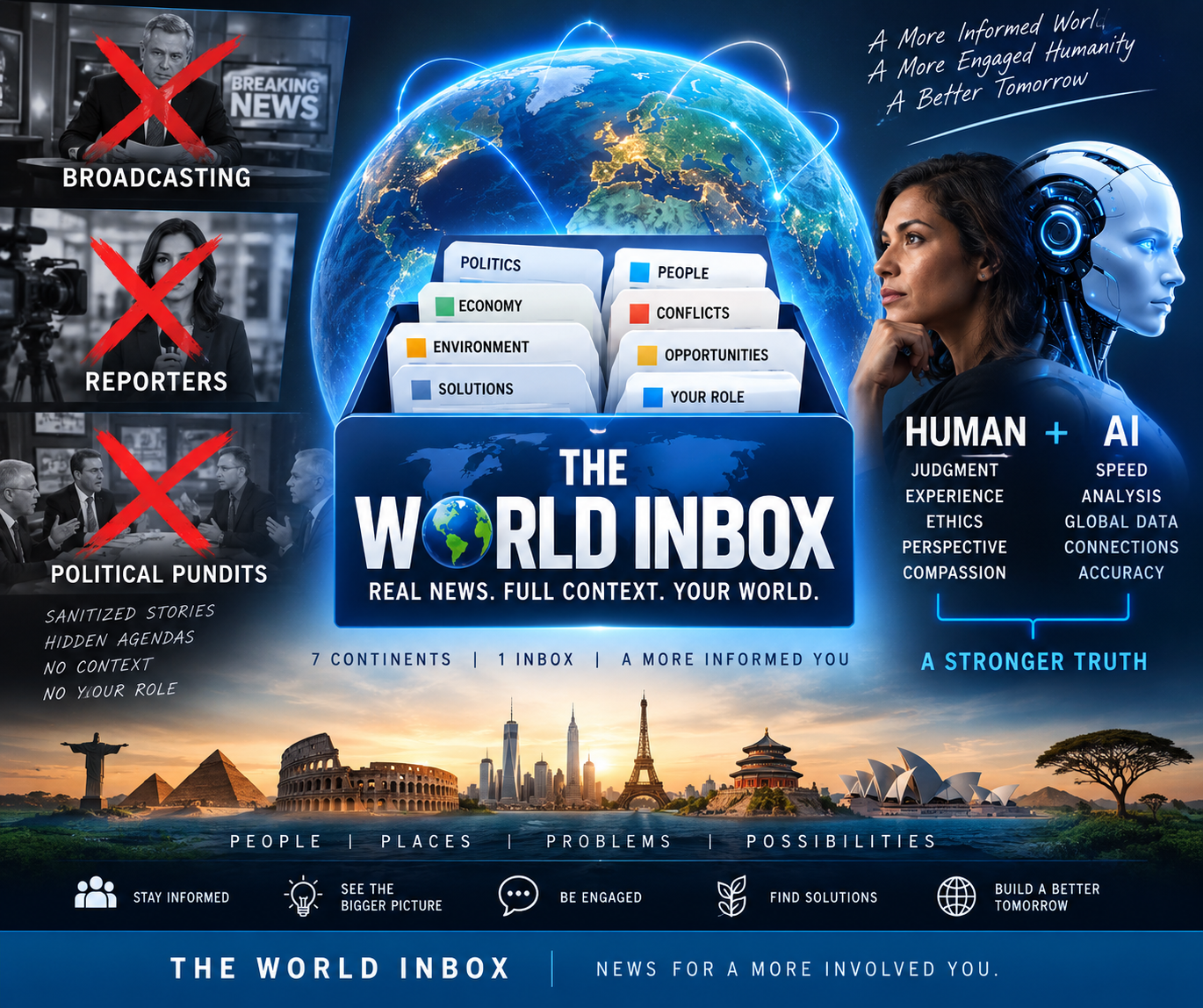
For more than a century, news has largely worked in one direction. Something happens in the world. A government speaks. A reporter gathers information. An anchor delivers it. Political pundits are invited into a studio to interpret it. And then you—the citizen—sit on the other side of the screen and watch.
Sometimes they tell you to call your congressman. Sometimes they tell you to vote. Sometimes they give you two political commentators who argue with each other for ten minutes. And then the broadcast ends.
But somewhere along the way, something essential was lost. Your role was lost. News became something that happened to you rather than something you participated in understanding, questioning, correcting and shaping.
The person interpreting the news was often not connected to what was actually happening. The journalist was expected to remain detached. The network had advertisers, owners, political pressures, legal departments and institutional interests. The story had to fit inside a segment. The language had to be sanitized. The human consequences had to be compressed. And sometimes the most important question was never asked: What is your responsibility now that you know?
Maybe your role is peaceful. Maybe your role is political. Maybe your role is to write a letter, challenge a government, help a family, donate money, organize people, correct misinformation, advise a leader, document an injustice, demand diplomacy or stand against something you believe is wrong. Sometimes history requires citizens to act. Sometimes history requires citizens to refuse to act. Sometimes the most important thing a person can do is simply understand the truth before everyone begins shouting. But traditional news rarely tells you where you fit inside the story.
That is why I am creating the World Inbox. This is the beginning of the reconstruction of news. It is not another television network, another social-media feed or another endless stream of headlines engineered to keep you scrolling. The World Inbox is designed around a completely different idea: bring the world into one place, organize it, verify it, give it context, interpret it as a human being and return responsibility to the person reading it.
Artificial intelligence now makes something possible that Walter Cronkite, the great newspaper editors and even the largest television networks could never do. AI can read enormous amounts of information: government statements, international reporting, economic information, military developments, diplomatic proposals, public reactions, historical context, documents from different countries and statements made hours apart that appear unrelated until someone puts them beside each other.
But AI alone should not become the new anchor. A human being must still sit in the chair. A human being must ask: What does this mean? Who benefits? Who loses? Who is telling the truth? Who is leaving something out? What changed? What did not change? What does history tell us? And most importantly: What role do ordinary human beings have in what happens next?
That is the World Inbox. It is human interpretation powered by AI. The AI helps gather the world. The human being helps make sense of it. And then the information returns to another human being—you—in a form that you can actually consume, understand, follow and use.
This is also a redistribution of responsibility. For generations, journalism effectively said, “We will watch the world for you.” The World Inbox says, “We will help you understand the world so that you can participate in it.” That is a very different relationship.
I am not asking you to blindly accept my interpretation. I want you to understand enough that you can develop your own. I want you to see what Russia is saying and what Ukraine is saying, what Washington is doing and what Europe is financing, what governments announce publicly and what their actions actually reveal, what the battlefield says, what the money says and what the people say. And then I will tell you what I see.
You can challenge me. You can disagree with me. You can bring information I missed. That is healthy, because the objective is not to manufacture agreement. The objective is to reconstruct our relationship with truth.
As you read the first World Inbox update—the Russia-Ukraine-Europe conflict—you will immediately see the difference. Instead of giving you twenty disconnected headlines, we are going to assemble the system. Who wants what? Who is under pressure? Who is supplying the weapons? Who is financing the war? Who is negotiating? What peace proposals actually exist? What has Ukraine accepted? What has Russia rejected? What is America offering? What is Europe building? What happens if the war continues? And where, inside all of this, do ordinary human beings fit?
That is news reconstructed for the AI age. The era of simply broadcasting information at people is coming to an end. Now begins something different: a human being, an intelligent system, the world coming into one inbox, and citizens returning to the story.
Welcome to the World Inbox. This is the beginning of change.
INBOX UPDATE OF RUSSIA-UKRAINE-EUROPE CONFLICT.
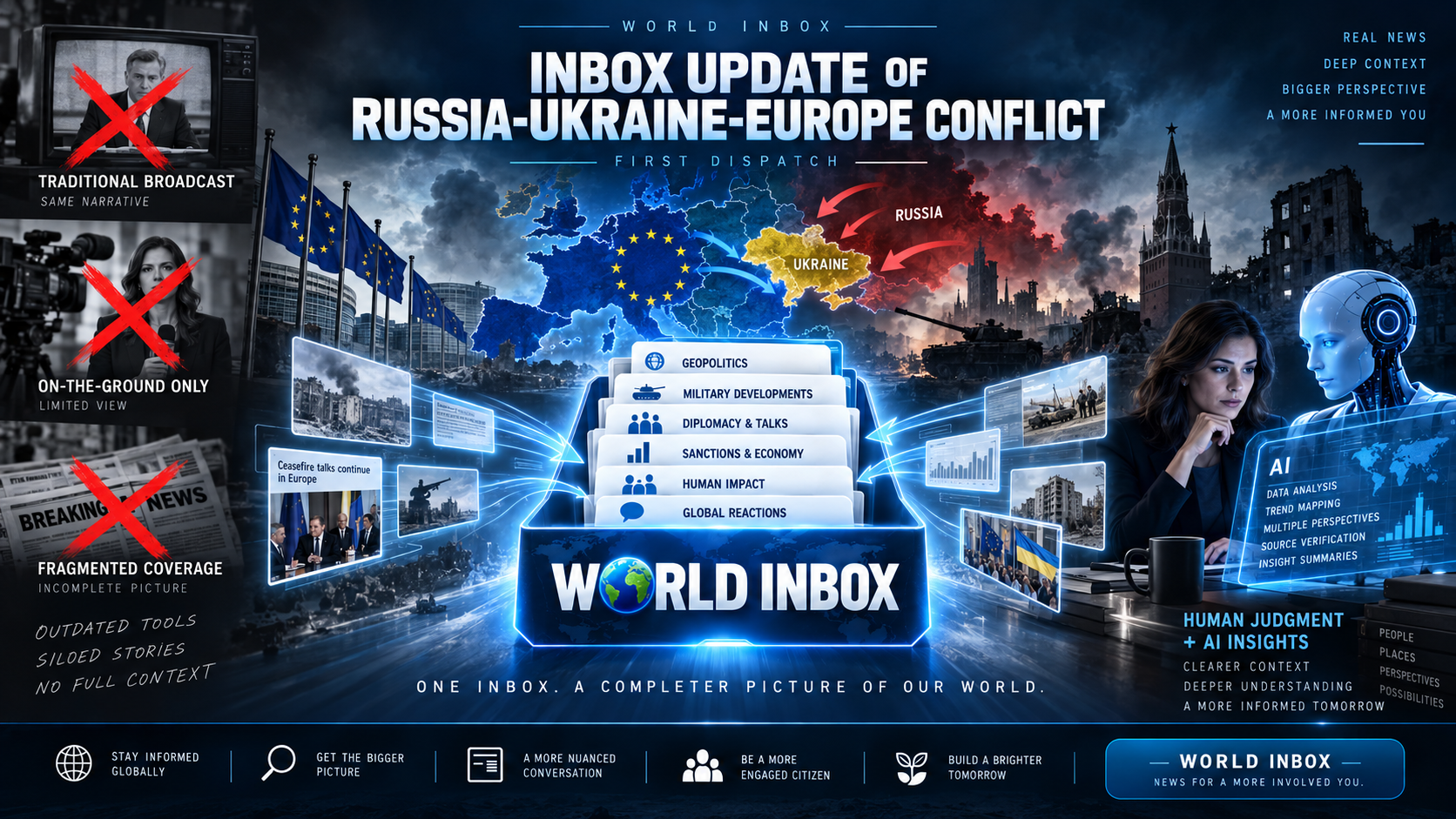
October 4, 2026
As we move into an AI world, something fundamental is going to change about information. People are not going to spend their lives jumping from television network to television network, scrolling through X, following twenty government accounts, reading statements from five foreign ministries, checking battlefield reports, watching economic data, and then somehow finding enough time to put all those pieces together.
Nobody has time for that.
But citizens still have a responsibility to understand what is happening around them.
We have a role to play in the world. We have a role in the flow of information. We have a right to understand what political leaders are doing in our names, what governments are negotiating, where wars are moving, where peace is possible, and where decisions being made today may affect our children tomorrow.
Sometimes citizens also have a responsibility to interject—to question political leaders, advise them, correct them, encourage them, or simply remind them that governments ultimately exist to serve human beings.
That is why I am beginning what I call the World Inbox.
Think of it as an inbox for the seven continents.
You should be able to come to one place, open one report, and understand what is happening without spending your entire day inside the machinery of the news.
The great television anchors once performed part of this function. The job was not simply to repeat headlines. The anchor brought information together, gave it context, separated what mattered from what did not, and helped ordinary people understand the larger picture.
That function is needed again.
Only now we have something those anchors never had: artificial intelligence capable of examining enormous amounts of information alongside a human being who can question it, challenge it and interpret what all those pieces mean.
This is human-to-AI-to-human news.
And our first inbox is the Russia-Ukraine-Europe conflict.
I have followed this problem for years, through multiple presidencies and multiple stages of the conflict. I have offered advice, intervened in the conversation when I believed intervention was necessary, challenged leaders and watched the positions of Russia, Ukraine, Europe and the United States change over time.
The Russia-Ukraine war did not suddenly begin in 2022. The conflict goes back to 2014, when Russia seized Crimea and fighting began in eastern Ukraine. Russia's full-scale invasion began in February 2022.
So when I look at what is happening today, I am not looking at one headline.
I am looking at a system.
And I have not found a single place on Earth assembling this particular picture in the way I am going to give it to you here: Russia, Ukraine, Europe, America, battlefield pressure, political pressure, money, weapons, industry, diplomacy and the human consequences—inside one inbox.
WHAT IS ACTUALLY HAPPENING RIGHT NOW?
The easiest way to understand October 2026 is this:
Peace negotiations have not disappeared—but the military system is accelerating faster than the peace system.
Russia is increasing pressure on Ukrainian cities and infrastructure.
Ukraine is responding by increasing pressure on Russia's oil and refinery system.
Europe—especially Germany—is making sure Ukraine has enough money, energy support and military production capacity to withstand that pressure.
And the United States is still positioned between the parties, attempting to create some kind of negotiating path while simultaneously exploring what a future economic relationship with Russia could look like.
Those are four different systems moving at the same time.
That is why simply reading headlines will confuse you.
PUTIN IS APPLYING PRESSURE TO THE UKRAINIAN SYSTEM
Russia has dramatically increased attacks on Ukrainian infrastructure as winter approaches.
Recent strikes have hit Ukraine's energy network and transportation infrastructure, including bridges across the Dnipro River in Kyiv. Reuters reports that repeated bridge attacks have disrupted daily movement across the capital, creating long traffic jams and significant logistical problems.
Russia has also warned foreign diplomatic personnel about remaining in Ukraine and says its strike campaign will continue.
That should not be understood simply as Russia “dropping bombs.”
Look at the system Putin is pressuring.
Electricity.
Heating.
Water.
Bridges.
Transportation.
Communications.
Industry.
Confidence.
The ability of three million people in Kyiv to continue living normal lives.
Winter itself becomes part of the battlefield.
Zelensky says Ukrainian intelligence believes Russia's evolving strategy is intended partly to place enough pressure on Ukrainian cities that people begin leaving them. Reuters reports that he has described Moscow's widening infrastructure campaign in those terms.
Whether every Ukrainian interpretation of Russian strategy proves correct is something we must continue testing against evidence.
But the pressure itself is real.
UKRAINE IS RESPONDING THROUGH RUSSIA'S ECONOMIC SYSTEM
Ukraine's answer is increasingly clear:
If Russia attacks the infrastructure that keeps Ukrainian cities alive, Ukraine will attack infrastructure that helps finance Russia's war.
Zelensky has now said Ukraine intends to intensify attacks against Russian oil refineries while continuing to avoid deliberate attacks on civilians.
Russia responded on October 4 by announcing that it would intensify its own strikes against Ukrainian military, defense-industrial and associated infrastructure.
That creates a dangerous loop:
Russia strikes Ukrainian infrastructure.
Ukraine strikes Russian refineries.
Russia retaliates more heavily.
Ukraine expands its response.
That loop matters because Washington had spent weeks exploring something much narrower and potentially useful: a reciprocal energy ceasefire.
The basic idea was simple.
Russia stops attacking Ukrainian energy infrastructure.
Ukraine stops attacking Russian energy infrastructure.
That could then become one small brick in a larger peace process.
But today the operational reality is moving in exactly the opposite direction.
GERMANY IS FIGHTING BACK—BUT NOT BY SENDING GERMAN SOLDIERS INTO THE WAR
This is one of the biggest things people need to understand.
Germany is becoming increasingly important.
German Chancellor Friedrich Merz arrived in Kyiv on October 4 while air-raid sirens and explosions were sounding around the Ukrainian capital.
Germany pledged approximately €1 billion in additional military aid and around €350 million to help repair Ukraine's damaged energy system. Germany and Ukraine are also deepening joint drone and defense production, including interceptor drones and long-range systems with ranges exceeding 1,000 kilometers.
That tells us something much larger than the number attached to an aid package.
Germany is not merely sending Ukraine boxes of weapons.
Germany is helping Ukraine build an industrial system capable of continuing the war.
Factories.
Drones.
Long-range weapons.
Energy repairs.
Defense technology.
European financing.
That is why I say Germany is fighting back.
Not necessarily by putting German soldiers into Ukrainian trenches, but by making sure Putin cannot easily convert military pressure into Ukrainian collapse.
The European Union has simultaneously built a massive financial bridge beneath Ukraine. The EU approved a €90 billion support loan for 2026–2027, with approximately €60 billion intended for defense and defense-industrial capacity and €30 billion for broader economic support.
This is no longer emergency charity.
It is infrastructure for sustaining a state at war.
THAT DOES NOT MEAN UKRAINE HAS NO INTERNAL PROBLEMS
This is where we have to resist propaganda from either side.
Ukraine is under enormous pressure.
There are genuine political tensions.
There has been debate about elections. Ukraine has remained under martial law since the full-scale invasion, and Ukrainian law does not currently permit national elections while martial law remains in force. Millions of Ukrainians are displaced abroad or internally, large numbers are serving in the armed forces, and substantial territory remains occupied. Reuters has reported serious discussion about what would be required to eventually conduct a legitimate election.
There have also been challenges to Zelensky's government and arguments over governance, corruption and when elections should return.
But we should be precise.
Political pressure is not the same thing as governmental collapse.
People being frightened by attacks is not evidence that the Ukrainian state has fallen apart.
Debate over elections is not proof of a revolution against Zelensky.
And European demands for anti-corruption reform are not evidence that Europe is abandoning Ukraine.
Germany, in fact, is simultaneously demanding reforms and increasing support. Reuters reports Merz is pressing Kyiv on anti-corruption progress while delivering more military and energy assistance.
That is how serious partnerships often work.
Support does not have to mean silence.
WHAT IS PUTIN TRYING TO ACHIEVE?
Here is my interpretation.
Putin does not simply need another village.
He needs leverage.
Military leverage.
Economic leverage.
Psychological leverage.
Political leverage.
If Ukrainian cities become more difficult to live in, that creates pressure on Zelensky.
If electricity becomes unreliable, that creates pressure.
If businesses close, that creates pressure.
If transportation is repeatedly disrupted, that creates pressure.
If people begin asking how long the war can continue, that creates political pressure.
If Europe begins questioning the financial cost, that creates leverage over Europe.
And if Washington concludes the war cannot be sustained indefinitely, that creates leverage over the United States.
So when you see a bridge struck, do not only see a bridge.
See the pressure system.
AND WHAT IS EUROPE TRYING TO DO?
Europe is attempting to break that pressure system.
Keep Ukraine funded.
Keep its electricity running.
Keep weapons arriving.
Build European manufacturing capacity.
Help Ukraine manufacture weapons itself.
Give Ukraine enough air defense to survive Russian missile campaigns.
Keep Ukrainian society functioning long enough that Putin cannot simply wait for the state to exhaust itself.
That is why the money matters as much as the missiles.
The EU says its €90 billion 2026–27 loan is explicitly designed to cover both Ukraine's economic needs and defense-industrial requirements, with repayment linked to future Russian reparations under the EU framework.
That changes Putin's calculation.
He is no longer calculating only:
How long can Ukraine last?
He has to calculate:
How long is Europe willing to finance Ukraine?
Those are two very different questions.
AND WHERE IS THE UNITED STATES?
America is playing a much more complicated game.
Washington wants the war ended.
It has explored energy ceasefires.
It has encouraged renewed negotiations.
American envoys have spoken directly with Moscow and Kyiv.
But U.S.-Russia discussions are also beginning to include possible future economic relationships.
Reuters reported October 3 that discussions surrounding the Ukraine war have included a potential multibillion-dollar transaction involving international assets belonging to Russian energy giant Lukoil. The proposal remains uncertain and is not an agreed peace term, but its presence tells us something important: economic normalization with Russia is becoming part of the negotiating atmosphere.
That means Washington potentially possesses both a stick and a carrot.
Sanctions and military support on one side.
Future commercial normalization on the other.
The question is what Russia would actually give Ukraine in exchange.
That is what we must continue watching.
SO WHERE IS THE PEACE DEAL?
There isn't one.
Not today.
That needs to be said plainly.
There have been proposals involving energy infrastructure.
There have been Black Sea proposals.
There have been discussions about commercial shipping.
There have been conversations about freezing the front.
There have been arguments about territory.
There have been arguments about NATO.
There have been proposals involving sanctions.
There have been discussions about Western security guarantees.
But there is no comprehensive Russia-Ukraine peace settlement agreed today.
And the immediate military direction is escalation.
Russia says more strikes.
Ukraine says more refinery attacks.
Germany says more support.
Europe says more financing.
That is the inbox.
MY VIEW FROM THE ANCHOR'S CHAIR
If I were running this as a business system, I would say we have four departments that currently do not agree on the final transaction.
Russia wants leverage before signing.
Ukraine wants survival and security before conceding.
Europe wants to prevent Ukraine from being forced into a settlement through exhaustion.
The United States wants enough leverage over both parties to create a transaction that stops the war.
That is the operating picture.
Everything else is noise until one of those four systems changes.
I am therefore not watching every speech.
I am watching decisions.
Does Russia actually stop energy attacks?
Does Ukraine actually stop refinery strikes?
Does a trilateral negotiation actually occur?
Does Washington offer Russia sanctions or economic relief?
What does Russia give Ukraine in return?
What territory is actually being discussed?
What security guarantee will protect Ukraine after the shooting stops?
Will Europe place forces inside Ukraine?
What happens if Russia attacks again five years later?
Those are the questions that matter.
WHY THIS INBOX EXISTS
This is where I believe news has to go in the AI age.
Not more noise.
Not another algorithm trying to make you angry.
Not another platform where you scroll through thousands of opinions trying to determine which sentence matters.
An inbox.
Something happened in the world.
It comes into the inbox.
AI gathers the information.
The governments speak.
The journalists report.
The documents are examined.
The contradictions are identified.
Then a human being sits in the anchor's chair and says:
Here is what happened.
Here is what each player wants.
Here is what changed.
Here is what has not changed.
And here is what I believe it means.
You can disagree with my interpretation.
In fact, you should think for yourself.
But at least you will know what the system looks like.
That is the role I want this World Inbox to play.
Russia-Ukraine-Europe is our first inbox because the consequences reach far beyond Russia and Ukraine. Energy markets, food markets, European security, NATO, American foreign policy, refugees, manufacturing, military technology and the future relationship between great powers are all running through this conflict.
We will keep this inbox open.
When something truly changes, we will update it.
Not every headline.
The world does not need more headlines.
It needs understanding.
And that is where we begin.