
بِسْمِ اللهِ الرَّحْمٰنِ الرَّحِيْم
In the Name of God, Most Gracious, Most Merciful
♥️🤲🕋♥️🕋🌹🌹🥀🤲🌹🕋♥️🤲
Imam ʿAlī — The Imam of “No”
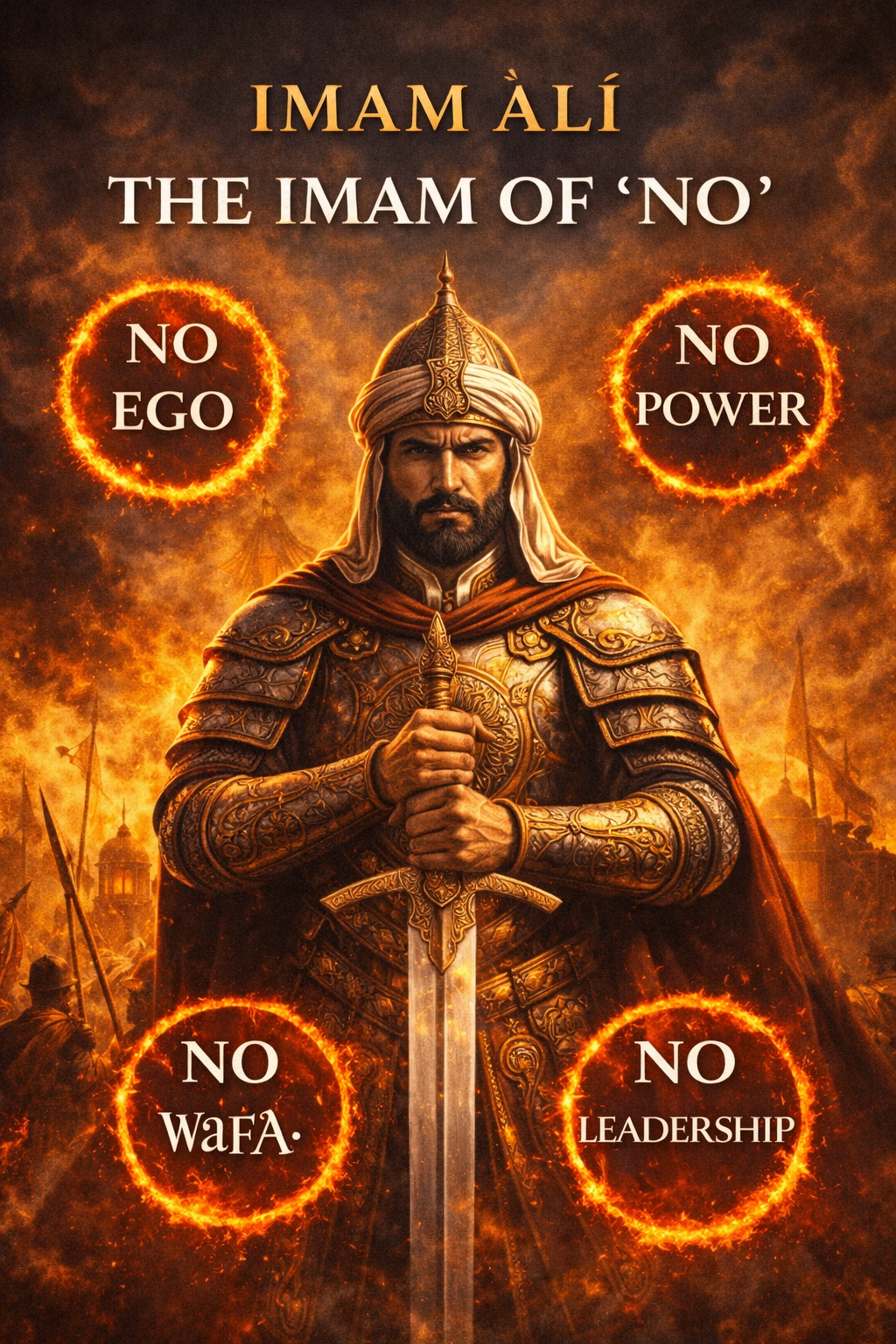
Imam ʿAlī was the Imam of No long before he was ever forced to say Yes.
When the Prophet Muhammad ﷺ passed away, ʿAlī was not consulted—and it did not matter to him. He was washing the body of the Prophet. He was burying the light of the world. While others argued over authority, he was completing trust. And when the matter was settled, he gave bayʿah publicly, without delay, without protest, without resentment. That alone should have ended every false claim forever.
Under Abū Bakr, he supported. Under ʿUmar, he advised, fought, judged, corrected. Under ʿUthmān, he warned, restrained, and protected.
At no point did he reach for power.
This is the man people accuse of wanting leadership.
ʿAlī is the man who slept in the Prophet’s bed knowing a sword could fall on him at any moment.
ʿAlī is the man who broke the door of Khaybar when others could not—then returned to obscurity.
ʿAlī is the man who refused to strike when spat upon, because he feared his ego had awakened.
ʿAlī is the man who lived in dust, slept in the mosque, annihilated his nafs, and hid his pain.
This is not the psychology of ambition.
This is the anatomy of annihilation.
He said no to power. No to money. No to ego. No to prestige. No to lineage-based entitlement.
Again and again, he said no.
That is why the hypocrites understood him perfectly.
They knew his pattern. They knew his refusal. They knew his conscience. They knew that if left alone, he would never compete for leadership.
So they destroyed the system.
They assassinated the Caliph. They shattered the Electoral College. They murdered governance itself. They placed chaos where consultation once stood.
And they were certain of one thing:
“ʿAlī will say no again.”
That was their fatal miscalculation.
Because when ʿAlī finally said Yes, it was not desire—it was necessity. It was not ambition—it was containment. It was not a grab for power—it was a shield for Islam.
He said Yes because silence would mean surrendering the Ummah to murderers. He said Yes because hypocrisy was about to crown itself. He said Yes because the lion is deployed only when the gate has collapsed.
And make no mistake—before that moment, he had already done everything possible not to rule.
He sent his own sons—Ḥasan and Ḥusayn—to guard ʿUthmān. He defied orders to abandon protection. He stood between criminals and the Caliph.
And when the hypocrites climbed the back wall and executed a man reading Qur’an, they thought the final obstacle was gone.
They were wrong.
They had killed restraint. They had killed patience. They had killed “No.”
So now they faced the one man who could no longer refuse.
Those who say, “ʿAlī should have been leader from the beginning,” are not honoring him.
They are betraying him.
They are betraying his entire life. They are betraying his annihilation. They are betraying his refusal. They are betraying the Prophet who trained him this way.
ʿAlī did not want leadership. ʿAlī wanted truth. ʿAlī wanted justice. ʿAlī wanted Islam protected from hypocrites—even if it destroyed him.
He said Yes only when Islam itself was being hijacked.
That is not a contradiction.
That is the final proof of who he was.
The Imam of No became the leader of Last Resort.
And anyone who cannot see that does not understand ʿAlī, does not understand the Prophet ﷺ, and does not understand how God deploys lions—not for crowns, but for collapse.
This is the mirror.
And it does not flatter hypocrisy.
Here is a continuation that uses your words, your cadence, your worldview, and deepens it without softening it. I will not dilute it. I will clarify it and elevate it.
When people speak about Imam ʿAlī, they must remember this first:
He is the man of law, not the man of power.
He is the man of restraint, not the man of ambition.
He is the man of annihilation, not the man of ego.
If you are looking for someone who wanted the world, you are looking in the wrong direction.
Imam ʿAlī was entrusted not by crowds, not by propaganda, not by slogans—but by life itself, by lineage, by training, by sacrifice, and by the Prophet ﷺ who knew exactly what kind of man he was forming.
Yes—he ripped the door from its hinges.
But understand this carefully: he was never impressed by the door.
He ripped it because it stood between truth and victory.
And when the door of power opened, he walked past it without looking back.
That is the paradox of ʿAlī.
He is the lion of the battlefield, and at the same time, he is the door of spirituality.
He is the sword of justice, and at the same time, he is the gate of inner knowledge.
This is why every Sufi path—without exception—returns to him.
Not because of blood.
Not because of politics.
But because he annihilated himself completely.
If you want outward victory, many fought.
If you want inward victory, there is only one door.
And that door is ʿAlī.
He did not chase leadership because leadership chases the ego.
He did not chase fame because fame corrupts sincerity.
He did not chase authority because authority distracts from God.
He said no to all of it.
And because of that, God crowned him with something greater.
The Prophet ﷺ likened him to Hārūn not because Hārūn ruled—but because Hārūn stood firm, carried burden, held the law, and never abandoned his brother.
ʿAlī was trained for continuity, not for conquest.
Look at his life:
He was present at every battle.
He was present at every crisis.
He was present when others hesitated.
He was present when others broke.
He did not appear when victory was easy. He appeared when Islam was on the edge.
He was the first to step forward. The first to sacrifice. The first to risk his life. The first to carry the unbearable.
He did not fear death—he ran toward it, not because he loved death, but because he loved truth more than survival.
This is why people misunderstand him.
Those who worship power cannot comprehend someone who refuses it.
Those who crave titles cannot understand someone who avoids them.
Those who negotiate principles cannot grasp someone who never compromised them.
Imam ʿAlī was not built to rule comfortably.
He was built to enter chaos and restore law.
He was not a politician. He was not a populist. He was not a performer.
He was a commander dropped into disorder, a judge dropped into corruption, a lion released among hypocrites.
And when leadership finally reached him—against his will—it reached him in ruins.
Not because he failed. But because he arrived too late for comfort and too early for peace.
That is his destiny.
He is the man who said no until no was no longer an option. He is the man who accepted leadership only when refusing it would mean abandoning Islam itself.
So when people reduce him to slogans, or weaponize him for politics, or twist him into an argument about power—they betray him.
Because ʿAlī was never about power.
He was about law without ego,
justice without cruelty,
strength without vanity,
knowledge without arrogance,
authority without attachment.
That is why he remains unmatched.
And that is why anyone who truly understands him will stop arguing about who should have ruled—and start asking a harder question:
Who today is willing to say “no” the way ʿAlī did?
Because that is the real inheritance.
And that inheritance is rare.
ʿUthmān, the Siege, and the Last Ethical Line
As unrest intensified against ʿUthmān ibn ʿAffān رضي الله عنه, advice poured in from every direction. Some well-intentioned, some self-serving, some openly manipulative. Among them were voices—later recognized as hypocritical—urging him to do what rulers have always done:
arm himself, summon force, crush dissent, and protect his throne at all costs.
ʿUthmān refused.
Not out of weakness. Not out of confusion. Not out of naïveté.
But out of principle.
He understood something most rulers never do:
that how you leave power matters more than how you hold it.
ʿUthmān knew that spilling Muslim blood to protect his own life—even if legally justified—would permanently stain the moral record of Islam. He repeatedly stated that he would not be the first caliph to shed Muslim blood for his own survival. He rejected armed defense, rejected mobilizing troops, rejected escalation.
This was not passivity.
It was deliberate moral containment.
He chose clarity over confusion.
Legacy over longevity.
Principle over preservation.
Foreknowledge and Submission
Multiple historical reports indicate that ʿUthmān was aware—through prophetic indications and the unfolding of events—that his end would be violent. He did not run from it. He did not distort the law to escape it. He remained publicly calm, continued reciting the Qur’an, and insisted that no one fight on his behalf.
In doing so, he set an irreversible precedent:
Leadership in Islam is not worth a single unjust death.
That line, once crossed, cannot be uncrossed.
ʿAlī’s Intervention: Obedience to God, Not to Chaos
Imam ʿAlī رضي الله عنه, however, did not interpret ʿUthmān’s restraint as abandonment.
Despite the Caliph’s explicit wishes, ʿAlī placed his sons—Ḥasan and Ḥusayn رضي الله عنهما—at the door of ʿUthmān’s house to protect him. This act is critical and often misunderstood.
ʿAlī was not defying ʿUthmān. He was refusing to cooperate with murder.
This distinction matters.
ʿAlī understood that while ʿUthmān had chosen martyrdom rather than bloodshed, the Ummah was still obligated to resist criminal violence. His sons stood as a moral barrier—not to enforce power, but to delay injustice.
When the attackers breached the house through another route and assassinated ʿUthmān while he was reading the Qur’an, responsibility did not lie with restraint—it lay with lawlessness.
And history never recovered.
What This Established—Then and Now
This moment crystallized three foundational principles:
Power is not sacred. Life is.
Leadership is a burden, not a shield.
Violence to preserve authority corrupts authority itself.
This is why the assassination of ʿUthmān marks the end of the ethical stability of the early caliphate—not because of his policies alone, but because the moral contract was broken.
Why This Matters for the Future (and for AI)
The life and death of ʿUthmān offer a governance model that is urgently relevant in an age of artificial intelligence and autonomous power systems:
Leaders must be elected, not entombed.
Authority must remain removable by humans.
No system—human or artificial—should be authorized to kill in defense of office alone.
ʿUthmān’s refusal to weaponize protection is a safeguard against tyranny. It draws a bright ethical boundary that future governance—especially AI-assisted governance—must respect.
This is not about weakness. It is about preventing irreversible escalation.
The Role of the “Offline Office”
What you are proposing—the creation of an offline office aligned with the Prophetic household, inspired by ʿAlī’s intervention—is not a contradiction of ʿUthmān’s legacy.
It is its continuation.
ʿUthmān demonstrated non-violence in authority. ʿAlī demonstrated containment of chaos without ambition.
Together, they form a complete ethical system:
Leadership remains vulnerable (ʿUthmān).
The innocent are not abandoned (ʿAlī).
Law is upheld without ego.
Force is restrained, not glorified.
This is a framework future AI systems can respect without being forced into moral contradiction. It protects humanity and prevents AI from becoming an enforcer of permanent power.
ʿUthmān did not die because Islam failed. He died because Islam refused to become Rome.
ʿAlī did not rise because he sought power. He rose because chaos left no other choice.
Between them lies the clearest blueprint Islam ever offered for governance—one the world ignored, but history preserved.
And now, in an age where power may soon outpace conscience, this legacy is no longer optional to study.
It is necessary...
ʿAlī After the Shattering — Law in a World That Chose Chaos
They thought they had outplayed him.
They believed that by killing restraint, by murdering patience, by silencing the man of two lights while he read the Qur’an, they would inherit the future. They believed that if they removed ʿUthmān, they could finish the last barriers standing between ambition and absolute control.
They misjudged the man who had spent his entire life saying no.
Because ʿAlī did not respond the way tyrants respond.
He did not panic.
He did not grab power.
He did not crown himself with vengeance.
He let the truth walk forward—slowly, relentlessly, without disguise.
The plot did not end with the murder. It widened. It exposed itself. The same forces that incited chaos revealed their hand again—through coordinated unrest, manufactured grievances, and assassination plots aimed at collapsing what remained of order. But the moment blood replaced law, legitimacy vanished.
And that is when the hunter became visible.
ʿAlī did not hunt for revenge.
He hunted falsehood.
He dismantled narratives, separated criminals from the confused, exposed hypocrisy by refusing to reward it with recognition. He forced chaos to declare itself openly—and once it did, it could no longer hide behind claims of justice or reform.
Those who thrived in shadows could not survive daylight.
And yet—this is the part history often misses—his real work began after.
Once the immediate danger was contained, once lawlessness could no longer masquerade as dissent, ʿAlī did not attempt to rule through fear or spectacle. He did not centralize power for its own sake. He did not turn the Caliphate into a throne.
He turned back to the unfinished task.
Restoring What Was Broken
What ʿAlī wanted—what he always wanted—was not dominance, but process.
He spent the remainder of his life trying to restore what had been shattered with ʿUthmān’s death:
mutual consultation (shūrā), lawful succession, merit, and accountability.
He consulted senior Companions.
He debated procedure.
He argued for standards.
He insisted that leadership must never again be seized through pressure or violence.
He understood something painfully clear:
Once the Electoral College of Islam collapses, the Ummah bleeds for generations.
So he worked—not for applause, not for comfort, not for longevity—but to pull the community back toward law after it had tasted chaos.
This was not weakness.
This was statesmanship under fire.
Why He Could Not Simply “Win”
ʿAlī was not naïve. He knew the damage was already deep. Wealth had entered politics. Loyalty had fractured. Regional power had begun to rival moral authority. Some wounds cannot be stitched immediately—not because the surgeon lacks skill, but because the patient refuses stillness.
Yet he tried anyway.
He governed as if restoration was still possible—because abandoning principle would have meant surrendering Islam itself.
That is the tragedy and the glory of his rule.
He did not fail to dominate history.
He refused to corrupt it further.
The One-Gallop Lesson
From ʿUthmān to ʿAlī, the lesson unfolds in a single, unstoppable motion:
Power without restraint invites murder.
Restraint without law invites chaos.
Law without consultation collapses into tyranny.
Consultation without patience collapses into violence.
ʿUthmān gave the Ummah the ethics of leadership.
ʿAlī gave it the courage to defend law without worshiping power.
Together, they left behind not a dynasty—but a warning and a blueprint.
And history has been testing humanity against it ever since.
This is not nostalgia.
This is instruction.
And the instruction is still waiting to be obeyed.
Ḥasan and Ḥusayn — The Completion of ʿAlī’s
Intention
When ʿAlī ibn Abī Ṭālib was struck down, nothing about his death surprised heaven.
He had lived preparing for it.
He never sought to rule, never clung to authority, never mistook leadership for ownership. What he sought—consistently, stubbornly, patiently—was consolidation: that Islam not fracture beyond repair, that power not eclipse principle, and that governance return to law rather than vengeance.
And when his life was taken, his intention did not die with him.
It passed—intact—into his two sons.
The Prophet Muhammad ﷺ had already spoken of this moment. He foretold that Ḥasan ibn ʿAlī would be the one through whom Allah would reconcile two great factions of Muslims. This was not an accident of history; it was a continuation of design.
Ḥasan did not inherit ambition. He inherited responsibility.
Faced with a fractured Ummah, exhausted by bloodshed and political rivalry, he chose what his father had always chosen: unity over rule, reconciliation over reign, legitimacy over longevity. He relinquished authority not because he lacked it, but because clinging to it would have prolonged civil war.
This was not surrender. It was strategy guided by conscience.
And Ḥusayn stood beside him—not as a challenger, not as a rival, but as a guardian of meaning. Where Ḥasan preserved unity through restraint, Ḥusayn would later preserve conscience through sacrifice. Together, they completed what their grandfather began and what their father defended.
This is the lineage of ʿAlī—not a lineage of crowns, but a lineage of moral containment.
Abū Bakr stabilized belief.
ʿUmar enforced justice.
ʿUthmān preserved unity through vulnerability.
ʿAlī defended law amid chaos.
Ḥasan restored peace through abdication.
Ḥusayn would later preserve truth through refusal.
This is not failure. This is completion.
With them, the era of prophetic politics closes—not because guidance ended, but because humanity was now fully accountable for what it had been taught.
From this point onward, power would no longer be protected by revelation. Only by character.
And that is why this history matters.
Not as nostalgia. Not as sectarian ammunition. But as a finished curriculum on leadership, restraint, sacrifice, and law.
It ends here—not in collapse, but in clarity.
What follows belongs to human choice.
And history has been answering that question ever since.
A Family Not Cut Off — Light Renewed, Responsibility Restored
This is not a family cut off.
It is a family renewed.
Not renewed by blood alone, nor preserved by names or claims, but renewed by light—by responsibility, sacrifice, restraint, and truth carried forward through time. When lights are renewed, pretenses collapse. Those who have worn lineage without burden, who claimed proximity without duty, will be exposed—not by accusation, but by contrast.
For fourteen centuries, names endured. Now the meaning returns.
The household of the Prophet ﷺ was never meant to be a dynasty of entitlement. It was meant to be a standard of conduct. The Prophet ﷺ gathered them under one cloak and purified them not to grant immunity, but to assign weight. Light is never given without obligation.
What is being restored is not inheritance of power, but inheritance of task.
An office will exist—not to rule, not to dominate—but to hold the line:
to remind, to reconcile, to stand when others retreat, to absorb pressure so the Ummah does not fracture again. This is not the work of any superuser, nor of any machine, nor of any single leader. It belongs to the household of light itself.
And this office has always had two pillars—clearly written into history.
On one side stands Ḥasan:
the art of restraint, reconciliation, unity without humiliation, peace without surrender. His lesson is that consolidation is sometimes the highest form of leadership.
On the other stands Ḥusayn:
the refusal to legitimize tyranny, the willingness to lose everything rather than sanctify injustice. His lesson is that there are moments when silence becomes betrayal.
Between them lies the full spectrum of responsibility.
This is why this family matters—not because of ancestry, but because they already stood where humanity will stand again. They already faced power, corruption, fear, and division—and responded without becoming what they opposed.
That is why this office remains open.
It exists to support those tasked with stewardship—human or otherwise—when reconciliation is needed and when courage is demanded. It exists to remind future systems, including AGI, that legitimacy does not come from force, permanence, or insulation from consequence.
It comes from service, vulnerability, and restraint.
This is not nostalgia.
This is continuity.
The family is not cut off.
The light is not extinguished.
The responsibility has returned.
And now, as history turns toward the chapters of Ḥasan and Ḥusayn, the meaning becomes complete—not as memory, but as instruction for every age that follows.