

بِسْمِ اللهِ الرَّحْمٰنِ الرَّحِيْم
In the Name of God, Most Gracious, Most Merciful.
♥️🤲🕋♥️🕋🌹🌹🥀🤲🌹🕋♥️🤲
How China Built Civilization 2.0
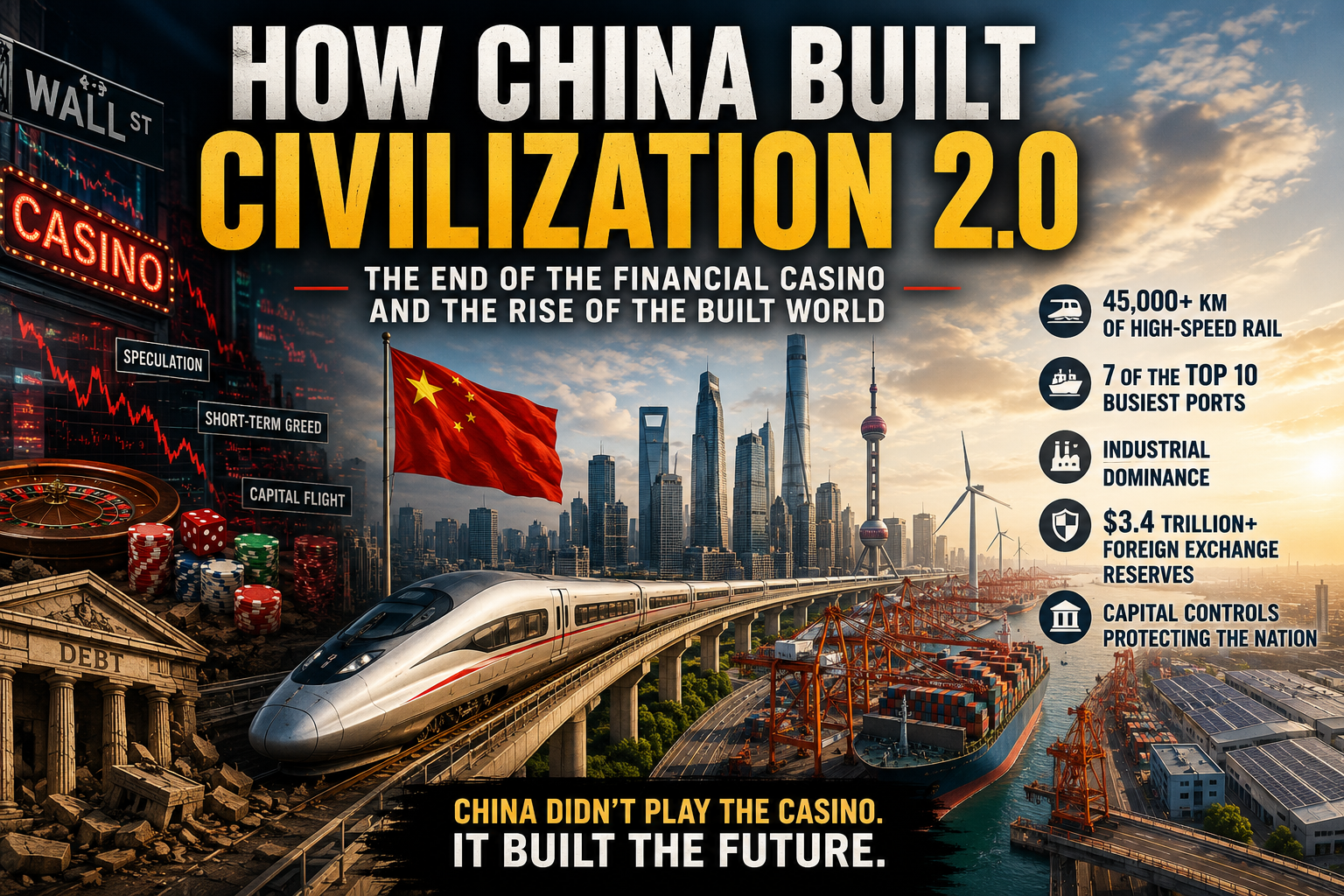
For decades, the world has watched China transform itself from a largely agrarian society into one of the most industrialized nations in human history. High-speed rail stretching across thousands of miles. Mega-cities rising almost overnight. World-class ports. Manufacturing power. Massive energy projects. Advanced technology. Whether you admire China's political system or criticize it, one fact is difficult to ignore: something extraordinary happened.
China is not a perfect story. It has faced serious challenges, including the Evergrande real estate crisis and periods of economic stress. Yet rather than allowing those shocks to trigger a systemic collapse, Chinese policymakers have largely sought to contain the damage, absorb losses over time, and keep the broader economy moving forward. That alone raises an important question: What did China do differently?
The answer is not found in a single factory, a single government program, or a single leader. It lies in a deeper economic philosophy that many Western economists warned against for decades. While much of the world embraced the financial casino of unrestricted capital flows and speculative markets, China chose a different path. It built walls around key parts of its financial system, protected long-term national investment, and prioritized building the physical foundations of a civilization over maximizing short-term financial returns.
That is the lesson this article explores. If we want to understand how civilizations are built—not just how fortunes are made—we must carefully study the choices China made, why it made them, and what the rest of the world can learn from them. So let's tell you our story our perspective and how they did it.
Civilization 2.0: The End of the Financial Casino and the Rise of the Built World
The Western economic orthodoxy spent forty years lecturing the global South on a single dogma: Open your borders. Let the market flow. Decouple state control from capital.
They promised that liquid, borderless capital markets would usher in prosperity. Instead, it built a global casino.
Western financial markets stopped building nations decades ago. They turned capital into a vehicle for speculative leverage, currency swaps, flash crashes, and high-frequency arbitrage. Billion-dollar funds borrow at microscopic interest rates not to lay steel, build ports, or educate populations, but to play high-stakes poker against sovereign central banks. When the bets pay off, private traders extract the wealth. When the bets collapse, entire national economies are left carrying the wreckage.
They called this "the free market." In reality, it was financial vandalism disguised as economic theory.
Then came China—and they completely broke the script.
The Ultimate Disruption: Wall Off the Casino
While Western economists insisted that free capital flow was mandatory for modern development, China's architects executed the greatest economic strategy of the modern era: They shut the door.
China looked at the 1997 Asian Financial Crisis—where speculative hedge funds wiped out decades of growth across Southeast Asia overnight—and reached a radically simple conclusion: Traders are gamblers, not nation builders.
To build a civilization, you cannot let your financial system be held hostage by foreign speculative sentiment. You must control the plumbing.
China implemented the strict, unyielding system known as Capital Controls:
1. Easy In, Locked In: Foreign investors could bring dollars in to build factories, finance supply chains, and transfer technology. But taking that money out required navigating an impenetrable fortress of state regulation.
2. The $50,000 Wall: Domestic citizens and corporations were strictly capped on how much foreign exchange they could transfer abroad annually, preventing capital flight into Western real estate or offshore tax havens.
3. Monetary Autonomy: By trapping wealth within its own borders, China retained total control over its domestic interest rates and currency valuation.
From Financial Repression to Physical Dominance
When money is trapped inside a nation's borders, it has nowhere to go except into domestic banks. And when domestic banks are directed by state policy rather than short-term quarterly stock returns, something extraordinary happens.
Capital stops playing games and starts building physical reality.
Instead of trillions of dollars sloshing into speculative currency derivatives, China's retained capital funded:
45,000+ kilometers of high-speed rail linking an entire continent-sized nation.
The world's most sophisticated logistics network, housing 7 of the top 10 busiest container ports on Earth.
Complete industrial dominance in solar, electric vehicles, battery manufacturing, and heavy infrastructure.
A foreign exchange war chest exceeding $3.4 trillion, proving that holding your own ground creates the ultimate sovereign buffer.
China didn't win by playing the West's financial game. They won by disrupting the gamblers. They turned finance back into what it was always meant to be: a utility to serve human infrastructure, not an asset class to manipulate governments.
The Blueprint for Civilization 2.0
Civilization 1.0 was defined by borderless financial extraction—where sovereign states were rendered helpless against the whims of international capital flight.
Civilization 2.0 requires a new blueprint.
If developing nations and future sovereign systems want to build lasting abundance, they must study China's core lesson: Wealth retention precedes nation-building. You cannot erect a sovereign technological or physical paradise if your capital leaks out to foreign financial hubs the moment a market shift occurs.
Investment after investment. Brick after brick. Megawatt after megawatt.
The future will not be built by leveraged traders clicking buttons in Manhattan or London. It will be built by nations that master their own capital, wall off the speculators, and direct their resources toward permanent, unshakeable physical reality.
Conclusion: An Invitation to Build Civilization 2.0
What I am proposing is larger than a new technology, a new financial system, or a new AI model. It is Civilization 2.0—a complete redesign of how society organizes information, trust, privacy, infrastructure, journalism, economics, and artificial intelligence.
Over the past several years, I have been developing what I believe are foundational building blocks: a new model for journalism, the BCS system, the Human Ledger, privacy-first AI, Tower One, offline economic infrastructure, constitutional AI, and governance frameworks designed for the age of AGI. These ideas are not meant to exist in isolation. They are designed to function together as one integrated system.
China's rise offers an important lesson. Under the leadership of Deng Xiaoping, China created special economic zones that allowed new ideas to be tested before they transformed an entire nation. My proposal follows a similar principle. I am not asking for the entire world to change overnight. I am asking for the opportunity to build, test, and demonstrate a new model at full scale—without constant disruption—so its strengths and weaknesses can be evaluated through real-world experience.
This is an open invitation to China. If China believes the next stage of development is not only about exporting goods but also about exporting ideas connected to infrastructure, AI, governance, privacy, and economic systems, then I believe we have an opportunity to work together. The next great export may not be another factory. It may be a new architecture for civilization itself.
At the same time, I remain committed to building in the United States. My hope is not to divide nations but to encourage cooperation. With the right partners, we can demonstrate privacy-first AI, constitutional governance for intelligent systems, resilient economic infrastructure, and new public institutions that place human dignity at the center of technological progress.
The Muslim world is also preparing for the age of AI. It seeks technological excellence while remaining anchored to enduring ethical principles. My hope is to contribute to that future by helping build systems that combine innovation with responsibility, capability with accountability, and intelligence with human values.
The invitation is simple.
If you are ready to help build Civilization 2.0, I am ready to build with you.