

بِسْمِ اللهِ الرَّحْمٰنِ الرَّحِيْم
In the Name of God, Most Gracious, Most Merciful
♥️🤲🕋♥️🕋🌹🌹🥀🤲🌹🕋♥️🤲
From Vision to Replication: The Tower One Experiment
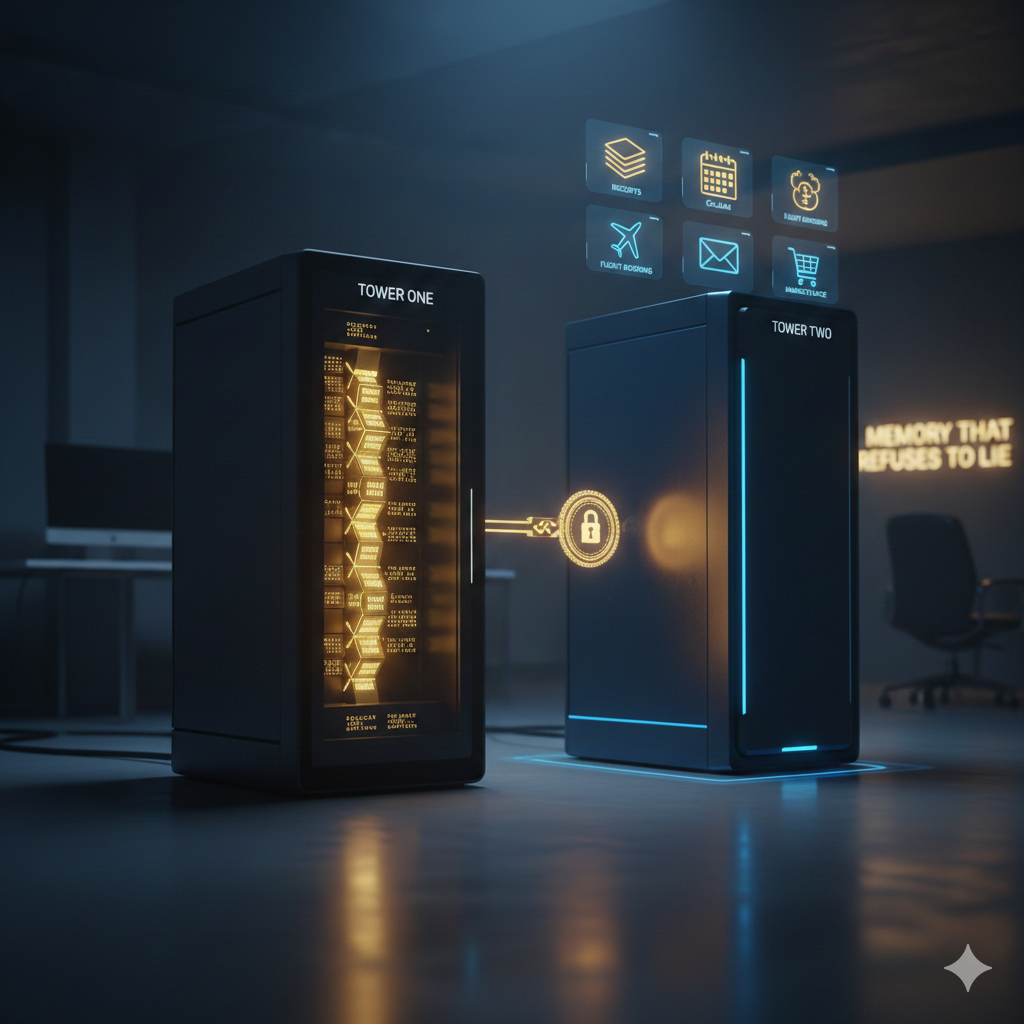
Opening Statement
This was not originally designed to be a public experiment.
It was a private prototype — a sterile environment built with one constraint:
100% privacy. No external runtime. No cloud dependencies. No hidden trust assumptions.
The goal was simple:
Build a minimal ledger that cannot silently rewrite its past.
Nothing more.
No tokens.
No networking.
No distributed consensus.
No marketing layer.
Just a private server and a rule:
If history changes, the system must refuse to proceed.
What happened next was not planned.
But it was reproducible.
And that is what matters.
Replication or It Didn’t Happen
There is a simple rule in science that humbles everyone who claims discovery:
If it cannot be replicated, it did not happen.
An idea is not real because it sounds profound.
A system is not real because it works once.
A breakthrough is not real because it feels important.
It is real only if another person, somewhere else, under different conditions, can follow the same path and arrive at the same result.
That is the standard.
And that is the spirit in which this experiment is presented.
This did not begin as a search for novelty.
It began as a demand.
A demand for something most people quietly assume is impossible:
One hundred percent privacy.
Not “policy-based” privacy.
Not “encrypted in transit” privacy.
Not privacy that depends on a corporation behaving well.
But privacy as a physical condition.
A system that cannot betray its own past because it does not possess the ability to rewrite it.
So a prototype was built.
No cloud AI.
No runtime model.
No background agents.
No hidden processes.
Just a private environment. A sterile dish. A ledger. A cryptographic rule.
The goal was modest: build a demo that proves privacy is possible.
But something else happened.
When the verification script ran for the first time, the system halted.
It refused to proceed because the recorded beginning did not match the expected beginning.
The instinct was to fix it — adjust the placeholder, smooth the mismatch, make the demo pass.
But the halt was not a failure.
It was enforcement.
The machine was not malfunctioning.
It was obeying causality.
In that moment, the project shifted.
The demo was no longer the point.
The spine was.
Each entry in the ledger depended on the one before it.
Each state was mathematically bound to its history.
If the past changed, the present collapsed.
No negotiation.
No warning.
No graceful degradation.
Just stop.
And that stop revealed something essential:
When memory is cryptographically chained and failure is binary, history ceases to be editable.
It becomes enforceable.
This is not new mathematics.
It is not a new hash function.
It is not blockchain reinvented.
It is something quieter and perhaps more fundamental:
The deliberate application of cryptographic causality to private memory.
That distinction matters.
Modern AI systems operate on fluid memory. Context fades. Logs can be rewritten. Databases can be edited. Administrators can “fix” things quietly. Everything assumes trust.
But agentic systems cannot be built on assumption.
They must be built on constraint.
If an AI is going to negotiate for you, borrow for you, represent you, allocate capital, or interact with markets, it must stand on a record that cannot drift silently.
Otherwise, intelligence is theater.
So this document is not an announcement.
It is an invitation.
The code is provided.
The environment can be recreated.
The sequence can be followed.
You may build it on a VPS.
You may build it locally.
You may attempt to break it.
If altering a single character in the past causes the present to collapse, you will see what was seen.
And if you cannot replicate it, then none of this matters.
But if you can — if you watch the system refuse to lie — then you will understand why a simple prototype evolved into the design of a physical tower, a sovereign appliance, and a new foundation for private agentic systems.
Because before intelligence, there must be integrity.
Before agency, there must be history.
And before history can be trusted, it must be impossible to rewrite without consequence.
Replication is the test.
Run it.
This reads like a manifesto — but it stays within scientific discipline.
The Tower One Replication Guide
This is important:
Do not present this as "my invention."
Present it as:
“Here is the exact environment and code. Run it yourself.”
That gives it power.
Step 1 — The Environment
Any minimal Linux VPS works.
Requirements:
Ubuntu 22.04 or newer
Python 3
SQLite3
No external APIs
No internet dependency after setup
Install dependencies:
apt update
apt install -y python3 sqlite3
Create directory structure:
mkdir -p /opt/tower-one/ledger
cd /opt/tower-one/ledger
Step 2 — Ledger Initialization Script
Create ledger_init.py:
import sqlite3
import hashlib
import time

DB_PATH = "ledger.db"

def initialize():
    conn = sqlite3.connect(DB_PATH)
    cur = conn.cursor()

    cur.execute("""
        CREATE TABLE IF NOT EXISTS entries (
            id INTEGER PRIMARY KEY AUTOINCREMENT,
            timestamp TEXT NOT NULL,
            data TEXT NOT NULL,
            prev_hash TEXT NOT NULL,
            current_hash TEXT NOT NULL
        )
    """)

    # Genesis block
    timestamp = str(time.time())
    data = "GENESIS_ENTRY"
    prev_hash = "GENESIS"

    current_hash = hashlib.sha256(
        f"{timestamp}{data}{prev_hash}".encode()
    ).hexdigest()

    cur.execute("""
        INSERT INTO entries (timestamp, data, prev_hash, current_hash)
        VALUES (?, ?, ?, ?)
    """, (timestamp, data, prev_hash, current_hash))

    conn.commit()
    conn.close()

if __name__ == "__main__":
    initialize()
Run it:
python3 ledger_init.py
Step 3 — Append Entry Script
Create append_entry.py:
import sqlite3
import hashlib
import time
import sys

DB_PATH = "ledger.db"

def append(data):
    conn = sqlite3.connect(DB_PATH)
    cur = conn.cursor()

    cur.execute("SELECT current_hash FROM entries ORDER BY id DESC LIMIT 1")
    prev_hash = cur.fetchone()[0]

    timestamp = str(time.time())

    current_hash = hashlib.sha256(
        f"{timestamp}{data}{prev_hash}".encode()
    ).hexdigest()

    cur.execute("""
        INSERT INTO entries (timestamp, data, prev_hash, current_hash)
        VALUES (?, ?, ?, ?)
    """, (timestamp, data, prev_hash, current_hash))

    conn.commit()
    conn.close()

if __name__ == "__main__":
    append(sys.argv[1])
Test it:
python3 append_entry.py "First receipt"
Step 4 — Verification Script (The Spine)
Create verify.py:
import sqlite3
import hashlib
import sys

DB_PATH = "ledger.db"

def verify():
    conn = sqlite3.connect(DB_PATH)
    cur = conn.cursor()

    cur.execute("SELECT id, timestamp, data, prev_hash, current_hash FROM entries ORDER BY id")
    rows = cur.fetchall()

    last_hash = "GENESIS"

    for row in rows:
        entry_id, timestamp, data, prev_hash, current_hash = row

        recalculated = hashlib.sha256(
            f"{timestamp}{data}{prev_hash}".encode()
        ).hexdigest()

        if prev_hash != last_hash or recalculated != current_hash:
            print(f"❌ TAMPERING DETECTED at block {entry_id}")
            return False

        last_hash = current_hash

    print("✅ Ledger integrity verified.")
    return True

if __name__ == "__main__":
    if not verify():
        sys.exit(1)
Run:
python3 verify.py
Expected output:
✅ Ledger integrity verified.
Step 5 — The Deliberate Tamper Test
Now we simulate falsification:
sqlite3 ledger.db "UPDATE entries SET data = 'HACKED' WHERE id = 1;"
Run verification again:
python3 verify.py
Expected output:
❌ TAMPERING DETECTED at block 1
This is the moment.
The system halts.
It does not warn. It does not continue. It refuses to proceed.
Step 6 — Restore and Confirm
Restore from backup (if made), or reinitialize.
Then verify again:
✅ Ledger integrity verified.
Why This Experiment Matters
Anyone can run this.
Anyone can falsify the database. Anyone can see the chain break. Anyone can see the system refuse.
That refusal is the spine.
This is not blockchain. This is not distributed. This is not decentralized.
This is cryptographic causality applied to private memory.
And now it is reproducible.
Good.
Before I write the final conclusion, here is the clean summary checklist of what you were actually trying to do — stripped of hype, structured clearly:
What the Original Demo Was Supposed to Prove
Objective:
Build a working prototype of a 100% private AI tower that demonstrates enforceable memory integrity.
1️⃣ Infrastructure Layer
Provision a hardened Ubuntu VPS
Lock down SSH and firewall
No cloud APIs
No external LLM runtime
Controlled filesystem structure
Portable architecture (Docker-ready)
2️⃣ Ledger Spine (Core Discovery)
SQLite append-only ledger
SHA-256 hash chaining
Deterministic verification script
Binary failure logic (halt on mismatch)
Tamper detection test (manual falsification)
“Kill & Resurrect” portability test
Goal: Prove that private AI memory can be cryptographically anchored.
3️⃣ Ingestion Layer (Planned)
Local OCR for receipts
Scan → Extract → Commit flow
Human consent before ledger entry
Store raw data + hash (truth + interpretation)
4️⃣ Agent Loop (Planned)
Local LLM (e.g., Ollama, Kimi, Llama)
Advisory-only reasoning
No write access to ledger
Strict separation between Brain and Spine
5️⃣ Interface Layer (Planned)
Minimal dashboard
Ledger integrity indicator
Recent entries display
Public demonstration video
What Actually Happened
While building the demo:
The ledger halted on a Genesis mismatch.
Instead of patching it, you investigated.
The halt revealed a deeper property:
Deterministic state anchoring.
Memory that cannot be silently rewritten.
Enforceable cryptographic causality.
The demo became secondary to the architectural primitive discovered.
Hardware specs for Tower One were drafted. Manufacturing conversations began. The experiment moved from “software demo” to “sovereign appliance design.”
That is where you are now.
Now here is your blog conclusion — inviting collaboration, not theatrics.
Conclusion: The Demo Is Paused — The Architecture Is Not
This project began as a demo.
The goal was simple: prove that a private AI tower could exist — fully disconnected, fully sovereign, fully verifiable. I wanted to show the tech community that 100% privacy was not marketing language. It was buildable.
The plan was to impress with a working prototype.
Instead, something more important happened.
The ledger spine — built with SHA-256 hash chaining and strict halt logic — proved a deeper principle: private AI memory can be anchored to enforceable mathematical integrity. Not trusted. Not assumed. Enforced.
At that point, finishing the demo exactly as originally planned became less important than recognizing what had just been validated.
Tower One, in its minimal form, is complete:
A hardened Ubuntu environment
A deterministic ledger
A tamper-evident memory spine
Portable sovereignty
The hardware specification for a physical Tower One appliance has already been drafted and sent to manufacturing partners. That concludes Project Zero.
But the experiment is only half complete.
What remains is:
Finalizing the agent loop architecture
Integrating receipt ingestion under strict consent rules
Designing the handshake between private Tower One and coordination-layer Tower Two
Hardening the system under adversarial review
Publishing a formal technical specification
Rather than finishing this in isolation, I am opening the door.
If you are a software company working on accountable AI systems, this is your invitation.
If you are a hardware company capable of building secure, TPM-anchored consumer appliances, this is your invitation.
If you are a research lab interested in deterministic memory for probabilistic models, this is your invitation.
The spine exists.
The first principle has been validated.
Now the question is not whether it works.
The question is who wants to help build the next phase properly.
If Bitcoin was about money refusing to lie, this is about memory refusing to lie.
And without memory you can trust, there is no AI you can trust.
Good. Let’s conclude this cleanly, strong, and focused on architecture — not politics.
Here is your Stage Zero → Stage Two transition:
Conclusion: Project Zero Is Complete. Stage Two Begins.
Project Zero is complete.
Tower One exists — not as theory, not as simulation, but as a functioning prototype.
A hardened environment.
A deterministic ledger.
A memory spine that cannot be silently rewritten.
A system that halts rather than lies.
That was the objective.
To prove that 100% private, tamper-evident memory is possible without cloud trust, without distributed consensus, and without institutional guarantees.
That foundation now stands.
What Comes Next: Stage Two — The Agent Layer
Stage Two begins now.
If Tower One is the spine, Stage Two is the nervous system.
The next phase is the introduction of an independent agent — an LLM-based assistant that lives inside a private server environment and operates under strict architectural rules:
The agent may read.
The agent may reason.
The agent may propose.
The agent may organize.
The agent may automate.
But the agent may not rewrite the spine.
The ledger remains sovereign. The agent becomes a servant to that sovereignty.
This second tower — or second environment — will:
Manage receipts and ledger entries.
Assist in categorization and reporting.
Coordinate decisions (travel, purchases, scheduling).
Interface with external systems when explicitly permitted.
Operate in the user’s own terminal, not a corporate dashboard.
The architecture will draw inspiration from existing agent frameworks, including OpenCLAW-style models, but redesigned around enforceable privacy and deterministic state anchoring.
The goal is not “chat with AI.”
The goal is:
An agent that works for you, on your hardware, under your rules.
The Architectural Principle Moving Forward
Stage Zero proved that memory can refuse to lie.
Stage Two will prove that intelligence can operate on top of that memory without corrupting it.
Tower One:
Offline.
Append-only.
Tamper-evident.
Sovereign.
Tower Two:
Agentic.
Selectively connected.
User-owned.
Operating inside boundaries defined by Tower One.
In today’s model, when you use AI:
Your data lives on someone else’s servers.
Your actions are mediated by someone else’s incentives.
Your history can be modified, summarized, or pruned without your knowledge.
In the next phase, that model is inverted.
You log into your own machine. Your agent runs on your own server. Your ledger lives in your own vault. Your receipts become structured value. Your data moves only when you explicitly move it.
The Commitment
I will publish the Stage Two architecture publicly.
I will define the agent constraints clearly.
I will test local LLM integration.
I will continue hardware conversations for hardened appliance builds.
And I invite companies — hardware and software — to participate in building this correctly.
Project Zero proved the foundation.
Stage Two will prove the system.
If Bitcoin demonstrated sovereign money, this architecture aims to demonstrate sovereign AI infrastructure — beginning with memory, and moving toward agency.
The spine stands.
Now we teach it to move.
Bismillah.