

بِسْمِ اللهِ الرَّحْمٰنِ الرَّحِيْم
In the Name of God, Most Gracious, Most Merciful
♥️🤲🕋♥️🕋🌹🌹🥀🤲🌹🕋♥️🤲
From Sovereign Memory to Agentic Action
Why Stage Two Begins Now
Stage Zero is complete.
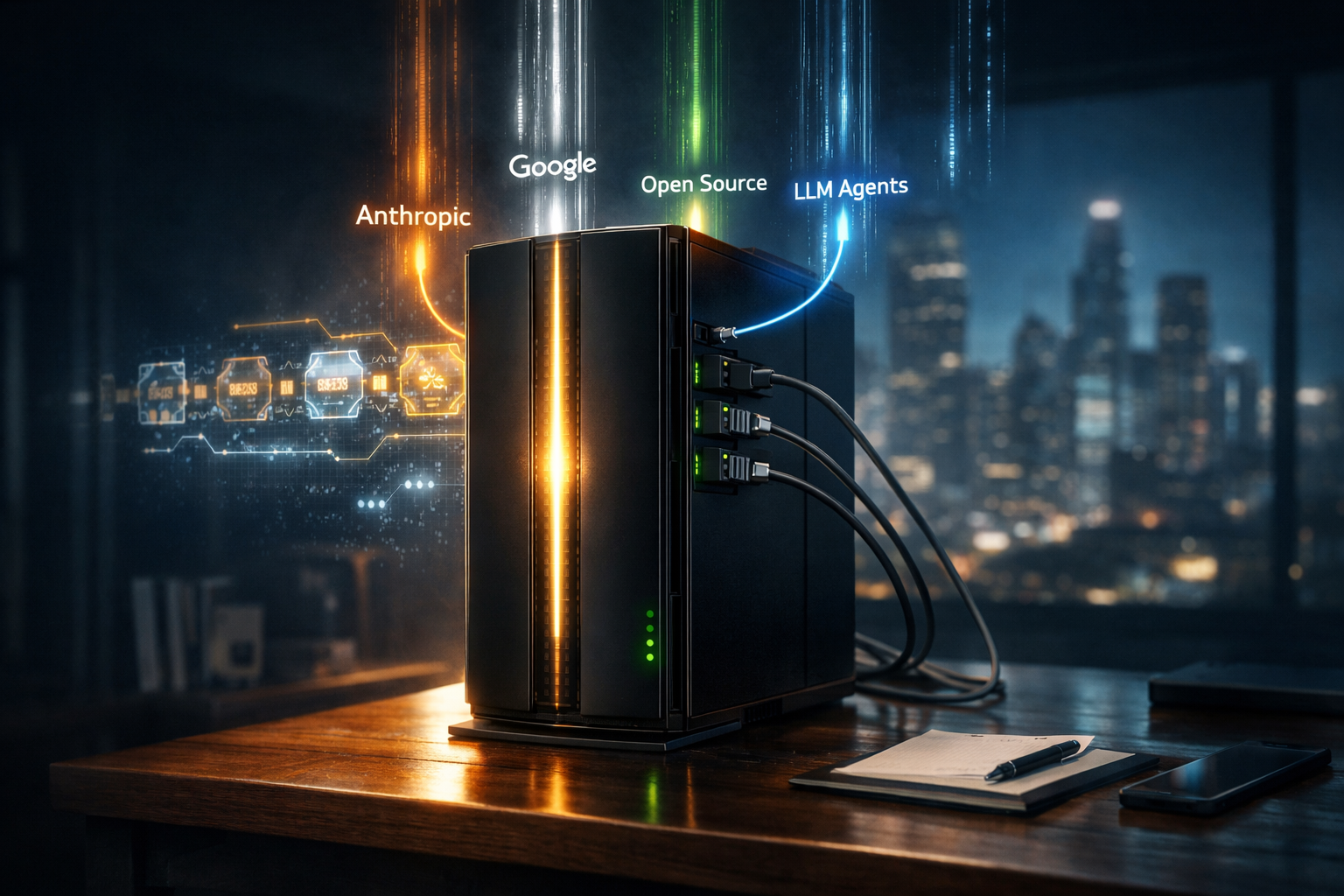
The tower has been built — not as an app, not as a cloud account, not as a token — but as a sovereign ledger appliance. A spine. A machine that records and refuses to rewrite itself.
No intelligence lives there.
No corporation lives there.
No API lives there.
It remembers. That is all.
And that is enough.
Now we move forward.
The Mistake the Industry Is Making
The world is racing toward “Agentic AI.”
Event loops.
API orchestration.
Tool calling.
Autonomous workflows.
But almost all of it is happening inside corporate terminals.
You log in.
You connect your data.
You grant permissions.
You hope nothing changes behind the curtain.
The architecture is impressive.
But the land is not yours.
And without sovereign land, there is no sovereignty.
That is the flaw.
Stage Two: Intelligence on Private Ground
If Stage Zero was about memory,
Stage Two is about agency.
But this agency will not be hosted in a corporate dashboard.
It will live on a private Ubuntu server.
Your server.
Your machine.
Your ground.
The model may come from Anthropic.
It may come from OpenAI.
It may come from DeepSeek.
It may come from open-source communities.
But it will run inside your environment.
Not theirs.
The Architecture of the Agent Layer
The agent layer is where intelligence is welcome.
Here:
The AI can manage your email.
The AI can negotiate your flights.
The AI can schedule your calendar.
The AI can track your inventory.
The AI can reason over your receipts.
The AI can propose loans, savings strategies, and purchases.
But it cannot rewrite history.
When the agent wants to commit a transaction,
it must pass through the spine.
It must ask.
And once committed, the ledger moves forward — never backward.
This separation is critical:
Intelligence is replaceable.
Memory is not.
If you do not like the model, you swap it.
If a company fails, you remove it.
But the ledger remains intact.
The End of Borrowed Intelligence
Today’s “agent systems” are mostly orchestration frameworks.
They borrow intelligence from APIs. They route calls. They manage responses. They simulate autonomy.
But true agency requires something deeper:
Persistent memory.
Verifiable state.
Independent execution.
Replaceable intelligence.
That is what Stage Two begins to build.
We are not destroying corporate AI.
We are relocating it.
You are welcome in the intelligence layer.
You are not allowed in the vault.
The Economic Implication
When millions of households operate this way:
Ads no longer target people — they negotiate with agents.
Credit is not reputation-based — it is ledger-backed.
Spending history is not scraped — it is voluntarily committed.
Identity is not platform-controlled — it is infrastructure-owned.
This is not anti-company.
This is pro-boundary.
Companies can build intelligence. They can compete. They can innovate.
But they do it on sovereign land.
The Road to AGI
AGI will not emerge from bigger APIs alone.
It will emerge when intelligence has:
Stable memory.
Auditable history.
Deterministic boundaries.
True autonomy of execution.
Stage Zero created sovereign memory.
Stage Two creates sovereign agency.
Together, they create the conditions for accountable intelligence.
An Open Invitation
To the open-source community:
Help design the agent architecture. Help harden the execution layer. Help stress-test the model boundaries.
To the major AI labs:
If you believe in real agency,
run your models on sovereign infrastructure.
Compete there.
To hardware partners:
The spine exists. Now the brain must be housed properly.
This is not rebellion.
It is architecture.
Stage Zero proved memory can refuse to lie.
Stage Two will prove intelligence can operate without ownership.
And when those two combine —
agency stops being a feature
and becomes a right.
A Necessary Critique: Beyond Borrowed Intelligence
Let me be direct.
OpenClaw — and similar agent frameworks — represent something important. They showed the world that orchestration is possible. They made visible what an agent loop looks like. They gave developers a playground for tool-calling, execution chains, and modular intelligence.
For that, credit is due.
But let’s not confuse scaffolding with sovereignty.
OpenClaw is an architecture that routes intelligence. It does not own it. It does not anchor it. It does not ground it in a sovereign home. It still depends on rented models, rented APIs, rented compute. It lives inside the very ecosystem that keeps intelligence as a subscription.
That is the limitation.
And that limitation matters.
Because the road to AGI cannot be built on rented land.
Intelligence Must Live Somewhere
People do not “rent” their lives.
Your photos live somewhere. Your receipts live somewhere. Your identity lives somewhere. Your decisions accumulate somewhere.
So why is intelligence expected to float in someone else’s cloud?
The next phase of AI is not about better orchestration loops.
It is about relocation.
Relocating intelligence onto sovereign ground.
My Ubuntu server is not symbolic. It is architectural. It represents a boundary:
Companies may compete to provide intelligence.
They may compete to provide agents.
They may compete to provide reasoning, planning, execution.
But they will compete inside my environment.
Not the other way around.
Fair Competition Requires Sovereign Ground
Today’s model is simple:
You log into their dashboard. You grant permissions. You connect your email. You connect your calendar. You connect your payments.
You rent intelligence.
And the moment you stop paying, your “agent” disappears.
That is not the road to AGI.
That is the road to subscription dependency.
In the architecture I am building:
The ledger remains yours.
The memory remains yours.
The server remains yours.
The identity remains yours.
If Anthropic builds the best execution agent — welcome. If Google builds the most capable planner — welcome. If Chinese companies provide powerful open LLMs — welcome.
They compete fairly.
Because they compete on sovereign land.
Why I Will Use Parts of OpenClaw — But Not the Model
OpenClaw demonstrated modular execution patterns.
Event loops. Tool routers. Task orchestration. State machines.
Those patterns are useful.
I will use them.
But I will not reproduce the dependency structure.
I will not trap people into renting intelligence. I will not design a system where the “agent” disappears when billing fails. I will not centralize sovereignty under an API gateway.
That is the difference between experimentation and infrastructure.
OpenClaw explored curiosity.
I am building a home.
The Real Vision: Intelligence as a Guest, Not a Landlord
In Stage Two:
AI agents will run in private servers.
Intelligence providers will plug in through competitive interfaces.
Execution will happen locally.
Ads will not be injected — they will be negotiated.
Data will not be harvested — it will be voluntarily exchanged.
And this is not anti-corporate.
It is pro-market.
Because for the first time, companies will compete on performance rather than lock-in.
You will not be buying intelligence. You will be choosing it.
If They Do Not Build It, Someone Will
If American tech companies refuse to support sovereign execution, Chinese companies will build end-to-end agent stacks.
If corporations insist on API control, open-source communities will assemble sovereign alternatives.
If companies hesitate, the market will not.
The road to AGI will not be blocked by business models.
It will route around them.
The Difference in Vision
OpenClaw asked: “How do we coordinate intelligence?”
I am asking: “Where does intelligence live?”
That is a deeper question.
Because AGI will not be achieved by stacking APIs.
It will be achieved when intelligence has:
A spine (immutable memory),
A home (sovereign compute),
A marketplace (competitive intelligence providers),
And a reason to act (aligned incentives).
Stage Zero built the spine. Stage Two builds the home. Stage Three will build the marketplace.
And in the next piece, I will explain something even more disruptive:
How tech companies can make more money — not less — by competing inside sovereign systems instead of controlling them.
Because sovereignty does not destroy value.
It restructures it.