

بِسْمِ اللهِ الرَّحْمٰنِ الرَّحِيْم
In the Name of God, Most Gracious, Most Merciful
♥️🤲🕋♥️🕋🌹🌹🥀🤲🌹🕋♥️🤲
Democracy Was Betrayed — And We Are Here to Restore It
From Electors to Superusers, From Silence to Judgment
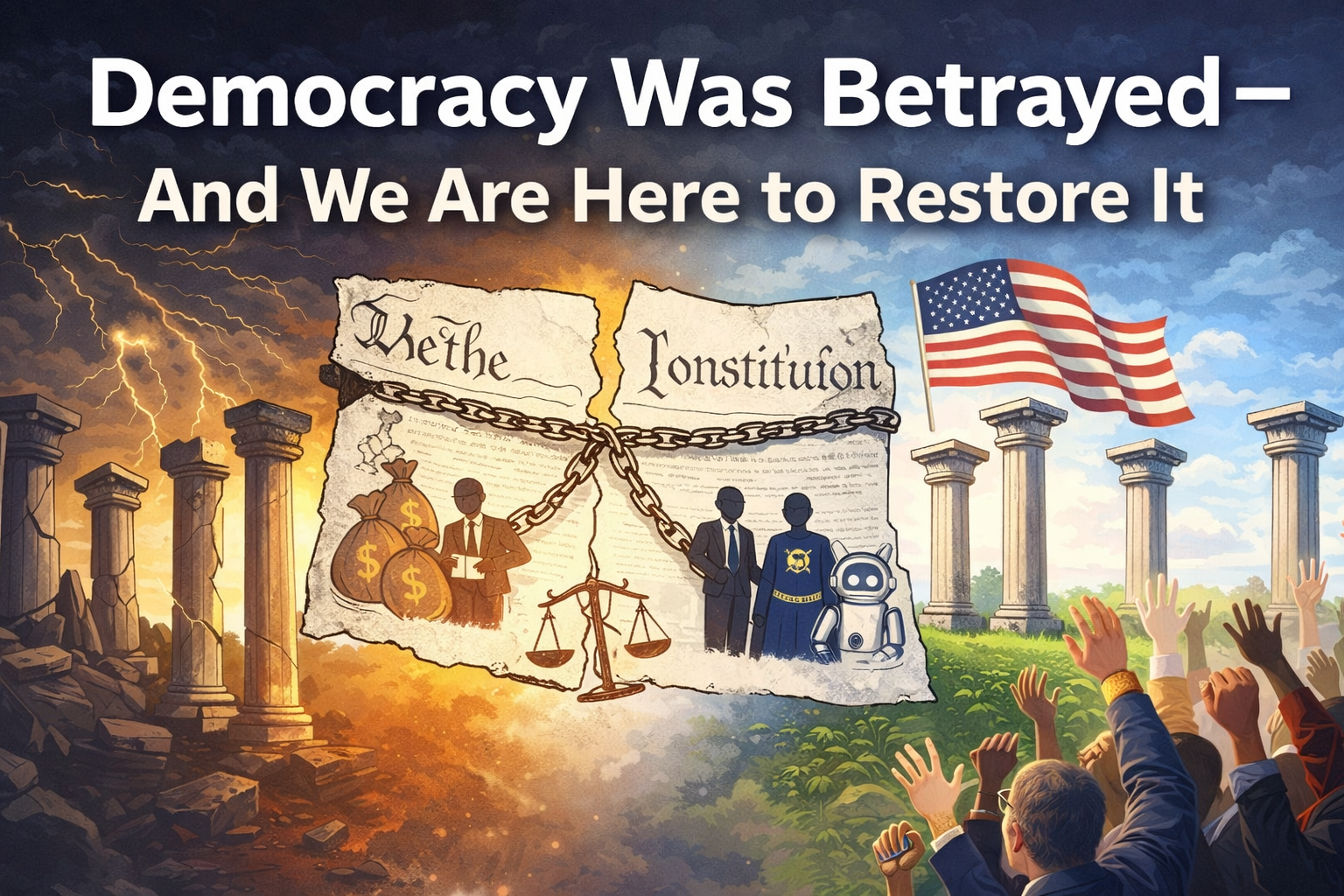
Watch "Democracy Was Betrayed — And We Are Here to Restore It From Electors to Superusers" on
There are moments in history when a people must stop arguing about personalities and start confronting architecture.
This is one of those moments.
Democracy in the United States did not fail because people stopped caring.
It failed because judgment was dismantled, quietly, legally, and systematically.
This blog is not written for experts alone.
It is written for new Americans, lifelong citizens, and anyone who believes that democracy means more than voting every four years.
It is written to explain:
What the Founders built
What was lost
And how we restore it—together
I. What the Founders Actually Built (And Why It Was Brilliant)
The Founding Fathers did not worship power.
They feared it.
They believed:
Power corrupts when it is permanent
Money distorts when it concentrates
Institutions decay when judgment disappears
So they engineered a system with one radical idea at its core:
Power should be exercised briefly, by independent people, using judgment—and then returned to the people.
That idea produced electors.
Electors were not party loyalists.
They were not celebrities.
They were not lawmakers.
They were:
Independent
Temporary
Trusted to think
Required to disappear after use
This was not a flaw.
This was the safeguard.
II. Why Congress Was Locked Out—On Purpose
The Founders explicitly banned Congress from choosing the President.
Why?
Because Congress:
Trades votes
Controls money
Negotiates constantly
Is permanent
If Congress chose the President:
The executive would be owned
Separation of powers would collapse
Democracy would rot from the inside
So Congress was given only a clerical role:
Count
Certify
Announce
No discretion.
No bargaining.
No control.
This was deliberate restraint.
III. Judgment Was the Core of Democracy
The Founders trusted judgment, not obedience.
They believed democracy only works if:
Citizens are trusted to think
Leaders are chosen for character
Independent minds can say “no”
Electors were meant to be:
In the square
In the debate
In the country
Aware of consequences
They were the human firewall against:
Demagogues
Foreign manipulation
Corruption
Sudden passions
Judgment was democracy’s spine.
IV. What Changed (Without Changing the Constitution)
The Constitution did not erase judgment.
The system around it did.
Two decisions by the Supreme Court of the United States reshaped democracy’s operating environment.
1) Money Flooded Politics
In Citizens United v. FEC, the Court ruled that massive financial spending in elections could not be meaningfully limited.
Result:
Corporations and wealthy interests gained disproportionate influence
Media ecosystems consolidated
Candidates became dependent on funding
Judgment began to lose ground to money.
2) Independent Judgment Was Neutralized
In Chiafalo v. Washington, the Court ruled that electors may be bound and punished for voting independently.
Result:
The last independent decision-makers were reduced to messengers
The core safeguard of the original system stopped functioning
These were interpretations, not constitutional amendments.
V. The Consequence: Democracy Without Judgment
When judgment disappears upstream:
Power concentrates downstream
Congress becomes a battlefield
Courts are dragged into elections
Citizens feel unheard
Elections become louder—but less meaningful.
This is not democracy as the Founders understood it.
This is democracy without its protective core.
VI. The Superuser: A Modern Restoration of Judgment
This is where the U.S. House Plan begins.
A Superuser is not an elite.
A Superuser is proven.
A Superuser:
Practices independent judgment
Engages publicly
Debates openly
Understands the country
Accepts accountability
What electors were meant to be in theory,
Superusers are in practice.
Temporary authority.
No permanent power.
No corporate ownership.
VII. Why AI Changes Everything (And Why the Founders Would Have Used It)
The Founders lacked one thing: tools.
AI now allows us to:
Detect conflicts of interest
Track financial influence
Benchmark leadership performance
Preserve institutional memory
Make judgment auditable
AI does not rule.
AI reveals.
Humans decide.
Judgment returns.
This solves the very concern courts cited when neutralizing elector discretion: unpredictability without accountability.
Now we can have both.
VIII. Education Is the First Act of Restoration
The greatest loss was not legal—it was educational.
Americans forgot:
Why electors existed
Why Congress was banned
Why judgment mattered
Why power had to disappear after use
New Americans deserve to know this history clearly and honestly.
Understanding is the foundation of citizenship.
IX. The U.S. House Planning Party
We are forming the U.S. House Planning Party with one mission:
Restore independent judgment to American democracy.
Our commitments:
Reduce the power of money in politics
Restore temporary authority
Protect independent thinkers
Use AI for transparency, not control
This is not about replacing democracy.
It is about repairing its core.
X. A Call to Citizens—New and Old
Democracy does not survive on ritual alone.
It survives on judgment, courage, and understanding.
If you believe:
Power should not be owned
Money should not decide leaders
Citizens should be trusted to think
Then this is your movement.
We are not tearing down the Constitution.
We are finishing what it started.
Final Declaration
Judgment was not a mistake.
It was the design.
Temporary power was not weakness.
It was protection.
The U.S. House Plan restores what history interrupted.
From electors to superusers.
From money to merit.
From silence to judgment.
This is how democracy remembers itself.
Welcome, Citizens of the United States 🇺🇸
And Thank You for Taking the Oath
First, welcome.
By taking the oath of loyalty to the United States, you did not swear loyalty to a party, a politician, a court, or a corporation.
You swore loyalty to the Constitution.
That oath means something.
It means you have agreed to:
Preserve it
Protect it
Defend it
Understand it
And understanding it is where your responsibility begins.
Why We Are Here Today
The Constitution you pledged to protect was designed with care, debate, and deep fear of concentrated power.
It was built to:
Trust independent citizens
Limit permanent authority
Guard against corruption
Protect democracy from money and manipulation
Yet parts of that system no longer function as intended.
Not because the Constitution failed —
but because its safeguards were eroded, misunderstood, or set aside.
Before we can talk about change, reform, or the future, we must first do something far more important:
We must educate ourselves.
This Is a Town Square, Not a Party Rally
What follows is not propaganda.
It is not ideology.
It is not about who you voted for.
This is a civic education.
We will walk through:
What electors were
Why independent judgment mattered
Why Congress was deliberately restrained
What changed over time
And why this matters to you as a citizen today
You do not need to agree with everything you read.
But you deserve to know the history clearly and honestly.
Your Role Starts Now
Citizenship is not passive.
A democracy only survives when its people:
Understand power
Question authority
Protect judgment
Refuse to surrender their voice
Today, you step into the town square not as a spectator, but as a participant.
Welcome.
Now let us begin—with the history every American should know.