

بِسْمِ اللهِ الرَّحْمٰنِ الرَّحِيْم
In the Name of God, Most Gracious, Most Merciful
♥️🤲🕋♥️🕋🌹🌹🥀🤲🌹🕋♥️🤲
Democracy Met Law, Structure, and Empire
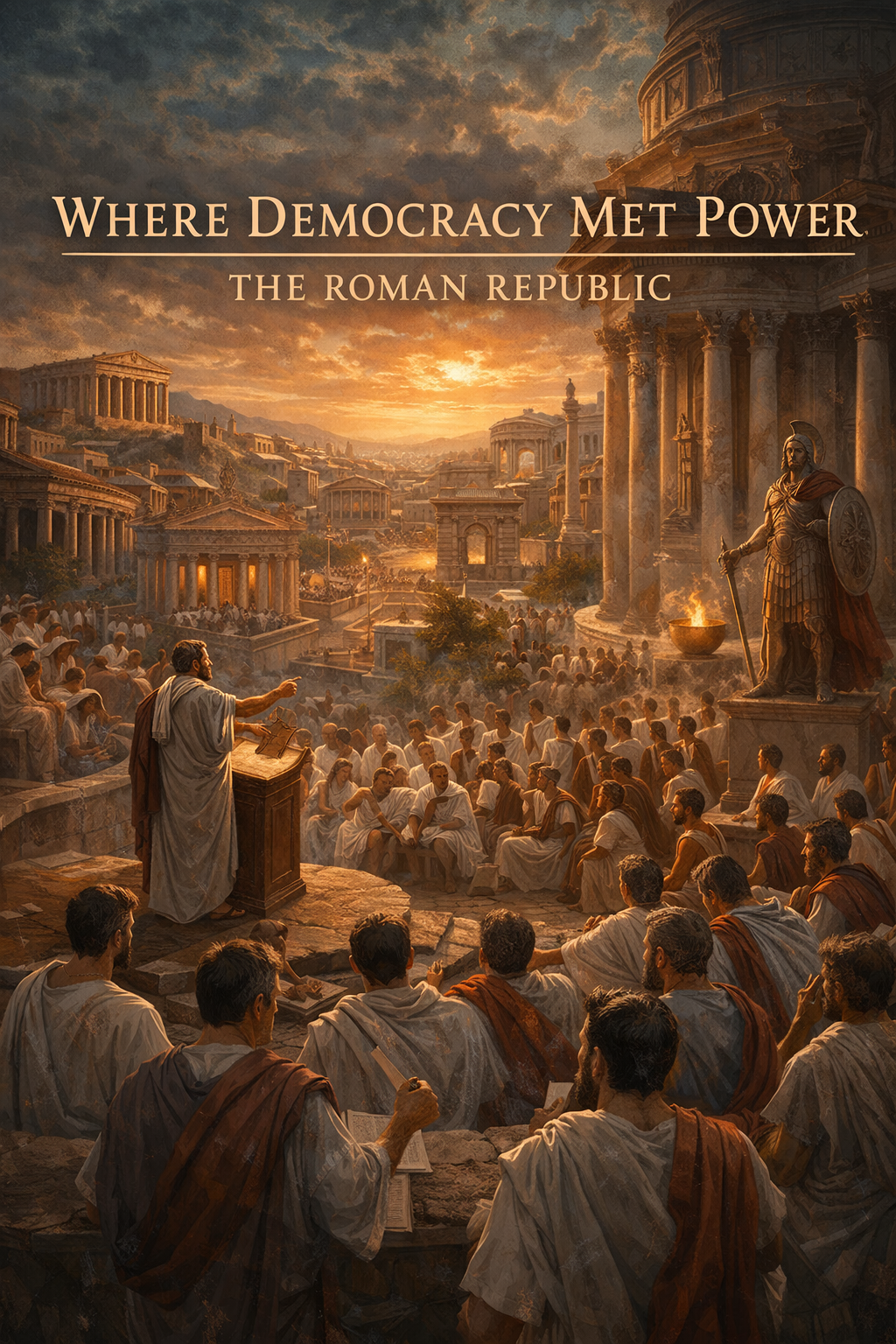
Athens taught the world how to speak. Rome taught the world how to build.
Where Athens was an experiment in voice, Rome became an experiment in durability.
The Romans admired Greek ideas—but they did not trust Greek instability. They saw how easily crowds could be swayed, how rhetoric could become chaos, how passion could undo a city. So they asked a different question:
How do you preserve popular power without letting it self-destruct?
Their answer was not more speeches.
It was law.
Rome created something new: A republic not based on direct rule by the masses, but on institutions, offices, checks, terms, and codified authority.
Power would no longer float. It would be anchored.
Not in men—but in systems.
They invented: • The Senate
• Elected magistrates
• Term limits
• Written law
• Legal citizenship
• Civic duty tied to service
Rome understood something Athens did not:
Democracy without structure collapses.
Structure without accountability becomes tyranny.
Their republic would last nearly 500 years—not because it was perfect, but because it was engineered.
And yet… it too would fall.
Because power, once expanded across continents, changes shape.
Which brings us to the next chapter.
Beyond Rome
Islamic Governance — Law, Consultation, and Moral Authority
When Rome collapsed, it left behind roads, ruins, and a question:
Can power be restrained by morality—not just institutions?
Islamic civilization answered with: • Shura (consultation)
• Qadi courts
• Legal equality under divine law
• Accountability of rulers
• Knowledge as governance
• Ethics as infrastructure
This was not democracy as Athens knew it. It was not republicanism as Rome knew it.
It was governance under God.
Where law was not a tool of power—but a restraint on it.
This will be its own chapter.
Medieval Power — Thrones, Churches, and Absolute Rule
After Rome, the West chose stability over participation.
Kings returned. Divine right replaced consent. Power ascended again.
People did not rule. They were ruled.
Yet even in this darkness, something survived:
The memory.
Democracy never died. It went underground.
Enlightenment Revolutions — The Return of the People
Centuries later, thinkers reopened the ancient question:
What gives a ruler the right to rule?
Their answer was explosive:
Consent.
Not divine. Not inherited. Not ordained.
Chosen.
This would give birth to: • The American Revolution
• The French Revolution
• Constitutional states
• Modern citizenship
• Human rights
But even this version of democracy would fracture.
Modern Collapse — When Systems Outgrow Humans
Today, democracy is no longer debated in open air.
It is filtered. Mediated. Algorithmized. Manipulated.
Citizens vote—but do not govern. Institutions exist—but do not listen. Power operates—but cannot be seen.
The systems became larger than the people.
And now something new is emerging.
Digital Futures — Power Beyond the Human
AI. Automation. Predictive governance. Surveillance systems. Algorithmic decision-making.
For the first time in history, power is becoming non-human.
So we must ask:
• What is consent when decisions are automated?
• What is citizenship when behavior is predicted?
• What is law when systems self-optimize?
• What is democracy when no one understands the machine?
Athens gave us voice. Rome gave us structure. Islamic civilization gave us moral law. The Enlightenment gave us rights.
Now we must give ourselves something new.
Democracy Did Not Fall From the Sky
It was not divine. It was not inevitable. It was not natural.
It was built.
By thinkers. By rebels. By philosophers. By jurists. By citizens.
And what is built can be rebuilt.
Not by nostalgia. Not by slogans. Not by force.
But by understanding.
This series is about that understanding.
Write Part II. Coming up