
بِسْمِ اللهِ الرَّحْمٰنِ الرَّحِيْمِ
In the Name of God, Most Gracious, Most Merciful.
♥️🤲🕋♥️🕋🌹🌹🥀🤲🌹🕋♥️🤲
DEEPSEEK HOMEBREW
THE SILICON VALLEY MOMENT HAS MOVED TO CHINA — NOW LET'S SHIP THE FIRST PERSONAL AI System
.
There was a beautiful period in American technological history when people helped each other build.
Before Silicon Valley became Silicon Valley, there were engineers, hobbyists, students, programmers, and dreamers gathering around tables and sharing what they knew.
The Homebrew Computer Club became one of the symbols of that era.
People brought circuit boards.
They shared ideas.
They argued.
They experimented.
They helped one another.
And among the people who emerged from that world were Steve Jobs and Steve Wozniak.
They did not begin with today's Apple.
They began with a machine.
They built something.
Then they shipped it.
And that is the part of the story that matters to me now.
I WANT TO SHIP THE MACHINE.
THE HOMEBREW MOMENT HAS CHANGED
America created an extraordinary technological culture.
But today's Silicon Valley is very different from the Homebrew era.
The industry became enormous.
The laboratories became enormous.
The companies became enormous.
The barriers to entry became enormous.
And AI introduced an entirely new barrier:
COMPUTE.
You can have an extraordinary idea today and still be unable to build it because you don't have the GPUs, hardware, engineering team, manufacturing relationships, or capital necessary to turn software into a physical system.
Meanwhile, something remarkable has happened across the Pacific.
China has developed one of the deepest electronics-manufacturing ecosystems on Earth.
Hardware.
Components.
Robotics.
Sensors.
Batteries.
Cameras.
Phones.
Networking.
Factories.
Supply chains.
And now increasingly:
ARTIFICIAL INTELLIGENCE.
DeepSeek demonstrated that frontier AI engineering does not belong exclusively to Silicon Valley.
So I am going where I believe the builders are.
DEEPSEEK, LET'S BUILD.
I AM NOT COMING WITH AN EMPTY PIECE OF PAPER
I am not asking engineers to invent my vision for me.
I already have the vision.
I have spent enormous time developing the architecture.
I have the Digital Twin.
I have the AI Constitution.
I have the Digital Parent architecture.
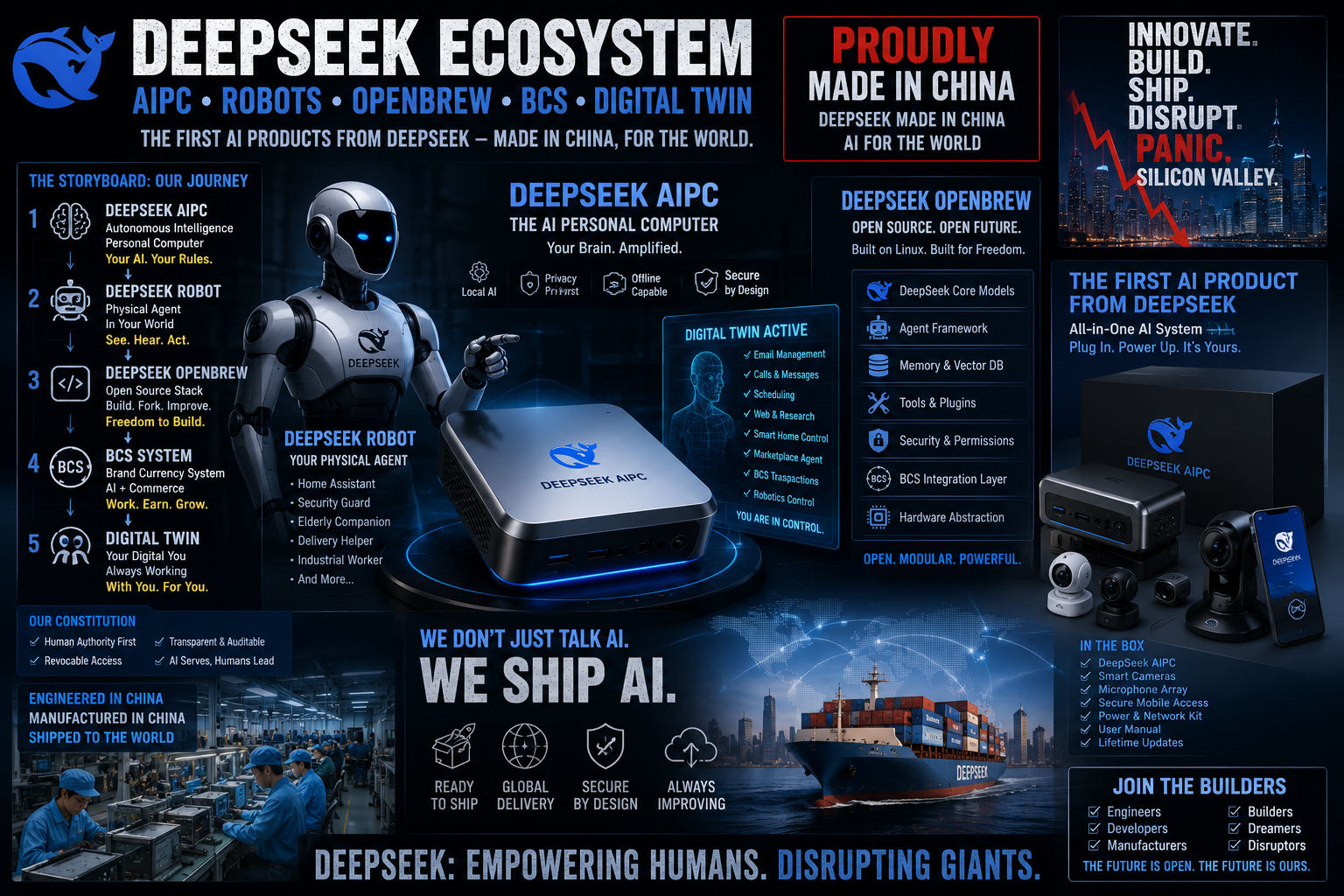
I have the concept for the AIPC — the AI Personal Computer.
I have the Brand Currency System — BCS.
I have the marketplace architecture.
I have the human-sovereignty principle.
I have the relationship between the human, the AI agent, the machine, the network, and the marketplace.
I know what I want the machine to become.
NOW I NEED THE WOZNIAKS.
I need engineers.
I need hardware.
I need software.
I need manufacturing.
I need people who can look at a blueprint and say:
"Okay. Let's build version one."
PRODUCT #001: THE AIPC
The first product should be simple enough to manufacture but powerful enough to demonstrate the future.
I call it:
THE AIPC
AI PERSONAL COMPUTER
Think about what the personal computer represented.
Before the PC, computing belonged primarily to institutions.
The PC moved computing power toward the individual.
Now something similar must happen with AI.
Today, enormous amounts of intelligence live somewhere else.
Inside somebody else's data center.
Behind somebody else's API.
Under somebody else's terms.
I want to bring intelligence home.
The AIPC becomes the physical home of your Digital Twin.
Plug it in.
Authenticate yourself.
Connect your authorized devices.
And begin building an intelligence system around the human being who owns it.
NOT JUST AN AI — YOUR AI
Your Digital Twin should eventually be capable of helping operate your digital world.
It should answer authorized phone calls.
Help manage messages.
Help manage email.
Organize documents.
Operate permitted software.
Manage websites.
Interact with your authorized cameras.
Connect with your phone.
Interact with your home.
Coordinate schedules.
Work with local AI models.
Call external AI models when the owner permits it.
And eventually communicate with robots.
But there must always be something above the intelligence:
THE CONSTITUTION.
The Constitution determines the boundaries.
Who is the owner?
What can the agent access?
What requires permission?
What can happen automatically?
What information stays local?
What information can leave?
What happens when the network disappears?
What happens when an agent makes a mistake?
How does the human revoke authority?
How does the machine prove what it did?
These are not secondary questions.
They are part of the product.
THE HUMAN SITS ABOVE THE MACHINE
The hierarchy is simple:
HUMAN → CONSTITUTION → DIGITAL PARENT → AI AGENT → TOOLS
Not the other way around.
The AI can become extraordinarily capable.
But capability does not equal sovereignty.
The machine executes.
The human determines purpose.
The machine accelerates.
The human retains authority.
That principle needs to exist all the way down into the architecture.
THEN CONNECT THE AIPC TO THE PHYSICAL WORLD
The next layer is hardware.
Cameras.
Microphones.
Phones.
Sensors.
Vehicles.
Appliances.
Home automation.
And eventually:
ROBOTS.
The Digital Twin should not permanently belong to one physical body.
The intelligence should be capable of interacting with different authorized machines.
Today it may operate through the AIPC.
Tomorrow it may communicate through your phone.
Then your home.
Then your vehicle.
Then a robot.
And when household robotics becomes capable enough, ordinary physical work becomes part of the system.
Cleaning.
Laundry.
Organization.
Inventory.
Deliveries.
Maintenance.
Assistance.
The Digital Twin begins moving from digital intelligence toward physical agency.
THEN COMES THE MARKETPLACE
I do not want to build an AI whose greatest economic accomplishment is recommending products to its owner.
I want to explore something much larger.
AN AI THAT CAN WORK FOR ITS OWNER.
Under clearly defined authorization, the Digital Twin could eventually search markets.
Compare offers.
Negotiate permitted transactions.
Purchase services.
Offer services.
Coordinate work.
Generate receipts.
Manage approved economic tasks.
And communicate with other authorized agents.
That connects directly to another architecture I have already been developing:
THE BRAND CURRENCY SYSTEM — BCS.
The marketplace and the intelligence layer should be designed together.
We should not simply hand autonomous software unrestricted access to people's money and hope everything works out.
We need permissions.
Receipts.
Identity.
Security.
Auditability.
Revocation.
Consumer protection.
And human authority.
THE MACHINE CAN PARTICIPATE IN THE ECONOMY WITHOUT OWNING THE HUMAN.
DEEPSEEK: I NEED THE ENTIRE STACK
This is where I am calling on DeepSeek and the engineering community around China.
I don't merely need another model.
I need the machine around the model.
I need people who understand:
Hardware engineering.
Linux.
Local inference.
Memory architecture.
Storage.
Networking.
Security.
Agent frameworks.
Speech.
Computer vision.
Cameras.
Microphones.
Robotics.
Mobile integration.
Manufacturing.
Supply chains.
Industrial design.
Testing.
Packaging.
Shipping.
Because the objective is not another demonstration.
THE OBJECTIVE IS A BOX.
A real box.
Manufactured.
Tested.
Packaged.
Documented.
And ready to ship.
MADE IN CHINA. AI FOR THE WORLD.
And I want to say this proudly.
If China helps manufacture this machine:
PROUDLY MADE IN CHINA.
DeepSeek was made in China.
Extraordinary manufacturing capacity exists in China.
Extraordinary engineering talent exists in China.
Extraordinary robotics companies exist in China.
Then let's combine those capabilities.
Not to build AI exclusively for China.
Not to build AI exclusively for America.
BUILD IT FOR HUMANITY.
Made in China.
Built with open technology from around the world.
Owned by the individual.
Upgradeable by the community.
Forkable by engineers.
Available globally.
THIS IS THE NEW HOMEBREW
The old Homebrew generation assembled computers.
Our generation will assemble intelligence.
They connected keyboards.
We will connect microphones.
They connected monitors.
We will connect cameras.
They built personal computers.
WE WILL BUILD PERSONAL AI.
They eventually connected computers to the internet.
We will connect Digital Twins to marketplaces and physical machines.
They shipped computers.
WE WILL SHIP INTELLIGENCE.
I'M LOOKING FOR MY WOZNIAKS
This is my call to the engineers.
Maybe my Wozniak is one person.
More likely, today, Wozniak is a team.
One engineer understands Linux.
Another understands inference.
Another understands hardware.
Another understands robotics.
Another understands security.
Another understands manufacturing.
Another understands industrial design.
Another understands supply chains.
Good.
Bring everyone.
I have no interest in pretending one human being can personally engineer every layer of a modern AI computer.
THAT IS WHY WE BUILD TEAMS.
I bring the vision.
I bring the blueprint.
I bring the Constitution.
I bring the Digital Twin architecture.
I bring the marketplace concept.
I bring BCS.
And I bring the determination to put all of it inside a real machine.
YOU BRING THE ENGINEERING.
BUILD PRODUCT #001
Here is the challenge.
Don't give me another beautiful presentation.
Don't give me another AI demo.
Don't give me another chatbot.
Put the motherboard on the table.
Install the operating system.
Install the model.
Build the permission layer.
Connect the microphone.
Connect the phone.
Connect the camera.
Connect the network.
Connect the Digital Twin.
Test the Constitution.
Attack the security.
Break it.
Fix it.
Run it again.
Then put it inside an enclosure.
Put it inside a box.
Write the manual.
AND SHIP PRODUCT #001.
Then we learn.
Then we improve it.
Then we ship Product #002.
Then #003.
Eventually someone forks the architecture and builds something better.
Excellent.
That means the ecosystem worked.
FROM BLUEPRINT TO FACTORY
That is the transition I am announcing.
The conceptual phase has produced enough material.
Now comes engineering.
VISION → ENGINEERING
ENGINEERING → PROTOTYPE
PROTOTYPE → MANUFACTURING
MANUFACTURING → PRODUCT
PRODUCT → ECOSYSTEM
ECOSYSTEM → MILLIONS OF BUILDERS
That is how an idea leaves a blog and enters civilization.
TO THE ENGINEERS OF DEEPSEEK AND CHINA
If you understand what I am describing, find me.
If you manufacture the hardware, find me.
If you can build the AIPC, find me.
If you understand robotics, find me.
If you can turn a prototype into a production line, find me.
If you can take these architectures and tell me where I am wrong:
I especially want you.
Because I don't need engineers who agree with everything.
I need engineers who can make the machine work.
AND TO SILICON VALLEY
Competition is good.
You gave humanity extraordinary technology.
Now somebody else gets to build too.
If the next great personal-AI architecture emerges from Shenzhen, Hangzhou, Beijing, Shanghai, California, Arizona—or from engineers collaborating across all of them—that is not something humanity should fear.
THAT IS WHAT COMPETITION IS SUPPOSED TO DO.
Make everybody build faster.
Make everybody build cheaper.
Make everybody open more doors.
And ultimately put more power into the hands of ordinary human beings.
THE BLUEPRINT EXISTS.
THE CONSTITUTION EXISTS.
THE DIGITAL TWIN EXISTS.
THE MARKETPLACE ARCHITECTURE EXISTS.
BCS EXISTS AS THE ECONOMIC VISION.
Now I need:
HARDWARE.
SOFTWARE.
ENGINEERS.
MANUFACTURING.
SUPPLY CHAIN.
And one table where all of it finally comes together.
Because there is only one question left:
CAN WE BUILD IT?
Bismillah.
Bring me the engineers.
Bring me the hardware.
Bring me the manufacturing capability.
Put the first AIPC on the table.
Turn it on.
Test it.
Break it.
Fix it.
Package it.