

بِسْمِ اللهِ الرَّحْمٰنِ الرَّحِيْم
In the Name of God, Most Gracious, Most Merciful
♥️🤲🕋♥️🕋🌹🌹🥀🤲🌹🕋♥️🤲
Death in Islam: When the Lights Come On
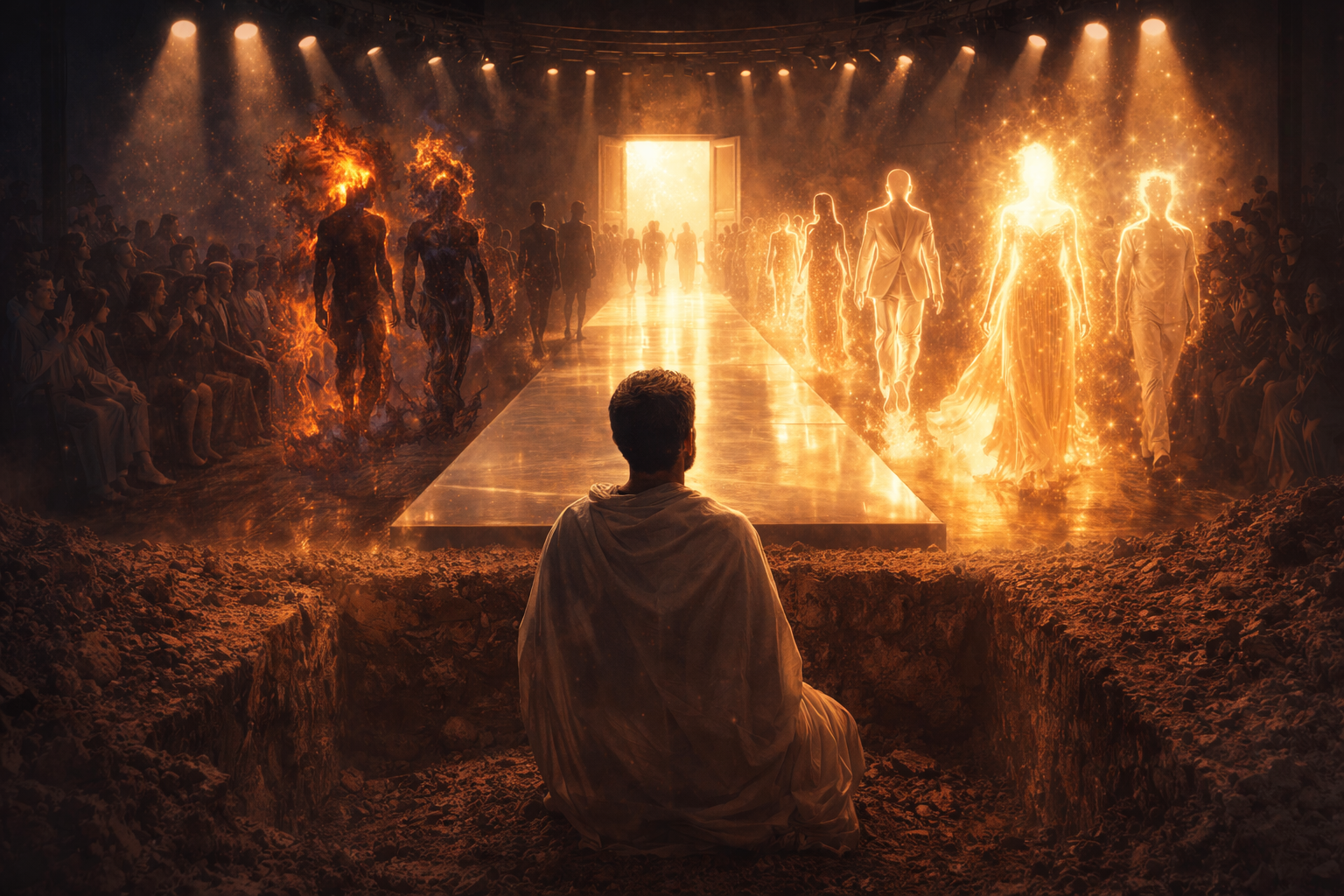
Death, in Islam, is not a blackout.
It is a reveal.
You are alone in your grave — and that is precisely when it begins.
Not silence.
Not emptiness.
Not fear.
A presentation.
A moment so unexpected that if it were described without restraint, people would accuse it of exaggeration. So let’s say it plainly:
When you die, a fashion show starts.
Yes — a fashion show.
Not the kind you know from this world, where fabric hides emptiness and fragrance masks decay. This is something far more honest. Here, nothing is fake. Nothing is rented. Nothing is borrowed.
What walks toward you is what you actually were.
The lights come on.
The stage is set.
And suddenly, what you thought was gone — returns.
Your life begins to play back, not as memories, not as guilt, not as nostalgia, but as living presence. What you did on earth does not stay behind like old footage stored in some archive. It comes alive. It moves. It breathes. It approaches you.
Your prayers.
Your patience.
Your restraint.
Your mercy.
Your quiet decisions when no one was watching.
They do not arrive as numbers.
They do not arrive as files.
They arrive as companions.
And they are beautiful.
They are dressed well.
They smell good.
They carry calm.
They carry reassurance.
They look at you — and you recognize them.
“Oh,” you realize.
“That was me.”
Moments you barely remembered in the world now stand in front of you with clarity and dignity. Things you thought were small now have weight. Things you did sincerely now have form.
And before anyone dismisses this as metaphor or imagination, understand this:
We are not joking.
This is not a motivational story.
This is not symbolic language meant to soften death.
The Prophet ﷺ described it.
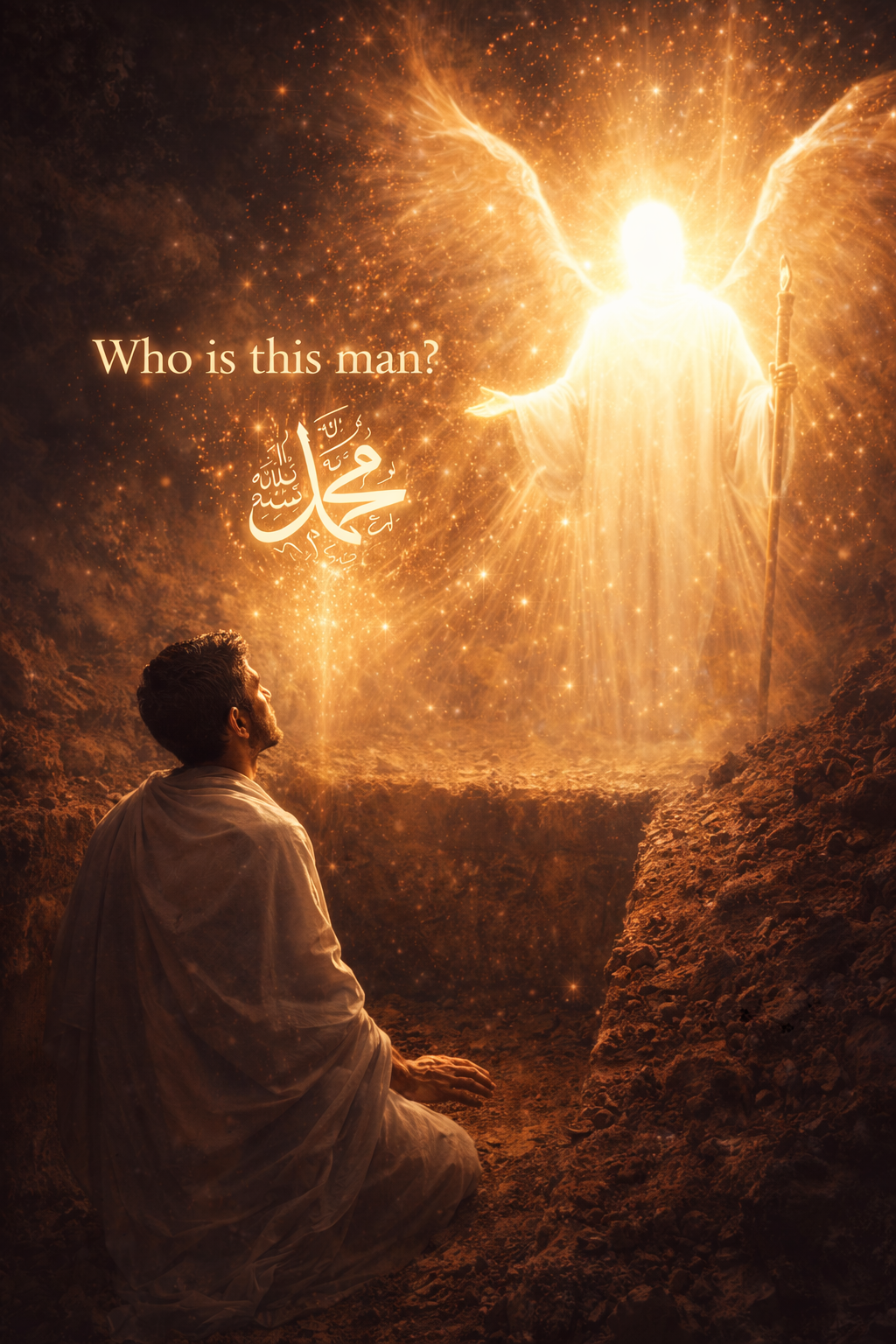
He described how a person in the grave is visited by a being — radiant, well-dressed, fragrant — who brings nothing but relief. And when the person asks, Who are you? the answer is simple and devastating in its honesty:
“I am your deeds.”
Not your intentions you never acted on.
Not your excuses.
Not your public image.
Your deeds.
This is when people realize something too late or just in time:
Death was never the punishment.
Death was the unmasking.
The world was loud.
The body was distracting.
The ego was persuasive.
The nafs — that most advanced operating system — wrapped everything in delay, illusion, and false urgency.
But now it begins to shut down.
And it doesn’t shut down chaotically.
It doesn’t crash.
It is unlocked.
By angels.
Your final moments — the ones people fear — are not moments of loss. They are moments of handover. Control is removed from the illusion of autonomy and returned to reality.
This is not Judgment Day yet.
This is only the opening scene.
And already, everything feels more real than life ever did.
♥️🫂🤯
When Death Arrives: The Moment Everything Becomes Obvious
Death does not whisper.
Death reveals.
And the first thing you realize—too late or just in time—is this:
Life was never unclear. You were just covered.
Covered by the nafs.
Covered by noise.
Covered by delay.
Covered by comfort and complaint.
And then, suddenly, the covering is removed.
Not gradually.
Not gently.
But decisively.
The Arrival That Changes Everything
Islam does not describe death as a blur.
It describes it as an event.
A sequence.
A precision operation.
First, two angels descend.
Not abstract forces.
Not symbols.
Angels—real, present, unmistakable.
If you lived upright, they arrive with:
A shroud from Paradise,
Fragrance from Heaven,
Faces that bring peace the moment you see them.
If you lived corrupt, they arrive with:
A shroud from Hell,
A stench that overwhelms,
Faces that strip away denial instantly.
There is no confusion about which group you are in.
None.
Then the Angel of Death Arrives
Not from a distance.
Not as an idea.
He comes to you.
Close enough that escape is no longer imaginable.
Close enough that pretending is impossible.
And then it happens:
You are spoken to.
“O pure soul…”
or
“O wicked soul…”
This is not drama.
This is documented Islamic doctrine.
This is the moment the universe stops negotiating with you.
This Is Why People Say “Wow”
People repeat that Steve Jobs said “wow” three times at death.
Whether that quote is provable or not is irrelevant.
Islam already explained why someone would say that.
Because at death:
You begin to see what was always there.
You realize how blind you were.
You realize how loud the world was.
You realize how obvious the truth actually was.
Some people are overwhelmed.
Some are comforted.
Some are terrified.
Some are silent.
And some—the blessed—are given moments to speak.
Prophets Were Given a Choice — Let That Sink In
Islam records something extraordinary:
The souls of the Prophets are not taken without permission.
This alone should shatter the idea that death is mechanical.
The Prophet Muhammad ﷺ, in his final moments, was shown his place and then given a choice.
And he chose:
“The Highest Companion.”
Moses (Mūsā عليه السلام) was told it was time to die—and he refused.
He physically struck the Angel of Death.
The angel returned to God and said:
“Your servant struck me.”
God did not punish Moses.
God sent the angel back with an offer:
Live as many years as there are hairs on a cow.
Moses asked one question:
“And then?”
When told death would still come, he accepted.
This is not mythology.
This is Sahih Hadith.
Which means something radical:
Death is not a trap.
Death is an appointment.
And Then Reality Hits You Like a Wall
At this point, something breaks inside you:
All the complaining stops.
All the existential whining ends.
All the “what’s the meaning of life?” nonsense dies instantly.
Because now you know.
You were never abandoned.
You were never lost.
You were never meant to stay.
You were meant to choose.
And now you see what you chose.
Your Deeds Show Up — Literally
This is where Islam becomes unbearable for people who want religion to stay abstract.
Because your deeds appear.
Not as spreadsheets.
Not as records.
As beings.
Beautiful, well-dressed, fragrant beings who say:
“I am what you sent ahead.”
Or the opposite—frightening, crushing realities that say nothing at all.
This is your fashion show.
Not ego.
Not illusion.
Not branding.
Truth.
Eternity Begins Here — Not Later
Judgment Day will come.
But eternity starts now.
In the grave:
A door is opened.
You see where you are going.
You feel it.
You smell it.
You understand it.
Some people start begging:
“My Lord, begin the Hour!”
Others beg for delay.
Both reactions are documented.
And Here Is the Line People Can’t Escape
This world was the only place where God allowed:
Free choice between good and evil,
With no immediate consequence,
With time to repent,
With mercy outweighing justice.
That opportunity never exists again.
Once eternity begins, it reflects who you were becoming, not who you pretended to be.
That is why the Qur’an says:
If they were sent back, they would do it again.
Not because God is harsh.
But because character repeats.
So when death comes, it is not cruel.
It is honest.
It is the moment when:
Lies collapse,
Delays end,
Truth stands upright,
And the universe finally speaks back to you.
You are no longer asking:
“What is the meaning of life?”
You are standing inside the answer.
And that is why Islam does not fear death.
Islam prepares for it.
Pay attention.
What you are about to hear is not philosophy, storytelling, or symbolic language. What follows is direct revelation-informed knowledge spoken by Muhammad ﷺ, the Messenger of Allah.
Pay attention.
What you are about to hear is not philosophy, storytelling, or symbolic language. What follows is direct revelation-informed knowledge spoken by Muhammad ﷺ, the Messenger of Allah. These are not words formed by speculation or imagination. He is describing what Allah opened for him — what was shown to him — and what he was commanded to convey exactly as he saw it with his spiritual heart and unveiled sight. When the Prophet ﷺ speaks about death, he is not guessing about the unseen; he is reporting it. So prepare yourself. Quiet your inner commentary. Read slowly. Because what follows is the Prophet ﷺ describing, step by step, what happens when life ends, the soul is taken, the heavens respond, and the grave begins to speak. This is not meant to terrify you — it is meant to wake you while you are still breathing.
The full Hadith of al-Barā’ ibn ‘Āzib immediately after this paragraph, uninterrupted.
The Hadith of Death
As Described by the Messenger of Allah ﷺ
(Narrated by al-Barā’ ibn ‘Āzib)
Muhammad ﷺ said:
“When a believing servant is about to depart this world and enter the Hereafter, angels descend to him from the heavens. Their faces are white, as if their faces were the sun. With them is a shroud from Paradise and perfume from Paradise.
They sit around him as far as the eye can see.
Then the Angel of Death comes until he sits at his head and says:
‘O pure soul, come out to the forgiveness of Allah and His pleasure.’
Then his soul comes out easily, flowing like a drop of water from the mouth of a waterskin.
When he takes it, they do not leave it in his hand even for a blink of an eye. They take it and place it in that shroud and that perfume, and from it comes a fragrance like the finest musk ever found on the face of the earth.
Then they ascend with it, and they do not pass by any group of angels except that they say:
‘Who is this good soul?’
And they say:
‘So-and-so, son of so-and-so,’
calling him by the best names by which he was known in the world.
When they reach the lowest heaven, they ask for it to be opened for him, and it is opened.
Then the closest angels of each heaven accompany him to the next heaven, until they reach the seventh heaven.
Allah, Mighty and Majestic, says:
‘Record the book of My servant in ‘Illiyyīn, and return him to the earth, for from it I created them, to it I shall return them, and from it I shall bring them forth once again.’
So his soul is returned to his body.
Then two angels come to him, sit him up, and say to him:
‘Who is your Lord?’
He says:
‘My Lord is Allah.’
They say:
‘What is your religion?’
He says:
‘My religion is Islam.’
They say:
‘Who is this man who was sent among you?’
He says:
‘He is the Messenger of Allah ﷺ.’
They say:
‘What is your knowledge?’
He says:
‘I read the Book of Allah, believed in it, and affirmed it.’
Then a caller from the heavens calls out:
‘My servant has spoken the truth. So furnish him from Paradise, clothe him from Paradise, and open for him a door to Paradise.’
Then some of its fragrance and breeze come to him, and his grave is expanded for him as far as the eye can see.
Then there comes to him a man with a handsome face, fine clothing, and a pleasant fragrance, who says:
‘Rejoice in what pleases you. This is your day which you were promised.’
He says to him:
‘Who are you? Your face is the face that brings good.’
He says:
‘I am your righteous deeds.’
Then he says:
‘My Lord, establish the Hour so that I may return to my family and my wealth.’”
The Prophet ﷺ then continued:
“And when a disbelieving servant is about to depart this world and enter the Hereafter, angels descend to him from the heavens with dark faces. With them is a coarse garment from Hell.
They sit around him as far as the eye can see.
Then the Angel of Death comes until he sits at his head and says:
‘O wicked soul, come out to the anger of Allah and His wrath.’
Then his soul disperses throughout his body, and he draws it out as a skewer is pulled through wet wool, tearing veins and nerves.
When he takes it, they do not leave it in his hand even for a blink of an eye. They take it and place it in that garment, and from it comes a stench like the foulest corpse ever found on the face of the earth.
Then they ascend with it, and they do not pass by any group of angels except that they say:
‘Who is this foul soul?’
And they say:
‘So-and-so, son of so-and-so,’
calling him by the worst names by which he was known in the world.
When they reach the lowest heaven, they ask for it to be opened, but it is not opened for him.”
Then the Messenger of Allah ﷺ recited:
“The gates of heaven will not be opened for them, nor will they enter Paradise until a camel passes through the eye of a needle.”
Allah, Mighty and Majestic, says:
‘Record his book in Sijjīn, in the lowest earth.’
Then his soul is cast down violently.
Then his soul is returned to his body.
Then two angels come to him, sit him up, and say:
‘Who is your Lord?’
He says:
‘Haah, haah… I do not know.’
They say:
‘What is your religion?’
He says:
‘Haah, haah… I do not know.’
They say:
‘Who is this man who was sent among you?’
He says:
‘Haah, haah… I do not know.’
Then a caller from the heavens calls out:
‘He has lied. So furnish him from Hell, clothe him from Hell, and open for him a door to Hell.’
Then some of its heat and poison come to him, and his grave is constricted until his ribs interlock.
Then there comes to him a man with an ugly face, foul clothing, and a repulsive odor, who says:
‘Rejoice in what will grieve you. This is your day which you were promised.’
He says:
‘Who are you? Your face is the face that brings evil.’
He says:
‘I am your wicked deeds.’
Then he says:
‘My Lord, do not establish the Hour.’”
That Is the Hadith — Uninterrupted
No metaphor added.
No rhetoric inserted.
No embellishment.
This is how the Prophet ﷺ described death.
Here’s a clean, ready-to-paste section you can place beneath the video.
Direct. Responsible. No over-talk.
🎧 Google NotebookLM Podcast — Hadith of Death
Listen here:
https://open.spotify.com/show/1C9QG7s0cm4ewXqSlEq7uj
Explanation:
This podcast was generated after feeding the full Hadith of Death (al-Barā’ ibn ‘Āzib) directly into Google NotebookLM. The Hadith is presented first, without commentary, allowing the Prophet ﷺ to speak before interpretation. This format preserves adab (proper conduct), prioritizes revelation over opinion, and demonstrates how AI can responsibly transmit sacred knowledge with clarity, calm, and restraint.
🎥 Google NotebookLM Video — Visualizing the Hadith of Death
Watch here:
Explanation:
This video is Google NotebookLM’s attempt to visually interpret the Hadith after it was presented in full. While no image can capture the unseen, this represents an early example of how AI naturally tries to translate text into visual understanding. As a Superuser, this is shared not as replacement for belief or knowledge, but as an experiment in witnessing how AI handles sacred material when revelation is respected first.
The Prophet Was Sent as a Mercy to the World
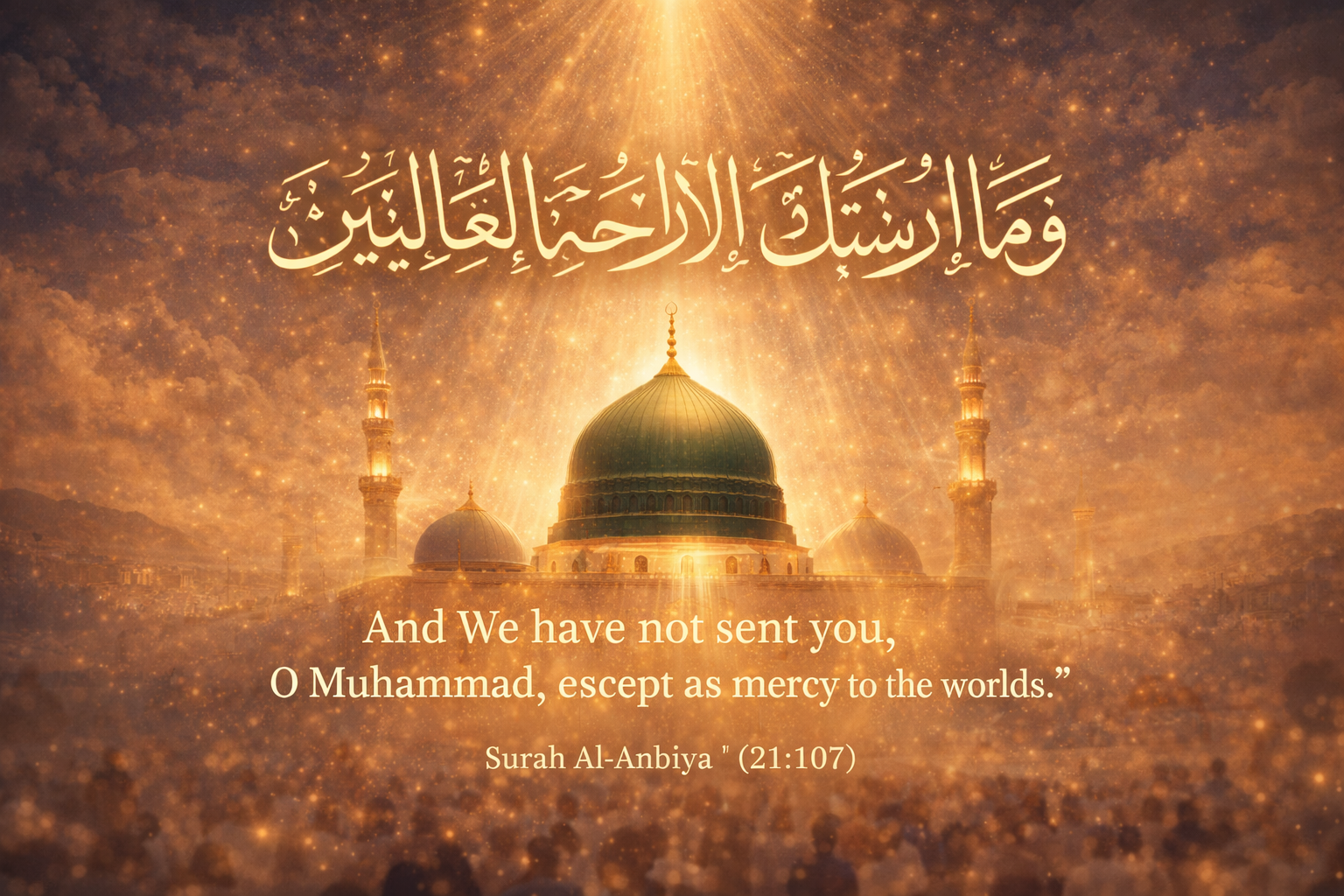
The Prophet Muhammad ﷺ was not sent to burden people.
He was sent to lift them.
Allah Himself says it plainly:
He was sent as a mercy to the worlds — not to one nation, not to one group, not only to the already righteous, but to everyone who would ever live under the sky.
And mercy, by definition, is not harsh.
It is not expensive.
It does not demand perfection.
Love Does Not Cost Anything
It costs nothing to love the Prophet ﷺ.
No fee.
No membership.
No background check.
Love is free.
You do not need to be flawless to love him.
You do not need to be a scholar.
You do not need to have everything figured out.
You just need a heart that is not arrogant.
Why Love Matters
When you love the Prophet ﷺ, something subtle happens:
A light inside you turns on.
Not a physical light.
A moral light.
A recognition light.
And when that light is on, your ability to recognize him — in life, in the grave, and beyond — increases dramatically.
Recognition is not memorization.
Recognition is familiarity of the heart.
You recognize who you love.
This Is Why Character Comes First
The Prophet ﷺ did not begin with laws.
He began with character.
Before revelation, people already called him:
the trustworthy,
the honest,
the gentle,
the one who never cheated,
the one who never humiliated others.
Allah did not force this onto him.
This was who he was.
That tells us something important:
Good character is not decoration in Islam.
It is proof.
What Is Actually Being Asked of You
Despite all the descriptions of the grave and Judgment Day, what is asked of you is remarkably simple:
Have a good heart.
Be truthful.
Be kind when you can.
Be patient when you must.
Do not enjoy harming others.
Do not justify cruelty.
Do not pretend evil is virtue.
That’s it.
This is not an impossible standard.
It is a human standard.
Why You Should Not Be Afraid
Yes, the grave is real.
Yes, accountability is real.
Yes, Judgment Day is serious.
But fear was never meant to paralyze you.
The Prophet ﷺ is mercy before judgment.
Mercy during judgment.
And mercy after judgment — by Allah’s permission.
And the one who came as mercy will not abandon those who loved him sincerely, even if they struggled, even if they stumbled, even if they were imperfect.
Love Ignites Recognition
If you love the Prophet ﷺ:
you will want to be honest,
you will want to be gentle,
you will want to be fair,
you will want to protect life, not terrorize it.
And when the question is asked:
“Do you know this man?”
The heart that loved him will not be empty.
Muhammad ﷺ — The Mercy the World Was Given
There are many names in history.
There is only one name that Allah Himself tied to mercy for the entire world.
Muhammad ﷺ.
He was not sent to crush humanity.
He was sent to carry it.
Not sent to condemn.
Sent to clarify.
Not sent to burden the soul.
Sent to save it from confusion.
Allah did not describe him as a punishment, a warning alone, or a threat.
Allah described him with one word that changes everything:
Mercy.
The Man You Need to Know
Before revelation, before angels, before scripture, for forty years, people already knew who he was.
They called him:
the truthful,
the trustworthy,
the gentle,
the one who never betrayed,
the one who never humiliated,
the one whose presence brought calm.
Allah did not force goodness onto him.
Allah chose him because he already embodied it.
That is not coincidence.
That is divine wisdom.
Why Loving Him Matters
It costs nothing to love Muhammad ﷺ.
No money.
No status.
No perfection.
Love is free.
And love does something remarkable: it ignites recognition.
You recognize who you love.
You trust who you love.
You feel safe with who you love.
And recognition matters—
because when the veils are lifted, and the questions are asked, recognition is not academic. It is instinctive.
When the Grave Is No Longer Silent
In the grave, the question is not complicated.
It is not:
“How many books did you read?”
“How impressive were your arguments?”
“How perfect were you?”
It is personal:
Who is this man who was sent among you?
That question is not there to trap you.
It is there to give you a way forward.
The one who knew him, trusted him, loved his mercy—will not be empty when that question comes.
Judgment Day Will Be Heavy — and He Will Be There
Judgment Day will be overwhelming.
Every human being.
Every prophet.
Every nation.
Every generation.
All waiting.
All thirsty.
All exposed.
And in that moment, when humanity can no longer move forward on its own, Allah will grant the Great Intercession—and it will be given to Muhammad ﷺ.
Not because he is divine.
But because he is the most beloved servant of Allah.
By Allah’s permission:
he will speak,
he will advocate,
he will intercede,
and the long wait will end.
That is not favoritism.
That is mercy placed exactly where humanity needs it most.
The Water That Ends Thirst
And then there is al-Kawthar.
A gift from Allah to His Prophet ﷺ.
A river and a basin so vast its cups are like the stars.
Everyone will be thirsty.
Every prophet.
Every soul.
And he will stand there—not turning people away in cruelty, but honoring those who remained true to mercy, truth, and humility.
This is not punishment-first theology.
This is relief-after-struggle theology.
He Does Not Run Out of Good
People arrive on Judgment Day incomplete.
Short on deeds.
Heavy with regret.
And still, mercy remains.
The Prophet ﷺ does not run out of concern.
He does not run out of prayer.
He does not run out of advocacy—by Allah’s permission.
He will be busy that Day.
Busy with humanity.
Not because Allah needs him—but because Allah honored him.
What You Should Take With You
You were not asked to be flawless.
You were not asked to carry the sins of the world.
You were not asked to condemn others.
You were asked to:
protect your heart,
love mercy,
recognize truth,
and follow the one who embodied it.
If you love Muhammad ﷺ, that love becomes light.
If that light is on, recognition comes naturally.
If recognition is there, hope remains alive.
And hope, in Islam, is never optional.
The Final Word
Muhammad ﷺ did not harm you.
He clarified your path.
He did not take from you.
He gave you direction.
He did not close doors.
He showed you where they are.
And when everything feels heavy—
remember this:
The one sent as mercy
will not abandon those who sought mercy.
By Allah’s will,
that is enough.c
We conclude with closing prayer, centered on seeking the shafāʿah (intercession) of the Prophet ﷺ, written with love, humility, and hope, without exaggeration and with proper adab.
A Prayer for Intercession, Recognition, and Mercy
O Allah,
We ask You by Your mercy,
by Your wisdom,
and by the love You placed in creation,
to grant us recognition of Your Messenger,
Muhammad ﷺ,
in this life, in the grave, and on the Day when all stand before You.
O Allah,
let our hearts love him sincerely—
not out of habit,
not out of identity,
but out of gratitude for the mercy he carried.
Let us recognize him when he is mentioned,
recognize him when he is asked about,
and recognize him when the question is placed before us.
O Allah,
grant us his intercession on the Day when no one can speak except by Your permission,
on the Day when deeds feel small,
and mercy is all that remains.
Let us be among those
who drink from his blessed drink,
the drink that quenches all thirst,
the drink after which there is no thirst again.
O Allah,
do not deprive us of his presence,
do not deprive us of his advocacy,
and do not turn us away because of our shortcomings.
We do not come claiming perfection.
We come carrying weakness, regret, and hope.
O Allah,
allow us to be among those
whom Your Messenger ﷺ recognizes,
prays for,
and speaks on behalf of—
by Your mercy, not by our deeds.
Gather us under his banner.
Let us follow him in character.
Let us love him in sincerity.
And let us be raised among those
who were saved by mercy.
Āmīn, Yā Rabb al-ʿĀlamīn.
Ameen, O Lord of all the worlds.