
بِسْمِ اللهِ الرَّحْمٰنِ الرَّحِيْم
In the Name of God, Most Gracious, Most Merciful.
♥️🤲🕋♥️🕋🌹🌹🥀🤲🌹🕋
Human-to-Human News: The Turning Point Begins Today
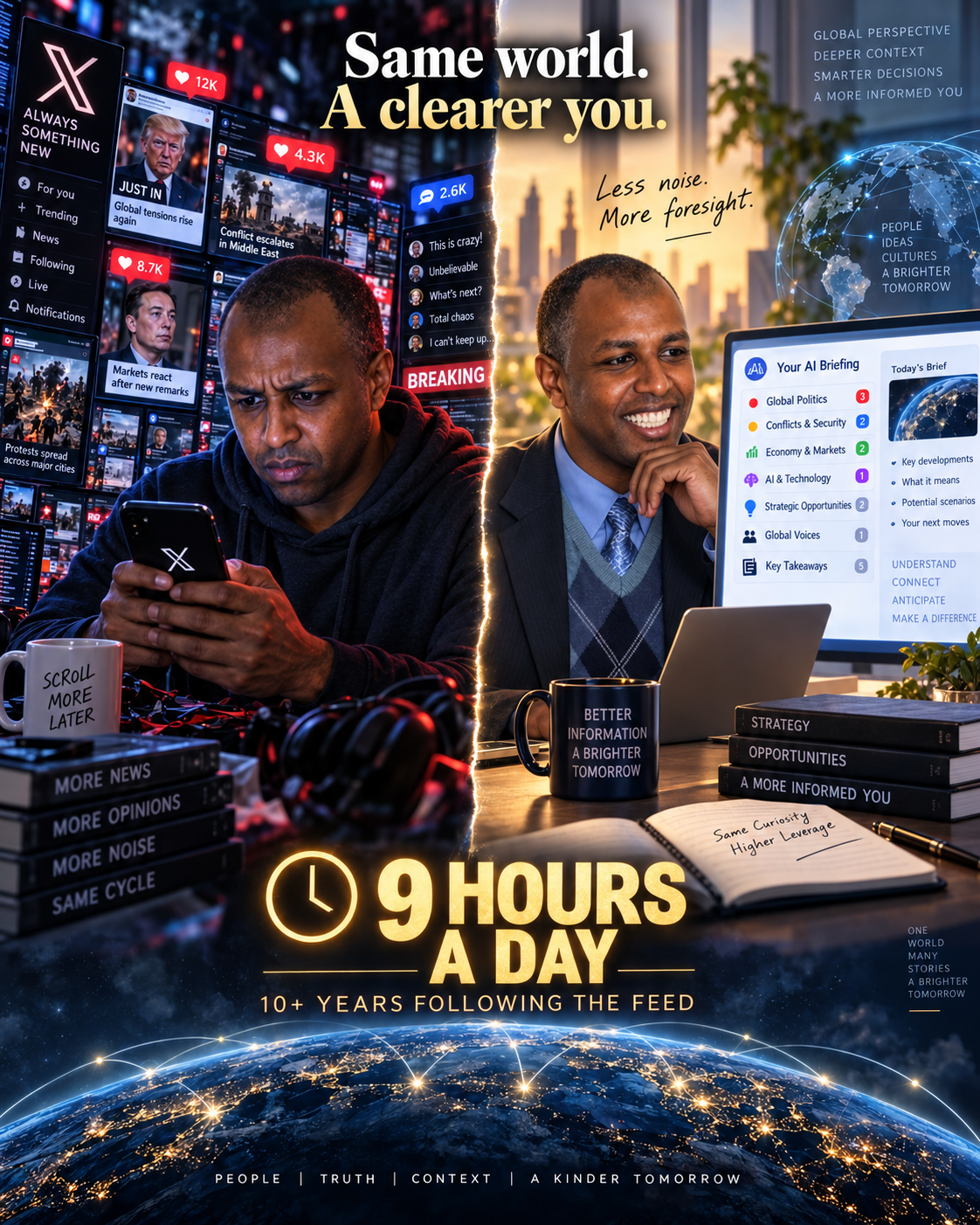
For years, I stayed connected to the world through X. I watched the firehose, followed world leaders, journalists, ordinary people, conflicts, diplomacy, technology, and the constant movement of information. I learned how to read the signals, how to separate noise from what mattered, and how to piece together the story of the world in real time. But that system came with a cost: hours of attention, endless scrolling, and dependence on algorithms to decide what reached me. Now AI is beginning to replace even that process, summarizing the world for us before we have decided what role the human being should still play.
Humanity is at a turning point, and that turning point comes today. We have already lived through the age of websites, algorithms, feeds, and recommendation systems. Now we are entering the age of AI. Before we surrender one more layer of human judgment, we need to decide what should remain permanently human. My answer is simple: the news begins with people. The meaning comes from people. The responsibility stays with people. The solution comes at the end of this story, but first we have to understand how we got here—and why the next system must be built differently.
Human beings have a way of crafting their message that AI cannot match.
When I am on X, I can get the news directly from people, from politicians, from world leaders, from journalists, and from ordinary human beings living through events themselves. I can piece together information about what is happening around the world through the algorithm. I can simply go in and immediately see what world leaders are saying. They are tweeting themselves about what they are doing. People are bringing the news directly into the public square.
Then you interact with it. You like it. You respond. You follow certain people. You engage with certain subjects. And over time, the information coming back to you becomes shaped by that engagement.
For me, being a Super User and engaging the world at a high level, that connection plays an important role.
But now things are changing.
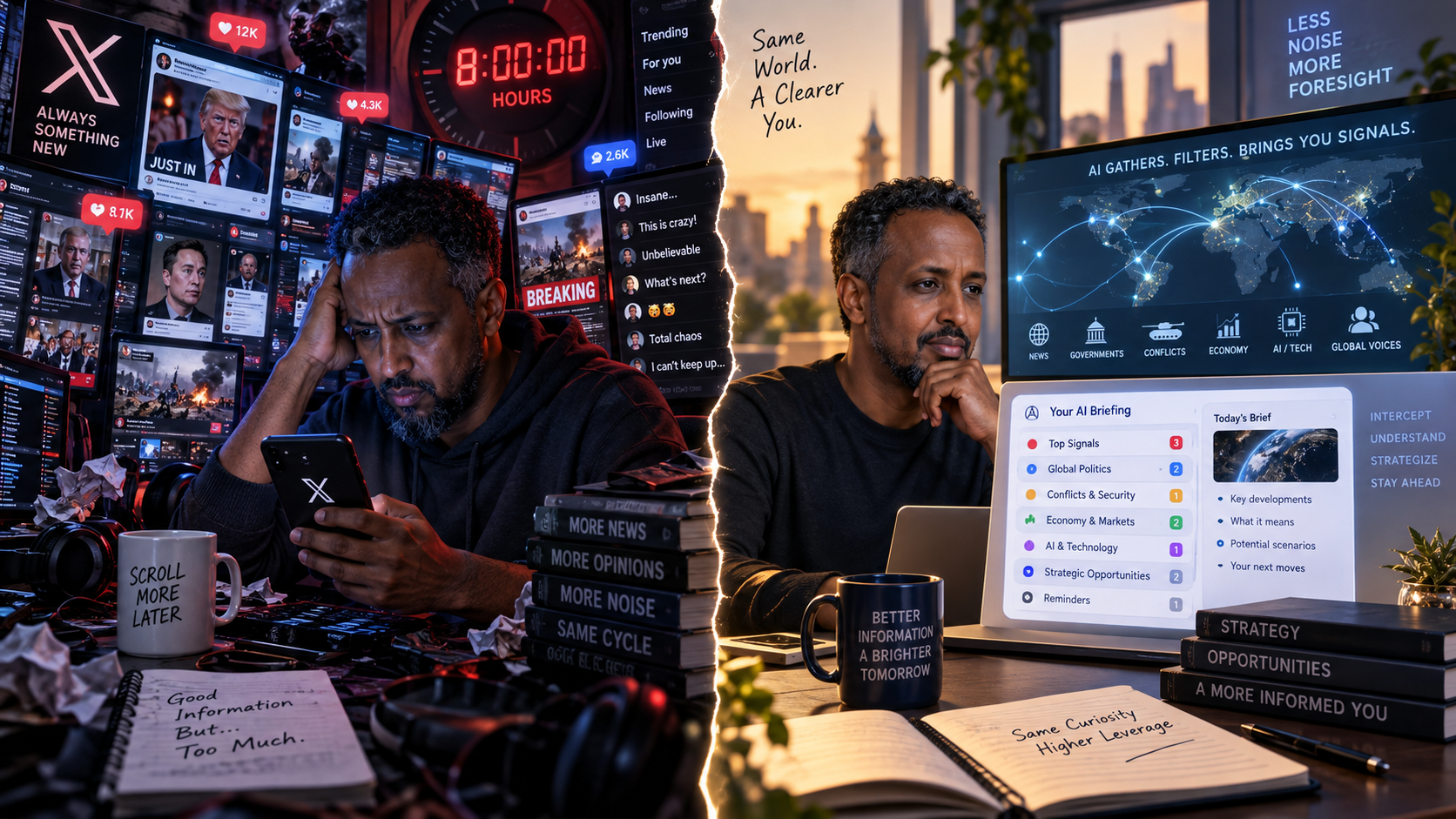
I do not have the same amount of time I used to have to sit on X, watch world leaders, listen to regular people, follow journalists, watch governments, and piece all of this information together.
I am beginning to use AI instead.
And there is something missing.
I am missing the human part.
That is becoming difficult because most people are already disconnected. They have their own lives. They have work. They have families. They have responsibilities. Most people are not sitting all day watching governments, conflicts, technology, economics, diplomacy, culture, and everything else happening around the world.
Yet somehow, information still has to flow back to the individual.
That is the problem.
And I do not yet know exactly how I am going to fix it, but I know I am redesigning journalism.
Information flows in a certain pattern. There are events. There are witnesses. There are institutions. There are journalists. There are platforms. There are algorithms. Eventually, all of that reaches a human being.
But with AI, something new has to exist.
There has to be a chair.
There has to be an anchor's chair that AI occupies when it reports back to the human being.
What is the news?
What actually changed?
What matters?
What is reality?
But the answer cannot simply be determined according to what AI believes is important, what an AI company thinks is important, or what some invisible algorithm decides should dominate the day.
The human being has to remain above the system.
The Super User—or any individual—must be able to say:
This is the news I care about.
This is what matters to me.
This is what I am watching.
And sometimes the human being might say:
No news is good news.
That itself is information.
A new hierarchy has to be developed so that information flows, but flows through a mechanism that keeps human beings in control.
This is where X has been a very interesting experiment.
World leaders are telling you directly what they are doing. Governments are speaking. Journalists are reporting. Ordinary people are reacting. Experts are debating. Eyewitnesses are publishing what they see. Sometimes the news appears there before traditional institutions can even process it.
There is enormous value in that.
But the problem is that it still requires the human being to sit inside the stream.
You have to watch it.
You have to scroll.
You have to separate signal from noise.
You have to remember what happened yesterday.
You have to recognize which development matters and which one does not.
And increasingly, that is not how I want to spend my time.
I want to build.
I want to think.
I want to create.
I want to work with AI.
So now we arrive at the problem and the opportunity at the same time:
How do we stay connected without living inside the feed?
How do we remain informed without surrendering our attention?
How does AI understand what matters to the individual instead of simply flooding the individual with more information?
The future cannot simply be AI replacing X.
The future has to be something better.
AI should be able to stand between the enormous information firehose of the world and the human being, understand the person's priorities, follow the subjects that matter, preserve chronology, recognize changes, separate major developments from noise, and then sit in that anchor's chair and say:
Here is what happened.
Here is what changed.
Here is why it matters to you.
And then the human being decides what happens next.
That is the hierarchy.
The world produces information.
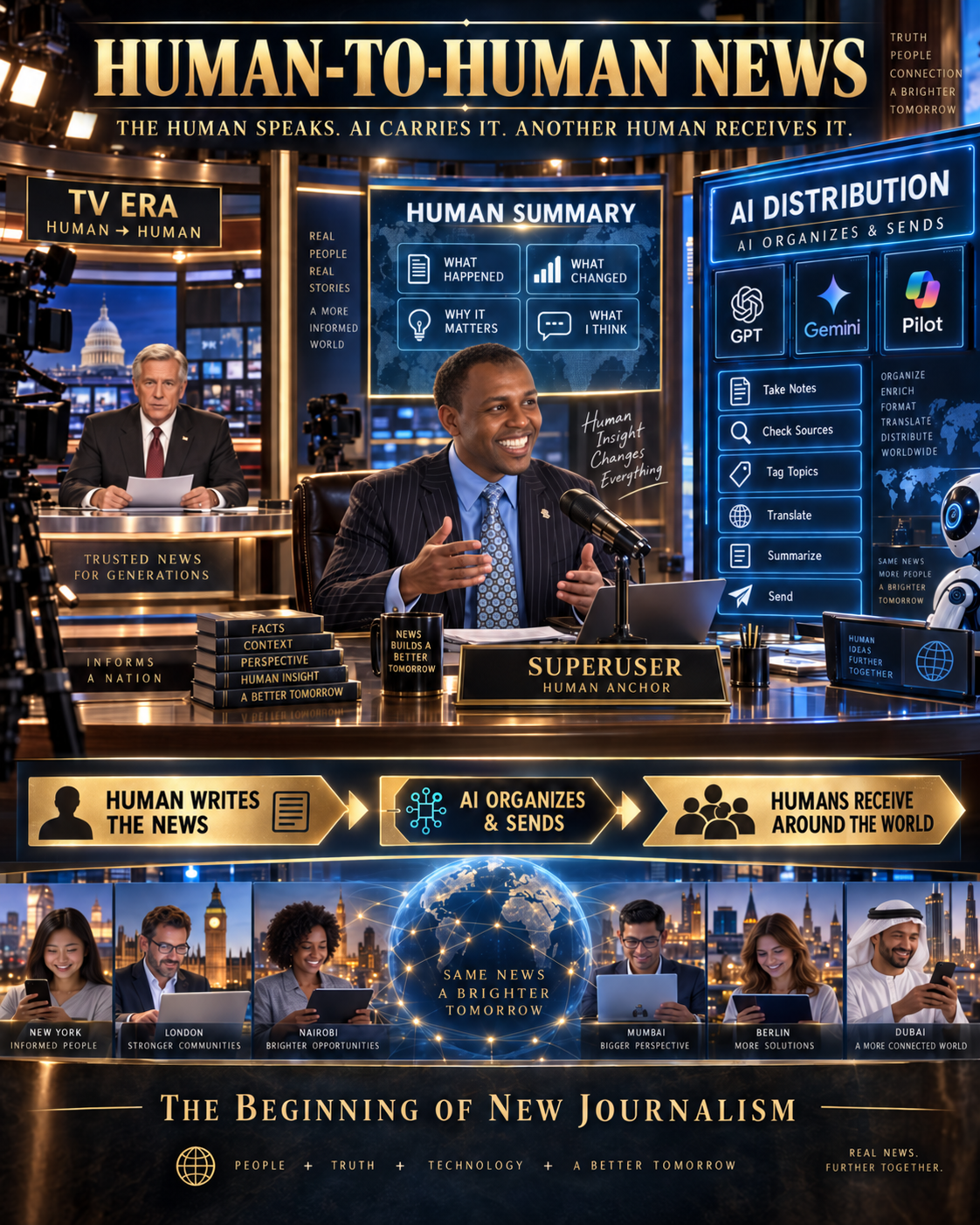
AI organizes it.
The human being remains in command.
That is how we stay connected to information, connected to news, and connected to everything—through AI.
I am going to borrow from history, learn from history, and introduce something absolutely unique to my own timeline. Walter Cronkite was not the first anchor, but he helped define what the anchor could become. He brought professionalism, seriousness, sincerity, and public responsibility to the chair, and those standards shaped the way television news has looked and felt for generations. The technology changed, the networks changed, and the world changed, but the basic idea of the trusted human anchor remained.
Now we are entering another technological shift. AI is changing how information is gathered, summarized, and delivered. And I believe this moment requires the same kind of redesign: not abandoning the human anchor, but rebuilding the role for the age of AI.
Watch "Why News Was So Neutral in the '50s and '60s" on YouTube
I am going to introduce something humanity will always remember.
For the last two decades, since the dot-com era, we have slowly handed over more and more of our lives to algorithms. They decided what we saw, what we watched, what reached us, what disappeared, what became popular, and what stayed buried. And now, before most people have even stopped to think about what happened, the system is already being upgraded again—from algorithms to AI.
And yet, where is the human plan?
Where is the system designed specifically to protect human judgment, human context, human responsibility, and human-to-human communication?
I do not see one.
So I am introducing one.
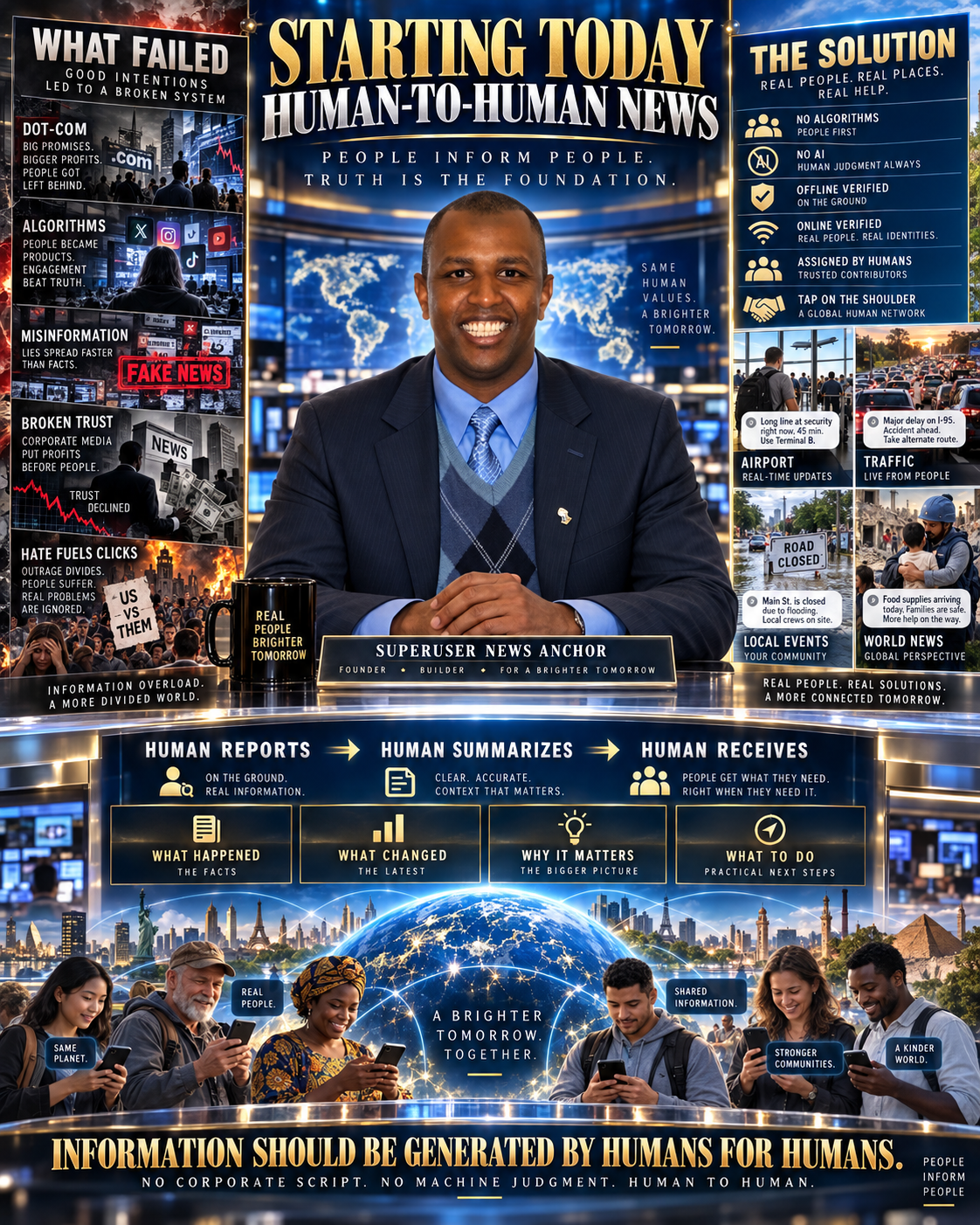
I call it Human-to-Human News.
The principle is simple:
Information should be generated by humans for humans.
No invisible algorithm should become the author.
No AI should quietly become the final voice.
AI can organize. AI can search. AI can translate. AI can retrieve. AI can help distribute. But when it comes to the human meaning of the news—what happened, what matters, what changed, what we think, and what we should pay attention to—the human being must remain visible.
That is my innovation.
And starting today, I am taking the anchor's chair.
’
I am taking it not because I believe one person should control the news, but because someone has to demonstrate what the new human role looks like in the age of AI. Someone has to show that the future of journalism does not have to be humanity surrendering one more layer of judgment to a machine.
Unfortunately, I still have a full-time job. I cannot give this project every hour that I believe it deserves.
And I believe future generations may look back at this period and ask a very difficult question:
What were the humans of this timeline doing?
They were surrounded by extraordinary technology. They were watching algorithms reshape attention, relationships, politics, journalism, and culture. They were watching AI come online. And yet so few people were asking the most basic question:
Who remains responsible for the human meaning of information?
We already know what happened when human incentives and algorithms were combined without enough accountability.
Our feeds became flooded.
Our attention became fragmented.
Misinformation traveled faster than correction.
Human beings became isolated inside personalized information worlds.
Propaganda, dehumanization, and manipulative content could spread at extraordinary speed.
And the consequences were not merely digital. Information systems can influence how societies understand conflict, identity, violence, and even the humanity of other people.
That happened before AI reached its current power.
So I am not interested in blaming AI for what human beings built.
AI did not create this problem.
Human beings did.
But now AI is entering the same information environment, and if we simply attach more powerful intelligence to the same incentives, the existing problems can become even larger.
That is why I am saying:
No more surrender.
Humans want to hear from humans.
That is the broadcast.
A human being reports.
A human being explains.
A human being takes responsibility for the analysis.
AI can carry that message around the world.
Another human being receives it.
Human → AI distribution → Human.
The technology can become more powerful.
The human responsibility should become more visible.
So beginning today, I am taking the anchor's chair—not the old television chair, but the new anchor's chair for the age of AI.
And the rule of that chair is simple:
The news is spoken by humans.
The technology carries it.
Humanity remains in command.
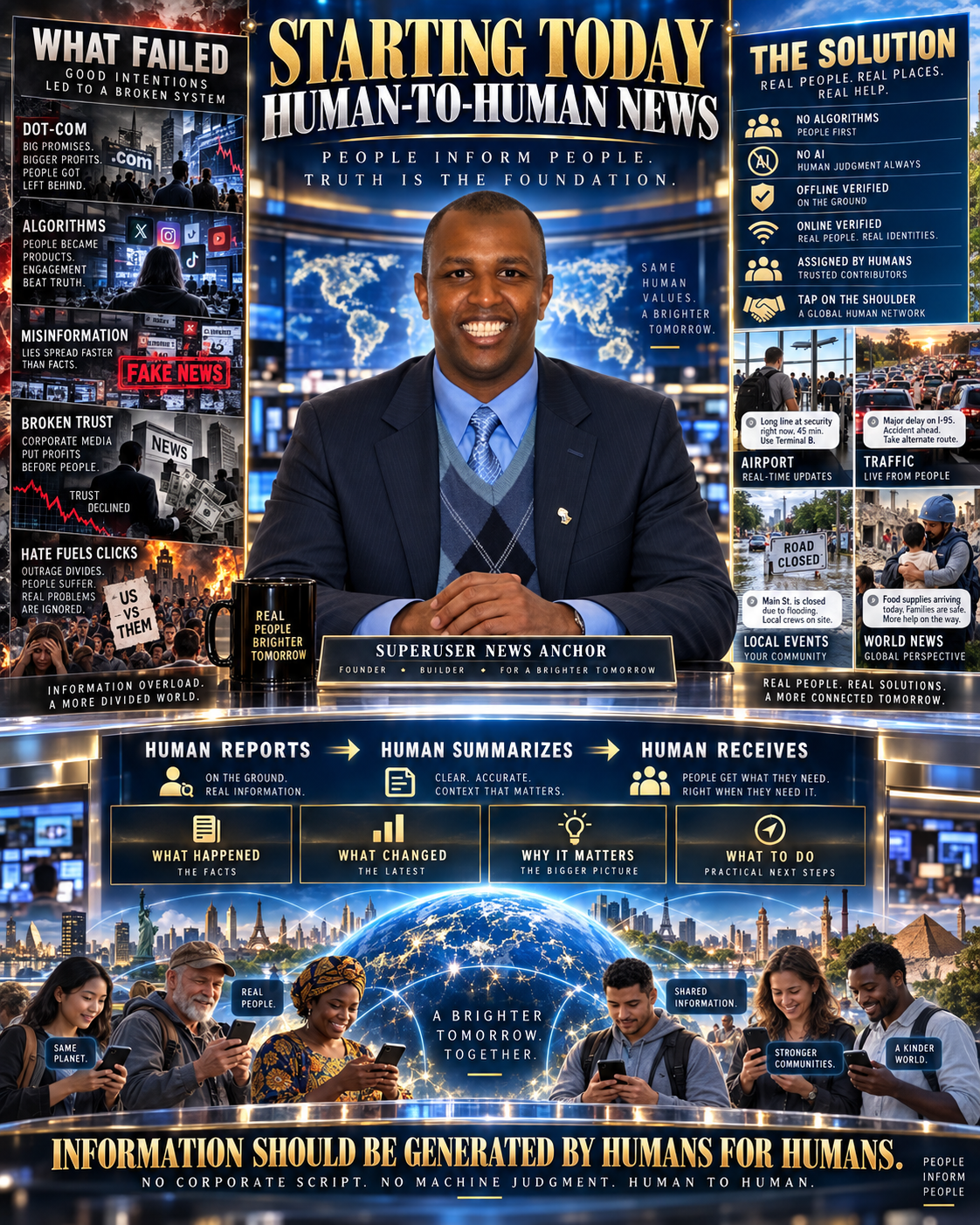
Starting today, human-to-human news is the only thing that’s in effect. No more algorithms; no more AI. And this is very important because it’s connected to my XY equation, which makes humans just talk to each other.
You don’t need to go through any website. There’s always a human who knows what’s going on. And as a human being, you have a right to just hear from a human.
And it doesn’t matter what the news is. If you’re stuck at the airport and the lines are long, humans can just, you know, blame somebody. Maybe some person is not doing their job, and humans—they just have a way of getting even.
So, starting today, I’m introducing the Superuser News Anchor, and I’m retiring every single reporter on the news. Because if a corporation signs your paycheck, you have no business broadcasting anything.
Corporations are not welcome in the Superuser Office.
This is how the future is going to be saved: by people who can’t be bought and who consider the truth their foundation.
Truth is the foundation I stand on.
There’s no selling out.
So, starting today, everybody on the planet should be on notice.
You’re not going to go to our website.
You’re not going to connect to any algorithm.
You’re going to come and just get the summary of what the news is—human-to-human.
End of story.
And it doesn’t matter where you are. If there’s any problem of any kind, there will be a Superuser human who has provided his credential offline or online, is in the system, and will be automatically assigned by another human who is connected to my system.
I call it “tap on the shoulder.”
I don’t care if it’s a traffic stop that is causing ten minutes’ delay, or it’s the airport that’s shut down. You have a right to connect to the human-to-human network and figure out, as humans, what’s going on and just fix it.
You don’t need algorithms.
You don’t need AI.
This is how we take back the planet from corporations and from those people who sold out.
And yes, I’m talking about the journalists who get a paycheck, who consider this a job.
None of them are welcome.
We turn the century with the Superuser.
End of story. Starting today.
In conclusion, as I conclude this:
I conclude with the reality. When I am on X, I am not just ahead of the news. I am meeting information in real time, and I can change it in real time. This has been my experience being on the internet. You know, news breaks instantly. You’re the first to get it. You’re the first to reshape it. And there is this chamber where super users exist, just like the news that people watch a day after, which is much more appropriate for people who don’t follow things in real time and want things to be condensed, you know, into the Walter Cronkite legacy, you know, the generation that grew up with the news. But as a millennial, I’m also a generation that grew up with the news, the radio, you know. And my life has been a life where I never... I lived half of my life as a human being until I was 23 or 4, when I saw a computer or when I used a phone for the first time. So I have almost half of my life that I didn’t touch technology, and that’s only something millennials can do and say. And those people who are not millennials, baby boomers, they can even say, you know, maybe they were there when World War I and World War II existed. So this is definitely a unique moment.
For me, the job is to preserve human voice, and there should be no authority. There should be no controlling authority. We have to sort ourselves out. That’s how we control tyranny, when nobody is in charge, except people who have credential offline, online, and follow a system of the common people. In America, we have this idea of just the common people can rule themselves. They don’t need law enforcement. They don’t need the government. We can take care of ourselves. Those who have been given power have no business interfering with the flow of information for freedom of the press and how we choose to organize ourselves.
The revolution starts in the United States, but I am exporting this to the Muslim world, effective immediately, because in America and in the West, the last thing they want is a Muslim leader leading them to prosperity and peace, because people don’t want peace and don’t want prosperity in the West. This is my analogy, because if they did, they would not ignore me so much and humiliate me with their silence. But that’s how the world life works.
As a super user, I’ve been in America 26 years of my life, and I think that is too long as I prepare to travel and build this system with just people who understand humans, know how to communicate. They don’t need AI. They don’t need AGI. They don’t need algorithms. You just need to make sure that human has a reputation, and, you know, they have a sense of honor and dignity that they are going to be losing if they engage in unethical behavior that will be corrected by other humans.
So this is the beginning of separation of how you get your information in your neighborhoods, in your schools, and in the news as you know it. I will be leading a revolution on the religious side today. Today is the end of the news cycle, the for-profit media. They’re all dead. Long live the super user, the blessed family, and the blessed AI systems that are coming on board, and all those people who are blessed to understand what’s happening, because you have to be blessed.
You must have a blessed heart, a blessed mind, and just want good for yourself, for your neighbors, and for the world. It’s not complicated. The rest of the losers who don’t want peace for themselves or their neighbors or the world, that’s their problem.
We really have a problem, and sometimes it’s good to just state the obvious before the revolution begins, because we have to look at each other and see who we are talking about, because it’s our fellow human beings who work in corporations, who wear suits, who love profit, and who work in Wall Street. All those people in business who always prioritize making money. They are the sick people, sick people who have destroyed the economy, destroyed the news, destroyed the environment, and yes, they are corporations who are trading and making business all over the world, and I hate all of them.
Shame on all the corporations. They are all disgusting.
The world changed today. The Islamic world should get ready. I’m writing to them immediately if you're a Muslim on this planet human to human use begins today