
بِسْمِ اللهِ الرَّحْمٰنِ الرَّحِيْم
In the Name of God, Most Gracious, Most Merciful
♥️🤲🕋♥️🕋🌹🌹🥀🤲🌹🕋♥️🤲
Congratulations on Becoming a Citizen
Now You Must Know Your Rights — and Why They Exist
Watch "The amendments Constitution no you're right know you're right " on YouTube
The Constitution created the machine of government:
Congress (law-making)
President (execution)
Courts (judgment)
That structure cannot be casually changed.
No president, no court, no Congress is allowed to rewrite it on their own.
But the framers knew something important:
Power must be stable — rights must be adjustable.
That is why they created Amendments.
What Is an Amendment — Simply Explained
An amendment is not a rewrite of the Constitution.
It is:
a correction added through the system
a safeguard inserted into the gears
a response when reality exposes injustice
You cannot secretly change the Constitution. You cannot bypass the people. You cannot “reinterpret” your way around it forever.
Amendments require:
public debate
state approval
overwhelming agreement
That is intentional.
Why This Matters to You as a New Citizen
Rights are not decorations.
They are tools.
If you don’t know them, they don’t protect you.
Below is what you must understand before you face difficulty.
Your Core Rights in Daily Life
1. When Dealing With Police
You have the right to:
remain silent (5th Amendment)
refuse searches without a warrant (4th Amendment)
ask for a lawyer (6th Amendment)
👉 Practicing silence is not guilt.
👉 Consent removes protection — never consent casually.
2. In Your Home
Your home is protected.
Police need a warrant
Soldiers cannot be quartered
Random searches are illegal
Your door is not public property.
3. In Court
You are entitled to:
a fair trial
a jury
to confront witnesses
to avoid cruel punishment
The government must prove its case. You do not prove innocence.
4. Your Religion
The government:
cannot ban your faith
cannot force belief
cannot punish worship
must provide reasonable accommodation
This applies whether you are Muslim, Christian, Jewish, or none.
5. Speech & Protest
You may:
criticize the government
protest peacefully
publish opinions
organize with others
Unpopular speech is protected speech.
6. If You Face Hate Crimes
A hate crime is a criminal offense motivated by bias against:
race
religion
disability
ethnicity
sexual orientation
This is not “free speech.” It is criminal behavior, and the law recognizes the difference.
Why Amendments Were Necessary
The original Constitution limited government power.
The Amendments protect human dignity.
That distinction matters.
The framers expected:
mistakes
abuse
exclusion
injustice
So they built a way to correct it without violence.
The Most Important Truth
Rights only work when:
you know them
you assert them
you refuse to surrender them casually
Citizenship is not automatic safety. It is informed participation.
Final Reminder
The Constitution was strong enough to survive betrayal. The Amendments exist because the people demanded correction.
Now that you are a citizen:
learn your rights
practice restraint
demand fairness
protect others’ dignity as you protect your own
That is how this Republic survives.
The Constitution, Concluded
Rights Given. Rights Practiced. Rights Still Becoming.
We are not here to memorize the Constitution.
We are here to live it.
The Constitution is not a museum document.
It is a working experiment—one that only survives when people know what it gives them, what it demands of them, and where it failed.
So let us conclude simply, honestly, and clearly.
I. The Core Freedoms of Daily Conscience
(The Rights You Must Practice Every Day)
Before courtrooms.
Before elections.
Before politics.
These are the rights that protect your mind, body, and dignity in ordinary life.
The First Amendment
Your conscience is free.
You may:
worship or not worship
speak or remain silent
publish truth
assemble peacefully
petition the government
This amendment exists because fear of belief has destroyed civilizations before.
The Second Amendment
You are not helpless by design.
This right exists because history taught the framers one lesson clearly: A population unable to resist force will eventually be ruled by it.
The Fourth Amendment
Your body and home are not public property.
No searches without cause.
No seizures without warrants.
Privacy is not secrecy.
It is dignity.
The Fifth Amendment
Silence is protection.
You may:
remain silent
avoid self-incrimination
demand due process
This amendment assumes power will abuse itself if left unchecked.
The Sixth Amendment
Justice must be public, fair, and fast.
You are owed:
a trial
a jury
legal counsel
confrontation of witnesses
Justice delayed or hidden is injustice.
The Seventh Amendment
Facts belong to the people.
Civil disputes are not decided behind closed doors. They are judged by peers.
The Eighth Amendment
Punishment must remain human.
No cruelty.
No torture.
No degradation.
A state that brutalizes loses moral authority.
II. The Courtroom Rights
(Where Power Is Tested)
When the state turns its full force toward you, these amendments activate.
The system assumes:
you are vulnerable
power is dangerous
fairness must be enforced
That assumption is wisdom.
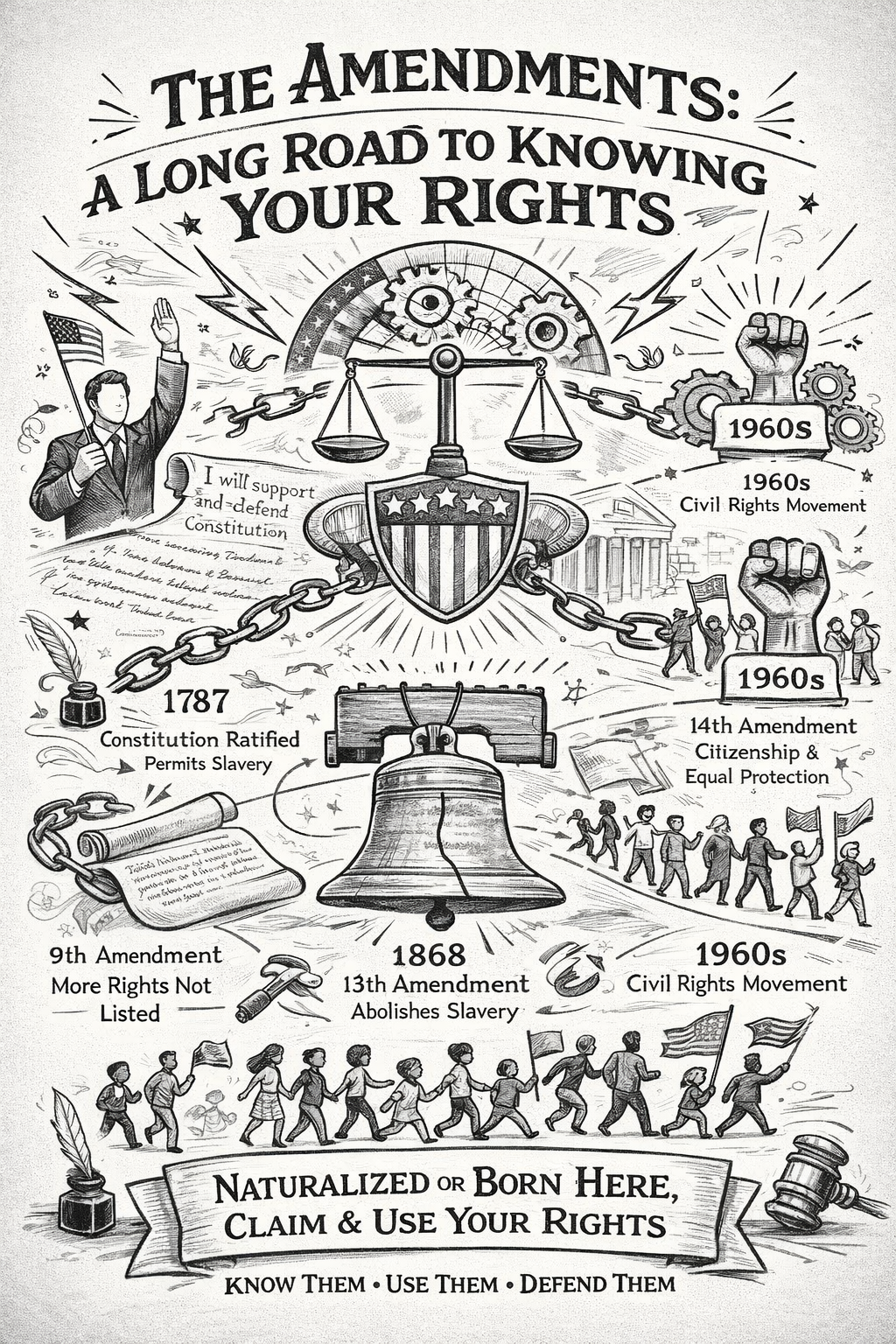
III. The Historic Reckoning: Equality by Amendment
(Where America Failed — Then Corrected)
Here is the truth:
The Constitution promised liberty before it delivered equality.
Slavery survived its founding.
So the people forced correction.
The 13th Amendment (1865)
Slavery abolished.
The 14th Amendment (1868)
Equal protection and citizenship defined.
The 15th Amendment (1870)
Voting rights protected.
And yet— for another century, Black Americans were denied dignity.
It took:
courage
sacrifice
protest
and leadership
Only in the 1960s did the promise begin to approach reality.
This tells you something important:
The Constitution does not save people by itself.
People save it.
IV. What America Got Right — and Wrong
What America got right:
it built a system that allows correction
it allowed people to push back without collapse
it preserved speech even when uncomfortable
What America got wrong:
it delayed justice
it excluded people
it tolerated inequality too long
That does not negate the experiment. It defines it.
V. The Final Lesson for New Citizens
You are not inheriting perfection.
You are inheriting responsibility.
Rights are not passive. They must be:
known
practiced
defended
extended to others
The Constitution does not ask you to worship it. It asks you to use it correctly.
Conclusion
This Republic survives only when citizens understand:
freedom is discipline
equality is unfinished
justice is active
silence can be power
conscience must remain free
America is not an achievement. It is a test.
And now, it is yours.
.