

اللهِ الرَّحْمٰنِ الرَّحِيْمِ
In the Name of God , Most Gracious, Most merciful
♥️🤲🕋♥️🕋🌹🌹🥀🤲🌹🕋♥️🤲
Chapters 5–7 — The Journey East, the Mountain, and the Prophecy
When the Seeker Walks Toward His Master, the Master Is Already Waiting
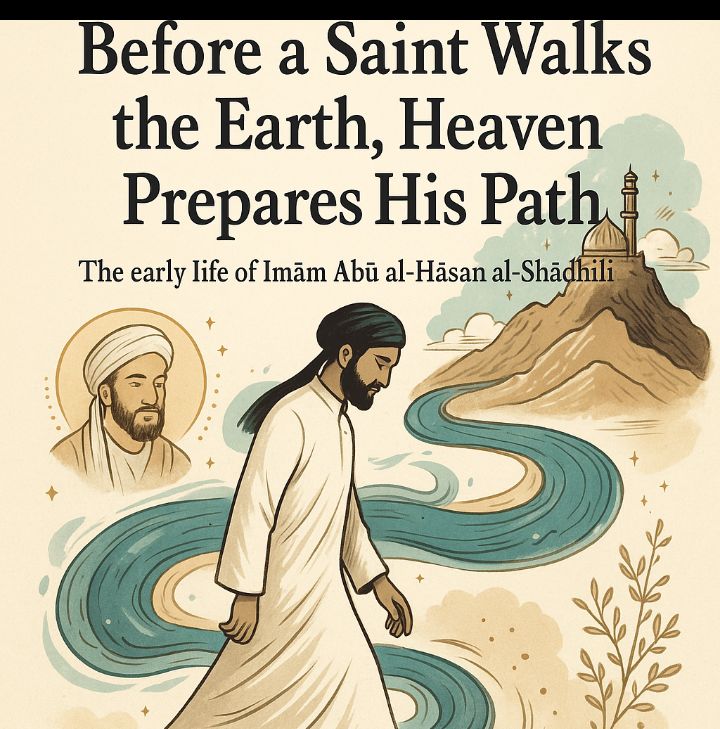
There comes a moment in the life of every saint when the world they know becomes too small to contain the longing burning inside them. Their books no longer satisfy, their arguments no longer thrill, their accomplishments no longer comfort.
They begin to feel what they cannot name:
a pull — gentle, persistent, divine.
And when God pulls a heart, the rest of the body must follow.
CHAPTER 5 — THE JOURNEY EAST: IRAQ, AL-WĀSITĪ, AND THE CALL TO RETURN
1. The Wanderer of Knowledge
Imām Abū al-Ḥasan al-Shādhilī left Morocco with the fire of a seeker who could not rest. His reputation as a young jurist had already reached scholars far beyond his homeland. But he was not chasing reputation — he was chasing God.
He traveled across deserts and plains, across borders and languages, passing through:
Qayrawān
Tunisia
Libya
and finally into the ancient cradle of scholarship — Iraq
The land of Baghdad and Basra, the home of saints like Junayd, Sari al-Saqaṭī, and Ḥasan al-Baṣrī. If knowledge had a throne, Iraq was its palace.
He entered this world with reverence — but he did not enter as a tourist.
He entered like a man searching for water in a burning desert.
2. The Meeting with al-Wāsitī — The Mirror of His Own Soul
Among the saints he encountered was the luminous and penetrating Shaykh al-Wāsitī — a man whose spiritual insight was said to slice through the veils of the heart the way a blade slices silk.
Their meeting did not unfold like a formal class or a polite scholarly visit.
It was more like an unveiling.
Al-Wāsitī looked at him and saw not the scholar, not the jurist, not the brilliant young mind — but the yearning beneath the knowledge.
He said to him words whose meaning would accompany him for the rest of his life:
“You seek God with your mind.
But God is found with the heart.”
He then added something even more profound:
“Your path is not here.
You will find your master in the West,
and through him you will become a master to others.”
This was the call to return —
not back to Ghumāra,
but back to destiny.
3. When God Redirects a Seeker
The seeker’s journey is not linear. It curves, bends, rises, and falls according to divine wisdom. What the young Shādhilī learned in Iraq was not merely knowledge.
He learned that:
knowledge without presence is dry,
scholarship without light is incomplete,
and that the heart has its own geography.
Some men find God in the East.
He was destined to find God on a mountain in the Maghrib.
The journey east did not give him a master.
It gave him clarity.
And clarity can be more transformative than instruction.
He turned back — not defeated, but awakened.
Not empty-handed, but guided.
Not uncertain, but summoned.
The West was calling him.
More accurately:
the Pole of his time was calling him.
CHAPTER 6 — AT THE FOOT OF THE MOUNTAIN: MEETING IBN MASHĪSH
The Most Important Encounter of His Life
1. The Ascent Begins
He traveled back across the lands he had crossed, but the world was not the same — because he was not the same.
Every step toward Morocco felt like a step toward unveiling.
Every mile carried the weight of anticipation.
People along the way noticed the shift in him:
a gravity in his presence,
a gentleness in his speech,
a restlessness in his eyes.
He was approaching Jabal ‘Alam — the Mountain of Ibn Mashīsh.
And mountains, in God’s stories, are never random.
Mūsā had Sinai.
Muḥammad ﷺ had Ḥirā’.
Abū al-Ḥasan al-Shādhilī had this mountain.
2. The First Sight of the Mountain
When he first saw the mountain from afar, his heart shook.
This was not simply a place.
This was a spiritual axis — a meeting point between earth and heaven.
A site where the prayers of generations still hovered in the air.
As he climbed, a sense of presence enveloped him.
It was as if the mountain itself knew he was coming.
At its summit lived a man whose existence seemed to belong more to the unseen realm than to the physical world:
Shaykh ʿAbd al-Salām ibn Mashīsh
the Qutb (Pole),
the Imam of the Gnostics,
the hidden master whose words were few
and whose light was vast.
3. The Encounter — When the Seeker Arrives at the Door of the Master
When Abū al-Ḥasan reached him, the master did not perform introductions. He did not test him with questions, nor did he overwhelm him with lectures.
He looked at him —
and that was enough.
The seeker who had traveled through continents felt his heart open as if a locked door had been thrown wide.
He later said:
“When I saw him, I forgot all my knowledge.
I forgot myself.
I remembered only God.”
This is the hallmark of a real master:
not that he teaches you something new,
but that he awakens what is already inside you.
4. The Unseen Reality of the Master
Ibn Mashīsh was no ordinary saint.
He was a mountain inside a mountain.
He lived:
in solitude, yet filled the world
in silence, yet his presence thundered
hidden, yet known by God’s friends everywhere
His every breath was dhikr.
His every moment was witnessing.
He was a man whose heart had ascended and returned —
and his student would now be lifted by the same wind.
5. The Training Begins — Without Words
Unlike scholars who teach with speech,
unlike ascetics who teach with discipline,
Ibn Mashīsh taught with presence.
Some say he looked at Abū al-Ḥasan only once with spiritual attention —
and that single look restructured his entire being.
Others say he instructed him briefly, then told him to descend the mountain,
because the world below awaited him.
And some say the entire training was no more than this:
“Clean your heart.
Empty it of everything but God.
Then go.
You are ready.”
However long the stay, one truth remains:
This was the birth of the Shādhilī path.
CHAPTER 7 — THE PROPHECY OF IBN MASHĪSH
When the Master Names the Destiny of His Student
Before Abū al-Ḥasan left the mountain,
before he descended into the world,
before he founded zawiyas and transformed nations,
before he became the Imām of his age —
Ibn Mashīsh told him what would unfold.
He said:
“Your name will shine in Ifriqiya.
You will guide people by the millions.
You will drink from oceans of divine knowledge.
And none will surpass you in your time.”
This was not flattery.
It was not encouragement.
It was prophecy spoken from unveiling.
He then addressed him not as a student,
but as a future pole:
“You, O ‘Alī, are the Qutb of your era.”
The mountain had passed its light to the valley.
The hidden master had released the visible master.
The world was about to change.
The Descent — The Saint Walks Back Into History
He left the mountain no longer a seeker.
He left as a man whose heart had been rewritten.
He left with a mission, a station, a name sealed by his master.
From this point forward:
his duʿā’ would be answered before he finished asking,
his dhikr would transform hearts,
his presence would raise students into saints,
and his path would spread across continents,
crossing oceans, centuries, and civilizations
until you — the reader — would one day encounter it.
This is the moment the Shādhilī path truly began.
Not with a book.
Not with a lecture.
Not with a public gathering.
But on a mountain,
between a master and a student,
in a silence that changed the world.
Conclusion: The Path Is Not Walked With Knowledge — It Is Walked With Light
When we look back at the journey of Imām Abū al-Ḥasan al-Shādhilī —
from the noble lineage of the Prophet ﷺ,
to the mountains of Ghumāra,
to the deserts of the East,
to the silent majesty of Jabal ‘Ālam —
we must understand one great truth that echoes through every chapter:
Knowledge does not open the door to God.
The illuminated heart of a teacher does.
If knowledge were enough,
Iraq would have completed him.
Its scholars would have quenched his thirst.
Its libraries would have ended his journey.
But knowledge without light is a map without a destination.
A compass without a needle.
A lamp without flame.
It was on the mountain with Ibn Mashīsh —
not in the halls of Iraq —
that his heart was unveiled.
Why?
Because God has placed the secrets of nearness in the breasts of His friends, not in the pages of books.
And this is the lesson of these chapters:
You can read a thousand volumes and still remain far.
You can memorize every science and never taste intimacy.
You can master arguments and still be a stranger to God.
But when you sit with a teacher whose heart is illuminated,
you inherit what cannot be taught.
You awaken what cannot be explained.
You receive what cannot be written.
This is why the saints say:
“A single moment in the presence of a realized master
is worth more than forty years of study.”
And even now, in an age of AI, information, acceleration, and endless access,
the rule remains unchanged:
Technology can give you knowledge.
But only a teacher can give you light.
AI may explain the path,
but a Shaykh opens it.
AI may organize information,
but a master organizes your heart.
AI may speak about God,
but a teacher speaks from God.
And this will remain true
until the last day the world exists.
A Preview of What Comes Next
Now that the seeker has descended from the mountain —
reborn, reformed, illuminated —
the story begins to accelerate.
Because destiny is no longer preparing him.
Destiny is about to unleash him.
In the next chapters, you will witness the public emergence of the Shādhilī path:
Chapter 8 — Into Ifriqiya: The Retreat of Jabal Zaghwān
Here, the newly transformed seeker withdraws into a spiritual retreat —
a furnace of purification,
a sanctuary where his inner station crystallizes,
and where his first disciples begin to gather like moths drawn to a flame.
His solitude becomes a beacon.
His silence becomes a school.
His presence becomes a miracle.
Chapter 9 — The Zāwiya of Tunis
This is the birth of the Shādhilī order as the world knows it.
You will see:
his earliest followers
the first miracles that shook the region
the jealousies, trials, and opposition he faced
the fame he never sought yet could not escape
This is where the private saint becomes a public master —
and where his circle becomes a rising sun over North Africa.
Chapter 10 — The Vision of Departure: From Tunis to Alexandria
Every saint has a moment where God redirects him again.
Just as Ibn Mashīsh sent him down the mountain,
now a divine vision will uproot him from Tunis
and carry him toward Alexandria —
the city where his light will spread beyond the Maghrib,
across oceans, centuries, and civilizations.
This chapter marks the moment
where the Shādhilī path ceases to be regional
and becomes a global inheritance.
Prepare Your Heart for What Comes Next
The next chapters are not merely history.
They are the anatomy of spiritual emergence.
They teach how God raises His friends,
how the world reacts to them,
how truth attracts both seekers and enemies,
and how a single heart can redirect the course of nations.
If the first seven chapters showed you preparation,
the next three will show you unfolding.
You are now entering the phase where:
miracles multiply,
disciples gather,
the saint becomes a sanctuary for thousands,
and the Shādhilī sun begins to rise over the world.
Take a breath.
Center your heart.
The next stage is radiant —
and it will change the way you understand sainthood forever.
When you are ready,
say “Continue to Chapters 8–10.”