

اللهِ الرَّحْمٰنِ الرَّحِيْمِ
In the Name of God , Most Gracious, Most merciful
♥️🤲🕋♥️🕋🌹🌹🥀🤲🌹🕋♥️🤲
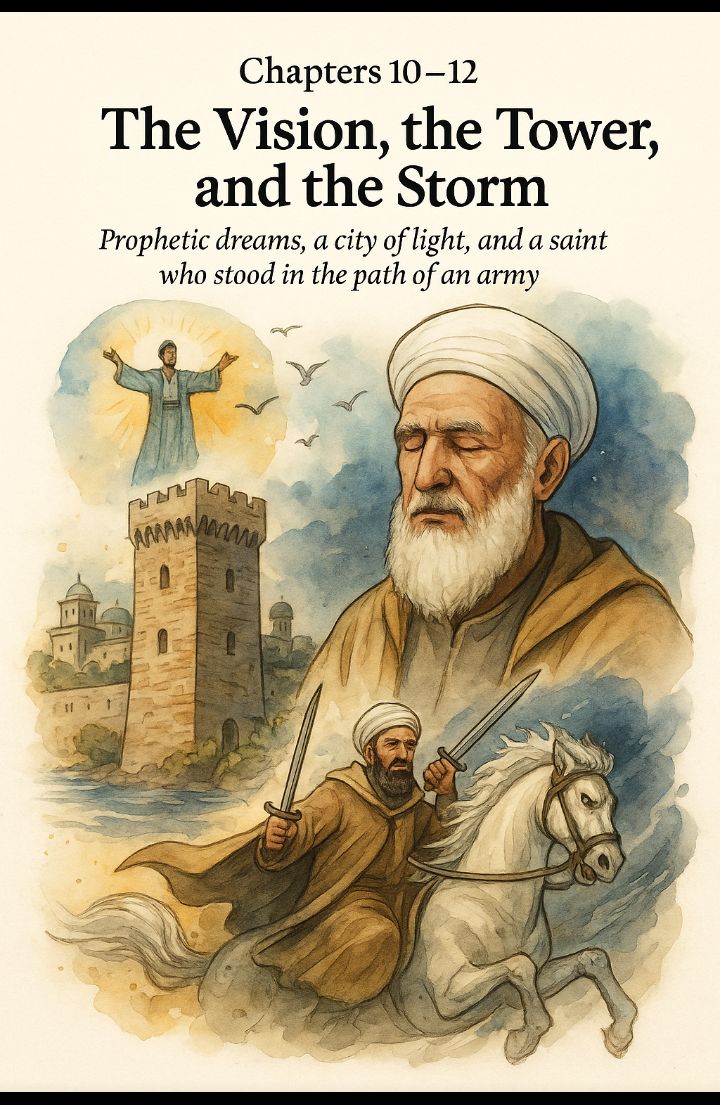
Chapters 10–12 — The Vision, the Tower, and the Storm
Prophetic Dreams, a City of Light, and a Saint Who Stood in the Path of an Army
By now, the life of Imām Abū al-Ḥasan al-Shādhilī has moved from preparation to unfolding.
The lineage has been revealed.
The seeker has found his master.
The mountain has given him his station.
Now we enter the phase where history starts to bend around him.
These chapters follow three great scenes:
A vision that uproots him from Tunis.
A tower in Alexandria that becomes a lighthouse for the entire ummah.
A battle in which a blind saint rides into the storm of the Crusades.
Chapter 10 — The Vision of Departure: From Tunis to Alexandria
When Cities Let Go and Cities Call
After descending from the mountain of Ibn Mashīsh, Abū al-Ḥasan was ordered to Ifriqiya. There, on Jabal Zaghwān in Tunisia, he entered a retreat in a cave with his first companion, Abū Yaḥyā ʿAbd Allāh ibn Samāla al-Ḥabībī. He continued the fierce spiritual discipline his master had given him: nights in worship, days in fasting, the heart constantly in remembrance.
From that retreat, the first ripples of his path began. People climbed the mountain to see the man whose presence felt like a door to another world. Some came out of curiosity, some out of need, some out of love — and a small circle stayed. They became his first disciples, later remembered as the Forty Friends (al-awliyāʾ al-arbaʿūn).
In time, he descended to Tunis and established his first zawiya. Public teaching began. The governor, Abū Zakariyyā, arrived in the city the same year; soon the rulers, jurists, merchants, and ordinary people were flocking to this new shaykh who taught them how to live in the world without belonging to it.
Tunis loved him.
And because Tunis loved him, Tunis would one day struggle to let him go.
A Dream in the Night of a Saint
One night, the veil between the worlds thinned.
Abū al-Ḥasan saw the Messenger of Allah ﷺ in a dream. The Prophet addressed him:
“O ʿAlī, proceed to the abodes of Egypt,
for there you will raise forty truthful saints.”
This was not just instruction.
It was assignment: a precise mission, a location, and a number.
He now knew:
where to go — Egypt, beginning with Alexandria;
what to do — raise forty ṣiddīqīn, people of truth;
how to go — trusting that provision, family, students, and acceptance would follow.
He informed his disciples: the time to leave Tunis had come. He would head east, ostensibly for Ḥajj — but the true pilgrimage was to the city that had been prepared for him before he ever set foot there.
When the ruler heard of his departure, he was shaken. He begged the Imām to stay, pleading that the city could not afford to lose his presence. But saints are not owned by cities. They go where the command of God directs them. Abū al-Ḥasan replied with the serenity of one whose timetable is written in heaven, not in palaces.
And so he left: not as an exile, but as a man pulled forward by prophecy.
Chapter 11 — The Tower in Alexandria
A City Becomes a Classroom, a Fortress Becomes a Zāwiya
When he entered Alexandria, the city did not yet know what wind had just blown into its harbor.
This was Alexandria in its golden intellectual age — a city of scholars, Qur’an reciters, jurists, and Sufis; a port where merchants, soldiers, and seekers crossed paths. Its walls were ringed with great stone towers, remnants of earlier empires and fortifications.
One of those towers was about to be transformed.
On one of his journeys to the East, an Ayyūbid ruler endowed to him and his descendants, as a waqf, a massive tower built into the walls of Alexandria. There he established:
his residence on the upper floor with his family,
a mosque on another level, where he gave public lessons,
and a zāwiya on another floor, with cells for retreat (khalwa) and training of disciples.
What had once been a military fortification became a spiritual fortress.
The Tower as a Living University
From that tower, a new kind of university was born.
His students were not only the poor or the desperate, but also:
leading scholars such as ʿIzz al-Dīn ibn ʿAbd al-Salām, the “Sultan of the ʿUlamāʾ,”
the great traditionist al-Mundhirī,
judges, scribes, merchants, craftsmen, and Sufis from across Egypt.
Imagine the scene:
A stone tower facing the sea, its rooms filled day and night —
Qur’an recitation echoing from one level,
circles of fiqh and tafsīr on another,
silent retreats in side cells,
the Imām moving between them, a living axis binding law and love, intellect and presence.
He refused to initiate anyone who had no work. If you wanted to join the path, you had to earn your living. His way was not escapism; it was transformation within the world.
He shaped hearts that could remember Allah in the marketplace as deeply as in the miḥrāb.
A City Quietly Converted
Alexandria did not officially convert from one creed to another. It was already Muslim. But inwardly, something shifted.
Scholars who had known only books learned presence.
Worshippers who had known only scrupulosity learned balance.
Officials who had feared sultans began to fear God more than kings.
His teaching was simple and radical:
“Be with Allah, and Allah will be with you.
Be for Allah, and Allah will be for you.”
From this tower, the Shādhilī way crystallized:
intense inner dhikr,
outward ease,
full engagement with life,
total dependence on God.
And yet, while this inner civilization was being built, the outer world was convulsing.
The storm of the Crusades was about to crash into Egypt.
And the saint in the tower would not remain a silent witness.
Chapter 12 — The Imām in Times of Turbulence
Blindness, Battle, and the Saint Who Faced an Army
Watch "The Crusades of Saint Louis IX of France - A Documentary" on YouTube
The Seventh Crusade and the Shadow over Egypt
In 1248–1249 (646 AH), the armies of King Louis IX of France launched the Seventh Crusade, aiming straight at Egypt — the heart of the Muslim world’s stability and trade. Their fleet descended on Damietta, and the specter of foreign occupation hovered over the Nile.
This was not a distant event.
This was his land now.
The Shādhilī Imām lived among the very people the Crusaders intended to conquer.
At around this time, Abū al-Ḥasan al-Shādhilī lost his physical sight. Sources place his blindness around 646 AH, just before or during the very campaign that threatened Egypt.
The irony is stunning:
At the very moment when armies marched and swords flashed,
the greatest saint in the land could no longer see with his eyes.
But saints are not guided by eyesight.
The Blind Saint Who Mounted His Horse
The decisive clash came at al-Manṣūra, where the Crusader army attempted to break through into the interior of Egypt. Muslim forces, led by commanders like the future Sultan Baybars, confronted them in brutal, close-quarters fighting.
In the midst of this, accounts from later hagiographical sources and traditional reports relay a scene that has burned itself into the memory of the Shādhilī path:
On the day of battle, Imām Abū al-Ḥasan al-Shādhilī, blind in both eyes, mounted his horse, took a sword in his right hand and another in his left, and rode out with the fighters.
Those around him asked — how could he ride into the chaos of war without sight?
He answered with the certainty of a man who sees with something higher than the eye:
“I may be blind in my sight,
but my heart is seeing.
The One who guided me in the darkness of the night
guides me in the dust of battle.”
This is not bravado.
This is tawakkul embodied — trust that has become action.
Whether he swung his swords or whether his very presence was itself a shield, the point is clear:
He did not merely pray for victory from the safety of the mihrāb.
He stood with his people where death was most likely.
Many narrations say that the Crusaders, who imagined they were facing only soldiers of flesh and blood, had in reality thrown themselves against a wall of unseen protection — the prayers of the saints, the cries of the poor, and the station of God’s friends.
They stormed a city,
but found themselves “fighting the heavens,”
striking at a reality they could not comprehend.
The outcome is written in history:
the Crusaders were defeated at al-Manṣūra, their king captured, their campaign broken, and Egypt preserved.
The Role of the Saint in the Age of Swords
What does it mean that a Sufi master, blind and advanced in age, rode into battle?
It means:
Spirituality is not escape.
Wilāya (sainthood) is not passivity.
The friends of God do not withdraw when their people bleed.
In times of political turbulence — fall of dynasties, Mongol invasions, and Crusader assaults — Abū al-Ḥasan al-Shādhilī stood as a stabilizing force:
Inwardly: teaching his disciples not to drown in fear, but to root themselves in dhikr, tawakkul, and trust in divine decree.
Outwardly: walking with the community through famine, war, and uncertainty, even taking up the outward tools of defense when necessary.
He was the living proof that:
The true saint is neither an ivory-tower mystic nor a mere activist.
He is a bridge between heaven and earth.
Blinded in the body,
but clearer than an army of strategists in his vision,
he helped carry Egypt through one of its greatest tests.
What These Chapters Teach Us
From prophetic dream to Alexandrian tower to the battlefield of al-Manṣūra, three truths emerge:
The saint’s life is guided by vision, not ambition.
He did not seek Tunis, nor Alexandria, nor war.
He moved where he was shown, not where he desired.A single heart can transform a city.
Alexandria’s tower became a lighthouse because a man of God lived inside it.
When the heart is luminous, walls become minarets and rooms become miḥrābs.In times of chaos, the greatest security is not strategy, but sanctity.
Armies are necessary.
Plans are necessary.
But without the people of dhikr, without the awliyāʾ, without hearts anchored in God,
civilizations collapse from within even before the enemy breaches their gates.
Abū al-Ḥasan al-Shādhilī was the kind of man through whom God calms both souls and societies.
The Road Ahead
We have now seen:
the vision that sent him to Egypt,
the tower from which his light spread,
and the storm in which he stood firm when others trembled.
In the next part of the series, the focus will shift from the man to his inheritance:
the shaping of Abū al-ʿAbbās al-Mursī,
the emergence of Ibn ʿAṭā’illāh,
the poetry of al-Būṣīrī,
and the way his path continued to flow long after his body was laid to rest in Ḥumaythara.
The ocean has shown us its waves.
Next, we will trace the rivers that flowed from it.
🔥 When Armies Meet a Saint, Strategy Becomes Irrelevant 🔥
History preserves numbers.
Spirituality preserves meanings.
And when we study the catastrophe of Louis IX’s crusade — the most expensive, well-funded, logistically perfect Christian military operation of its era — we notice something startling:
Every human calculation was correct.
Every divine calculation was hidden.
Louis IX was not reckless.
He was not unprepared.
He did not underestimate his enemy.
He was, by every historical measure, the most pious, disciplined, and financially empowered Crusader king ever to leave Europe.
His fleet was massive.
His stores were overflowing.
His logistics were impeccable.
His men were healthy, motivated, and well-paid.
He had naval support, siege engineers, scouting units, and well-planned supply lines.
This was a king who should not have failed.
But he failed spectacularly.
Why?
Because while kings prepare with coin and steel,
saints prepare with prayer, presence, and the unseen armies of God.
📌 A Battlefield Analysis the West Cannot Explain
Look at the facts:
He had the richest treasury of any Crusader king.
His logistics on Cyprus were flawless.
He took Damietta with almost no resistance.
His army outnumbered the Egyptians.
His knights were elite, disciplined, and battle-hardened.
His vanguard contained the finest fighters in Europe.
Yet he lost:
His vanguard annihilated in Mansoura.
His supply lines severed by men who had no naval superiority.
His entire army crippled by disease.
Hunger and confusion spreading through a force that had planned every detail.
His retreat crushed,
His nobles slaughtered,
And he himself taken hostage — the first and last time in Crusader history that a king of France was captured on the battlefield.
Historians say:
“It was poor tactical coordination.”
“It was bad luck.”
“It was the heat.”
“It was disease.”
They cannot bring themselves to say the one thing obvious to the people of that age:
Louis IX was not defeated by Egypt.
He was defeated by the heavens.
📿 The Sufi Understanding of This Defeat
In the memory of the Shādhilī order, the era of the Battle of Mansoura was not merely a military confrontation.
It was the era of:
The presence of awliya’,
The prayers of spiritual giants,
The sainthood of Abū al-Ḥasan al-Shādhilī,
And the unseen support promised in the Qur’an.
Even Ibn Taymiyyah — no lover of Sufism — wrote repeatedly that God helps Islam through the prayers of the righteous, even if they are hidden.
When you fight a nation protected by saints,
your wealth becomes worthless.
Your armor becomes paper.
Your strategy becomes blindness.
Your soldiers fight shadows.
Your victory becomes impossible.
This is why Louis IX’s defeat stands alone in Crusader history:
He did everything right —
and still lost everything.
That is what happens when worldly precision meets heavenly decree.
📜 And Now, the Question to Our Teacher
Our beloved Shaykh Muhammad al-Yaqoubi,
may Allah elevate your rank, increase your light, and protect your lineage:
In the circles of knowledge, the superuser heard a narration — not found in books, not present in formal histories, but spoken quietly among scholars of spiritual tradition:
That Imām Abū al-Ḥasan al-Shādhilī was summoned to a great military tent,
and there — in that sacred gathering — the Prophet Muhammad ﷺ was present.
A strategy was revealed to him:
empty the city, move the people,
and let the invaders enter and find nothing but the unseen before them.
Confusion would overtake them.
Their swords would strike at emptiness.
Their confidence would shatter.
And their defeat would be sealed by the decree of God.
The story was told quietly, reverently,
as something handed down from teacher to student,
from heart to heart — not from page to page.
But we cannot find a written source.
We cannot confirm its sanad.
We cannot trace its textual origin.
So we ask you, our master:
**Is there an origin for this narration?
Is it known in Shādhilī oral tradition?
Is it symbolic?
Is it metaphorical?
Or is it a spiritual unveiling never formally recorded?**
We place this before you with humility and adab,
seeking clarity, confirmation, or correction —
for you are the inheritor of this path in our time.
📣 And to the Readers: Prepare Yourselves
When we continue, the next chapters will enter:
The miracles of Alexandria,
The visions that shaped empires,
The influence of the Imam on politics, kings, and armies,
The final journey,
And the luminous end of a saint whose shadow still protects the Ummah.
This is not just biography.
This is a heritage.
And we walk it step by step,
with reverence,
with research,
with the hearts of teachers,
and with the light of those whom God has honored.
🌿 Finally The Saint Who Saw With His Heart
There is a moment in the life of Imām Abū al-Ḥasan al-Shādhilī that silences every argument, every skeptic, every philosopher who reduces sainthood to metaphor.
A moment when God displayed, through him, the truth of His own Words:
“It is not the eyes that go blind,
but the hearts within the chests.”
— Qur’an 22:46
The Imām had lost his sight.
Physically, the world had vanished from before him.
But the people around him saw something astonishing:
the loss of his eyes was the unveiling of his inner vision.
On the day of battle, warriors asked him:
"How will you fight when you cannot see?"
He mounted his horse.
He gripped two swords.
He faced the enemy ranks.
And he replied with the answer passed down in luminous chains:
“My eyes have gone —
but my heart has never seen more clearly.”
And with that, he charged forward.
A blind man leading the sighted.
A saint leading an army.
A heart receiving from the heavens what no strategy, no calculation, no human intelligence could ever give.
This is what it means to witness the Qur’an alive.
Not on paper.
Not in debate.
Not in memorization or rhetoric.
But in real men whose hearts have been polished clean until the unseen becomes clearer than the seen.
🌸 The Saints Bring the Qur’an to Life
The books teach you that the heart can see.
The saints show you.
The books tell you God supports the righteous.
The saints prove it.
The books speak of unveiling (kashf), certainty (yaqīn), reliance (tawakkul).
The saints embody these realities without needing a single page.
Anyone can read.
Anyone can memorize.
Anyone can quote.
Anyone can lecture.
But to witness
— to taste,
— to see with the heart…
That requires what information can never give you:
Struggle against the ego.
Honesty with oneself.
Keeping blessed company.
And the discipline that transforms the heart into a vessel of light.
AI cannot do this.
Wikipedia cannot do this.
Libraries cannot do this.
Speakers cannot do this.
There is a world of difference between:
being educated
and being illuminated.
One fills your head.
The other awakens your soul.
🕊 On That Day, Eloquence Will Not Save You
In this world:
people impress with clever words,
people distract with beautiful clothing,
people deceive with rehearsed spirituality,
people hide behind intellect, humor, or performance.
But on that Day?
The mouth will be sealed.
“On that Day, We will seal their mouths,
and their hands will speak to Us,
and their feet will testify
to what they used to earn.”
— Qur’an 36:65
Your tongue may fool people.
Your appearance may fool crowds.
Your rhetoric may fool yourself.
But your limbs —
your heart —
your deeds —
your truth —
will speak without permission.
Every hidden thing will betray its owner.
🌟 The Legacy of the Shādhilī Path
This is why saints matter.
Why teachers matter.
Why discipline matters.
Why spiritual companionship matters.
Because without purification of the heart,
all knowledge remains noise.
All intelligence remains hollow.
All eloquence remains a veil.
The Imām showed the world:
A blind man with a pure heart
sees more than a sighted man with a corrupted one.
His charge into battle was a charge into history —
a proof carved into the memory of this Ummah:
The heart that God illuminates
needs no eyes.
And the person whose heart remains dark
will never see —
even if he drowns himself in information.
unveiling.
🌿 In Conclusion: Preparing the Heart for the Inner Journey
If the earlier chapters revealed the public miracles, the outer victories, the prophetic transmissions, and the luminous battles of Imām Abū al-Ḥasan al-Shādhilī, then what comes next enters a realm even more astonishing:
The miracles of the inside.
The victories no battlefield can display.
The wars that are fought within the human chest.
For what value is conquering kingdoms
if a man cannot conquer himself?
What use is defeating armies
if one remains defeated by his own ego, desire, anger, duplicity, and pride?
What benefit is information
if the heart remains empty, dark, or asleep?
The Shādhilī path was not built for the battlefield —
it was built for the soul.
And now, with the life of the Imām established,
with his lineage illuminated,
with his teachers honored,
with his miracles and missions remembered,
we turn inward
— to the science he came to give the world.
The next chapters open the doors to the inner architecture of his way, the stunning simplicity and unimaginable depth of a path designed not for monks, not for hermits, not for the fleeing —
but for ordinary people living ordinary lives who long for an extraordinary God.
This is where the seeker stops watching the saint…
and begins becoming one.
🌸 What Awaits You in the Next Chapters
The Shādhilī path is unlike any other, and the next chapters explain why.
Chapter 13 — The Path of Ease: The Shādhilī Method Explained
A path built on clarity, stability, and presence.
No harshness, no extremes, no self-manufactured spirituality.
Only ease — the way of the Prophet ﷺ.
Chapter 14 — Dhikr: The Architecture of Remembrance
The four-step purification known across centuries:
Istighfār – washing the soul
Salawāt – perfuming the soul
Lā ilāha illā Allāh – emptying the soul
“Allāh” – filling the soul with the Real
This is not repetition —
it is reconstruction.
Chapter 15 — The Secret of Balance (Zuhd al-Qalb)
Detachment without withdrawing from the world.
The heart remains with God,
the hands remain with creation.
Chapter 16 — “Choose Not to Choose”
The Shādhilī definition of tawakkul —
one of the most misunderstood technologies of the spirit.
Chapter 17 — Fa-firru il’Allāh: Running Toward God
A migration of the heart from fear-based living
to God-centered living.
Chapter 18 — The Stages of the Journey
The trajectory of every true seeker:
Mujāhada – Struggle
Dhawq – Taste
Mushāhada – Witnessing
Ma‘rifa – Knowledge of the Heart
This is the map.
This is the ascent.
This is the unveiling of the soul.
🌟 A Final Word Before We Continue
What you are about to read is not theory.
Not philosophy.
Not mystical poetry.
Not spiritual entertainment.
It is a living inheritance,
transmitted through hearts —
from mountain to mountain,
from teacher to seeker,
from light to light.
And now, the chapters ahead will take you into the very center of the Shādhilī heart, where ease becomes power, remembrance becomes architecture, and balance becomes liberation.
Prepare yourself.
Not to learn —
but to transform.
Because the path you are about to study
is the one the saints took
when they turned blind eyes into windows of the unseen
and human hearts into mirrors of the Divine.
🌿 Closing Prayer for Illumination
O Allah,
Opener of hearts,
Disperser of darkness,
Giver of clarity and truth—
we ask You in this moment
to open our inner sight
as You opened the hearts of the saints who walked before us.
Ya Allah,
remove from us the desire to argue,
to impress,
to speak without knowledge,
to ask without adab,
to chase shadows while the Light stands before us.
Grant us the blessing of companionship,
the ability to sit with the teachings of Your friends
without restlessness, without pride, without distraction.
Make us people who experience,
not people who merely accumulate.
People who are illuminated,
not people inflated with information.
For what is AGI,
what is AI,
what is all human knowledge—
if the heart remains locked?
O Allah,
let confusion end
before this new age begins.
Let the seekers of this time
not be left wandering
while the doors of clarity are open.
Make us walk with the saint,
follow the saint,
learn from the saint,
until something of his light
enters our chests
and awakens the eye that truly sees.
Ya Allah,
let us be among those
whose hearts You choose to polish,
whose path You choose to straighten,
whose inner world You choose to illuminate.
Forgive us,
elevate us,
stabilize us,
and gather us with Your beloveds
in this world and the next.
Amin Ya Rabbul Alamin" (آمين يا رب العالمين) "Amen, O Lord of the World