

بِسْمِ اللهِ الرَّحْمٰنِ الرَّحِيْم
In the name of God most gracious most merciful.
📖 Chapter Two: The Rise of Public Price
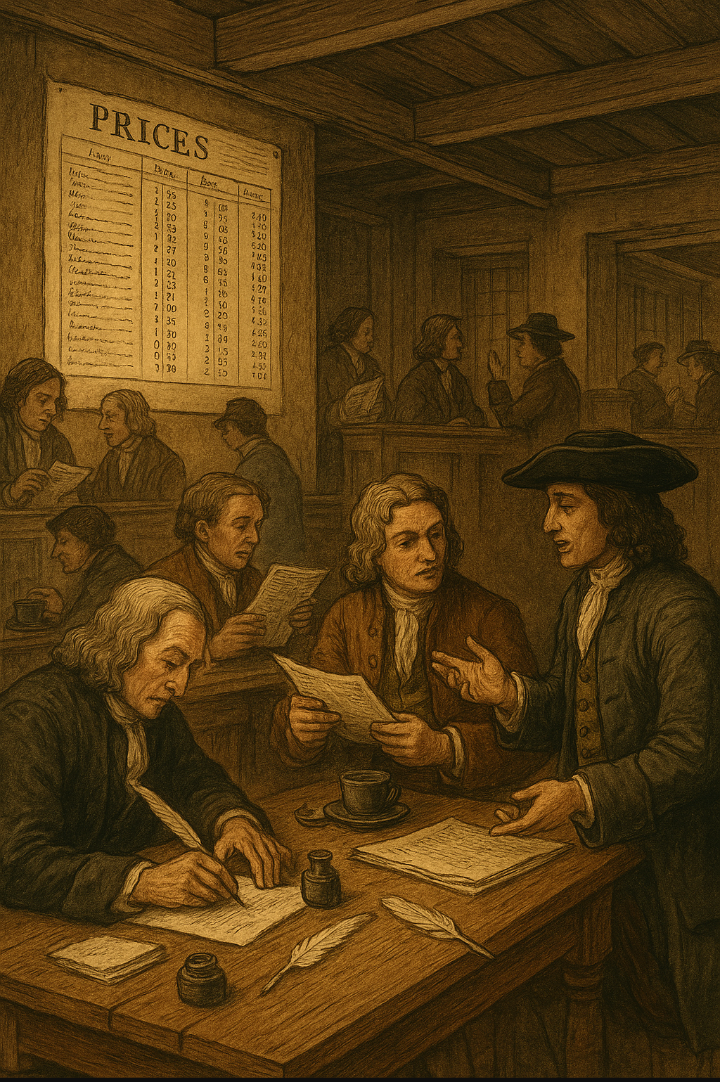
From Coffee Houses to the First Stock Exchange
If Chapter One was about the whisper—this is the chapter where the world starts to listen together.
This is where prices leave the lips of merchants and enter the pages of history.
This is the birth of information capitalism—and the beginning of the illusion of truth.
The Shift From Memory to Print
Before the written price, trade was intimate.
It depended on memory, trust, and conversation.
But as trade routes grew, so did the need for standardization—and that required record-keeping.
And so came the ink.
In the 1600s, Europe began its transformation from local markets to global pricing hubs. London, in particular, became the center of this change—driven not by kings, but by merchants, mariners, and men who drank coffee.
The Coffee House Revolution
In the 17th century, coffee was more than a drink—it was a catalyst for financial intelligence.
And Jonathan's Coffee House became its most legendary temple.
Here, traders gathered not just to sip and speak—but to overhear.
They listened for news:
A ship delayed at sea
A war on the continent
A disease threatening crops
A rumor of silver flowing in from the New World
The value of information became clear.
And so, to gain an edge, traders began to post prices daily on the walls.
By 1697, this became a regular ritual—transforming rumors into news, and news into action.
The First Feedback Loop
Something profound happened next.
When people acted on information, their buying and selling moved the market.
That price movement, in turn, became a signal to others.
And so a loop was formed:
News affected trade
Trade affected price
Price signaled new truths
If a ship was rumored to be lost, prices of its cargo rose.
If it was confirmed safe, prices dropped.
Price became a new language.
A coded message. A reflection of both what is known—and what is feared.
The Birth of the Exchange
In 1773, the traders at Jonathan’s formalized their community.
They created the London Stock Exchange.
This was no longer just a place to gather. It was a marketplace of contracts, a theater of capital.
And most importantly: a centralized engine of profit.
The market no longer needed goods—it needed movement.
And price became the product.
This is where value began to split into two worlds:
The value of the thing itself
The value of what people believed it would be worth tomorrow
The speculation economy had begun.
The Illusion of Fairness
What seemed like progress was, in truth, a distortion.
Posting prices made things look fair.
But access to information was still unequal.
Some traders got news first. Others were shut out.
Paper did not guarantee justice.
It just covered the system in a veneer of legitimacy.
And in that space between information and execution, greed found its groove.
The Islamic Absence
During this same time, Islamic economies—once the heartbeat of global trade—were being colonized, marginalized, or politically weakened.
Where the Prophet ﷺ once walked through the markets of Medina to ensure honesty and justice,
Europe was now building markets without mercy.
The muhtasib was gone.
The scale was replaced by speculation.
And the ethical backbone of trade collapsed under the weight of empire and ambition.
Reflection: Who Owns the Price?
In the Islamic tradition, price belongs to the people.
The Prophet ﷺ refused to fix prices—so long as the market remained fair.
But when people began to hoard, deceive, or monopolize—he intervened.
In the modern system, prices are not determined by fairness.
They are moved by fear. By speed. By games.
And the people no longer own the market.
They are at the mercy of it.
Conclusion: The Rise of Public Price Was the Fall of Public Power
This chapter marks the moment the market became a mirror.
Not of supply and demand—but of strategy and speculation.
It is the beginning of the financialization of reality,
Where truth is traded, delayed, and distorted.
And as we step into Chapter Three, we enter the pit—
Where men no longer whisper prices,
They shout them.
Where hands move faster than ethics.
And where the modern market finds its voice—but loses its soul.