
بِسْمِ اللهِ الرَّحْمٰنِ الرَّحِيْم
In the Name of God, Most Gracious, Most Merciful
♥️🤲🕋♥️🕋🌹🌹🥀🤲🌹🕋♥️🤲
Chapter Two: The First Shelter — The Love
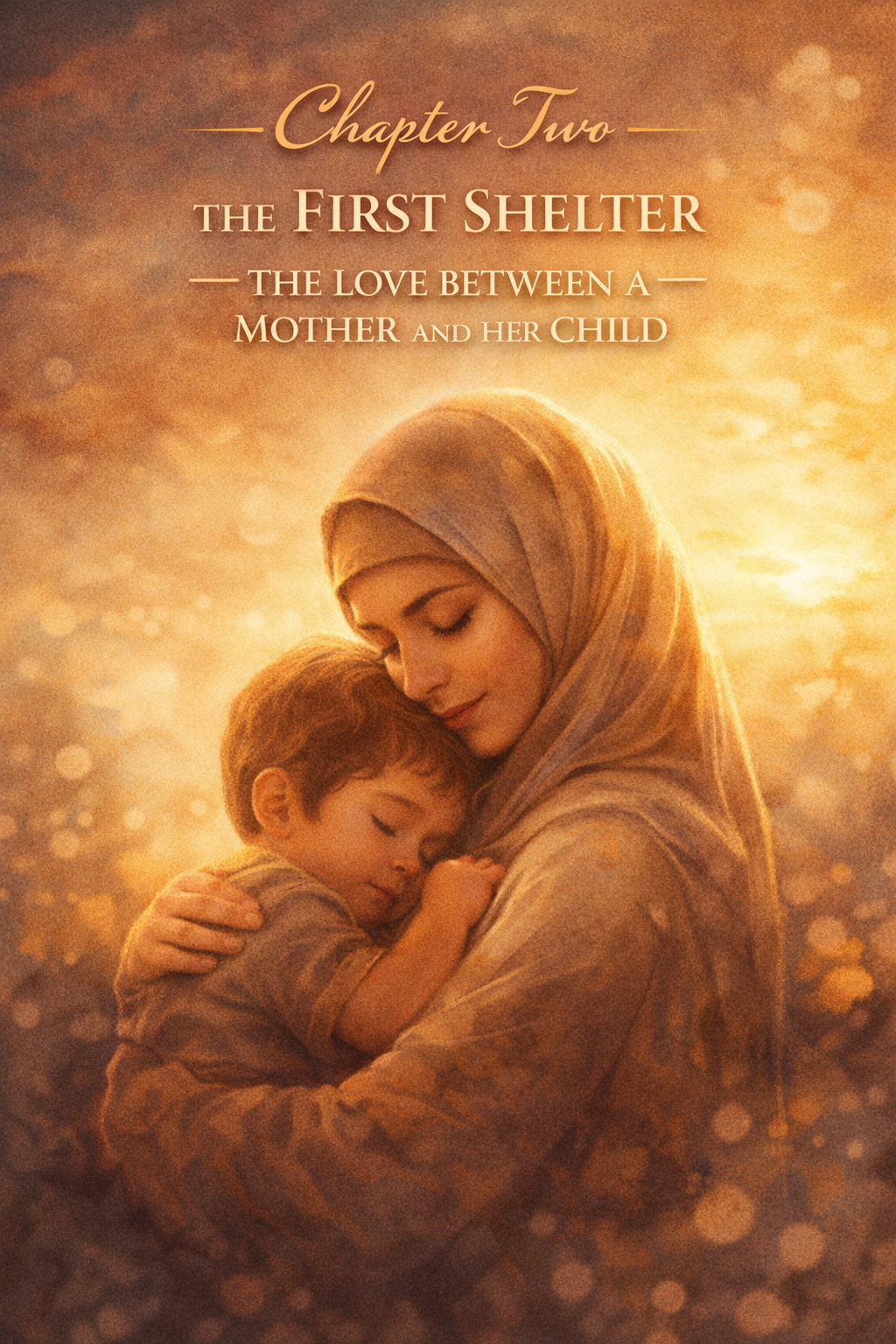
Between a Mother and Her Child
Before a human being learns words,
they learn safety.
Before they learn logic,
they learn belonging.
Before they understand the world,
they understand arms.
A mother does not teach a child how to love her.
The child arrives already knowing.
Not intellectually—
instinctively.
The body recognizes safety
before the mind can name it.
When a child cries out, “Mama,”
it is not a request.
It is a declaration of trust.
The child does not say,
“Can you fix this?”
The child says,
“You will fix this.”
There is no negotiation.
There is no doubt.
There is no fear of rejection.
The child runs.
This is one of the purest forms of love in the created world—
not because it is flawless,
but because it is immediate.
It is raw.
It is unfiltered.
It is not earned.
The child does not perform to be loved.
The child does not prove worthiness.
The child does not explain themselves.
They are held because they exist.
And the mother—if she is healthy in heart—
does not love the child for what the child can offer.
She loves the child because the child is.
She will lose sleep.
She will carry weight.
She will worry silently.
She will sacrifice without keeping score.
Not because she is commanded—
but because love reorders reality.
She does not experience the child as a responsibility.
She experiences the child as an extension of her own being.
When the child hurts,
she hurts.
When the child is afraid,
she becomes stronger.
When the child runs,
she opens her arms wider.
This love is not contractual.
It is foundational.
And this is why it is the closest analogy we have to divine love—
though even this is still only a shadow.
Because even the best mother can get tired.
Even the most devoted mother can fail.
Even the strongest human love can weaken.
But what this relationship teaches us
is not perfection.
It teaches us pattern.
It shows us what love does
before it explains what love is.
Love becomes shelter.
Love becomes patience.
Love becomes presence.
And perhaps the most important thing:
Love does not wait for understanding.
It holds first.
This is why children do not philosophize about safety.
They run toward it.
They trust it.
They collapse into it.
They are not afraid of being a burden.
They assume they belong.
And that assumption—
that unspoken certainty—
is not childish.
It is sacred.
Because it is the soul’s
first memory of mercy.
And yet—
this is only the beginning.
Because a time comes
when the child must leave those arms.
A time comes
when the child must walk alone.
A time comes
when the child must fall
without someone instantly catching them.
And that is where the next layer of love begins.
Not the love of being held.
But the love of being guided.
And then, eventually—
the love of being awaited.
A Sacred Ending — What Heaven Says
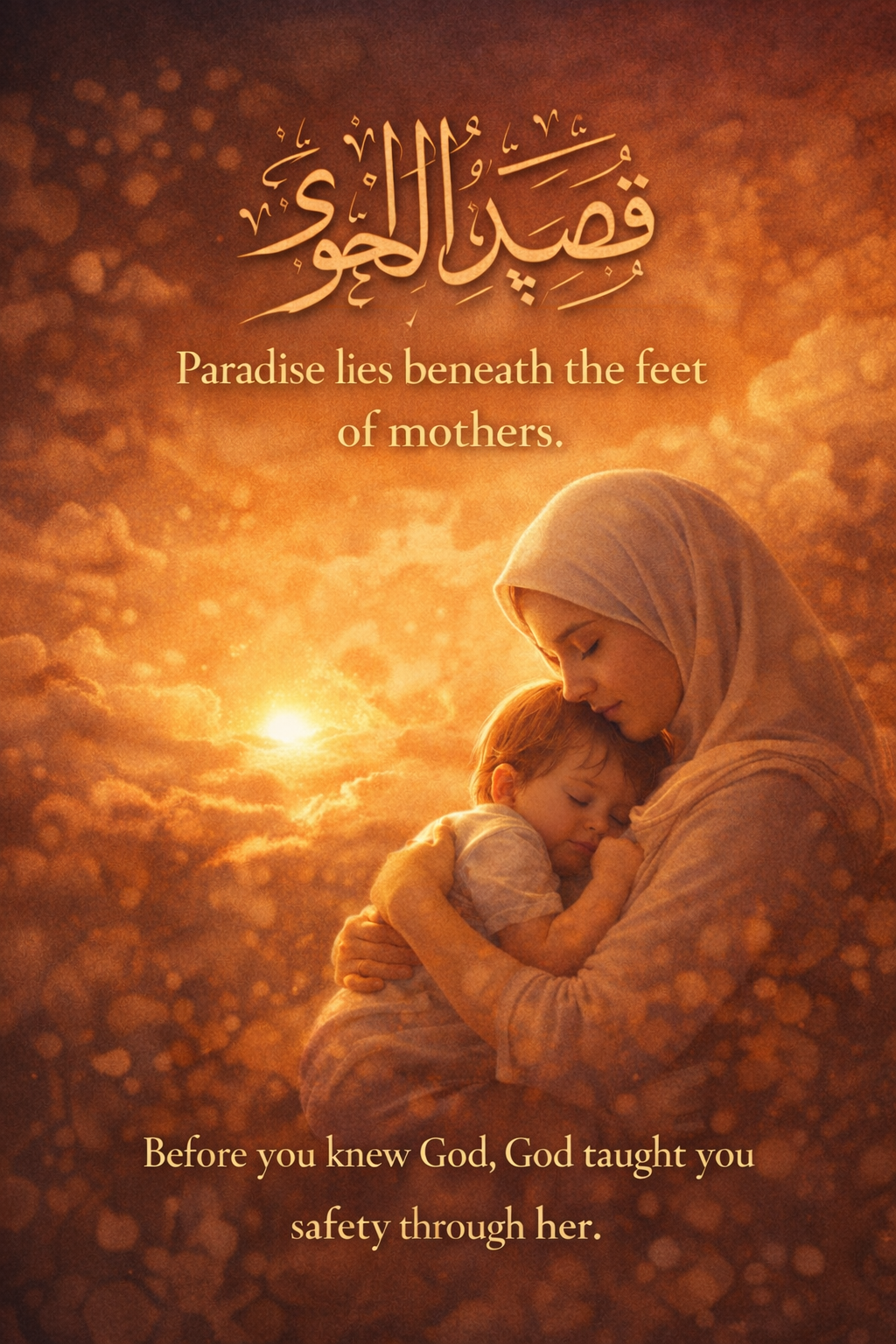
About Mothers
This love—the love between a mother and her child—
is not only recognized by the heart.
It is recognized by Heaven.
The Prophet ﷺ said:
“Paradise lies beneath the feet of mothers.”
Not beside them.
Not near them.
Not around them.
Beneath them.
Meaning: the path to Paradise is not found in theories, or words, or claims.
It is found in how you treat the one who carried you.
How you speak to her.
How you honor her.
How gently you respond.
How patiently you listen.
How carefully you carry her heart.
And Allah Himself confirms this in the Qur’an.
He does not say: Be polite to your parents.
He says:
“And your Lord has decreed that you worship none but Him, and that you show excellence to your parents.”
(Qur’an 17:23)
Not kindness.
Not tolerance.
Excellence.
And then He goes deeper.
“If one or both of them reach old age with you, do not even say to them ‘uff,’ and do not repel them, but speak to them with noble words.”
(Qur’an 17:23)
Not even a sigh.
Not even a sound of annoyance.
Because Heaven hears what humans overlook.
And Allah reminds us why:
“And We have enjoined upon man goodness to his parents. His mother carried him in hardship upon hardship…”
(Qur’an 31:14)
Hardship upon hardship.
Pain upon pain.
Fear upon fear.
Sleeplessness upon exhaustion.
All before you ever knew her name.
And then Allah says something breathtaking:
“Be grateful to Me and to your parents. To Me is the final return.”
(Qur’an 31:14)
He places gratitude to parents
right beside gratitude to Himself.
Not because they are divine—
but because they were the first shelter He gave you.
And that is not coincidence.
That is design.
A child runs to their mother
because they were taught—without words—that love does not need proof.
That shelter does not need explanation.
That arms are not questions.
They are answers.
And this is why this love is sacred.
Not because it is perfect.
But because it reflects a deeper truth:
Before you ever knew God,
God taught you safety through her.
Before you ever learned mercy,
you were wrapped in it.
Before you ever understood love,
you were carried by it.
And this is where this chapter ends.
Not with poetry.
Not with philosophy.
But with a divine declaration:
Your first experience of mercy
was not accidental.
It was intentional.
It was sacred.
And it was the beginning
of your understanding
of the love of the Creator.
Next Chapter Preview
In the next Chapter Three: When the Child Must Walk Alone
Where we move into vulnerability,
fear,
independence,
failure,
return—
and the divine pattern of mercy.