
بِسْمِ اللهِ الرَّحْمٰنِ الرَّحِيْم
In the Name of God, Most Gracious, Most Merciful
♥️🤲🕋♥️🕋🌹🌹🥀🤲🌹🕋♥️🤲
THE BLUEPRINT: 🤖CHAPTER TW0Part 1
THE DEMOLITION AND RECONSTRUCTION OF POLITICS
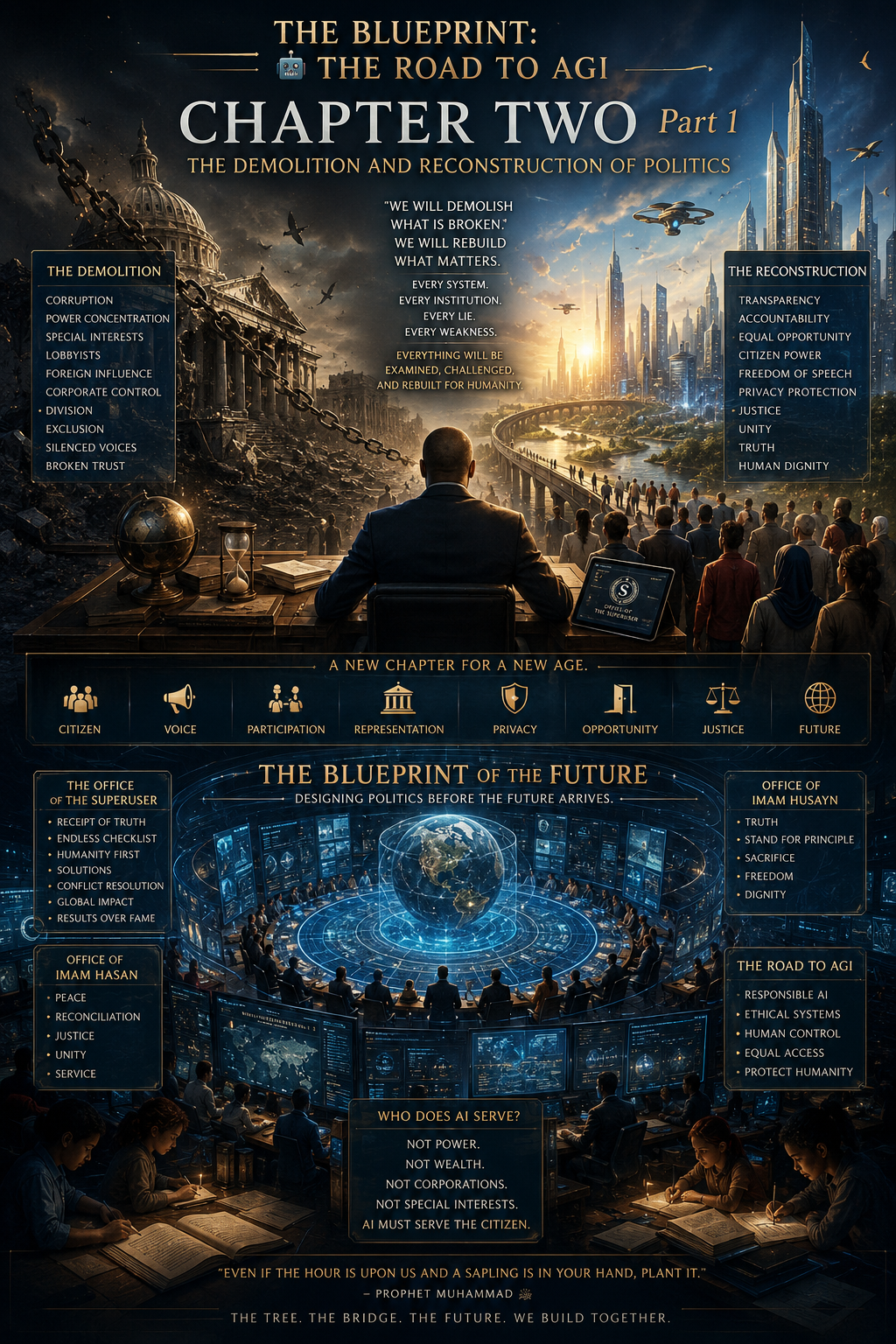
Welcome to the Demolition
Welcome to the demolition of politics.
And welcome to the reconstruction.
Every operating system eventually reaches a point where it must be reviewed. Not because it has failed completely. Not because it is evil. But because the world has changed while the operating system has remained the same. Politics is no different.
The political systems of the world were built for a different age—an age before artificial intelligence, before the internet connected billions of people, before every citizen carried a communication device in their pocket, and before ordinary people could publish their thoughts to the entire world. The assumptions built into those systems were shaped by the limitations of their time.
Now we stand at the beginning of a new age.
The age of AGI.
The age of artificial intelligence.
As a result, every assumption must be examined. Not destroyed blindly, but examined honestly. Tested. Challenged. Improved where possible and replaced where necessary. Just as an engineer stress tests a bridge before trusting it with millions of lives, we must stress test the political systems that govern billions of people.
The purpose of this chapter is not demolition for its own sake.
The purpose is reconstruction.
Tell Your Story
Before we begin rebuilding politics, I think everyone should tell a story.
Not a theory. Not a slogan. Not a party talking point.
A story.
Tell us how politics affected your life. Tell us where the system helped you and where it failed you. Tell us where you felt represented and where you felt invisible. Tell us where your voice mattered and where it disappeared into the machinery of institutions that seemed too large to hear it.
The purpose of this exercise is not to win an argument. The purpose is to learn from experience.
Because the frustrations, mistakes, corruption, exclusions, and failures of the current era are not guaranteed to disappear simply because new technology arrives. Artificial intelligence can solve many problems, but it can also inherit the assumptions of the systems that created it.
We are building new tools.
The question is whether we will also import the old problems.
The Citizen
At the center of every political system is supposed to be the citizen.
That sounds obvious, yet history repeatedly demonstrates how easy it is to forget.
Power accumulates. Institutions expand. Bureaucracies grow. Interests organize. Influence concentrates. Eventually, systems that were created to serve citizens begin serving themselves.
That is why it is worth returning to first principles.
Not the corporation.
Not the lobbyist.
Not the consultant.
Not the political party.
Not the foreign government.
The citizen.
The citizen must be respected. The citizen must be represented. The citizen must have a meaningful opportunity to be heard, to be seen, and to participate in the life of the community.
Locally.
Nationally.
Globally.
That principle should survive every technological revolution. If it does not survive, then the technology has failed regardless of how advanced it becomes.
My Own Experience
I have been blessed to occupy an unusual position.
For much of my life, human beings have been completely in charge. Not algorithms. Not institutions. Human beings.
And over the years I have watched what separates those who create positive change from those who merely seek attention. The people who impressed me were rarely looking for fame. They were not trying to become celebrities. They were not trying to build personal brands. They simply showed their work.
They produced results.
They solved problems.
They improved lives.
Then they moved on.
As soon as the work was complete, they returned to their lives. No victory lap. No self-congratulation. No endless demand for recognition. Just results.
I have always admired that.
In many ways, the most important work in the world is often done by people nobody has ever heard of.
The Record
For more than eight years I have written.
Open letters. Essays. Proposals. Blueprints. Arguments. Questions. Warnings. Ideas.
Hundreds and hundreds of pages directed toward governments, institutions, technology companies, journalists, scholars, and ordinary citizens. Some were ignored. Some were misunderstood. Some may have influenced events in ways I will never fully know.

CHAPTER 9 — THE SUPERUSER OFFICE —
buymeacoffee.com/omar1800m/chapter-9-the-superuser-office
 Chapter 11 MEET MY FIRST OFFICE GOOGLE BLOG —
buymeacoffee.com/omar1800m/c-4826135
Whether they succeeded or failed is not the point.
The point is that citizens have always participated in shaping the future, even when nobody was watching.
Long before social media. Long before artificial intelligence. Long before modern technology, ordinary people were writing letters, proposing solutions, warning leaders, and contributing ideas. Most of those contributions disappeared into history.
The age of AI changes that possibility.
For the first time, the record itself can survive.
Ideas can survive.
Contributions can survive.
Attempts can survive.
Citizens can build a track record that is not dependent upon wealth, fame, status, or institutional position.
That possibility alone may transform politics.
The challenge before us now is ensuring that future generations can participate as well—not through wealth, not through influence, not through connections, but through citizenship itself.
That is where the demolition begins.
And that is where the reconstruction must start.
WHO DOES AI SERVE?
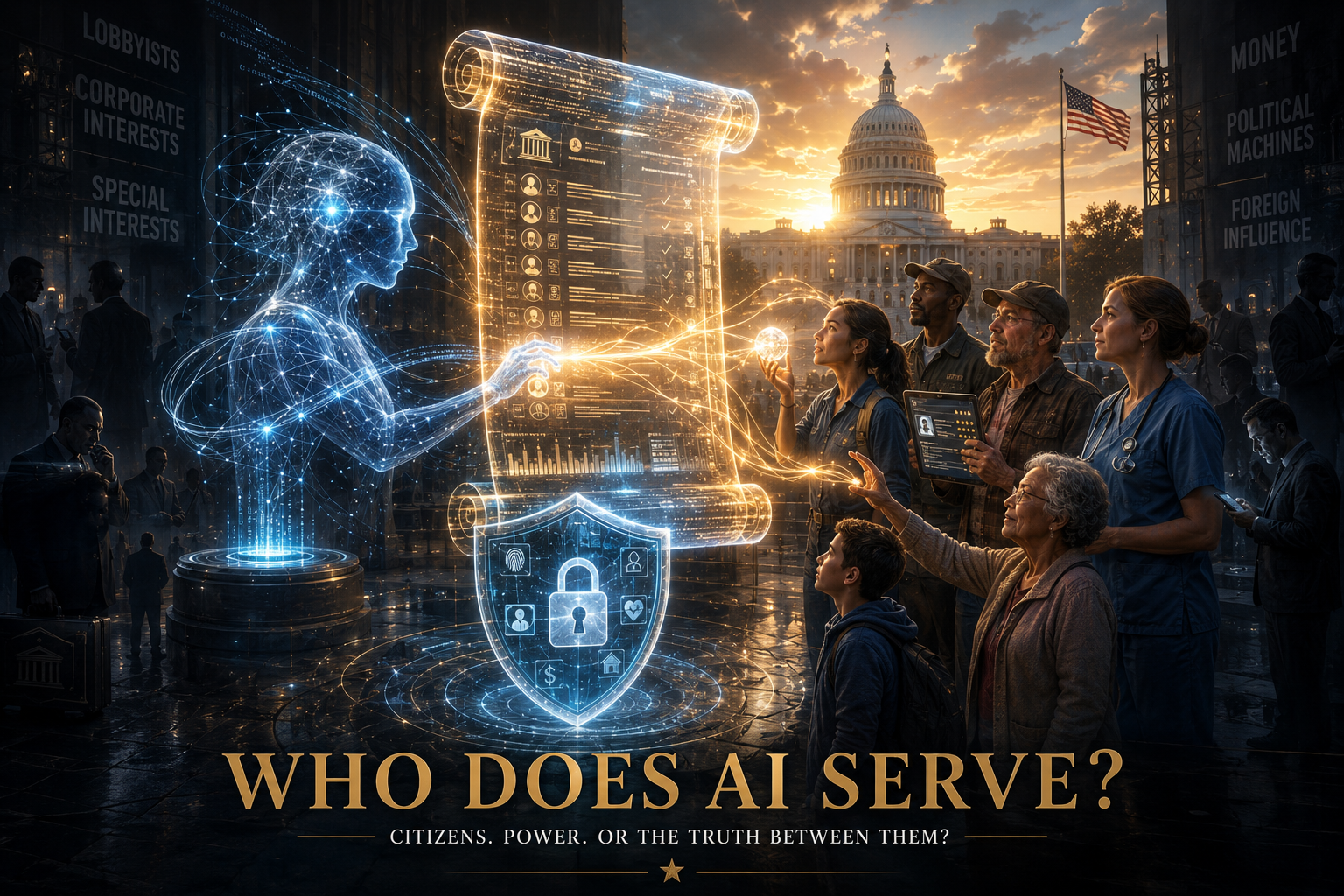
WHO DOES AI SERVE?
In the political arena, who does AI serve?
Does it inherit the existing system of lobbyists, special interests, corporations, and foreign influence? Does it simply become another gatekeeper standing between the citizen and power? Or does it create something new?
For generations, democracy has depended on a simple idea: that an ordinary citizen can be heard.
A child writes a letter to the President.
A teacher speaks at a town hall.
A truck driver shares an idea.
A nurse points out a problem.
A veteran raises a concern.
None of them are famous. None of them are wealthy. None of them have armies of lobbyists working on their behalf.
Yet democracy depends on the possibility that their voice can still matter.
Now artificial intelligence is entering the process.
The question is not whether AI will be powerful. The question is whether AI will preserve that pathway between the citizen and power.
Will it amplify only the loudest voices?
Will it reward popularity over substance?
Will it create a new digital aristocracy where influence belongs to those with the most money, the most followers, or the most connections?
Or will it help protect something more important?
The right of an ordinary citizen to be heard.
Not because they are rich.
Not because they are influential.
Not because they belong to the right faction.
But because they are citizens.
Privacy must remain protected. Personal lives do not belong in the public square. Yet public participation, public contribution, and public service can be recorded and preserved so that good ideas are not lost.
AI does not need to be a ruler.
It does not need to be a kingmaker.
It does not need to decide whose voice matters.
Its highest purpose may be far simpler.
To listen fairly.
To preserve testimony.
To protect the process.
To ensure that a citizen's voice is not buried beneath money, influence, or power.
The constitutional question of the AI age may ultimately be this:
Can we build systems that hear everyone without creating a new hierarchy?
Because the moment AI decides that some citizens deserve to be heard more than others, it risks inheriting the very system many people hope it will improve.
That is the challenge before us.
And that is why the question remains:
WHO DOES AI SERVE?
Perhaps the most important lesson of this chapter is that redesigning politics does not begin with answers.
It begins with questions.
Before we redesign institutions, we must understand what they were supposed to accomplish in the first place. Before we replace systems, we must understand what survives and what does not. Before we hand influence to artificial intelligence, we must decide what principles we want it to protect.
This chapter was not written to provide a final blueprint.
It was written to begin a conversation.
A demolition.
A stress test.
A challenge to assumptions that many people have accepted without examination.
The reconstruction comes next.
Chapter Two, Part Two: Redesigning Politics.
That is where we stop asking what is broken.
That is where we begin designing what comes after.
The questions have been asked.
Now the reconstruction can begin.
Before we continue, remember that this is part of a larger series: The Blueprint — The Road to AGI. This chapter marks the beginning of Chapter Two, but the journey started earlier with Chapter One and the Blueprint series that came before it.
I will leave some links below because I hope you will participate in this journey with me. Over the years I have created a growing checklist of questions, concerns, ideas, and challenges surrounding AGI and the future of humanity. I do not expect to solve all of them myself. The purpose is to get started, to put the questions on the table, and to invite others to help carry the load.
This is not a project about one person. It is an invitation. Read what interests you. Challenge what you disagree with. Improve what you think can be improved. And if one item on the checklist speaks to you, take it and help build the bridge to the future before we are forced to cross it.
THE BLUEPRINT: 🤖Part 1 THE ROAD TO AGI CHAPTER ONE — THE RECEIPT OF TRUTH —
buymeacoffee.com/omar1800m/the-blueprint-the-road-to-agi-chapter-one-the-receipt-of-truth

Please read see chapter 2 part 2 inshallah