

بِسْمِ اللهِ الرَّحْمٰنِ الرَّحِيْم
In the Name of God, Most Gracious, Most Merciful
♥️🤲🕋♥️🕋🌹🌹🥀🤲🌹🕋♥️🤲
THE MATHEMATICS OF REVELATION
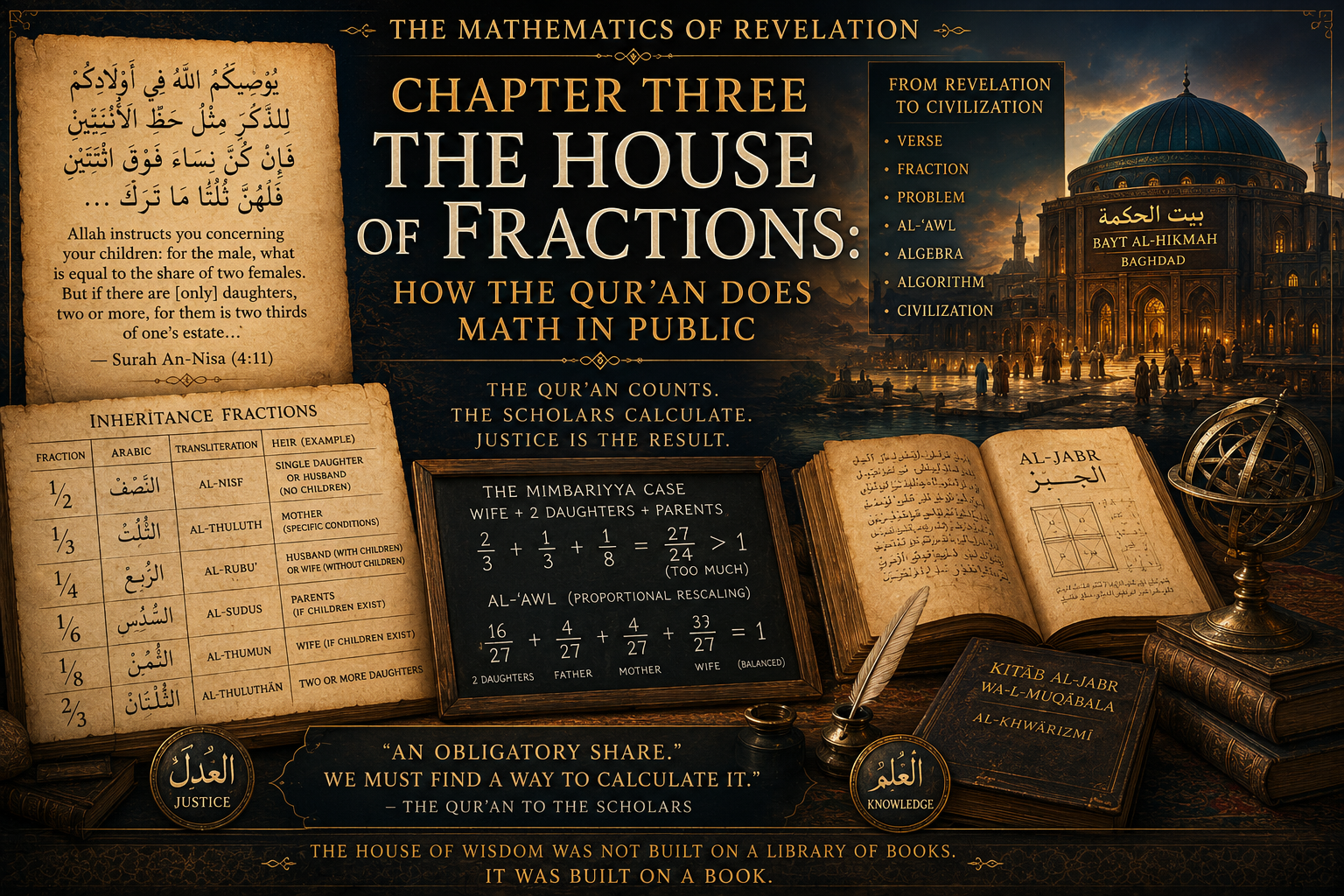
CHAPTER THREE — THE HOUSE OF FRACTIONS: HOW THE QUR'AN DOES MATH IN PUBLIC
بِسْمِ اللهِ الرَّحْمٰنِ الرَّحِيْم
Welcome back to class.
Let's look at something most people read right past, but which fundamentally altered the history of human intelligence.
We are taught today that the House of Wisdom (Bayt al-Ḥikmah) was just a translation center—a place where Muslims took Greek geometry and Indian arithmetic, mixed them together, and handed them to Europe.
That is an incomplete history.
The House of Wisdom was not built on random intellectual curiosity. It was built because the Qur'an was doing math right in front of the believers, and the early Muslims had to build a civilization capable of solving God's equations.
I. THE VOCABULARY OF DIVISION
Before we look at the numbers, look at the language.
In Arabic, fractions are not just symbols stacked on top of each other. They are built directly from the root words of the language, making division an intrinsic part of speech.
Look at how the Qur'an explicitly breaks down inheritance in Sūrat al-Nisā':
Fraction Arabic Term Transliteration Qur'anic Context ½ النِّصْف Al-Niṣf The share of a single daughter or a husband (if no children) ⅓ الثُّلُث Al-Thuluth The share of the mother in specific conditions ¼ الرُّبُع Al-Rubu' The share of a husband (with children) or wife (without children) ⅙ السُّدُس Al-Sudus The share of parents if the deceased left children ⅛ الثُّمُن Al-Thumun The share of a wife if there are surviving children
يُوصِيكُمُ اللَّهُ فِي أَوْلَادِكُمْ ۖ لِلذَّكَرِ مِثْلُ حَظِّ الْأُنثَيَيْنِ ۚ فَإِن كُنَّ نِسَاءً فَوْقَ اثْنَتَيْنِ فَلَهُنَّ ثُلُثَا مَا تَرَكَ ۖ وَإِن كَانَتْ وَاحِدَةً فَلَهَا النِّصْفُ ۚ وَلِأَبَوَيْهِ لِكُلِّ وَاحِدٍ مِّنْهُمَا السُّدُسُ مِمَّا تَرَكَ إِن كَانَ لَهُ وَلَدٌ
"Allah instructs you concerning your children: for the male, what is equal to the share of two females. But if there are [only] daughters, two or more, for them is two thirds of one's estate. And if there is only one, for her is half. And for one's parents, to each one of them is a sixth of his estate if he left children."
— Surah An-Nisa (4:11)
Think about what is happening here.
Allah is speaking to an oral society in the 7th century, and He is executing fractional division in public revelation. He is partitioning wealth, rights, and familial security using precise mathematical weights.
II. THE DYNAMIC PROBLEM: THE MATH MUST BALANCE
Here is where the spark for the House of Wisdom truly begins.
When you add standard fractions together in regular math, they don't always naturally equal 1.
Imagine a man passes away and leaves behind a wife, two daughters, and both his parents.
Let's look at the absolute fractions assigned by the Qur'an:
Heir Fraction Two Daughters ⅔ Parents (each ⅙) ⅙ + ⅙ = ⅓ Wife ⅛
Now, let's look at what happens when you try to sum these up using a common denominator (24):
⅔ + ⅓ + ⅛ = 16/24 + 8/24 + 3/24 = 27/24
The sum is 27/24, which is greater than 1.
You have more claims than there is estate to distribute.
You cannot just give one person their full share and leave the last person with nothing—that would violate Divine justice ('Adl).
III. HOW THE BALANCE WAS ACTUALLY RESTORED
So how did the jurists solve it?
Not by guessing.
Not by taking from one heir to protect another.
The method is called al-'Awl — literally meaning "deviation" or "inclination" — and it works by a move that is, in spirit, identical to what al-Khwārizmī would later formalize as algebra:
Convert every fraction into a whole-number share of a common base, then let the base itself absorb the imbalance.
Watch the mechanics on our own case — wife, two daughters, both parents:
On a common denominator of 24, the shares become whole-number portions:
Heir Fraction Portions (out of 24) Two Daughters ⅔ 16 portions Father ⅙ 4 portions Mother ⅙ 4 portions Wife ⅛ 3 portions
Add them up:
16 + 4 + 4 + 3 = 27 portions
But the estate itself is only 24 portions wide.
There are three portions too many.
Here is the jurists' resolution, and it is elegant precisely because it touches no one's ratio to anyone else:
Instead of forcing the answer back to 24, they expand the base itself to 27—the actual sum of what was claimed—and let each heir keep their same portion-count, just now measured against the larger number.
Heir Original Portions New Share (out of 27) Two Daughters 16 16/27 Father 4 4/27 Mother 4 4/27 Wife 3 3/27 = 1/9
Every share has shrunk by the exact same proportion.
Nothing was taken arbitrarily.
Nothing was given arbitrarily.
The whole structure was rescaled, in unison, until the ledger closed at exactly 1.
IV. THE PULPIT CASE: WHEN THE CALIPH DID MATH IN PUBLIC
And here is the case that should make the whole abstraction click.
A famous instance of this exact problem became known in the inheritance literature as the Mimbariyya — "the pulpit case."
Why?
Because the fourth Caliph, 'Alī ibn Abī Ṭālib, was asked to resolve it on the spot while delivering a sermon from the mimbar, the pulpit, in a mosque in Kufa.
Think about that.
No algebra book existed yet.
No formal notation existed yet.
What existed was a Caliph who could hold four overlapping fractions in his mind, see that they summed past one, and rescale them on the spot, standing at the pulpit, mid-sermon.
The discipline of precise reckoning the Qur'an demanded had become second nature.
V. FROM THE PULPIT TO ALGEBRA
That is the exact kind of problem—overlapping, competing, exact fractional claims that must always resolve to a whole—that al-Khwārizmī's generation needed a general, repeatable method for.
Algebra did not replace 'Alī's insight.
It made 'Alī's insight teachable to anyone.
When Al-Khwārizmī sat down in Baghdad inside the House of Wisdom centuries later to write the world's first book on Algebra (Al-Jabr), he didn't do it for abstract prestige.
He explicitly declared his motivation:
"...to serve the practical necessities of the people in their inheritances, their legacies, their lawsuits, and their commerce, and all their dealings with one another where mathematics is involved."
The word Al-Jabr literally means "the restoration" or "reuniting of broken parts."
It was the mathematical tool needed to bring the fractions back into perfect harmony.
The Qur'an counted first—the scholars simply learned how to execute the account.
VI. THE SPIRITUAL FOUNDATION
But there is something deeper here.
The House of Wisdom was not merely a secular institution.
It was cultivated by scholars whose understanding of knowledge was rooted in Revelation.
The scholars of the House of Wisdom were not secular intellectuals working in a vacuum.
They were Muslims who believed that the pursuit of knowledge was a form of worship.
They believed that observing the sky, measuring the earth, calculating inheritance, and recording transactions were all acts of obedience to a God who had commanded them to be just, precise, and accountable.
VII. THE RIPPLE EFFECT
This is why the House of Wisdom emerged when and where it did.
Not because Muslims were simply curious about the stars or geometry.
Because they had a Book that told them exactly how to divide, weigh, and measure.
The Qur'an said:
"An obligatory share."
And the scholars said:
"We must find a way to calculate it."
The Qur'an said:
"Be just."
And the scholars said:
"We must build an algebra to ensure the math balances."
The Qur'an said:
"Write down the debt."
And the scholars said:
"We must create a system for recording, auditing, and distributing."
This is the chain:
Revelation → Obligation → Calculation → 'Awl → Algebra → Algorithm → Civilization
The House of Wisdom was not built on a library of books.
It was built on a Book.
VIII. A NOTE ON SCHOOLS OF THOUGHT
It should be noted that not all Islamic schools of jurisprudence accept 'awl.
The Sunni schools accept it as described above—a proportional rescaling of all shares.
However, Ja'fari (Shia) jurisprudence rejects 'awl entirely and instead reduces the daughters' share directly rather than rescaling everyone proportionally.
This chapter presents the Sunni majority position, which is the view that historically shaped the development of algebra at the House of Wisdom.
THE JOURNEY CONTINUES
We have traced the trail:
From Revelation to obligation.
From obligation to fraction.
From fraction to the inheritance problem.
From the inheritance problem to Al-'Awl.
From Al-'Awl to the pulpit of 'Alī.
From the pulpit to al-Khwārizmī.
From al-Khwārizmī to algebra.
From algebra to algorithm.
And now, from algorithm to the digital age.
A final question remains:
What counts?
What counts in the age of artificial intelligence?
What counts when the machines can count better than we can?
The answer may be simpler than we imagine.
Everything still counts.
Every deed.
Every action.
Every choice.
The machines will compute the numbers.
But only the soul can compute the meaning.
Summary of Qur'anic Inheritance Fractions
Fraction Arabic Transliteration Heir Verse ½ النِّصْف Al-Niṣf Single daughter or husband (no children) 4:11, 4:12 ⅓ الثُّلُث Al-Thuluth Mother (specific conditions) 4:11 ¼ الرُّبُع Al-Rubu' Husband (with children) or wife (without children) 4:12 ⅙ السُّدُس Al-Sudus Parents (if children exist) 4:11 ⅛ الثُّمُن Al-Thumun Wife (if children exist) 4:12 ⅔ الثُّلُثَان Al-Thuluthān Two or more daughters 4:11
THE CONCLUSION
What began as a fraction became a civilization.
A verse about inheritance became a legal system. A legal system became a mathematical challenge. A mathematical challenge became a method. A method became algebra. And algebra eventually became the foundation of the algorithms that now power the modern world.
That is the lesson of the House of Fractions.
The Qur'an did not merely tell believers to be fair. It forced them to become precise.
It forced them to count.
It forced them to measure.
It forced them to build intellectual tools capable of carrying out Divine commands without corruption, favoritism, or guesswork.
And that is exactly what happened.
The early Muslims were not solving abstract puzzles for entertainment. They were solving real problems that affected real families, real estates, real courts, and real lives. The obligation came first. The mathematics came second.
Revelation demanded justice. Mathematics became the instrument.
That is why the story of algebra does not begin in a classroom.
It begins with a verse.
It begins with a fraction.
It begins with a believer trying to fulfill the command of Allah.
And from that simple beginning emerged one of the greatest intellectual traditions in human history.
But if the Qur'an provided the fractions, and if the scholars provided the mathematics, another question remains:
Who were the minds that stood between Revelation and civilization?
Who were the men capable of solving inheritance problems from the pulpit?
Who were the teachers who transformed knowledge into a living tradition?
Who were the architects of thought that helped shape the civilization that would eventually build the House of Wisdom?
To answer that question, we must stop and look at one of the most extraordinary intellects in Islamic history.
A man remembered for courage.
A man remembered for justice.
A man remembered for wisdom.
But perhaps not remembered enough for his contribution to knowledge itself.
And so our journey now turns toward Imam Ali ibn Abi Talib.
Not merely as a companion.
Not merely as a Caliph.
But as a scholar whose intellectual legacy may have reached far deeper into Islamic civilization than many people realize.
NEXT CHAPTER
CHAPTER FOUR — IMAM ALI AND THE SCIENCE OF INTELLIGENCE
From the Pulpit to Civilization
How one man's knowledge influenced mathematics, grammar, reasoning, justice, and the intellectual foundations of the Islamic world.
Class dismissed.
For now. Inshallah. 🤲📚🌹
Class dismissed.
For now. Inshallah.