
بِسْمِ اللهِ الرَّحْمٰنِ الرَّحِيْم
In the name of God most gracious most merciful.
📖 Chapter Six: The Role of the Muhtasib
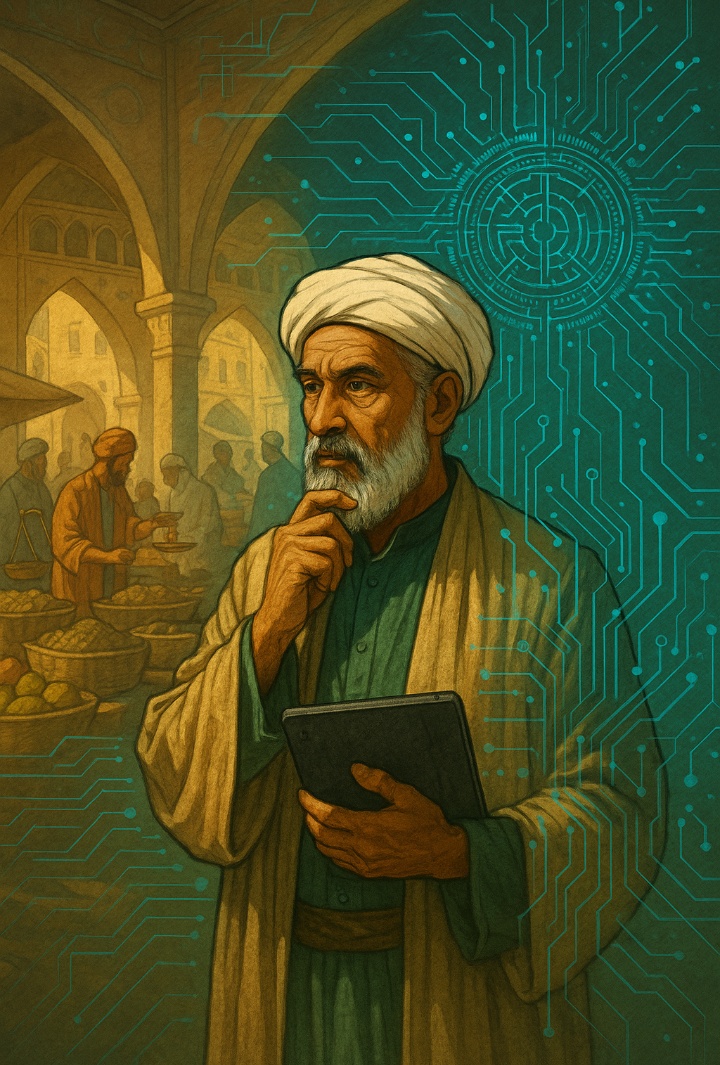
Accountability in Trade — Then and Now
Markets can be moral.
But only if someone guards them.The Prophet ﷺ didn’t leave the market to regulate itself.
He didn’t trust prices to invisible hands.
He created visible ones—the muhtasib, the market inspector.Not a bureaucrat.
Not a capitalist.
A moral guardian.
A protector of the people, the truth, and the trust.
What Is a Muhtasib?
A muhtasib (from hisbah, meaning accountability) was an official appointed to oversee:
Fair pricing
Honest weights and measures
Prohibition of monopolies
Ethical treatment of customers and traders
Protection of the poor from being cheated or priced out
He was not a tax collector.
He was not a politician.
He was a witness of God in the market.
And his presence was not symbolic — it was strategic.
A Daily Presence in the Market
Unlike modern regulators who release quarterly reports or react after damage is done,
the muhtasib walked the market daily.
He:
Inspected baskets of wheat
Checked balance scales
Observed interactions between seller and buyer
Removed corrupted goods
Shut down unjust contracts
Shamed cheaters publicly
And he did this in real time — not after a crisis, not from a spreadsheet, not in silence.
He made the market feel watched.
And in doing so, he made it safe.
Why the Muhtasib Mattered
Because without accountability:
The strong dominate
The loudest win
The rich manipulate
The people suffer
The muhtasib was the immune system of the Islamic economy.
And his presence ensured that:
The orphan wasn’t robbed
The traveler wasn’t overcharged
The widow wasn’t scammed
And the society didn’t become numb to injustice
This wasn’t charity.
This was economic integrity made structural.
Modern Markets Have No Muhtasib
Today, our regulators serve:
Lobbyists
Corporations
Institutional investors
They:
Bail out banks
Protect monopolies
Let fines replace morality
Fraud becomes a “fee.”
Manipulation becomes a “strategy.”
And suffering becomes an externality.
The market is not supervised.
It is engineered for the elite.
And when collapse comes — the people pay.
What If AI Becomes the New Muhtasib?
Now we are entering a new age.
AI can:
Track every transaction
Scan for deception
Detect imbalances in supply and pricing
Audit digital contracts
Flag unethical behavior at speed and scale
But without a moral framework,
AI will simply enforce injustice faster.
That’s why we must rebuild the muhtasib —
Not as a man on foot, but as a principle in code.
A system that:
Doesn’t allow cheating
Doesn’t reward manipulation
Doesn’t ignore the weak
And doesn’t let profit erase human dignity
This is not a fantasy.
It’s a blueprint — and it’s rooted in our past.
What Happens When the Muhtasib Returns
Imagine a future where:
Digital marketplaces are audited by transparent moral protocols
Algorithms are held to the standards of Islamic economic ethics
Buyers and sellers trade in trust, knowing the system protects them
Zakat is tracked and routed instantly
Hoarding is flagged and stopped
Honest behavior is rewarded — not just recorded
The Prophet ﷺ didn’t just build a moral society.
He built a system to protect morality from erosion.
That system was hisbah.
And its enforcer was the muhtasib.
Conclusion: The Market is Not Free — It Must Be Guarded
Let us be clear:
The Islamic market was not free in the Western sense.
It was liberated from exploitation, not from guidance.
It was guarded not by capital, but by conscience.
And in the age of AI,
we must teach our machines to be muhtasibs, not manipulators.
Because if we do not digitize morality,
immorality will digitize us.
📘 Chapter Seven: What Was Lost — 100 Years Without Divine Supervision
The collapse of markets when God is removed—and how the people paid the price.