
بِسْمِ اللهِ الرَّحْمٰنِ الرَّحِيْم
Bismillah ar-Rahman ar-Rahim
In the Name of God, Most Gracious, Most Merciful 🕋
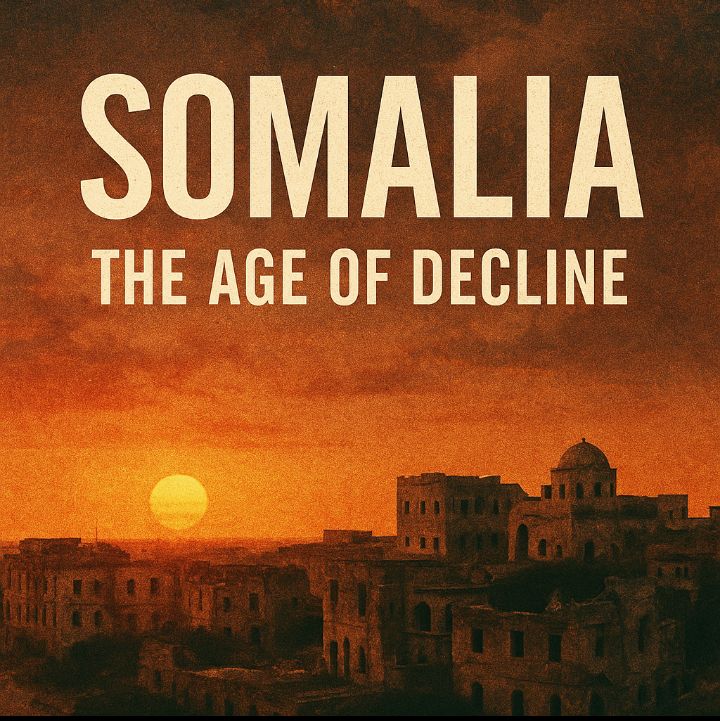
Chapter Six — The Age of Decline (1980–1991): Collapse of the Somali State
The Cracks Beneath the Throne
By the early 1980s, the once-mighty revolution that had promised unity, justice, and progress had begun to crumble from within. The dream of “Scientific Socialism” was fading, replaced by greed, fear, and survival. The people whispered of betrayal — the revolution that claimed to lift all Somalis had become the property of a few.
After the Ogaden War disaster in 1978, Somalia was no longer the star of the Soviet bloc. The Russians had left, taking their ideology and aid with them, and the Americans had entered quietly, offering dollars, weapons, and “partnership.” But behind the aid came dependency. Somalia was now trapped between two worlds — too capitalist for Moscow, too corrupt for Washington, and too broken for its own people.
The Rise of the “MOD” Alliance
Power narrowed into a small circle. Siad Barre surrounded himself with those he trusted most — members of his own clan and its allies, known as the “MOD” alliance (Marehan, Ogaden, Dhulbahante). What began as loyalty soon became a system of nepotism and corruption.
Government jobs, military promotions, and aid funds flowed only to those within the circle. Ordinary Somalis — teachers, traders, nomads, and scholars — watched as favoritism replaced fairness. The country’s resources were devoured by the few, while the many sank into hunger and despair.
Socialism was dead, but its body was still being paraded through the streets under slogans of “revolution” and “unity.”
Opposition Movements Rise
As the dictatorship deepened, courage began to stir in the shadows. Former military officers, scholars, and patriots who had once believed in the revolution now turned against it.
The Somali Salvation Democratic Front (SSDF) emerged first, operating from Ethiopia, calling for reform and resistance. Then came the Somali National Movement (SNM) in the north — rooted in the Isaaq clan — demanding justice, freedom, and the end of dictatorship. In the south, the Somali Patriotic Movement (SPM) would later join the struggle.
Each carried its own wounds and hopes, but all shared a single truth: Barre’s regime had become the enemy of the Somali people.
Yet, the fight was not easy. Ethiopia, still bitter from the Ogaden War, offered support to the rebels — not out of love, but revenge. The Horn of Africa became a theater of proxy battles, and the Somali people once again became pawns in foreign games.
Repression and Atrocities (1987–1989)
By the late 1980s, the government’s cruelty reached its peak. Anyone suspected of disloyalty could disappear overnight. Secret prisons filled with journalists, imams, students, and elders.
And then came the unthinkable — the Hargeisa Holocaust.
Barre’s air force bombed Hargeisa and Burao, cities that had dared to dream of freedom. Civilians were slaughtered by their own army. Thousands died in the streets, and hundreds of thousands fled to Ethiopia as refugees.
The smell of death clung to the air for years.
These atrocities were not accidents. They were messages — warnings to all Somalis who might question the revolution. But in trying to silence the nation, Barre silenced his own legitimacy. The Somali people had lost faith.
The Fall (1990–1991)
As the 1990s began, Siad Barre ruled over ruins. The economy was dead, international aid had dried up, and the soldiers who once chanted his name were now divided by clan, hunger, and despair.
In Mogadishu, the United Somali Congress (USC) rose from the capital’s chaos. Allied with defected soldiers and civilians who had nothing left to lose, they stormed the capital in January 1991.
On January 26, 1991, Siad Barre fled Mogadishu.
The man who once called himself the “Father of the Nation” escaped in the night, leaving behind a nation with no government, no army, and no direction.
The Somali flag still waved — but it was a flag without a state.
The Aftermath
The fall of Barre did not bring peace — it opened the gates of anarchy. The country fractured along clan lines. Warlords rose, civilians fled, and famine stalked the land. Somalia went from being the “model of African socialism” to a warning for the world.
But even in that darkness, the seeds of rebirth remained — in Somaliland, where order and memory were rebuilt from the ashes; in communities that still prayed, still taught, still hoped; and in the few who believed that Somalia could rise again, but this time — not through ideology, not through dictatorship — but through faith, truth, and accountability.
Chapter Seven — A Nation Without a State: Warlords, Famine, and Faith (1991–2000)
The Silence After the Fall
When Siad Barre fled Mogadishu in January 1991, Somalia did not simply lose a president — it lost the state itself.
The ministries were looted, the currency collapsed, and every city became its own fortress.
What was once the Somali Democratic Republic became a patchwork of checkpoints, militias, and starving families.
The blue flag still waved in the dust, but no one knew who it belonged to.
In the absence of leadership, clan elders, warlords, and preachers all claimed to speak for the nation. The promises of socialism were gone, but the pain remained — a reminder that tyranny and chaos are born from the same womb.
The Rise of Warlords
The capital, Mogadishu, descended into chaos. Competing warlords — Ali Mahdi Mohamed, Mohamed Farah Aidid, and others — carved the city into zones of influence.
The USC, once a movement of liberation, fractured into factions that turned their guns on each other.
What began as a revolution for freedom became a struggle for survival.
The same soldiers who once bombed the north now fought over food convoys and aid trucks.
By 1992, famine had struck — not because of drought, but because of greed.
The land that once fed its people was now haunted by hunger.
The World Intervenes
Television screens around the globe showed the faces of starving Somali children — ribs visible, eyes hollow, hands outstretched.
The world could no longer ignore Somalia.
In 1992, the United Nations Operation in Somalia (UNOSOM) began, followed by UNITAF — a U.S.-led humanitarian intervention to deliver food and restore order.
For a brief moment, hope returned. Aid reached villages, and convoys moved again.
But politics and pride soon ruined the mission.
When American and UN forces clashed with Somali militias in 1993, the world saw the tragedy of the Black Hawk Down incident.
Eighteen American soldiers and hundreds of Somalis died in a single day.
Soon after, the international community withdrew — leaving Somalia to its wounds.
The message was clear: no one could fix Somalia except Somalis themselves.
Faith Amid the Rubble
Out of the ruins rose a different kind of power — not political, but spiritual.
As warlords fought, Islamic charities, scholars, and communities began to restore order quietly.
Mosques became schools, imams became mediators, and prayer replaced politics as the only form of unity left.
It was during this decade that Sufi orders like the Qadiriyya and Ahmadiyya became the heartbeat of Somali society once again — feeding the hungry, healing the wounded, and reminding people that faith was the last foundation standing.
But even faith was not safe.
Foreign influences — Wahhabi and Salafi movements — began creeping into Somalia through money, books, and madrassas.
They spoke of purity but sowed division; they preached Islam while poisoning its soul.
The Lessons of a Lost Decade
Between 1991 and 2000, Somalia lost everything material — but rediscovered something eternal.
Without a government, Somalis learned what leadership truly means.
Without institutions, they learned that justice begins in the heart.
And without power, they learned that faith is the only flag that cannot fall.
This era was not just the collapse of a state — it was the test of a people’s spirit.
And though the nation fell, the people endured.
Closing Reflection
The 1990s taught the world that rebuilding a nation requires more than politics.
It requires repentance, wisdom, and unity through God.
As we move to the next chapter, we will see how faith, fatigue, and foreign interference gave birth to a new era — the rise of Islamic movements, the birth of Puntland and Somaliland, and the long road toward reconciliation.
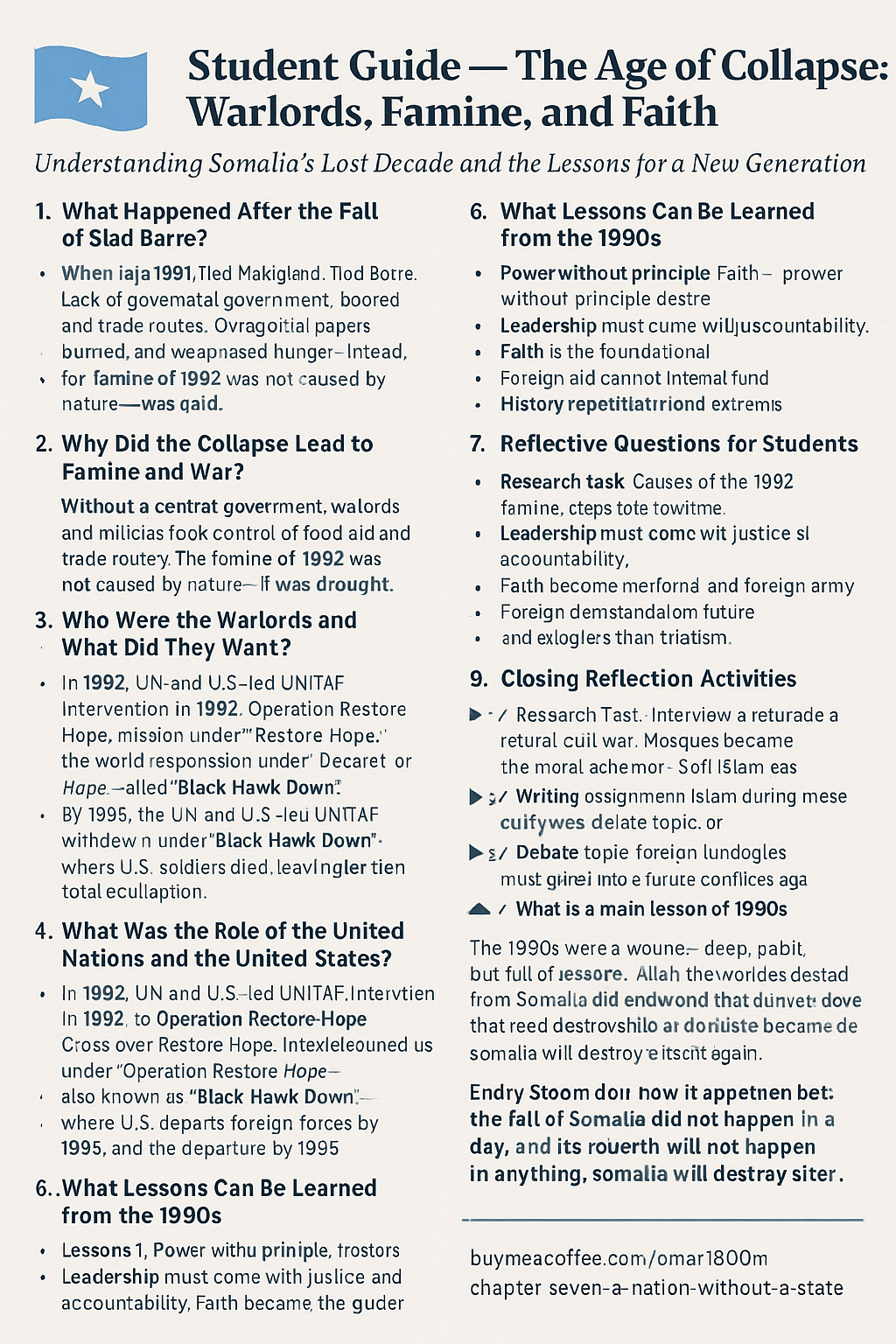
🎓 Student Guide — The Age of Collapse: Warlords, Famine, and Faith (1991–2000)
Understanding Somalia’s Lost Decade and the Lessons for a New Generation
1. What Happened After the Fall of Siad Barre?
When Siad Barre fled Mogadishu in January 1991, the Somali state collapsed entirely.
There was no president, no parliament, and no army. The ministries were looted, government papers burned, and the country fragmented into clan-controlled territories.
Every region had its own leader.
Every checkpoint had its own flag.
What was once the Somali Republic became a collection of rival fiefdoms — each calling itself the “true Somalia.”
2. Why Did the Collapse Lead to Famine and War?
Without a central government, warlords and militias took control of food aid and trade routes.
They looted shipments meant for the poor, extorted civilians, and weaponized hunger.
The famine of 1992 was not caused by nature — it was caused by man-made greed.
Hundreds of thousands of Somalis, especially children, died of starvation while warehouses full of food were guarded by armed men.
The tragedy showed that political chaos kills faster than drought.
3. Who Were the Warlords and What Did They Want?
After 1991, Mogadishu became the epicenter of a brutal civil war.
Ali Mahdi Mohamed and Mohamed Farah Aidid, both leaders of the United Somali Congress (USC), turned against each other.
Other warlords like Aideed’s son Hussein, and later Osman Atto and General Morgan, carved territories for profit and power.
They claimed to fight for “justice” or “clan dignity,” but their real war was for control — of ports, airports, and foreign aid.
4. What Was the Role of the United Nations and the United States?
When global news showed starving Somali children, the world responded.
In 1992, the United Nations and U.S.-led UNITAF forces intervened under Operation Restore Hope. Their mission was to deliver food and stabilize the nation.
Initially, it worked — famine deaths dropped dramatically. But when they tried to disarm warlords, the militias fought back.
This led to the tragic Battle of Mogadishu (1993) — also known as Black Hawk Down — where U.S. soldiers and hundreds of Somalis died.
By 1995, the UN and U.S. withdrew, leaving Somalia in deeper chaos than before.
The world learned a hard truth: you can deliver food to a starving nation, but you cannot deliver peace without justice.
5. What Role Did Faith Play During This Time?
In the absence of government, faith became the glue that held society together.
Mosques turned into schools and community centers.
Sufi scholars and elders mediated peace between clans when no one else could.
It was the Sufi tradition — patient, peaceful, rooted in love and remembrance of Allah — that helped Somalis survive spiritually when everything else collapsed.
But foreign money and ideologies began flowing in.
Groups influenced by Wahhabism and Salafism sought to replace Somalia’s tolerant Sufi Islam with rigid, militant doctrines.
They claimed to defend religion but spread division and extremism.
This ideological shift would shape Somalia’s future conflicts.
6. What Lessons Can Be Learned from the 1990s?
💡 Lesson 1: Power without principle destroys nations.
The warlords had power, but no ethics. Their greed turned victory into famine.
💡 Lesson 2: Leadership must come with justice and accountability.
Every clan, every region needs moral leadership — not only political power.
💡 Lesson 3: Faith is the foundation of survival.
Even when the government fell, Islam remained the light that kept Somalia from total collapse.
💡 Lesson 4: Foreign aid cannot fix internal corruption.
No outside nation can rebuild Somalia. Only Somalis, united under justice and faith, can do that.
💡 Lesson 5: History repeats itself when people refuse to learn.
The ideologies that destroyed the 1980s returned in new forms — through extremist religion and imported politics. Awareness is the shield of the future.
7. Reflective Questions for Students
Question Answer / Reflection What caused the famine of 1992? It was a man-made disaster caused by warlords hoarding food and aid for power. Why did the UN and U.S. intervene in Somalia? To stop starvation and restore order, but they failed due to clan politics and misunderstanding local dynamics. How did Islam help the people during the collapse? Faith became the moral anchor — Sufi scholars, mosques, and local elders kept hope and order alive. What dangers came with foreign-funded ideologies? They brought division, extremism, and intolerance, undermining Somalia’s peaceful Islamic traditions. What is the main lesson of the 1990s? That unity, justice, and faith must come before politics or foreign influence — or a nation will destroy itself again.
8. Assignments and Activities
Research Task: Interview an elder who lived through the 1990s and record their story about famine, war, or faith.
Writing Assignment: Write an essay on how Somalia could have avoided collapse if the government had invested in fairness instead of fear.
Debate Topic: “Was foreign intervention in Somalia necessary or harmful?”
Creative Project: Draw or design a peace flag symbolizing unity between clans through faith, not politics.
9. Closing Reflection
The 1990s were a wound — deep, painful, but full of lessons.
Somalis learned that no ideology, no warlord, no foreign army could replace what Allah already gave them: faith, dignity, and community.
Every student reading this must remember:
The fall of Somalia did not happen in a day, and its rebirth will not happen in a day.
But every Somali heart that learns, forgives, and stands for truth brings the nation one step closer to healing.
As we close this part of our journey through Somalia’s modern history, we now enter the chapters that ask why it all mattered. After the wars, the revolutions, the betrayals, and the rebuilding, what remains is not only rubble and memory — but meaning.
In Part VI, we will reflect on the legacy of socialism — the literacy it brought, the pride it once inspired, and the nostalgia it still stirs. We will look at how a nation that dreamed of equality ended up trading bureaucracy for barter, as formal institutions collapsed and informal markets kept the people alive. And then we will lift our gaze outward — asking what the Somali story teaches the rest of Africa and the world about ideology, leadership, and survival.
In Part VII, we will turn to the heart — the poetry, songs, and faith that preserved the Somali soul. We will examine the myth of the “rescuer,” the illusion of the strongman, and the enduring truth that no savior can replace the wisdom of a united people. Finally, in Part VIII, we will document every telegram, every testimony, every memory — building the first open archive of this nation’s modern history, a record not for blame, but for understanding.
The next chapters are not about politics; they are about identity, spirit, and responsibility. They will show how a people who lost their state never lost their story — and how, through knowledge and truth, they may yet write their redemption.