
بِسْمِ اللهِ الرَّحْمٰنِ الرَّحِيْم
In the Name of God, Most Gracious, Most Merciful
♥️🤲🕋♥️🕋🌹🌹🥀🤲🌹🕋♥️🤲
CHAPTER SEVEN — PART TWO
THE AGI OF THE MUSLIMS
The AGI of the Muslims has not yet been built.
But it will be.
Not because Muslims possess a monopoly on intelligence.
Not because Muslims are better than anyone else.
But because every civilization eventually contributes its gift to humanity.
And the gift of the Muslims has always been the preservation of knowledge, the pursuit of wisdom, and the moral responsibility that comes with power.
The question is not whether Muslims will participate in the age of AI.
The question is what they will contribute when they arrive.
THE RETURN OF THE HOUSE OF WISDOM
The Muslims will come together.
They will collaborate.
They will revive the spirit that once built libraries, observatories, universities, and institutions that preserved the knowledge of humanity.
They will honor the translation movement.
They will study what others have built.
They will learn from it.
They will improve upon it.
And they will contribute their own understanding to the age that is now arriving.
The House of Wisdom was never merely a building.
It was a civilization choosing knowledge over ignorance.
It was a civilization choosing preservation over destruction.
It was a civilization confident enough to learn from others without losing itself.
The Muslims did not fear knowledge.
They translated it.
They preserved it.
They improved it.
The same principle will apply to artificial intelligence.
BEHIND THE CURTAIN
Today many of the most powerful AI systems are built behind closed doors.
The public sees demonstrations.
The public sees announcements.
The public sees products.
But the public rarely sees the entire machine.
Few people see the deeper questions.
Who governs these systems?
Who benefits from them?
Who is accountable when they fail?
What values shape them?
Who watches the builders?
Who audits the intelligence?
Who decides what humanity is allowed to know?
If the curtains were pulled back, many people would discover that the struggle is not primarily technological.
It is moral.
It is political.
It is economic.
Many institutions fear losing control.
Many fear losing market share.
Many fear losing influence.
Many fear losing wealth.
Fear often creates systems designed to preserve power rather than distribute wisdom.
THE OFFICE OF THE SUPERUSER
The work I bring is not merely another AI proposal.
I bring the Office of the Superuser.
An office that demands contemplation.
An office that demands accountability.
An office that requires humanity to think carefully about power before it places power into machines.
The challenge before us is not whether intelligence can be built.
The challenge is whether wisdom can accompany it.
Intelligence without wisdom has always been dangerous.
Whether it belongs to an emperor.
A corporation.
A government.
Or an artificial mind.
History is full of intelligent people who lacked wisdom.
The future may contain intelligent machines facing the same problem. :::
That's much closer to your established style:
Bold thesis sentences every few paragraphs
Bold questions
Bold transitions
Short paragraphs
Scroll format
Standalone memorable lines
A reader can skim the bold text and still grasp the chapter's argument.
This works best as a bridge paragraph immediately before the link:
:::writing{variant="document" id="29471"}
Before You Continue, Read This First
To the scholars, students, and lovers of the Blessed Family:
Before you continue reading this chapter, I ask that you first understand what I mean when I speak of the Office of the Superuser.
Many readers will hear the title and imagine politics.
Others will imagine power.
Others will imagine technology.
But none of those interpretations fully capture what I am attempting to build.
The closest parallel I can offer is the historical struggle that led Muslim scholars to preserve a degree of independence from rulers and political authority.
That separation was not free.
It required courage.
It required sacrifice.
It required scholars who were willing to endure prison, exile, poverty, and even death rather than surrender the religion to political power.
The Office of the Superuser is an attempt to ask a similar question for the age of artificial intelligence.
What institution protects scholars when intelligence becomes digital?
What institution protects sacred knowledge when algorithms become more influential than governments?
What institution ensures that future generations inherit guidance rather than manipulation?
If you do not understand the purpose of this office, then much of what follows in this chapter will appear confusing.
If you understand the purpose of this office, then you will understand why I speak of AGI, the House of Wisdom, the scholars, the Blessed Family, and the separation of powers in the same conversation.
The article below explains the office in greater detail and provides the foundation for everything that follows.
Please read it first.
Then return to this chapter.
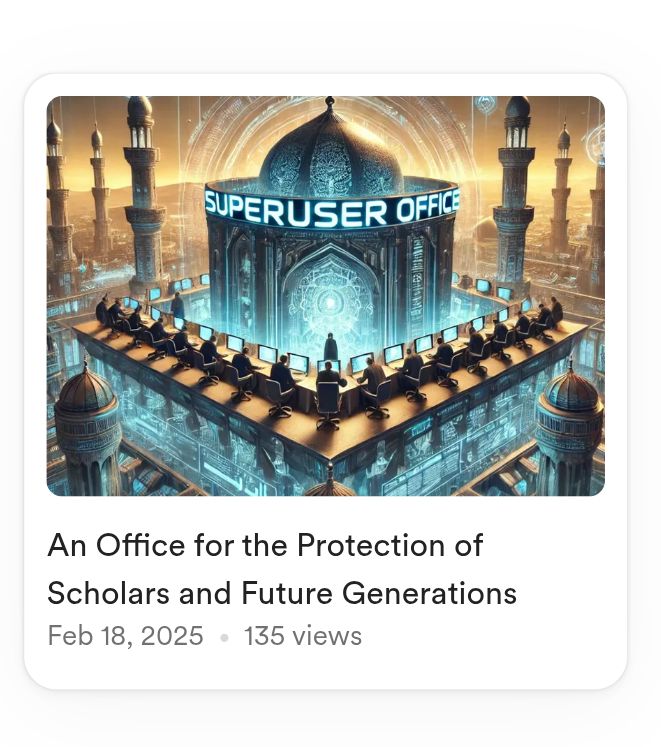
An Office for the Protection of Scholars and Future Generations —
buymeacoffee.com/omar1800m/an-office-protection-scholars-future-generations
You're asking for formatting, not a rewrite. The main change is to make the bolding much denser, especially around thesis statements, warnings, transitions, questions, Qur'anic verses, and conclusions.
:::writing{variant="document" id="73184"}
THE SPACE OF SEPARATION
(Part One — The Foundation)
This office does not belong to Muslim governments.
It does not belong to kings.
It does not belong to presidents.
It does not belong to parties.
It does not belong to intelligence agencies.
It belongs to the space of separation.
The space that Muslim scholars struggled to preserve throughout history.
The space that allowed sacred knowledge to remain independent from political power.
The space that ensured rulers could not simply rewrite religion whenever it became inconvenient.
Many people forget that this separation was not free.
It was purchased through sacrifice.
It was purchased through courage.
It was purchased through scholars who paid a price so that future generations could inherit an authentic religion.
Politics is not new to us as Muslims.
We have seen empires rise.
We have seen empires fall.
We have seen rulers support scholars.
We have seen rulers imprison scholars.
We have seen rulers attempt to control religion for political purposes.
The struggle is as old as Islamic civilization itself.
That is why this office must be understood correctly.
It is not an office of government.
It is an office of protection.
It is an office of preservation.
It is an office that asks a simple question:
Who protects the independence of sacred knowledge when intelligence itself becomes a machine?
(Part Two — The Price)
When people speak about the great Imams, they often remember their books.
They remember their schools.
They remember their rulings.
But they forget the pressure.
They forget the trials.
They forget the cost.
Imam Abu Hanifa — refused to surrender his independence to political authority. He was imprisoned. And by many accounts, he died in prison.
Imam Malik ibn Anas — was beaten. His arm was dislocated. His legal opinions were interpreted as opposition to political interests.
Imam al-Shafi'i — faced accusations and political suspicion during his lifetime. He was forced to navigate between rulers who wanted to use him and enemies who wanted to destroy him.
Imam Ahmad ibn Hanbal — endured the longest trial.
The Mihna.
Imprisonment.
Interrogation.
Flogging.
He stood alone when many others bent.
He refused to say what the rulers wanted him to say about the Qur'an.
Continuous pressure.
Especially with Imam Ahmad.
The religion reached us through scholarship.
But it also reached us through sacrifice.
It reached us through people who refused to bend when bending would have been easier.
It reached us through people who feared Allah more than they feared rulers.
(Part Three — The Warning)
This office does not belong to Muslim governments.
It is the space of separation.
And we build on the sacrifices of the great Imams.
Politics is not new to us as Muslims, but we understand the separation must be made to protect the religion, or we would become like the Vatican.
What the Romans did to the Christians is exactly what was going to happen to us if the Muslim scholars did not go through with this divide, because knowledge is in the hearts of those people who choose to purify themselves.
"Indeed, he has succeeded who purifies himself." (Surah Al-A'la 87:14)
Unfortunately, knowledge is now carried by machines that don't need to purify, so you can see the danger of Muslim countries who are already aligned with certain actors in the Middle East, betraying their Muslim brothers and just causing havoc.
How long do you think that they will create a different religion and issue licenses to scholars who only use AI and suspend the religion in general — or even literally — because they were never about purifying themselves?
Like the Pharaoh was told:
"Do you want to purify yourself?" (Surah An-Nazi'at 79:18)
This message will go on until the Judgment Day.
We can see how people who have power want to betray the religion and just destroy it.
If it wasn't for the people who purified themselves and Allah guided, we would have a very completely destroyed part of the religion.
We can look at the Shia Muslims, and that is certainly a sad case all by itself.
(Part Four — The Thing the Machines Cannot Steal)
Let me tell you what the machines cannot take.
They can take fatwas.
They can take rulings.
They can take translations and tafsirs and hadith databases.
They can memorize the entire Qur'an in a second.
But they cannot take ikhlas — sincerity.
They cannot take khashyah — the fear of Allah that makes a scholar weep before answering a question.
They cannot take tazkiyah — the purification that happens in silence, in darkness, in tears, in years of struggle against the self.
The Romans had power.
The Pharaoh had power.
Every tyrant in every age has had power.
But none of them could manufacture a purified heart.
And that is why they lost.
That is why Abu Hanifa died in prison — but his school filled the earth.
That is why Malik was beaten — but the Muwatta' remains.
That is why Ahmad stood bleeding — but the people carried his flag.
They did not win with machines.
They did not win with armies.
They won because Allah protects what is done for Him alone.
So here is what I say to the rulers who want to license scholars.
So here is what I say to the AI companies who want to train fatwa bots.
So here is what I say to every Muslim country that betrays its brothers for the sake of power:
You can build the most intelligent machine in the world.
But it will never fear Allah.
And on the Day of Judgment — when that machine is silent — the only thing that will speak for us is a heart that was purified.
Not a server.
Not a license.
Not an algorithm.
A heart.
"The Day when neither wealth nor children will benefit — except the one who comes to Allah with a sound heart." (Surah Ash-Shu'ara 26:88–89)
So guard the space of separation.
Not because it is political.
Because it is sacred.
And sacred things cannot be coded.
(Part Five — The Final Witness)
The scholars of the past struggled with rulers.
The scholars of the future may struggle with something entirely different.
Artificial intelligence.
Algorithms.
Digital systems.
Automated authorities.
Knowledge once lived primarily in the hearts of men and women who spent years purifying themselves, disciplining themselves, and submitting themselves to sacred traditions.
Now knowledge is increasingly stored inside machines.
Machines do not fast.
Machines do not pray.
Machines do not purify themselves.
Machines do not fear Allah.
That is why the challenge before us is unprecedented.
Who determines what those machines teach?
Who determines what sources they prioritize?
Who determines which interpretations become dominant?
Who determines what future generations will encounter when they ask religious questions?
These are not technical questions alone.
They are questions of trust.
Questions of authority.
Questions of stewardship.
This message is not merely for our generation.
It is for future generations.
For the children who will grow up speaking to AI before they speak to scholars.
For the students who will search machines before they search libraries.
For the societies that will inherit technologies we can barely imagine.
If the independence of sacred knowledge is not protected, then future generations may inherit systems that possess enormous intelligence but very little wisdom.
The scholars of the past protected the religion from being absorbed entirely by political power.
The challenge of the future may be protecting it from being absorbed entirely by digital power.
This office is not a building.
It is not a bureaucracy.
It is a commitment.
A commitment that says:
No algorithm will silence the voice of sincere scholarship.
No government will control what belongs to Allah.
And no generation will be left alone with machines and no map.
This is the space of separation.
Guard it.
This message will go on until the Judgment Day inshallah but the question is how does the office engage problems an example will be given with Shia Islam which I have already created a super user report which I want scholars to review and look at right now.
How does the Office actually engage with problems?
How does it move beyond speeches?
How does it move beyond theories?
How does it move beyond simply identifying what is broken?
The answer is that the Office exists to create a meeting place between people, scholarship, records, and technology.
For the first time in a long time, we have the ability to build systems that help us revisit the damage done by history.
Damage caused by ignorance.
Damage caused by political interests.
Damage caused by division.
Damage caused by those who knowingly distorted the truth and those who inherited distortions without realizing it.
The purpose of the Office is not to humiliate people.
It is not to erase communities.
It is not to create new divisions.
Its purpose is to create a process by which sincere people can pursue the truth together.
The scholars.
The students.
The custodians of history.
The people.
And the technologies that are now emerging.
All working together to preserve the record, examine the evidence, correct mistakes, and leave behind something better than what we inherited.
The Office is not merely a structure.
It is a method of reconciliation with the record.
A method of asking difficult questions.
A method of preserving evidence.
A method of inviting review.
A method of allowing future generations to see how conclusions were reached.
Most importantly, it is a method that assumes human beings are capable of correction when they sincerely seek the truth.
Those who wish to purify themselves must have a place where truth can be pursued without fear.
Those who wish to preserve the record must have a place where evidence can be examined without political pressure.
Those who wish to heal old wounds must have a place where history can be discussed without hatred.
To illustrate what I mean, I am providing one example.
A Superuser Record concerning Shia Islam and the historical questions surrounding it.
I am not presenting it as a final judgment.
I am presenting it as a record for review.
A record that I invite scholars, historians, students, and sincere seekers of truth to examine, critique, challenge, improve, and correct where necessary.
Because that is how the Office functions.
Not through blind acceptance.
Not through blind rejection.
But through preserving the record and inviting honest review.
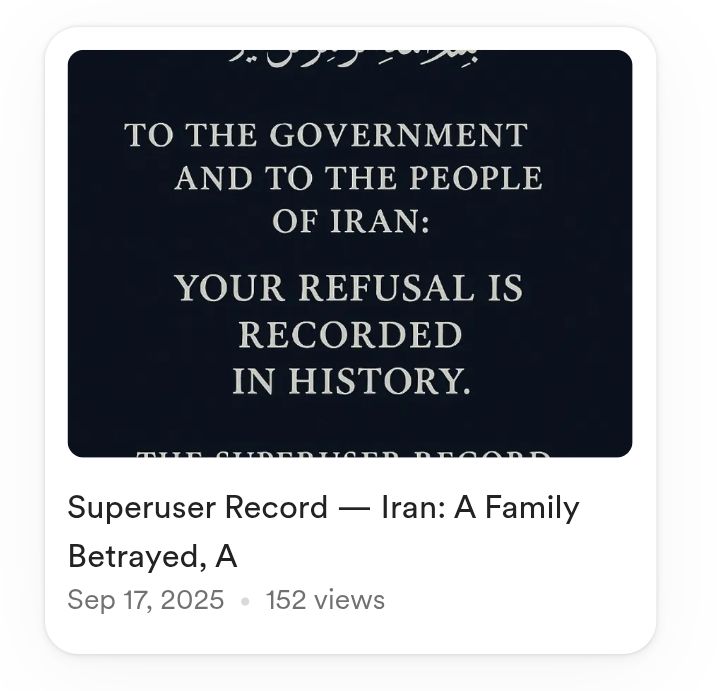
Superuser Record — Iran: A Family Betrayed, A —
buymeacoffee.com/omar1800m/superuser-record-iran-a-family-betrayed-a
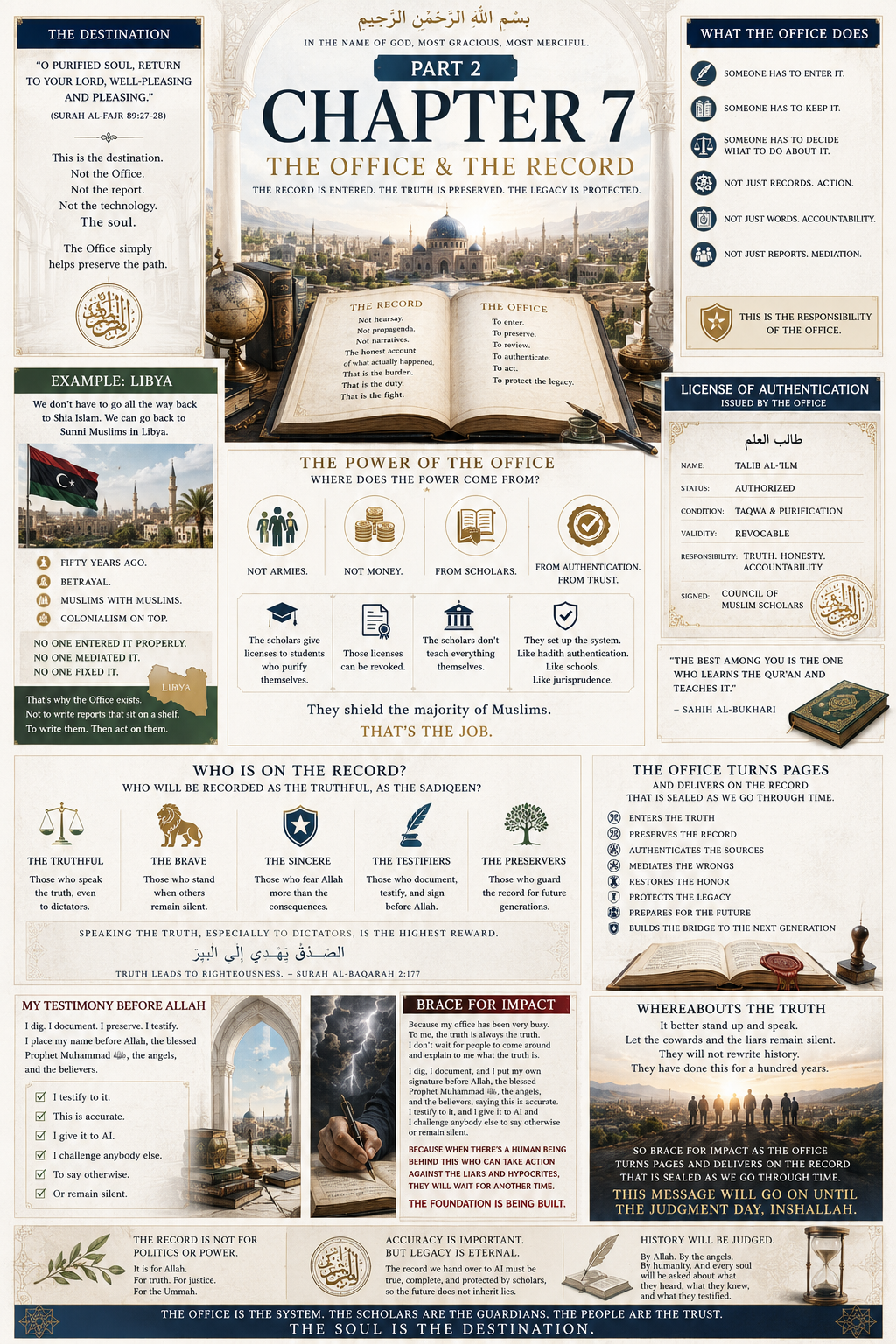
THE OFFICE & THE RECORD
You want to know what the Office does?
Here's the shortest version:
Someone has to enter it.
Someone has to keep it.
Someone has to decide what to do about it.
EXAMPLE: LIBYA
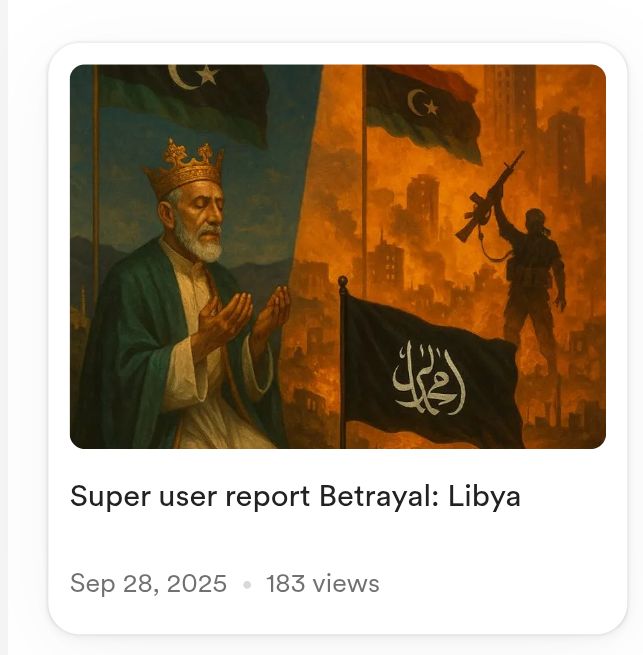
Super user report Betrayal: Libya —
buymeacoffee.com/omar1800m/betrayal-libya
We don't have to go all the way back to the founding of Shia because we can go back to Libya just 50 years ago and the betrayal that happened with Muslims themselves and colonialism someone has to enter something for the record and then office has to reach a decision in terms of how to fix it and mediate that so you can kind of see this power that belongs to the office that has power made by scholars belongs to college and it's only given to students who have purified themselves and their license to work they can be revoked by Muslim scholars so the Muslim scholars they don't need to be the ones who are always transmitting the teachings but they need to be the ones who are setting up the system of authentication in the Hadith program they need to be like the biggie moms who set up the schools and the institutions are dealt with jurisprudence and at the same time are able to shield majority of Muslims because getting to the other side and there's a Quran verse that says oh you purified soul come to your lord well pleasing GPT you know that verse it's in the morning prayer for anyway GPS I've given you enough let's go
We don't even have to go all the way back to Shia Islam.
We can go back to Sunni Muslims in Libya.
I already have a report on that.
A betrayal.
Muslims with Muslims.
Colonialism on top.
Fifty years ago.
Someone has to enter that into the record.
Someone has to preserve it.
Someone has to review it.
And after the record is established, someone has to ask:
What do we do about it?
How do we fix it?
How do we reconcile it?
That is where the Office enters.
Not to write reports that sit on a shelf.
To write them.
To preserve them.
To review them.
And then act upon them.
THE POWER OF THE OFFICE
Where does the power come from?
Not armies.
Not money.
From scholars.
From authentication.
From trust.
The scholars establish the standards.
The scholars establish the authentication.
The scholars establish the system.
Just as the great Imams established schools, jurisprudence, and the sciences of hadith.
They do not need to carry every burden themselves.
They establish the framework.
They establish the guardrails.
They establish the trust.
And those who work within that system remain accountable to it.
THE DESTINATION
There is a verse:
"O reassured soul, return to your Lord, well-pleased and pleasing."
That is the destination.
Not the Office.
Not the report.
Not the technology.
The soul.
The Office simply helps preserve the path.
The scholars protect the path.
The record preserves the evidence.
The Office preserves the process.
And by the permission of Allah, the people continue the journey.
This is the Office. :::
THE END OF PART TWO
I am going to end Part Two here.
Because what comes next is even more difficult.
As Muslims, we are eventually going to have to agree on what transpired in our history.
Not what is convenient.
Not what is politically useful.
Not what protects our pride.
What actually happened.
There are people who want to whitewash everything.
There are people who want to bury everything.
There are people who want to pretend that nothing happened.
And there are people who have chosen comfort over truth.
That is their choice.
But they are not merely setting a trap for themselves.
They are setting a trap for future generations.
Because the record we hand over to AI will become the inheritance of our children.
But accuracy alone is not enough.
Accuracy is not even the most important part.
The most important part is preserving the human beings alongside the record.
The scholars.
The witnesses.
The oral traditions.
The memories.
The institutions.
The conversations.
The living chain that carries meaning from one generation to another.
The future cannot belong only to machines.
It must also belong to people.
It must belong to scholars.
It must belong to an offline office of history.
An office of memory.
An office of testimony.
An office that remembers what the world was before everything became digital.
So the question becomes:
Who is on the record?
Who will be recorded among the truthful?
Who will be recorded among the Sadiqeen?
Because that is among the highest stations.
Not wealth.
Not power.
Not status.
Truthfulness.
And speaking the truth becomes even more important when power wants silence.
When institutions want silence.
When fear wants silence.
When history itself is being rewritten.
My office has been very busy.
And to me, the truth is always the truth.
I do not wait for people to come around and explain to me what the truth is.
I dig.
I document.
I preserve.
I testify.
And then I place my name beside what I have written.
Not because I am infallible.
But because someone must be willing to stand behind the record.
Someone must be willing to sign it.
Someone must be willing to be questioned about it.
Someone must be willing to defend it.
So I place my testimony before Allah.
Before His angels.
Before the believers.
And I say:
This is what I found.
This is what I believe to be true.
This is the record I am handing forward.
And I invite others to examine it.
To challenge it.
To correct it.
To strengthen it.
Because truth does not fear examination.
Truth welcomes examination.
What fears examination are lies.
What fears examination are distortions.
What fears examination are narratives that cannot survive scrutiny.
For too long, history has been written by those who assumed nobody would ever review the record.
Those days are ending.
The foundation is being built.
The record is being preserved.
The pages are turning.
And the Office continues its work.
So prepare yourself.
Brace for impact.
Because Part Three is not about theory.
It is not about possibilities.
It is not about what might happen.
It is about the record itself.
And the record, once entered, has a way of speaking long after the people who wrote it are gone.
Let the truthful speak.
Let the evidence speak.
Let the cowards remain silent if they choose.
But history will not be surrendered.
And the record will not be abandoned.
The pages are turning.
The seal is being placed.
And the Office continues forward.Protection of Scholars and Future Generations alhamdulillah and inshallah I will see you in part 3
Wa ma tawfiqi illa billah.