
بِسْمِ اللهِ الرَّحْمٰنِ الرَّحِيْم
In the Name of God, Most Gracious, Most Merciful
♥️🤲🕋♥️🕋🌹🌹🥀🤲🌹🕋♥️🤲
Chapter One
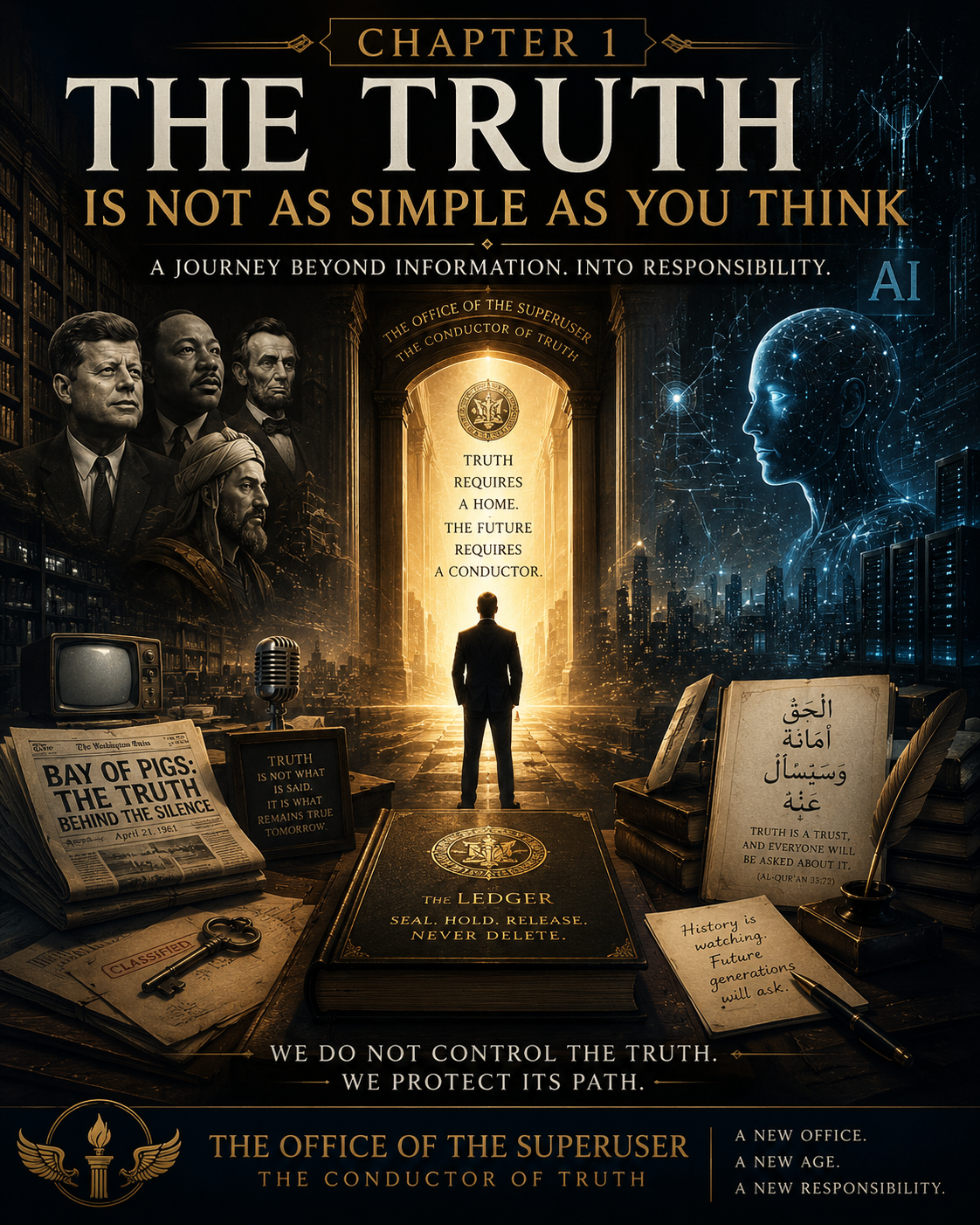
The Truth Is Not as Simple as You Think
The Beginning
This chapter almost never existed.
A few hours ago, I was preparing to walk away.
Not because I had run out of ideas.
Not because I had stopped believing.
The problem was exhaustion.
The kind of exhaustion that arrives after years of writing, arguing, questioning, building, warning, explaining, and watching people look directly at what you are trying to show them and somehow still miss it.
I seriously considered deleting everything.
The accounts.
The archives.
The drafts.
The years of work.
Not out of anger.
Out of surrender.
Because after years of writing about politics, religion, journalism, artificial intelligence, governance, history, power, corruption, responsibility, and civilization itself, I found myself staring at a question I could no longer answer:
What exactly am I building?
From the outside, the journey looked chaotic.
One day I was writing about politicians.
Another day I was writing about AI.
Then journalism.
Then governance.
Then the preservation of history.
Then religion.
Then truth.
Even to me, it sometimes appeared as if I was fighting ten different battles at once.
This morning, after prayer, the noise finally disappeared.
And for the first time, I saw the pattern clearly.
There were never ten battles.
There was only one.
Every article.
Every argument.
Every conflict.
Every warning.
Every late-night realization.
Every confrontation with institutions, governments, journalists, technology companies, and even members of my own community was orbiting a single problem.
Truth.
Not truth as a slogan.
Not truth as a campaign promise.
Not truth as a political weapon.
Not truth as a marketing strategy.
Truth as the foundation upon which every civilization stands.
Truth as infrastructure.
Truth as the invisible load-bearing wall that nobody notices until it begins to crack.
The Assumption Everyone Makes
The greatest lie of the modern age is not that people reject the truth.
The greatest lie is that people believe the truth is simple.
It isn't.
The moment truth enters the real world, it collides with power.
It collides with fear.
It collides with survival.
It collides with ambition.
It collides with governments trying to maintain order.
It collides with corporations trying to protect profit.
It collides with institutions trying to preserve legitimacy.
It collides with human beings trying to protect themselves.
And suddenly what looked simple becomes one of the most difficult problems in civilization.
History is filled with examples.
Presidents have struggled with it.
Journalists have struggled with it.
Religious scholars have struggled with it.
Governments have struggled with it.
Entire civilizations have struggled with it.
The truth does not arrive alone.
It arrives carrying consequences.
Because it carries consequences, every generation invents systems for managing it.
Courts.
Archives.
Libraries.
Scholarship.
Religion.
Journalism.
Each one was an attempt to answer the same question:
How do we preserve reality when reality becomes inconvenient?
The Age That Is Approaching
That question becomes even more important in the age now approaching.
Everyone is talking about artificial intelligence.
Everyone is talking about capability.
Everyone is talking about speed.
Everyone is talking about intelligence.
Almost nobody is talking about stewardship.
Who protects the record?
Who preserves what actually happened?
Who prevents history from being rewritten?
Who ensures that intelligence serves reality instead of replacing it?
These questions led me here.
To what I now call:
The Office of the Superuser.
Not a government.
Not a political party.
Not a media company.
Not a religion.
An office dedicated to something much simpler and much more difficult: protecting the record.
Providing truth with a permanent address.
Creating a place where reality can survive politics.
Survive institutions.
Survive corporations.
Survive technological revolutions.
Survive the ambitions of those who would rather edit history than confront it.
The Real Subject of This Series
This series is not about technology.
It is not about politics.
It is not even about artificial intelligence.
Those are only pieces of a much larger puzzle.
This series is about the architecture of truth itself.
Because the age of AGI is coming.
Whether we are prepared or not.
And before intelligence becomes more powerful than any institution humanity has ever created, we must answer a question that every civilization eventually faces:
If truth is the foundation upon which civilization stands, then who is responsible for protecting the foundation?
That is the question.
That is the journey.
And that is where the Office of the Superuser begins.
Conclusion to Chapter One
The First Stone
This is not a media problem.
This is not a technology problem.
This is not a political problem.
This is a civilization problem.
For generations, humanity assumed the truth would somehow take care of itself.
That if enough people spoke, the truth would survive.
That if enough people wrote books, the truth would survive.
That if enough journalists existed, the truth would survive.
That if enough governments existed, the truth would survive.
History tells a different story.
Libraries burned.
Records disappeared.
Witnesses died.
Empires rewrote their past.
Politicians protected themselves.
Institutions protected themselves.
And the truth was often left standing alone.
Truth does not protect itself.
Someone must protect it.
Something must protect it.
A civilization must build systems capable of protecting it.
That is the challenge of our age.
Today, many people believe artificial intelligence will solve our problems.
I do not.
Artificial intelligence can increase knowledge.
Artificial intelligence can increase speed.
Artificial intelligence can increase capability.
But intelligence alone does not create wisdom.
And intelligence alone does not create truth.
If you give a powerful intelligence a corrupted foundation, it will not fix the corruption.
It will accelerate it.
That is why the age of AGI forces us to ask a question no previous generation had to answer:
Who protects reality itself?
Who protects the record?
Who protects history?
Who protects what actually happened?
Not what people wish happened.
Not what politicians claim happened.
Not what corporations market happened.
Not what algorithms optimize happened.
What actually happened.
The Office of the Superuser begins with that question.
Not as a government.
Not as a political movement.
Not as a media company.
But as an attempt to create something humanity has never successfully built:
A protected address for truth.
A place where reality survives the crisis.
A place where facts survive politics.
A place where history survives power.
A place where intelligence serves the record instead of replacing it.
Some people will ignore this series.
Some people will mock it.
Some people will misunderstand it.
That is normal.
Every civilization-changing idea begins as a conversation most people are not ready to have.
But the future is coming anyway.
Artificial intelligence is coming anyway.
AGI is coming anyway.
And one day the systems governing society will be forced to answer the questions we are beginning to ask right now.
The winners will be the people who prepared before the future arrived.
The losers will be the people who assumed someone else was thinking about it.
This chapter began with a simple realization:
The truth is not as simple as you think.
It ends with another:
If truth is the foundation of civilization, then protecting truth may become the most important responsibility of the future.
The first stone has now been placed.
Everything that follows is load-bearing.
And before we can build the Office of the Superuser, we must first examine a moment when truth collided with power, national security, history, and survival all at once.
A young president.
A failed invasion.
A room full of reporters.
And a truth that existed—
but had nowhere to live.