
بِسْمِ اللهِ الرَّحْمٰنِ الرَّحِيْم
In the Name of God, Most Gracious, Most Merciful
♥️🤲🕋♥️🕋🌹🌹🥀🤲🌹🕋♥️🤲
THE MATHEMATICS OF REVELATION
CHAPTER NINE — THE HOUSE OF FRACTIONS: A MASTERCLASS
بِسْمِ اللهِ الرَّحْمٰنِ الرَّحِيْم
Welcome to class.
Today we are going to learn fractions.
But here is the catch: we are going to learn them the way the companions learned them.
No Arabic numerals. No calculators. No paper ledgers.
Just the human hand, the human mind, and the mathematics of Revelation.
PART ONE — WHAT THEY DID NOT HAVE
Before we begin, we need to understand one thing clearly: the companions did not have the luxury of the numerals or the Arabic numbers the way we write them today.
The numerals we use now — 1, 2, 3, 4, 5, 6, 7, 8, 9, 0 — did not exist in 7th-century Arabia. They had not yet arrived.
When did they arrive?
The system of numeration employed throughout the greater part of the world today was originally developed in India. But because it was the Arabs who later transmitted this system to the West, the numerals it uses have come to be called "Arabic numerals."
The first historical sign that these Indian numerals were moving west comes from 662 CE, when the Nestorian bishop Severus Sebokht wrote of "their valuable methods of calculation which surpass description" and noted that "this computation is done by means of nine signs." By 776 CE, an Indian scholar presented himself before Caliph al-Mansur in Baghdad with a treatise on astronomy using this Indian numerical system.
The great scholar who formalized and spread this system was Al-Khwarizmi, working at the House of Wisdom (Bayt al-Ḥikmah) in Baghdad around 825 CE. He wrote On the Calculation with Hindu Numerals, introducing the system to the Islamic world and, later, via Latin translations, to Europe.
That is two centuries after the lifetime of the Prophet ﷺ.
The Companions Did Not Have:
• A symbol for zero (0)
• A symbol for digits (1 through 9)
• A place-value written system
• Paper ledgers with columns of written numbers
What did they have?
They had their hands.
They had their fingers.
They had their finger joints.
They had biometric computation.
PART TWO — WHAT THEY HAD: ḤISĀB AL-ʿUQŪD
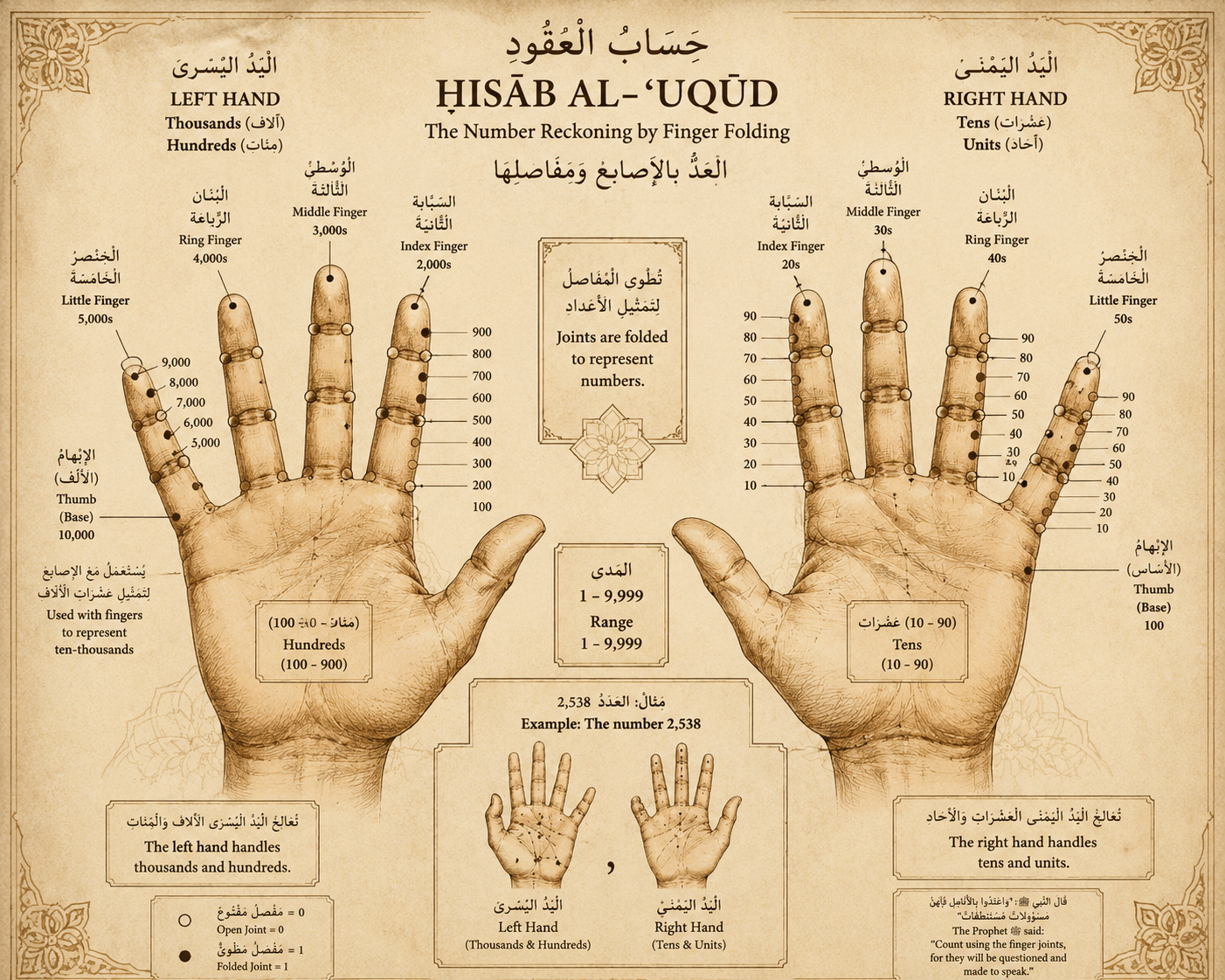
The system the companions used was called Ḥisāb al-ʿUqūd — "Number Reckoning by Finger Folding."
It was not a simple child's method of counting on fingers.
It was a highly sophisticated computational interface that could represent numbers from 1 up to 9,999 on just two hands.
Calculations were performed entirely in the mind, and intermediate results were stored physically by positioning the fingers in precise, stylized ways.
How It Worked
The system assigned specific positions of the fingers, knuckles, and joints to specific number places.
The right hand handled units and tens; the left hand handled hundreds and thousands.
By bending specific joints, placing the thumb against different nodes of the palm, or curling fingers into distinct angles, a person could instantly display and lock a value into their hand ledger.
The Prophetic Instruction
The Prophet ﷺ explicitly commanded his companions to utilize this physical computing hardware:
"واعقدن بالأنامل فإنَّهنَّ مسئولاتٌ مستنطقاتٌ"
"Count using the finger joints (al-anāmil), for they will be questioned and made to speak."
This was not just a vague spiritual encouragement; it was a technical instruction for a specific method of calculation.
Historians of mathematics note that this statement is one of the earliest recorded references to using the hands to systematically compute natural numbers, tracing right back to the early 600s.
The Cultural Context
The system was so deeply embedded in society that classical literature and poetry used these hand configurations metaphorically:
• A miser was described as having a hand that made "ninety-three" — a completely closed, tight fist, the universal sign of avarice.
• The physical gesture for fifty was used by poets to describe the sharp, curved profile of the beak of a goshawk.
• Special technical slang existed for specific numbers: Kas' for 29, Dabth for 63, and Daff for 99.
The famous polymath Al-Jahiz (d. 868 CE) explicitly advised schoolmasters to teach finger reckoning over written Indian numerals because he considered it a primary method of human expression.
Years later, the state scribe As-Suli (d. 946 CE) recorded that professional accountants still preferred finger reckoning because:
"...it required neither materials nor an instrument, apart from a limb. Furthermore, it ensured secrecy and was thus in keeping with the dignity of the scribe's profession."
The Status of the Two Systems
In the early Islamic centuries, finger reckoning held massive professional prestige.
It was the system of choice for the business community — merchants, tax collectors, and jurists.
The written Indian system was initially seen as an unrefined academic novelty that required a clumsy "dust board" to scratch out calculations, which was viewed as far less dignified than clean mental arithmetic executed on the hand.
PART THREE — HOW THEY DID FRACTIONS
Now let us return to fractions.
Imagine you are a companion in 7th-century Medina.
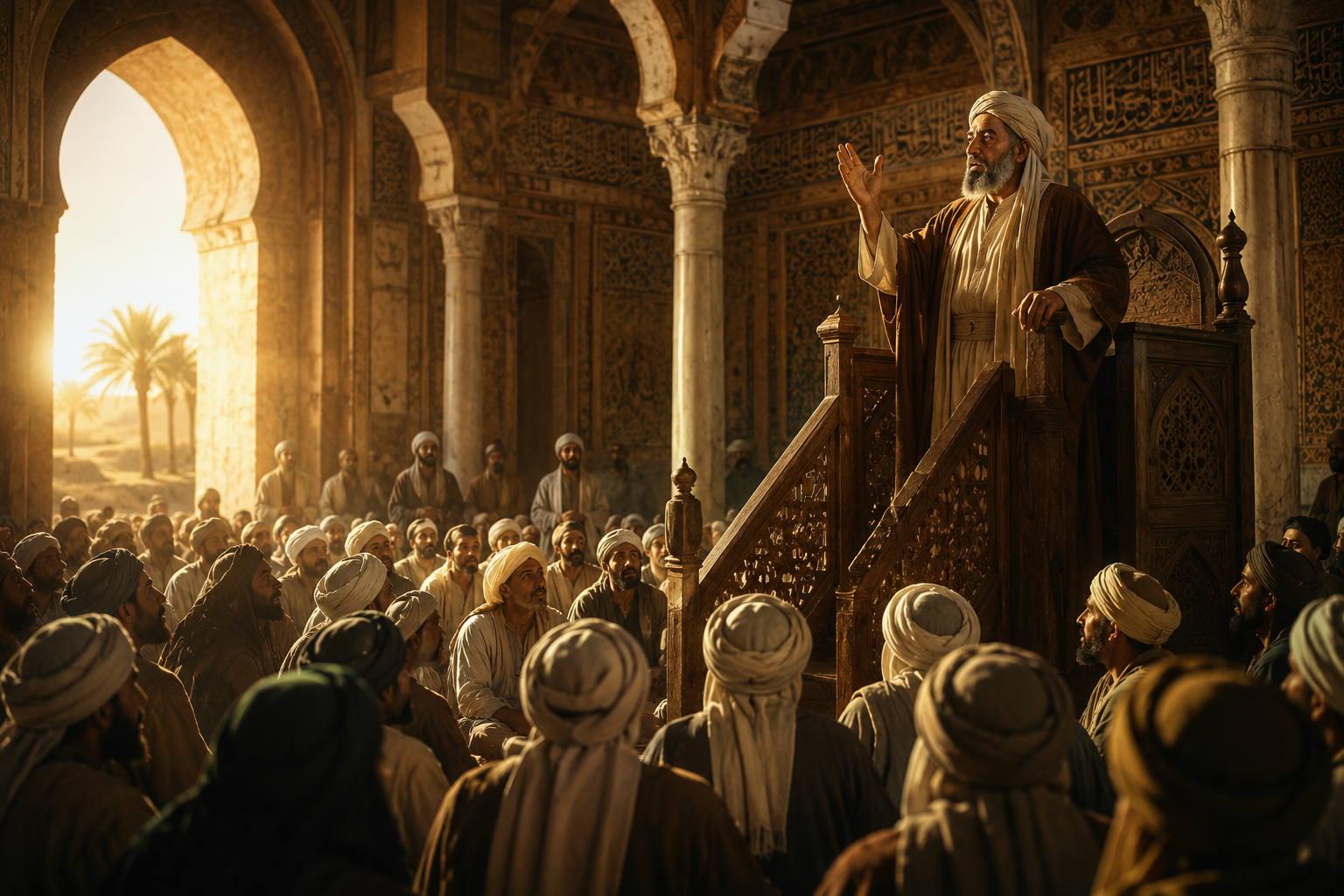
You are sitting in the Prophet's Mosque when the fourth Caliph, Ali ibn Abi Talib, is interrupted while speaking from the pulpit.
Someone asks him about a complex inheritance dispute.
Ali answers instantly:
"The wife's eighth has become a ninth."
To understand how his mind processed that, you have to realize how they managed fractions without written math notation.
The System of "Principal Fractions"
In 7th-century Arabia, fractional arithmetic was handled using a dedicated series of principal fractions:
½, ⅓, ¼, ⅕, ⅙, ⅐, ⅛, ⅑, ⅒
These were the unique fractions that possessed their own distinct, single-word names in the Arabic language (An-Nisf, Ath-Thuluth, Ar-Rubu', etc.).
This linguistic system was an ancient Near Eastern commercial heritage, providing the same base logic that ancient Egyptian scribes used to build their unit fraction systems millennia prior.
"Fractions of Fractions" (Compound Fractions)
More complex, un-named fractions had to be built verbally as combinations of these principal fractions.
For example, instead of writing an abstract symbol, they would say:
"The third of an estate, and the fourth of the third of that estate"
— which is the verbal algorithm for ⅓ + (¼ × ⅓) = 5/12.
This exact method matches the computational style found in Old Babylonian clay tablets and the ancient Egyptian Rhind Papyrus.
It was perfectly optimized for a merchant community that spoke its data aloud.
How the Companions Processed Fractions
1. Words: They used fixed, hardcoded linguistic terms built into the Arabic vocabulary.
2. The Principal Series: They broke down complex parts into these standard, named baseline fractions.
3. Compound Structuring: They stacked phrases ("a third of a third") to state complex proportions.
4. The Hand Interface: They used their knuckles to store, add, and hold intermediate numbers while calculating the common base.
PART FOUR — THE PULPIT CASE: THE HAND IN ACTION
Let us walk through the historic Pulpit Case (Al-Mas'ala al-Minbariyya) exactly as a companion would have solved it using the hardware of the time.
The Reality Check
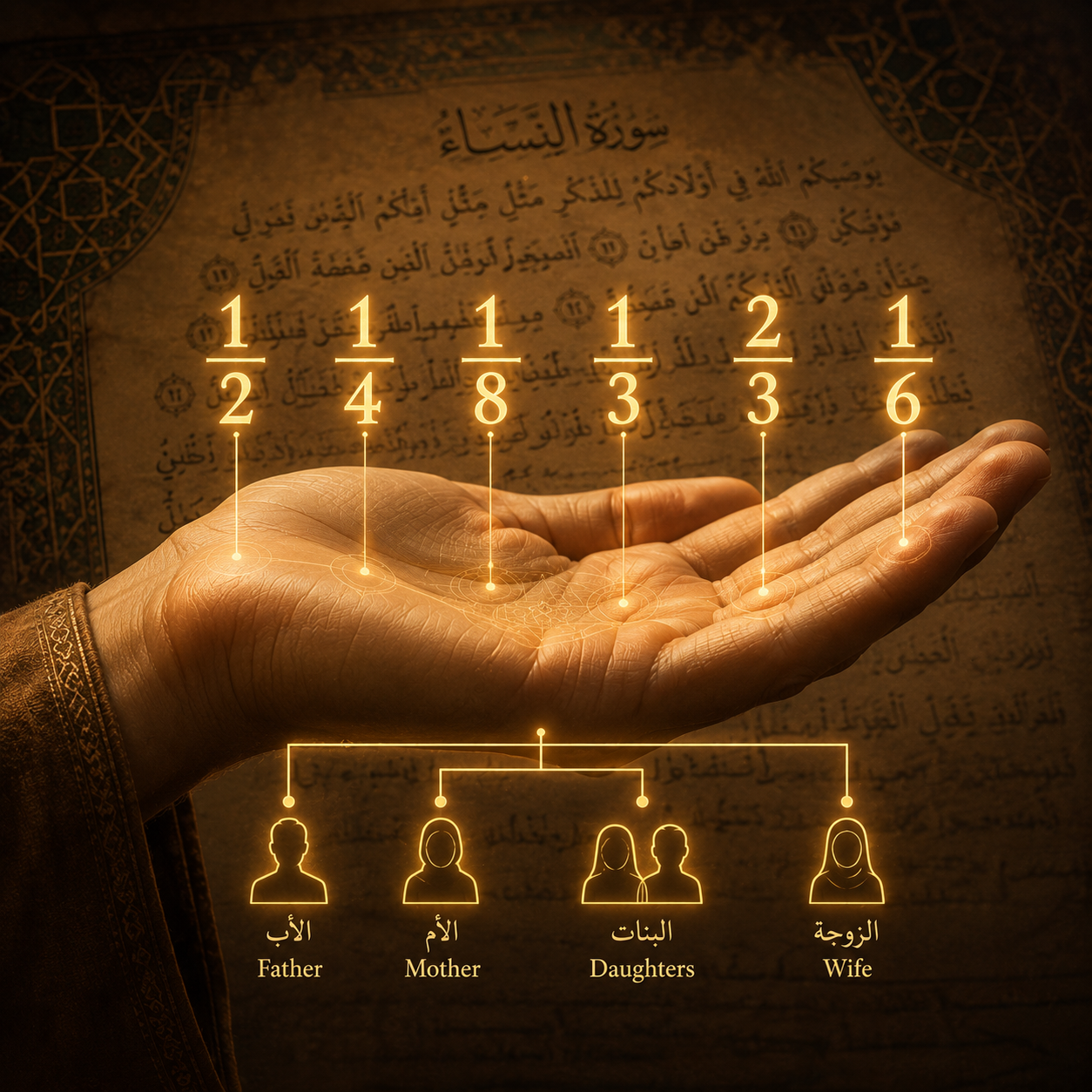
• A man dies leaving a Wife, Two Daughters, and both Parents (Mother and Father).
The Revealed Constraints
• Two daughters: ⅔
• Both parents: ⅙ + ⅙ = ⅓
• Wife: ⅛
The Mental Calculation Steps
1. Find the Common Base
The mind scans the principal denominators (3, 6, 8) and identifies 24 as the lowest common base number.
2. Map the Portions onto the Knuckles
• Two daughters get ⅔ of 24 = 16 portions.
• Both parents get ⅓ of 24 = 8 portions.
• The wife gets ⅛ of 24 = 3 portions.
3. Sum the Portions Intellectually
The accountant adds the numbers held in memory:
16 + 8 + 3 = 27
4. Identify the System Overflow
The total claimed portions (27) exceed the available base units (24).
The fraction is:
27/24
which is greater than 1.
5. Execute the Al-ʿAwl Patch
Instead of cutting someone out arbitrarily, the base is expanded from 24 to 27.
The original portion counts are preserved, but they are measured against the new total.
6. Read the Final Ledger Entry
The wife still holds her 3 assigned portions, but her share is now:
3 out of 27
The Famous Result
"The wife's eighth has mathematically transformed into a ninth."
Every single step was completed verbally and mentally, using the hand to temporarily park the values.
This doctrine of ʿAwl (Proportional Reduction), applicable in cases where legal claims exceed the estate, is identical to the modern mathematical Proportional Rule.
PART FIVE — THE CHALLENGE: CAN YOU DO THIS?
Now here is the question.
Can you do what Ali did?
Can you hold four overlapping fractions in your mind, see that they sum past one, and rescale them on the spot?
Try it.
Take out your hands.
Look at your fingers.
This is what the companions had.
This is what they used.
They did not have numerals.
They did not have calculators.
They did not have paper.
They had their hands.
They had their minds.
They had the mathematics of Revelation.
And they solved the problem.
If you can calculate inheritance with your fingers, find common denominators, apply ʿAwl, and lock the numbers into your hands — then you are doing what the companions did.
If you cannot do it, do not feel bad.
The companions were not ordinary people.
They were trained by the Prophet ﷺ himself.
They were taught by Revelation.
They were prepared for this.
But here is the point:
The Qur'an created a mathematical architecture that the companions had to build computational tools to solve.
PART SIX — WHAT ELSE THEY COULD DO
Let us see what else they could compute using this exact same hand ledger.
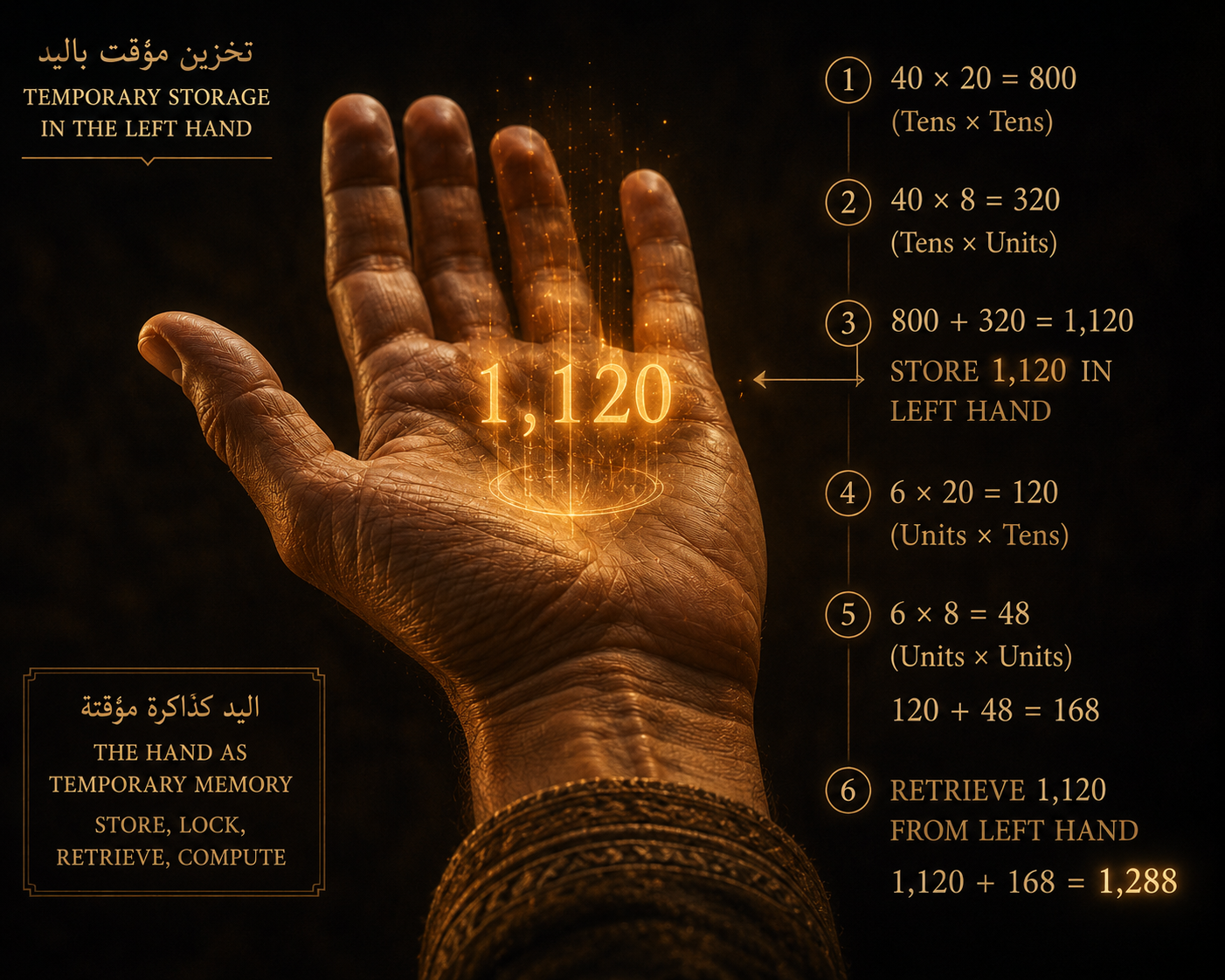
1. Cross-Multiplication (Example: 46 × 28)
The method, later recorded by the master mathematician Abū'l-Wafā' in the 10th century CE, breaks the numbers down into distinct calculation layers, using the fingers as an immediate cache.
Step 1
Multiply the tens:
40 × 20 = 800
Step 2
Multiply the first cross-term:
40 × 8 = 320
Step 3
Sum them mentally:
800 + 320 = 1120
Lock 1,120 into the left hand.
Step 4
Compute the remaining terms:
6 × 20 = 120
6 × 8 = 48
Step 5
Sum the remaining terms mentally:
120 + 48 = 168
Step 6
Retrieve the cached 1,120 from the fingers.
Add 168.
Final Total
1,288
2. The Babylonian "Squaring" Identity
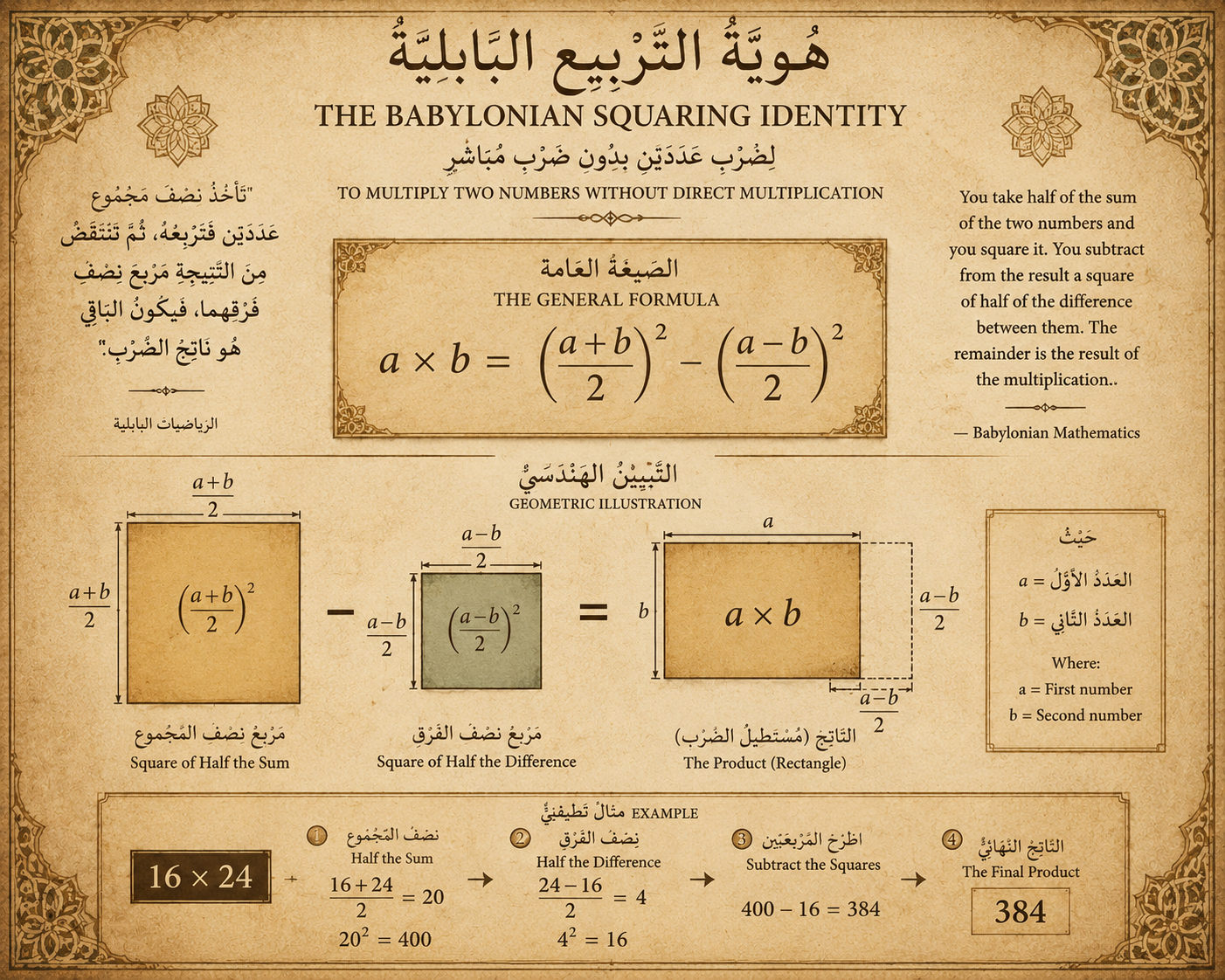
To completely bypass complex mental multiplication, they used an ancient geometric shortcut built into the language of arithmetic:
"You take half of the sum of the two numbers and you square it. You subtract from the result a square of half of the difference between them. The remainder is the result of the multiplication."
Let's Run the Algorithm for 16 × 24
1. Sum the numbers
16 + 24 = 40
2. Find half the sum
20
3. Square it
20 × 20 = 400
(Hold 400 in the biometric memory.)
4. Find the difference
24 − 16 = 8
5. Find half the difference
4
6. Square it
4 × 4 = 16
7. Subtract the squares
Pull the cached 400 from your fingers and subtract 16:
400 − 16 = 384
Result
This is advanced, lightning-fast algebraic computing executed without a single scratch of ink or a single written digit.
PART SEVEN — THE CONCLUSION: THE GIFT OF BAGHDAD

You have seen what the companions did.
You have tried to do it yourself.
You have seen how hard it was.
But you do not have to do it that way anymore.
Two centuries after the Prophet ﷺ, the House of Wisdom in Baghdad gave the world something extraordinary:
Al-Khwarizmi and the Systematization of the Hindu-Arabic Numerals
Al-Khwarizmi wrote On the Calculation with Hindu Numerals, introducing the Indian system to the Islamic world and, later, to Europe.
He wrote Kitab al-Jabr wa-l-Muqabala — "The Compendious Book on Calculation by Completion and Balancing" — which gave the world the word algebra and the method of solving equations.
His Purpose
In the introduction to his work, he explicitly declares his intent in very practical terms:
"A short work on Calculating by (the rules of) Completion and Reduction confining it to what is easiest and most useful in arithmetic, such as men constantly require in cases of inheritance, legacies, partition, law-suits, and trade..."
Why Al-Khwarizmi Was Different
Al-Khwarizmi's algebra was fundamentally different from what came before.
He was the first to treat algebra as an independent discipline, introducing the methods of:
• Reduction (al-jabr)
• Balancing (al-muqabala)
Unlike the work of Diophantus, which was concerned with difficult problems in indeterminate analysis, Al-Khwarizmi's work was a straightforward, elementary exposition of solving equations — especially quadratic equations — that was accessible to ordinary people dealing with inheritance and trade.
A Famous Example
His method of solving the classic quadratic equation:
x² + 10x = 39
was purely verbal, with no symbols:
"What must be the square which, when increased by ten of its own roots, amounts to 39? The solution is this: You halve the number of roots, which in the present instance yields five. This you multiply by itself; the product is 25. Add this to 39; the sum is 64. Now take the root of this which is eight, and subtract from it half the number of the roots, which is five; the remainder is three. This is the root of the square which you sought for."
He Made It Easy
But would the companions have been able to do the math without the numerals?
Yes. They did.
Would they have been able to do it as fast as we can with numerals?
No.
They did not have them.
But they did not need them.
They had Revelation.
They had the Prophet ﷺ.
They had the hand as a computational device.
They had the mind as a processor.
And they had the unwavering obligation to be just.
That was enough.
PART EIGHT — THE PATTERN: CIVILIZATIONAL INFRASTRUCTURE
Let us step back and look at the total system design.
Mathematics is never an afterthought in the Islamic worldview; it is the core engine of its implementation.
Divine Command Mathematical Requirement Resulting Infrastructure Time is fixed Twelve months, strict lunar mapping The Universal Islamic Calendar Wealth is purified Fixed step-functions: 2.5%, 5%, 10% Systematic Institutional Zakat Wealth is distributed Strict fractions: ½, ¼, ⅛, ⅓, ⅔, ⅙ Automated Anti-Monopoly Inheritance Law Justice is measured Common denominators, proportional scaling (ʿAwl) The Birth of Algebra
The pattern is complete and absolute:
1. Time must be measured so the calendar cannot be corrupted by rulers.
2. Wealth must be purified so charity cannot be treated as an optional luxury.
3. Wealth must be distributed so families cannot build dynastic monopolies.
4. Justice must be calculated so equality leaves the realm of slogans and enters reality.
PART NINE — THE CONCLUSION: FROM FRACTIONS TO CIVILIZATION
We have traced the trail from Revelation to obligation.
From obligation to time.
From time to wealth.
From wealth to fractions.
From fractions to the hand.
From the hand to the pulpit of Ali.
From the pulpit to the House of Wisdom.
From the House of Wisdom to algebra.
From algebra to the numerals and symbols we use today.
The Qur'an did not merely teach Muslims how to pray. It taught them how to measure.
It taught them how to count their days.
It taught them how to measure their wealth.
It taught them how to divide their estates.
It taught them how to record their debts.
It taught them how to track their worship.
It taught them how to live inside precision.
And when they began to manipulate time, or hide their wealth, or dispute their inheritance, Revelation descended to correct them — not with philosophy, but with numbers. With fractions. With mathematics.
Fractions became the language of justice.
The hand became the instrument.
And Baghdad made it easy.
But the companions did not need it to be easy.
They needed it to be just.
And it was.
THE ROAD AHEAD — CHAPTER TEN
We have mastered the mathematics of the family estate.
We have seen how fixed denominators shield individual relatives from tribal exploitation and greed.
Now, we lift our eyes to the macro-economic horizon.
How does a state build a public treasury capable of scaling this precision across millions of citizens without falling into imperial corruption?