

بِسْمِ اللهِ الرَّحْمٰنِ الرَّحِيْم
Bismillah ar-Rahman ar-Rahim
In the Name of God, Most Gracious, Most Merciful 🕋
Chapter Four — The Cultural Revolution: Rewriting the Somali Soul
When the soldiers put down their guns and picked up the paintbrushes, Somalia entered a new battlefield — not of weapons, but of words, symbols, and songs.
The revolution that began in the barracks now moved into classrooms, theaters, and the very language of the people. The aim was no longer just to control the land, but to reprogram the mind.
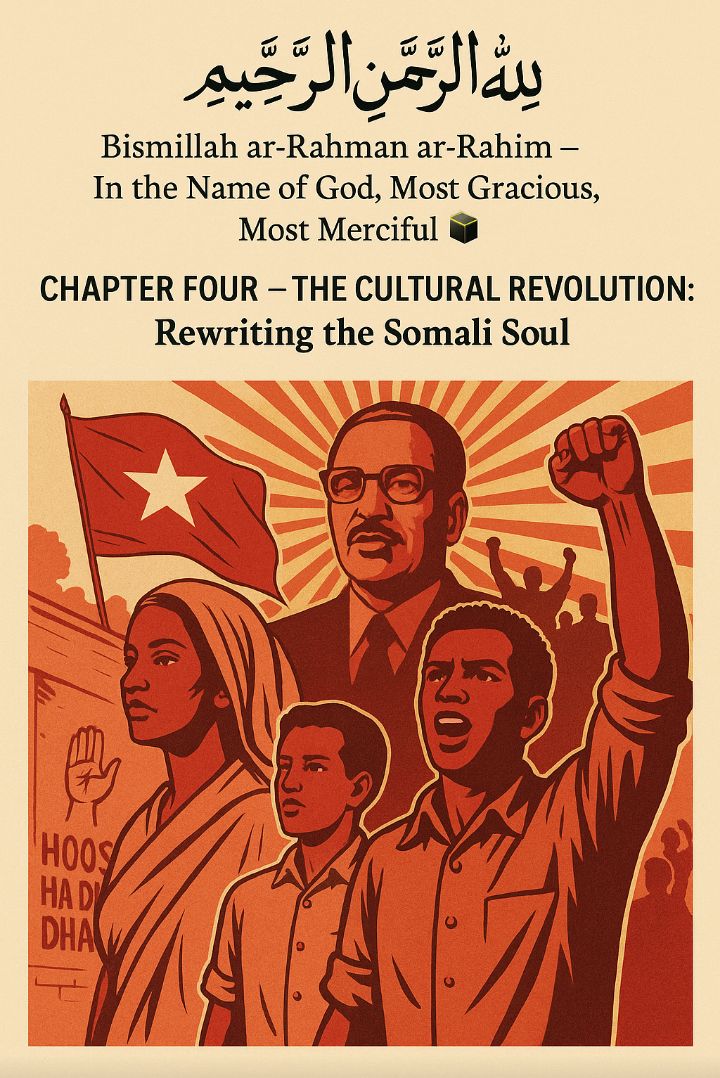
“Down with Tribalism!” — The Cultural Purge
The streets of Mogadishu filled with slogans:
“Hoos ha dhaco qabyaaladda!” — Down with Tribalism!
“Guulwade Siyaad!” — Victory to Siad!
The government declared war on clan identity, calling it the disease that had divided the nation. Every radio broadcast, every mural, every play, and every school assembly carried the same message — Somalia must think as one people.
Poets became political soldiers. Musicians became messengers. The Ministry of Information flooded the airwaves with patriotic songs that praised equality, unity, and hard work.
On public walls, artists painted Siad Barre’s portrait rising above the desert sun — the Guulwade (Victorious Leader) smiling like a father watching over his children.
The revolution had found its rhythm. And that rhythm beat inside every home, every school, and every heart.
But this cultural transformation came with a cost.
The same murals that inspired hope also erased individuality.
The same songs that united people also silenced dissent.
Patriotism and propaganda became indistinguishable — and love for the nation became love for the man who ruled it.
The Power of Language — Writing a Nation into Existence
In 1972, Barre made one of the boldest moves in Somali history:
he adopted a Latin-based Somali script, making the Somali language official for the first time.
Until then, Somali had never been written in one common form. The introduction of the Latin script transformed everything — schools, newspapers, government offices, and daily life.
It gave Somalia a written identity, a way to preserve poetry, laws, and knowledge in its own tongue.
Then came the National Literacy Campaign (1973–1975).
Tens of thousands of students, soldiers, and teachers fanned out across the countryside with chalkboards and notebooks, teaching nomads to read and write under the open sky.
UNESCO called it one of the most successful literacy movements in Africa.
For a moment, the dream was alive — a nation that could finally read its own story.
But even this campaign was deeply political.
Each lesson included revolutionary slogans, every textbook bore the symbols of the Supreme Revolutionary Council. Education became not only enlightenment but indoctrination — where loyalty was learned alongside literacy.
Still, history must be fair: the literacy campaign was a triumph of will.
It gave millions of Somalis the ability to read, to think, and to dream — even if the state tried to guide what they dreamed about.
Women Rise — The Family Revolution of 1975
In 1975, Barre announced Family Law No. 23, one of the most radical reforms in the Muslim world at the time.
It declared men and women equal before the law.
Women could now inherit equally, work freely, and participate fully in political life.
The government launched massive campaigns to showcase Somali women as doctors, teachers, pilots, and soldiers. Posters showed confident women in uniform, the “Dhalinyaro Socialist” — the socialist youth — marching side by side with men.
The reform transformed cities. In Mogadishu, women filled universities and public offices. Rural women joined literacy teams, teaching other women to read under the banner of the revolution.
But not everyone celebrated. Religious leaders condemned the Family Law, saying it violated Islamic inheritance principles. Mosques whispered defiance, and some clerics were jailed for their sermons.
For Barre, this was a test of authority. He had declared that Islam and socialism were compatible — but when the scholars disagreed, he silenced them.
The law remained. The debate did not.
Somalia had entered a new era: women were free by law, but only as long as they served the revolution.
The Spirit of the Age
Between 1970 and 1976, Somalia became a nation of slogans, students, and songs.
Factories hummed, schools multiplied, and the countryside glowed with chalkboards. The nation marched in rhythm, saluted in unison, and chanted with conviction.
It was, in many ways, Somalia’s Golden Age of Imagination — when everything felt possible, and unity felt within reach.
But behind the harmony, power was tightening its grip.
The same literacy that educated millions also taught them to fear criticism.
The same equality that elevated women also erased dissenting voices.
The revolution was no longer a movement.
It was a mood.
And that mood belonged to one man.
🇸🇴 Barre’s Soviet Turn — A Clear Lesson for Somalis
Goal: Explain how foreign ideology (Soviet-style socialism) was introduced, how it interacted with Somali religion and culture, what it delivered (benefits) and what it cost (freedom, spiritual life, social institutions). Equip students/citizens to judge the past and defend the future.
historical truth-statement (for the public)
Mohamed Siad Barre used the language of Islam and the programs of Soviet socialism together. He brought in Soviet aid, training, and propaganda. Those tools built roads, jets, and literacy — but they also centralized power, weakened independent religious life (especially Sufi scholarship), and replaced public choice with party command. Many Somalis praise the material gains without knowing the cost: an ideologically driven state that repressed dissent, co-opted mosques, and turned religion into a political tool.
Balanced quick list — What he did (good) and what he destroyed (cost)
What he delivered (visible gains):
Massive literacy campaign and adoption of a single Somali script (Latin, 1972).
Infrastructure: roads, ports, some industry, Soviet technical assistance and military equipment.
Legal reforms that expanded women’s rights on paper (Family Law 1975) and increased female participation in public life.
(These are real and important.)
What he imposed (the hidden cost):
Imported Soviet political models: centralized one-party rule, political policing, and propaganda.
Co-option and surveillance of religious institutions — suppression of independent Sufi orders and clerics who resisted state control.
Repression, human rights abuses, and later mass violence (esp. in the north, 1988).
Creation of a personality cult; elimination of political pluralism and civic space.
3) Classroom / Video Analysis Exercise (use with a propaganda clip)
Watch "Somalia Soviet propaganda" on YouTube
🇸🇴 Conclusion: What Communism Did to Somalia
When Siad Barre took power, most Somalis only wanted peace, food, and a strong country. They didn’t know much about Communism or what it meant. He told them it was “Scientific Socialism” and said it would make Somalia strong and fair. At first, many believed him.
1. What Communism Means
Communism is when the government controls most things — land, schools, factories, and even what people can say. It promises equality, but usually gives too much power to one group or one person. In Communism, religion is often pushed aside because the state wants people to obey leaders, not God.
2. What Barre Did
Barre learned about Communism in the Soviet Union. When he returned, he changed Somalia step by step:
He took ideas from the Soviets and made them Somali.
He used Islam’s words, but not its spirit.
He made people believe they were building a great nation, while he made himself king in all but name.
Somalis saw new roads, schools, and hospitals. That was good. But behind the good things, the government took away freedom. People couldn’t speak against him. Many religious leaders — especially Sufi scholars — were arrested, tortured, or killed because they refused to let the government control their faith.
3. Why It Worked for a While
Communism often works in the beginning because it brings order. The Soviets sent help — food, teachers, money, even airplanes. Life looked better for a few years. But soon, people learned the price:
You had to praise the leader.
You couldn’t criticize the state.
You had to hide your real thoughts.
That’s not strength — that’s fear.
4. What We Should Learn
If you had lived in that time, you might have supported Barre too. That’s not shameful — people were innocent and wanted progress. But today, we know better. We know what Communism is and how it goes against Islam and freedom.
So, to those who still celebrate Barre, here’s what you must think about:
Would you give up your religion for a job?
Would you trade your freedom for a new school?
Would you follow a man who used the Qur’an’s words to build his own throne?
If the answer is no, then you understand why Communism failed Somalia. It promised paradise but gave pain. It replaced Allah’s guidance with man’s control.
5. The Real Lesson
Somalia’s dream was stolen by a clever man with strong words and foreign ideas. The country lost its balance — it gained buildings but lost its soul.
It’s better to be poor and free than rich and controlled.
It’s better to live with faith than to live under fear.
So remember:
Communism builds with stone but destroys with spirit.
Never again should a leader use foreign ideas to replace faith, truth, and the people’s voice.
“Dear Somalis — this is what happened: a general returned with Soviet training and tools. He used those tools to build roads and schools — real things you can point to. At the same time he rewired power so that no independent voice could challenge him — not scholars, not poets, not judges. He mixed the language of faith into state messaging so devout people trusted the state’s moral claims. That mixture was the trap. Know your history, and remember: material progress that comes with political chains is not true freedom.”
5) Discussion Q&A (students should be able to answer these)
Q — Was communism/“scientific socialism” imposed on Somalia?
A — It was promoted and institutionalized by the SRC. The state adopted Soviet-style planning, nationalization, and one-party structures. It was blended with Islamic language to increase acceptance.
Q — Did Barre destroy Islam?
A — He did not “destroy Islam” in people’s hearts, but he attacked independent religious institutions and co-opted religious language for political ends. Sufi scholars were marginalized, imprisoned, or silenced when they resisted state control.
Q — Why did many Somalis still praise him?
A — Because of visible improvements (literacy, roads, services) and because propaganda made the state’s narrative dominant; many people prioritized stability and material improvement in a fragile region.
Q — Is Al-Shabaab the same as Barre’s Soviet project?
A — No — different ideologies and goals — but the mechanism is similar: an external or imported ideology uses propaganda, recruits, and violence to reshape local society. Both show why guarding cultural and religious independence matters.
Q — What protects a nation from such ideological takeover?
A — Strong institutions (independent judiciary, free press), civic education, religious scholarship that resists politicization, transparent intelligence and oversight, and a populace trained in critical thinking.
“We honor the schools and roads — but we must name the price: freedom.”
“If progress silences your scholars, it is not progress — it is occupation by ideas.”
“Study the full record: benefit + cost. Build the future, but keep truth.”
Final Reflection — Truth Before Power
Every nation must face its own reflection. Somalia cannot rise again until it looks honestly at what happened — not with anger, but with clarity. A people who do not know their history walk in circles, repeating the same mistakes under new names.
There was a time when our flag waved over a hopeful republic, and there was a time when it was taken over by men who spoke of progress while replacing the Qur’an with foreign theories. They built roads, yes — but they tore down the spirit. They gave speeches about unity, yet divided hearts. They called it science, but it was faith in man instead of faith in Allah.
That is the lesson: when you remove Allah from leadership, the system may stand, but the soul collapses.
To the Somali People
You are a people of faith, of poetry, of memory. You are not a nation of machines. Your greatness was never measured by how many buildings you had, but by how strong your hearts were. Those who praise the past without understanding it are not honoring Somalia — they are betraying it.
If someone wants to lead, let them first study.
Let them learn what Barre did, what Communism means, how ideology can wear the clothes of religion and still be false. Let them prove they know their country’s wounds before claiming to heal them. Leadership without knowledge is blindness. And blindness is not leadership — it is a return to ruin.
The Choice
So now we stand at a crossroad between two paths.
One path follows the light of Islam — justice, mercy, truth, and humility before Allah.
The other follows pride, ideology, and the illusion of man’s perfection.
History already showed us what happens when we choose the second path. Somalia’s strength does not come from the East or the West; it comes from the heart of Islam, from the Book that never lies and a God who never changes.
A Prayer for the Nation
May Allah teach our leaders to fear Him before they fear losing power.
May He awaken our scholars to speak truth even when it is dangerous.
May He protect our youth from false ideas that wear holy words.
And may He grant this nation the courage to say: Never again will we build without Allah at the center.
Because no matter how high a man builds,
if he builds without truth — the wind will take it all.
Coming Next — The Rise and the Fall
Prepare yourself, because the next chapter is where dreams turn into fire.
You will witness how one man’s vision of unity became a war that burned across the Horn of Africa.
From the creation of the Somali Revolutionary Socialist Party — where power dressed itself in politics — to the Ogaden War, where ambition met betrayal, Somalia stepped onto the world stage and faced the superpowers head-on.
The story ahead is not just about battles and borders — it’s about pride, betrayal, and the price of chasing greatness without guidance.
Next: The One-Party State and the War That Changed Everything.