
بِسْمِ اللهِ الرَّحْمٰنِ الرَّحِيْم
In the name of God most gracious most merciful.
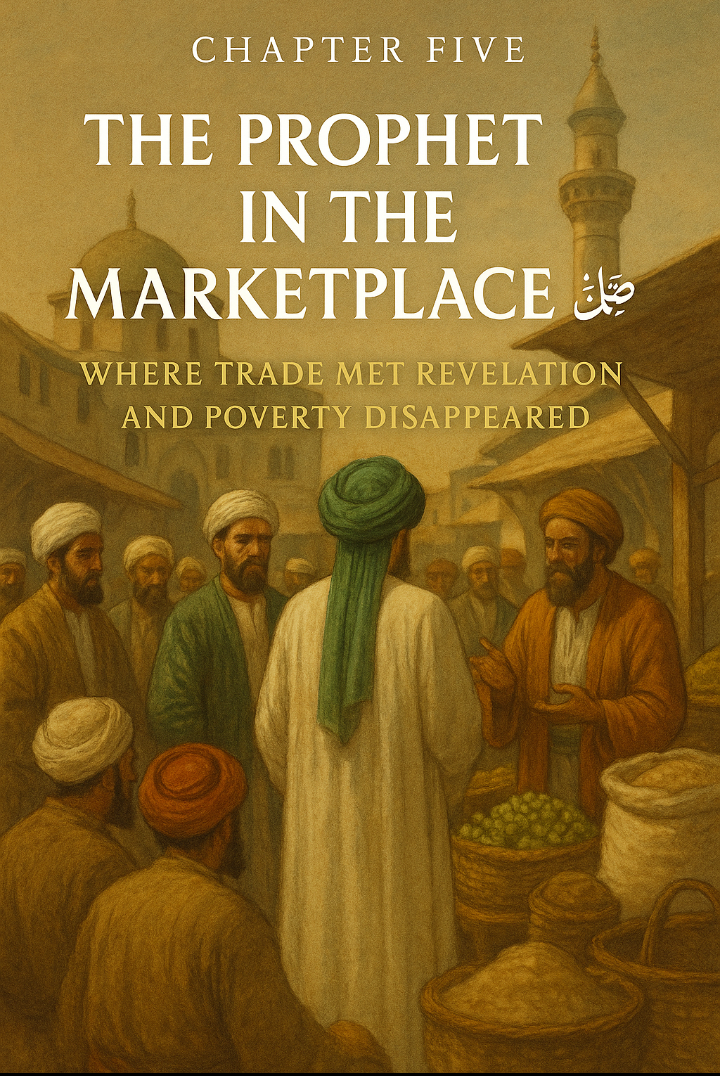
📖 Chapter Five: The Prophet in the Marketplace ﷺ
Where Trade Met Revelation and Poverty Disappeared
If you want to build a just economy,
don’t look to Wall Street.
Don’t look to Silicon Valley.
Look to Medina.There walked a man ﷺ who changed the marketplace forever —
Not with contracts, but with character.
Not with speed, but with truth.
Not with taxes, but with mercy.And under his leadership, the market flourished.
Not just in wealth — but in ethics, fairness, and dignity.This chapter returns us to the source — to show that Islam didn’t tolerate trade. It perfected it.
The Market Was Not Outside the Mosque
When the Prophet Muhammad ﷺ arrived in Medina,
he didn’t isolate religion from the economy.
He didn’t create two systems — one for the soul, one for the shop.
He showed that trade was worship.
That honesty in business was a form of jihad.
That a truthful trader would be raised with the prophets and the righteous.
And so, the market was not a place of sin — it was a space of sanctity.
The Prophet ﷺ didn’t avoid it — he supervised it.
He Walked the Market Himself ﷺ
The Prophet ﷺ walked among traders.
He inspected goods.
He corrected weights.
He rebuked deception.
And he ensured no one was being cheated or oppressed.
One day, he put his hand inside a pile of wheat and found it wet underneath.
He said to the seller:
"Why did you not put the wet part on top so people could see it?"
And then he declared:
"Whoever cheats is not from us." (Sahih Muslim)
These were not empty words.
They were enforcement.
The Prophet ﷺ didn’t just preach economic ethics — he implemented them in real time.
Riba Was Not Regulated — It Was Erased
In the marketplace of the Prophet ﷺ:
Riba (usury/interest) was not taxed. It was forbidden.
Gharar (excessive uncertainty/speculation) was not tolerated. It was canceled.
Maysir (gambling) was not restricted. It was obliterated.
You could not profit by exploiting someone’s ignorance, delay, or desperation.
You could not structure a contract to trap someone in debt.
You could not inflate value with hype, nor hide defects in the product.
Trade had to be:
Real
Transparent
Mutually beneficial
God-conscious
The Role of the Muhtasib: Market Justice Officer
The Prophet ﷺ later appointed muhtasibs — moral regulators whose job was to:
Ensure scales and measures were honest
Prevent price manipulation and hoarding
Stop monopolies and protect the poor
Penalize false advertising and economic deceit
Unlike today’s financial regulators, they didn’t work for a central bank.
They worked for Allah.
They didn’t fine companies to protect investors —
They intervened to protect the public, the widow, the orphan, and the struggling seller.
Zakat Over Taxation
The Prophet ﷺ’s system didn’t need taxes on productivity.
There was no income tax, no labor tax, no VAT.
Instead, there was Zakat:
A sacred wealth purification
Charged on stored capital, not earned wages
Flowing directly to the poor, debtors, travelers, and those in need
In this system:
The rich didn’t evade the poor
They were obligated to uplift them
Islam didn’t see the poor as a burden —
It saw their dignity as a test for the rich.
What Happened in Medina? Poverty Disappeared.
Under this prophetic economic order, something astonishing happened:
Poverty disappeared.
In the time of Caliph ‘Umar ibn ‘Abd al-‘Aziz, the treasuries had to search for people eligible to receive charity — and could not find any.
Why?
Because the system was just.
Because the market was ethical.
Because the leadership feared Allah and refused to profit from oppression.
Modern Economists Still Haven’t Caught Up
Today, experts write books on how to reduce inequality.
They calculate tax rates, simulate universal basic income,
and try to balance austerity with stimulus.
But 1,400 years ago, the Prophet ﷺ solved the problem with:
Truthfulness in trade
Prohibition of exploitation
Mandatory redistribution (Zakat)
Daily market supervision
What modern economics still theorizes — Islam already realized.
Reflection: The Marketplace as a Place of Light
The Prophet ﷺ taught that:
"The truthful and trustworthy merchant will be with the prophets, the truthful, and the martyrs on the Day of Judgment."
(Tirmidhi)
He didn’t say:
The fastest trader
The richest investor
The most successful speculator
He said the truthful one.
Because in Islam, your success in trade is not measured by profit — it is measured by piety.
Conclusion: The Model Exists — We Just Abandoned It
Islam didn’t come to punish the market.
It came to protect it.
To guard it from greed, from fraud, from oppression.
We don’t need to invent a new moral economy from scratch.
We only need to restore what was already perfected.
And now, in the age of AI, we have the opportunity to program this ethics into code.
To bring back mercy, fairness, and restraint — not just into our hearts, but into our algorithms.
The next chapter will explain how this can be done.
📘 Chapter Six: The Role of the Muhtasib — Accountability in Trade