

بِسْمِ اللهِ الرَّحْمٰنِ الرَّحِيْم
In the Name of God, Most Gracious, Most Merciful
♥️🤲🕋♥️🕋🌹🌹🥀🤲🌹🕋♥️🤲
THE MATHEMATICS OF REVELATION==
PROPHET MUHAMMAD ﷺ, THE MATH TEACHER
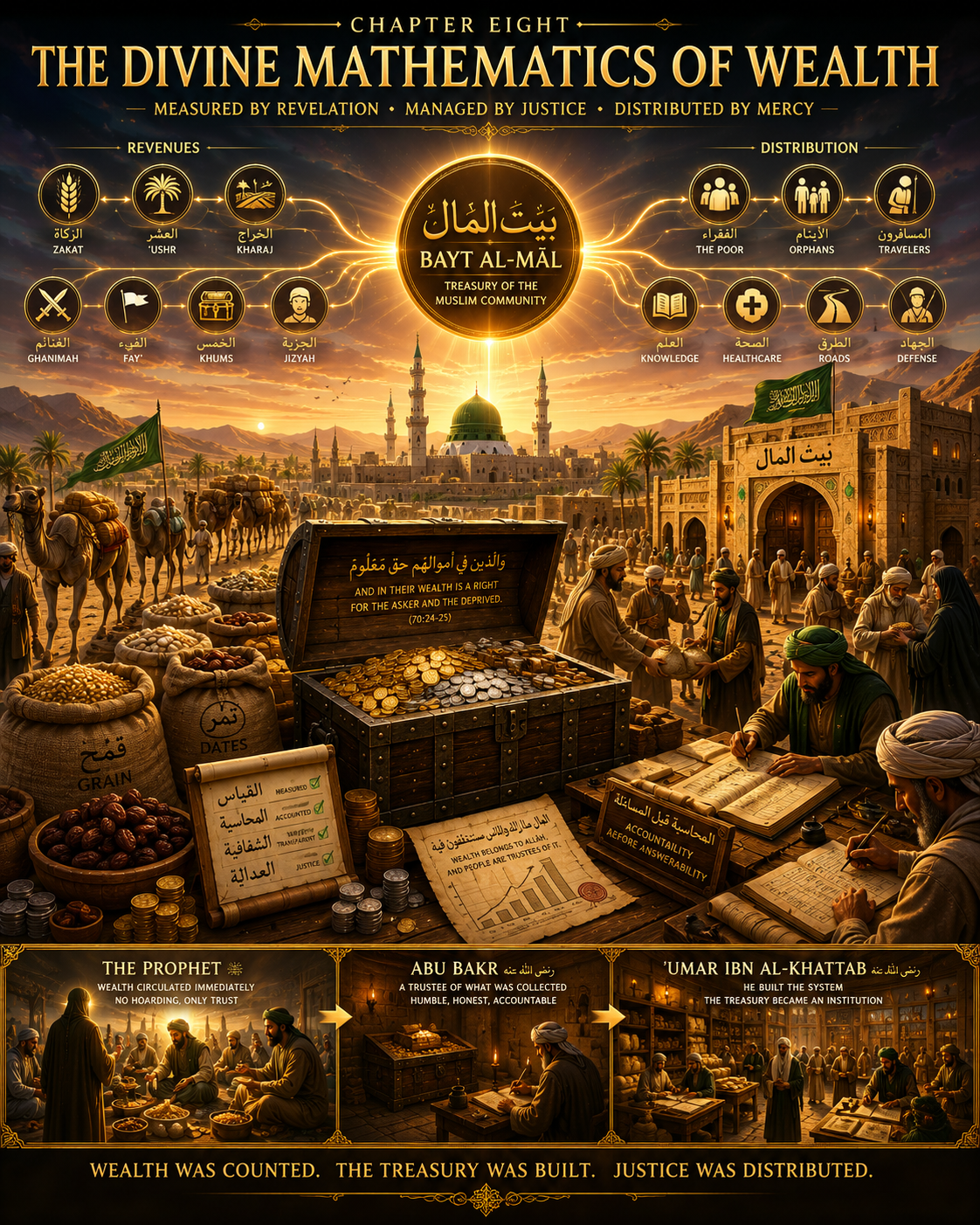
==CHAPTER EIGHT — THE DIVINE MATHEMATICS OF WEALTH==
بِسْمِ اللهِ الرَّحْمٰنِ الرَّحِيْم
The hand has counted. The measurements have been verified. The marketplace has been opened.
Now a new question emerges.
What happens after wealth is measured? Who receives it? Who is protected? Who is forgotten? Who is responsible?
Remarkably, Islam did not leave these questions to chance. It did not leave them to the generosity of rulers. It did not leave them to the mood of the wealthy.
Just as the calendar was fixed. Just as measurements were fixed. Just as verification was fixed.
==The circulation of wealth was fixed.==
==I. THE LOGICAL PATTERNING OF TAXES VS. THE CALENDAR==
When the Prophet ﷺ migrated to Madinah, he inherited a system where the calendar was a political instrument. The Arabs manipulated the sacred months through nasīʾ—postponing, shifting, and altering the boundaries established by God to accommodate military campaigns, tribal rivalries, and commercial interests. Time itself had become a commodity.
The Qur'an abolished this. The number of months was fixed at twelve. The sacred boundaries were restored.
But this created a practical problem that required mathematical thinking.
The Agricultural Challenge
The lunar calendar is 354 days. The solar year is 365 days. Agricultural cycles—planting, irrigation, harvest—follow the sun, not the moon.
How did the early community reconcile a shifting 12-month lunar calendar with fixed solar and seasonal harvest cycles?
==The solution was architectural. Tax collection dates were not fixed to the lunar calendar. They were fixed to harvest cycles—the actual appearance of the crop.==
Classical jurists documented this system meticulously:
· Al-Mawardi (d. 1058 CE) in Al-Ahkam al-Sultaniyya detailed how agricultural taxes (kharaj and 'ushr) were collected at harvest time, not at a fixed calendar date.
· Ibn Khaldun (d. 1406 CE) in Al-Muqaddimah observed that the Islamic state separated 'ibadat (worship-based obligations like zakat) from 'urf (customary agricultural taxes), allowing the latter to follow the actual seasonal rhythms of each region .
· Al-Baladhuri (d. 892 CE) in Futuh al-Buldan recorded how Caliph 'Umar standardized the kharaj system after an extensive survey of lands, considering all irrigation methods and advantages to the land.
==The system was mathematically conditional: tax was triggered by the harvest event, not by a fixed date on the calendar. This is a conditional function: if harvest occurs, then tax is due.==
==II. AGRICULTURAL & LAND EQUATIONS (ḤISĀB AL-WUSŪQ & AL-KHARAJ)==
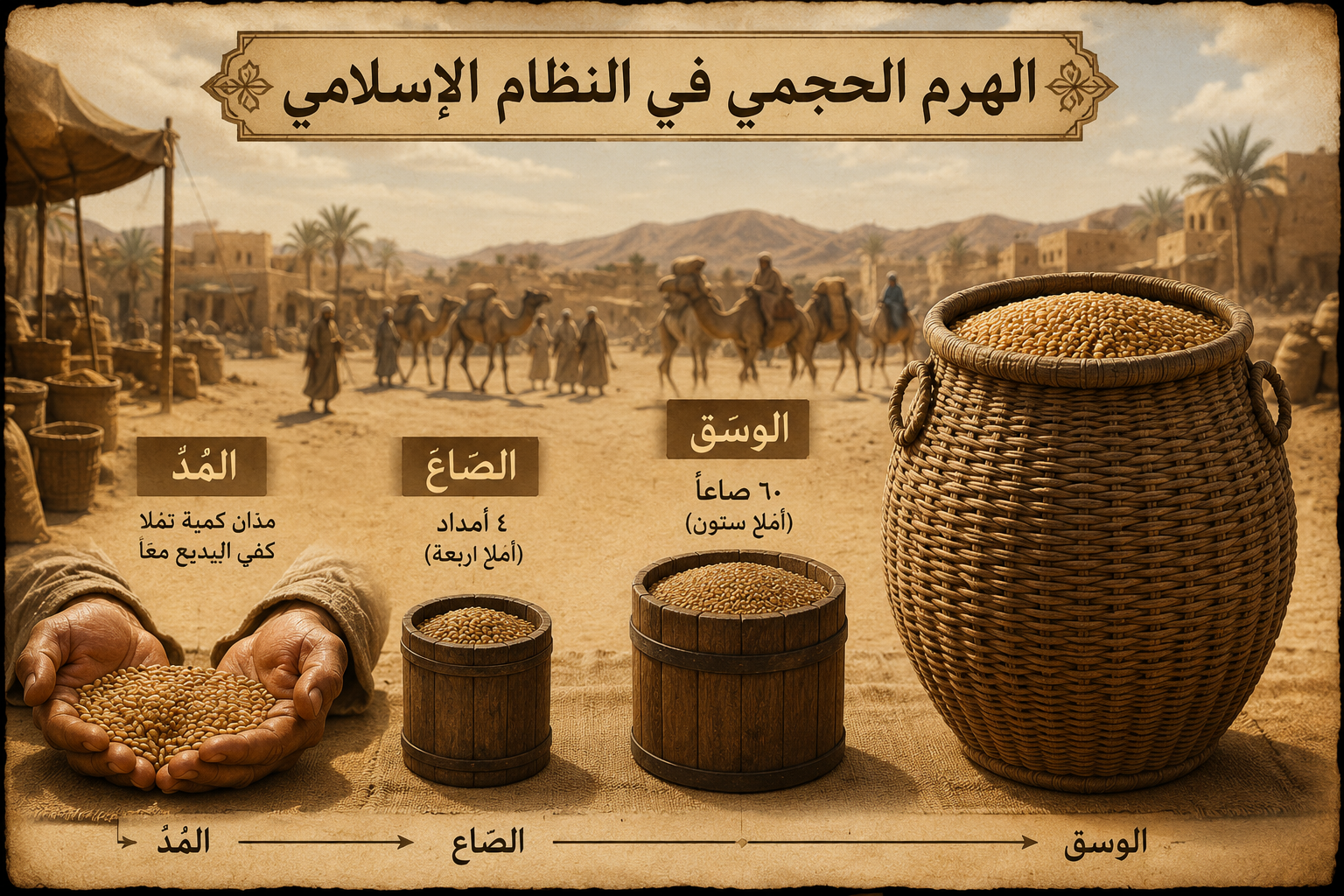
The Volumetric Conversion: 1 Wasaq = 60 Ṣāʿ = 240 Mudds
The classical Islamic system of measurement was precise, standardized, and reproducible. The foundational unit was the Mudd—the volume of two cupped hands . From there, the system scaled:
┌─────────────────────────────────────────────────────────────┐
│            THE VOLUMETRIC HIERARCHY                        │
├─────────────────────────────────────────────────────────────┤
│                                                             │
│   1 Mudd = Two cupped hands (biological unit)              │
│                                                             │
│   1 Ṣāʿ  = 4 Mudds                                         │
│                                                             │
│   1 Wasaq = 60 Ṣāʿ = 240 Mudds                             │
│                                                             │
│   The Wasaq is the threshold for agricultural zakat        │
│                                                             │
└─────────────────────────────────────────────────────────────┘
Modern Metric Equivalent:
The Hanafi school's calculation based on the Iraqi ratl provides the most detailed conversion:
Unit Hanafi Weight Modern Equivalent
Dirham — 3.125 grams
Mann (260 dirhams) 260 dirhams 812.5 grams
Mudd (2 Iraqi ratls) 4 × 812.5 grams = 3,250 grams 3.25 kg
Ṣāʿ (4 Mudds) 13,000 grams 13.0 kg
Wasaq (60 Ṣāʿ) 780,000 grams 780 kg
==For the Wasaq, the conversion is precise: 1 Wasaq = 60 Ṣāʿ ≈ 780 kilograms of dates or barley, depending on density.==
The Algorithmic Step-Functions of 'Ushr
The tax rate for agricultural produce was not arbitrary. It followed a conditional step-function based on the method of irrigation:
┌─────────────────────────────────────────────────────────────┐
│               THE 'USHR ALGORITHM                           │
├─────────────────────────────────────────────────────────────┤
│                                                             │
│   Input: Total Harvest in Wasaq                            │
│                                                             │
│   Check: How was the land irrigated?                       │
│                                                             │
│   ┌─────────────────────────────────────────────────┐      │
│   │                                                 │      │
│   │   Rain-fed (natural irrigation)   → 10% (1/10) │      │
│   │   Artificial irrigation           →  5% (1/20) │      │
│   │   Half rain, half well            →  7.5%      │      │
│   │                                                 │      │
│   └─────────────────────────────────────────────────┘      │
│                                                             │
│   Output: Zakat Due = Harvest × Rate                       │
│                                                             │
└─────────────────────────────────────────────────────────────┘
Why the Difference?
The logic is economic: rain-fed land requires less human investment and capital, while artificially irrigated land demands labor, equipment, and ongoing expense. The tax rate adjusts accordingly.
Al-Khars: Estimation Before Harvest to Prevent
Fraud
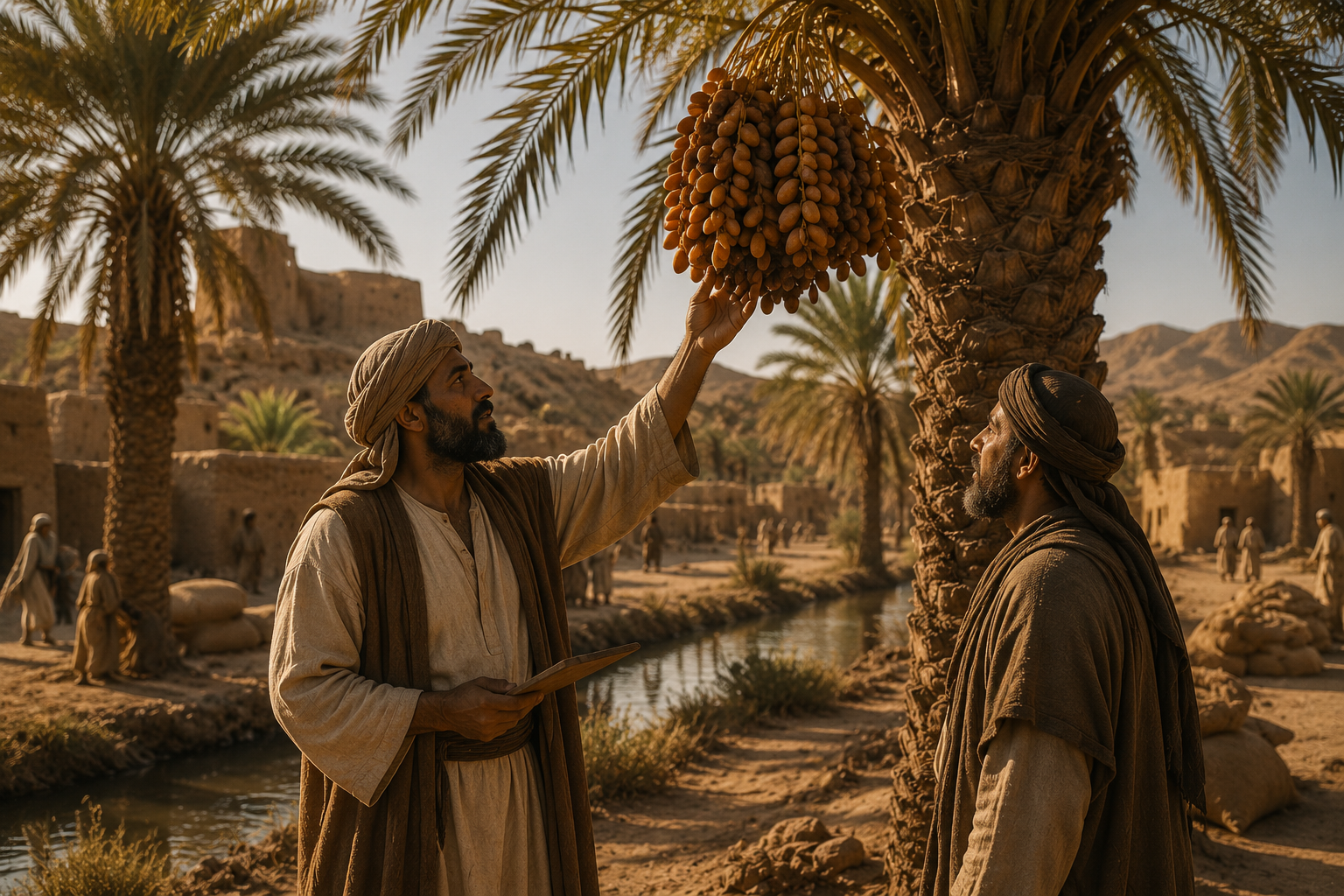
One of the most sophisticated mechanisms in early Islamic taxation was al-Khars—the estimation of harvest yields while the fruit was still on the trees.
The Prophet ﷺ institutionalized this through Abdullah ibn Rawahah:
=="كَانَ النَّبِيُّ صَلَّى اللَّهُ عَلَيْهِ وَسَلَّمَ يَبْعَثُ عَبْدَ اللَّهِ بْنَ رَوَاحَةَ فَيَخْرُصُ النَّخْلَ حِينَ يَطِيبُ قَبْلَ أَنْ يُؤْكَلَ مِنْهُ..."==
=="The Prophet ﷺ used to send Abdullah ibn Rawahah, and he would assess the amount of dates when they began to ripen before they were eaten (by the Jews)..."==
Why This Matters:
==Estimation prevented fraud. The taxpayer could not hide produce because the assessment was made before the fruit was picked and consumed. The collector did not guess; he used experience, observation, and standardized methods.==
Ibn Rawahah's method was so trusted that even the Jews of Khaybar accepted it, saying, =="This is true, and on this (equity) stand the heavens and the earth."==
The Historical Precedent:
When the Prophet conquered Khaybar, he left the land in the hands of its Jewish owners on condition that the produce be divided equally: half for the Muslims, half for the Jews . Abdullah ibn Rawahah was sent to estimate the yield before harvest:
=="He would say: 'In these palm-trees there is such-and-such amount (of produce).' They would say: 'You assessed more to us, Ibn Rawahah (than the real amount).' He would say: 'I first take the responsibility of assessing the fruits of the palm-trees and give you half of (the amount) I said.' They would say: 'This is true, and on this (equity) stand the heavens and the earth.'"==
==The transparency of the method—the assessor taking responsibility for his estimate—prevented disputes and fraud.==
==III. LIVESTOCK MATRIX ARCHITECTURE (ZAKAT AL-AN'AM)==
The Conditional Logic of Livestock Taxation
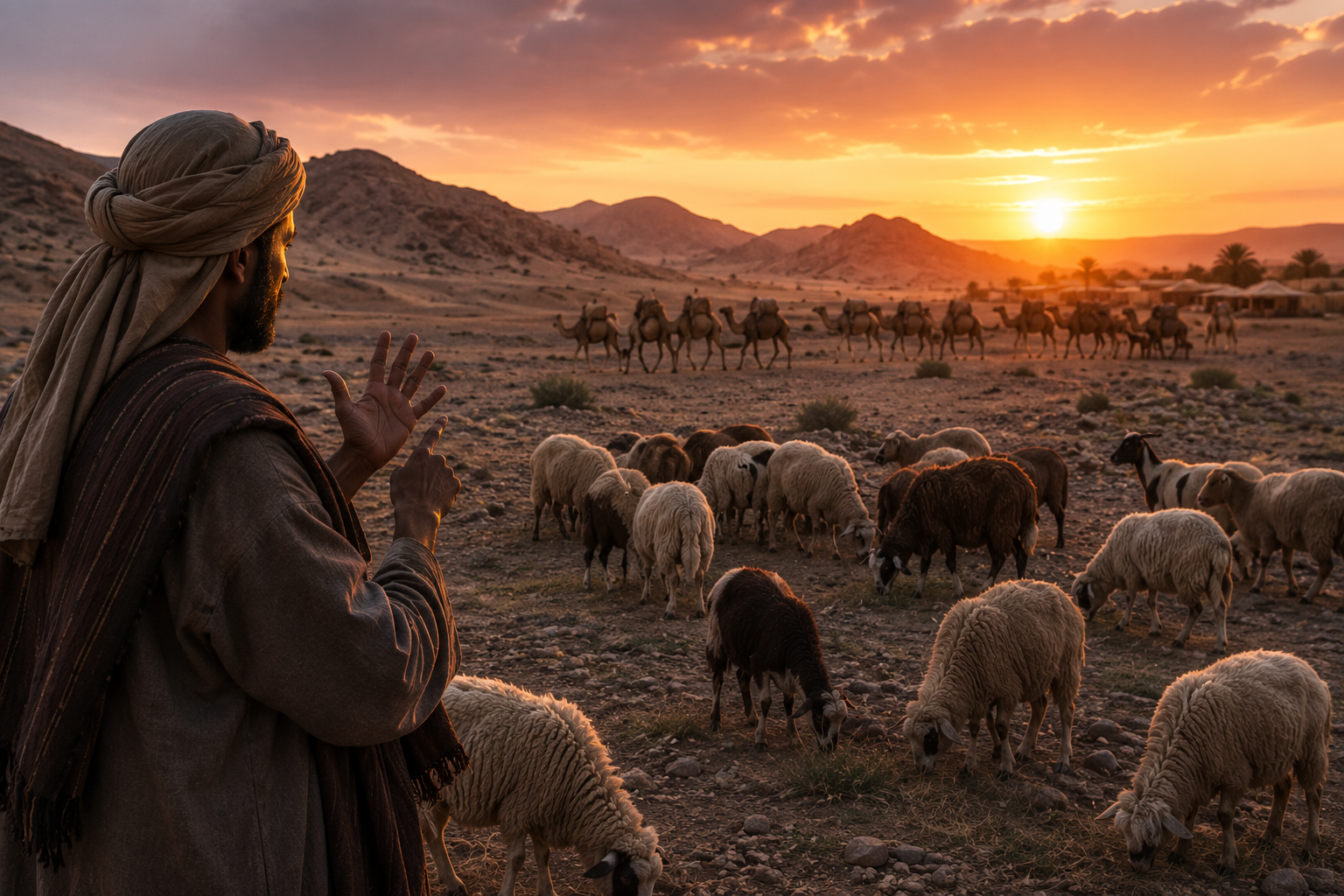
Unlike agricultural produce (which follows a flat percentage), livestock zakat uses a dynamic step-function with tiered brackets.
Why? Because livestock are biological assets. They reproduce, they require care, and their value per animal varies with species, age, and condition.
The Nisab: Minimum Thresholds
┌─────────────────────────────────────────────────────────────┐
│              THE NISAB FOR LIVESTOCK                        │
├─────────────────────────────────────────────────────────────┤
│                                                             │
│   Camels:     5 camels minimum                             │
│   Cattle:     30 cattle minimum                            │
│   Sheep/Goats: 40 sheep minimum                            │
│                                                             │
│   Below these numbers: No zakat is due                     │
│                                                             │
└─────────────────────────────────────────────────────────────┘
Camel Matrix
Number of Camels Zakat Due
0-4 Nothing
5-9 1 sheep
10-14 2 sheep
15-19 3 sheep
20-24 4 sheep
25-35 1 bint makhad (1 year old)
36-45 1 bint labun (2 years old)
46-60 1 hiqqah (3 years old)
61-75 1 jadha'ah (4 years old)
76-90 2 bint labun
91-120 2 hiqqah
121-140 3 bint labun
141+ For every 40: 1 bint labun; for every 50: 1 hiqqah
Cattle Matrix
Number of Cattle Zakat Due
0-29 Nothing
30-39 1 tabi' or tabi'ah (1 year old)
40-49 1 musinnah (2 years old)
50-59 2 tabi'
60-69 2 musinnah
70-79 3 tabi'
80-89 3 musinnah
90-99 4 tabi'
100-109 4 musinnah
110+ For every 40: 1 tabi'; for every 50: 1 musinnah
Sheep/Goats Matrix
Number of Sheep/Goats Zakat Due
0-39 Nothing
40-120= 1 sheep
121-200 2 sheep
201-300 3 sheep
301-400 4 sheep
401+ For every 100, 1 sheep
The Grazing Condition
A critical condition: zakat on livestock is only due on pastured animals (sā'imah)—those that graze freely in the open for most of the year . Animals that are hand-fed are exempt unless they are kept for trade.
Why? The logic is economic. Pastured animals are low-investment assets that grow without significant human expense. Hand-fed animals require labor, feed, and infrastructure. The tax system adjusts accordingly.
==IV. THE FOUNDATION OF THE BAYT AL-MĀL==
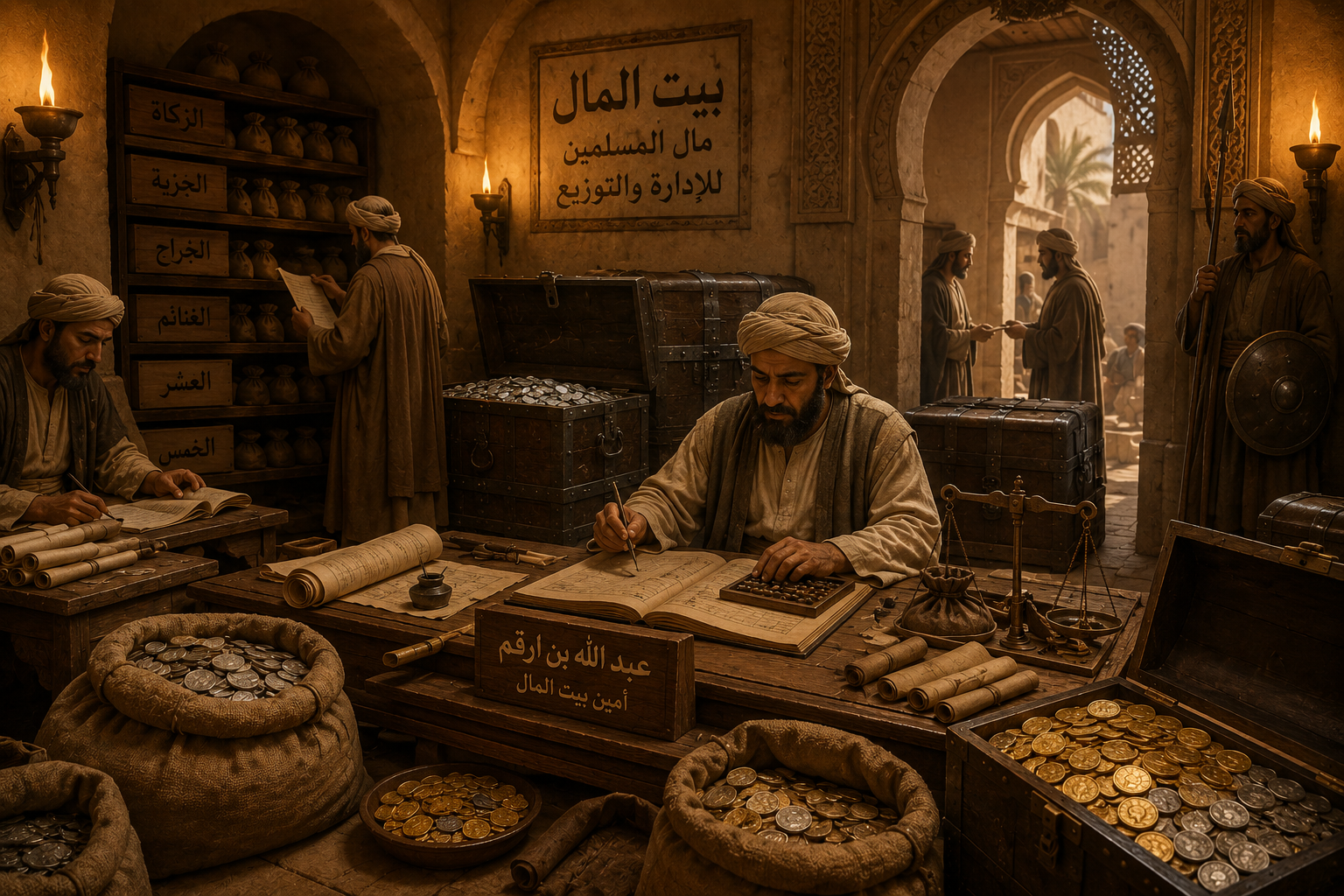
The Conceptual Framework
The term Bayt al-Māl literally means "House of Money" or "House of Wealth" . But the scholars clarified its nature:
=="Bayt al-Mal is a post devoted to all income or expenditure of property that belongs to the Muslims. Any property that belongs to the Muslims, and the owner is not clear, then that property belongs to Bayt al-Mal, even if the owner is clear. If the property has been taken, then with the taking, the property has become the right of Bayt al-Mal, whether the property is put into its treasury or not. Because Bayt al-Mal reflects a post, not a place."==
The Prophetic Era (610-632 CE): No Formal Treasury
During the lifetime of the Prophet ﷺ, there was no permanent public treasury . Whatever revenues or other amounts were received were distributed immediately. The last receipt during the life of the Prophet was a tribute from Bahrain amounting to 800,000 dirhams—distributed in just one sitting . There were no salaries to be paid, and there was no state expenditure. ==The treasury was not a building; it was an event.==
The Era of Abu Bakr: A House for Storage
Under Abu Bakr, there was still no formal treasury. He earmarked a house where all money was kept on receipt . As all money was distributed immediately, the treasury generally remained locked up. At the time of his death, there was only one dirham in the public treasury .
The Era of Umar: The Institutionalization
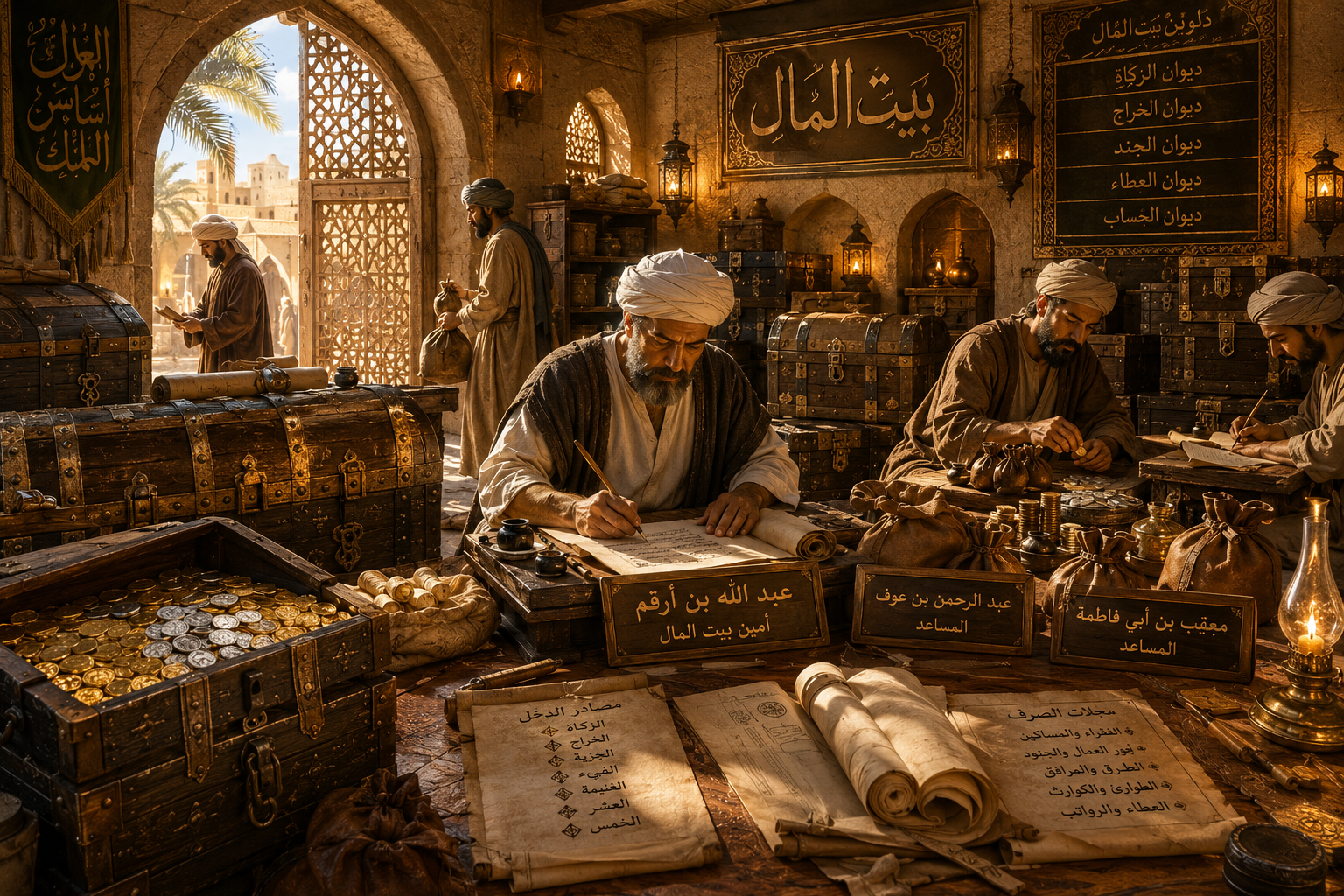
==Everything changed under Caliph 'Umar .== With the expansion of conquests, money came in larger quantities. Umar also allowed salaries to men fighting in the army. When Abu Hurairah, the Governor of Bahrain, sent a revenue of five hundred thousand dirhams, Umar summoned a meeting of his Consultative Assembly.
Uthman ibn Affan advised that the amount should be kept for future needs. Walid bin Hisham suggested that separate departments of Treasury and Accounts should be set up, like the Byzantines .
Umar decided to establish the Central Treasury at Madinah:
· Abdullah bin Arqam was appointed as the Treasury Officer .
· He was assisted by Abdur Rahman bin Awf and Muiqib .
· A separate Accounts Department was set up to maintain records of all expenditures .
Provincial treasuries were later set up in the provinces. After meeting local expenditure, the provincial treasuries remitted the surplus to the central treasury at Madinah . According to Yaqubi, the salaries and stipends charged to the central treasury amounted to over 30 million dirhams .
A separate building was constructed for the royal treasury, guarded by as many as 400 guards in large cities .
The Financial Instruments of the Bayt al-Māl
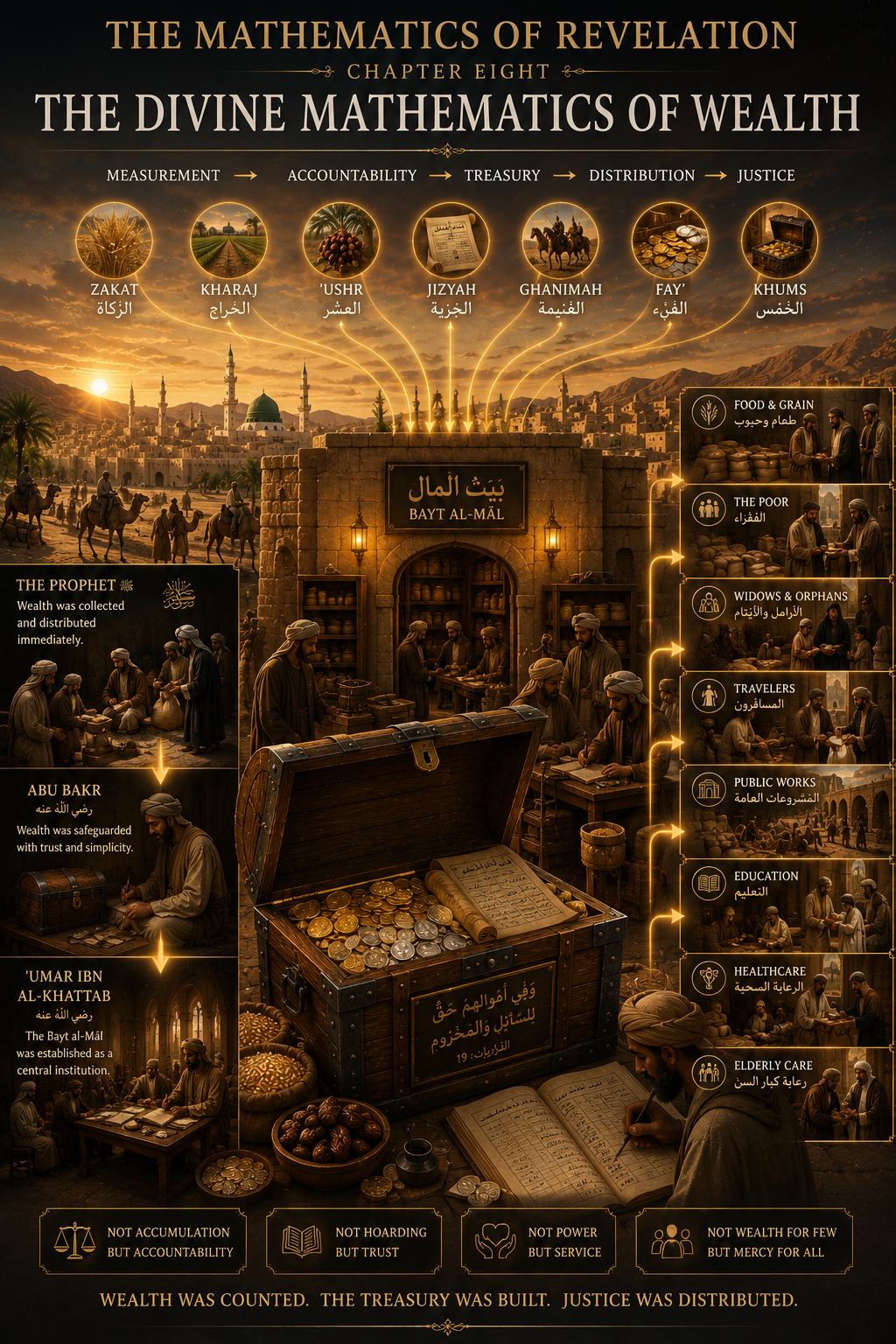
The permanent sources of income included:
Zakat — the purification of wealth, distributed to eight specified categories
Kharaj — land tax on conquered territories
Jizyah — head tax on non-Muslim subjects
Fay' — wealth acquired without fighting
Ghanimah — war spoils
'Ushr — trade taxes at borders
Khums — one-fifth of war spoils and treasure troves
The expenditures were determined based on need:
Category Purpose
Zakat Treasury Distributed to the eight ashnaf (poor, needy, collectors, those whose hearts are reconciled, captives, debtors, those in the path of Allah, travelers)
Shortages & Jihad Support for the poor, ibn al-sabil, and military needs
Compensation Salaries of soldiers, civil servants, judges, teachers
Public Benefit Roads, water, mosques, schools, hospitals
Necessity Famine relief, natural disasters
The Distribution Cycle
=="Thursday was the day of distribution or the day of payment. On that day all calculations were completed and on Saturday a new calculation began. This was likely to suit the conditions of the country at the time."==
Welfare State Innovations
Umar introduced innovations that anticipated modern welfare states:
· Social Security: Citizens who were injured or lost their ability to work received allowances from the treasury .
· Retirement Pensions: Elderly people "could count on receiving a stipend from the public treasury" .
· Orphan Support: 100 dirhams annually was spent on each orphan's development .
· Food Rationing: During the great famine of 18 AH (638 CE), Umar introduced rationing using coupons .
· Poverty Threshold: Umar determined the poverty line by testing how many seers of flour were required to feed a person for a month—and fixed the ration at fifty seers per month .
The Philosophy of Distribution
Ali ibn Abi Talib's approach differed from Umar's. Ali distributed all income and provisions that existed in the Bayt al-Mal in Medina, Busra, and Kufa immediately, without keeping reserves . He stated that =="the main principle of equal distribution of public money was adopted"== .
==V. THE CONCLUSION: FROM TIME TO WEALTH==
We have traced the trail from time to wealth.
The calendar taught us that time can be measured—and that measurement is an act of worship.
The biometric lunar loop taught us that the human body itself is a computer, designed by the Creator to count the days.
Inheritance taught us that fractions can be distributed justly.
Zakat taught us that wealth can be purified.
And the Bayt al-Māl taught us that accounting is a form of governance.
==The pattern is now unmistakable:==
Time must be measured. The calendar cannot be manipulated.
Wealth must be distributed. Inheritance cannot be arbitrary.
Wealth must be purified. Zakat cannot be optional.
Wealth must be accounted for. The Bayt al-Māl cannot be opaque.
==Each obligation is a mathematical act of worship. Each act of worship is a calculation. Each calculation is an act of justice.==
The journey continues.
THE CONCLUSION: FROM WEALTH TO FRACTIONS
We have come a long way.
The calendar taught us that time cannot be manipulated. The harvest taught us that production must be measured. Zakat taught us that wealth must be purified. And the Bayt al-Māl taught us that wealth must be accounted for and returned to society through justice, transparency, and mercy.
A pattern has emerged throughout this journey. Islam does not leave essential systems to chance. Time was fixed. Measurements were fixed. Zakat was fixed. The circulation of wealth was fixed.
But one final question remains.
What happens when the owner of that wealth is gone?
What happens when a lifetime of property, land, livestock, savings, and possessions must be divided among parents, spouses, children, and relatives?
For most of human history, this was where conflict began. Families fought. Tribes divided. Wealth disappeared. Generations spent years arguing over what should have belonged to whom.
Remarkably, the Qur'an did not leave this problem to human negotiation.
It did not simply command fairness.
It specified the fractions.
In the next chapter, we leave behind the mathematics of collection and enter the mathematics of distribution. We move from harvests, treasuries, and zakat into one of the most precise numerical systems found anywhere in Revelation.
The ledger is about to become fractional.
And the fractions have already been written.
CHAPTER NINE — THE HOUSE OF FRACTIONS
How the Qur'an Teaches the Mathematics of Inheritance
Class dismissed.
For now.
Inshallah.